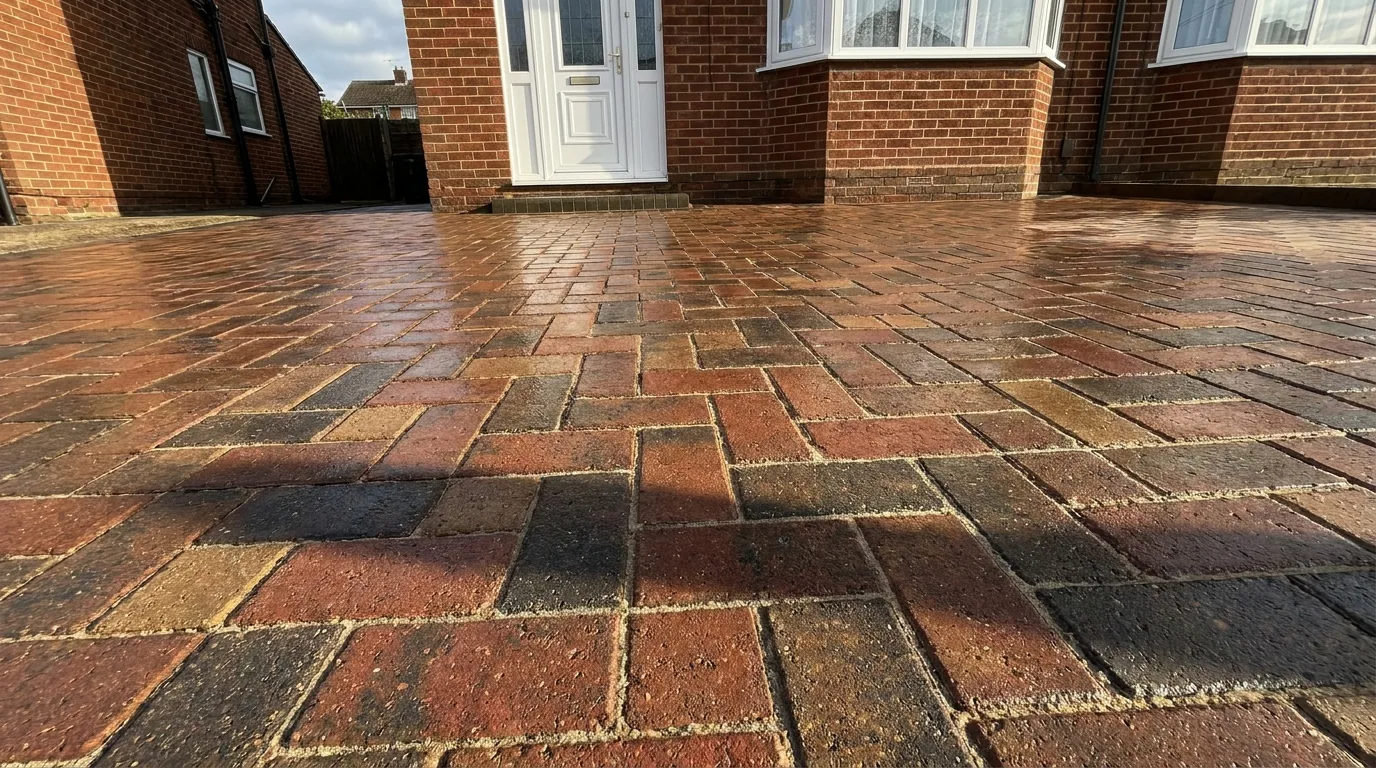
Pressure washing is the most effective way to restore outdoor surfaces in Surrey. Whether it’s a moss-covered driveway in Redhill, an algae-stained patio in Reigate, or oil marks on block paving in Horley, professional cleaning lifts years of grime in hours. This guide covers everything — costs, methods, surfaces, problems, prevention, and how to pick a contractor.
What is pressure washing?
Pressure washing uses a high-powered water jet (typically 2,000–4,000 PSI for professional kit) to blast dirt, moss, algae, oil and organic staining off hard surfaces. It’s also called jet washing in the UK — the terms are interchangeable.
Professional pressure washing differs from consumer hire machines in three ways: pressure output, water flow rate, and operator expertise. The right combination prevents damage and produces an even finish.
The process: pre-treatment with a biocide or detergent to loosen biological growth, high-pressure cleaning with a flat surface cleaner for an even finish, then rinsing and optional sealing.
Professional vs consumer equipment
| Specification | Consumer (hire) | Professional |
|---|---|---|
| Pressure (PSI) | 1,400–2,000 | 3,000–4,000 |
| Flow rate (L/min) | 5–8 | 12–21 |
| Cleaning speed | 2–4 m²/hour | 8–15 m²/hour |
| Surface cleaner | Rarely included | Standard — even finish |
| Result longevity | 3–6 months | 12–18 months |
Flow rate matters more than raw PSI. A pro machine at 3,000 PSI / 15 L/min will out-clean a consumer one at 2,000 PSI / 6 L/min on speed and quality. The flat surface cleaner attachment is the other big advantage — even pressure across 30–50 cm prevents zebra-stripe finishes.
Types of pressure washing
- High-pressure (2,000–4,000 PSI) — standard for driveways, patios and block paving.
- Soft wash (under 500 PSI) — low pressure plus specialist solution for render, painted surfaces, sandstone, limestone and timber decking.
- Steam (150°C+) — superheated water kills biological growth at the root. Best for long-term moss prevention. ~20–30% more expensive.
- Chemical only — biocide application without pressure. Cheapest but slow (2–4 weeks for full effect). Used on surfaces that can’t take any pressure.
Pressure washing costs in 2026
Professional pressure washing in the UK runs £3–£8 per square metre depending on surface and condition. Breakdown by surface:
| Surface | Per m² | Typical job | Detailed guide |
|---|---|---|---|
| Concrete driveway | £3–£5 | £120–£200 (40 m²) | Driveway costs |
| Block paving | £4–£7 | £160–£280 (40 m²) | Block paving costs |
| Patio slabs | £3–£6 | £60–£120 (20 m²) | Patio costs |
| Indian sandstone | £5–£8 | £100–£160 (20 m²) | Sandstone guide |
| Decking | £4–£6 | £80–£120 (20 m²) | Decking service |
| Render / walls | £5–£10 | £200–£500 | Render service |
| Clean + seal block paving | £8–£14 | £320–£560 (40 m²) | Sealing costs |
Factors that move the price: area size, condition, access and whether re-sanding or sealing is needed. Full breakdown on our pricing page or use the cost calculator for an instant estimate.
Surface-by-surface guide
Driveways
Concrete, tarmac and block paving each need a different pressure and technique. Block paving must be re-sanded after cleaning. Concrete and tarmac take a flat surface cleaner. Oil stains need pre-treatment with a degreaser. See our driveway cleaning service, the driveway types comparison and the oil stain guide.
Patios
Black spot algae, green moss and weathering. Natural stone (Indian sandstone, limestone, slate) needs lower pressure and pH-neutral detergents to avoid etching. Concrete and porcelain take more pressure. See patio cleaning.
Block paving
Most common Surrey driveway type. Cleaning restores colour; sealing prevents weeds, ant nests and staining. Our block paving service includes cleaning, re-sanding and optional sealing. Detail: block paving sealing guide.
Render and exteriors
Rendered walls, pebble dash and facades need a soft wash — not high pressure. Low-pressure water plus specialist biocide kills algae without forcing water into the wall. Render cleaning.
Decking
Wood and composite both pick up biological growth and become slippery. Timber needs lower pressure (under 1,500 PSI) to avoid splintering. Decking oil after cleaning extends life and appearance. Decking cleaning.
Roof & gutters
Moss and lichen on tiles need soft-wash treatment (high pressure damages tiles and forces water under them). Gutters are best cleared by ground-level vacuum extraction. Roof cleaning · gutter cleaning.
Commercial
Car parks, shopfronts, loading bays. Chewing gum removal, oil degreasing and anti-slip treatments are common add-ons. Out-of-hours scheduling. Commercial jetwashing.
DIY vs professional
The most common question. Here’s a 40 m² driveway compared:
| Factor | DIY (hire) | Professional |
|---|---|---|
| Total cost | £80–£150 | £160–£300 |
| Time | 4–6 hours | 1–2 hours |
| Equipment | 1,400–2,000 PSI consumer | 3,000+ PSI commercial |
| Risk of damage | High (inexperience) | Low |
| Result | Variable, uneven | Consistent, professional finish |
| Guarantee | None | Typically included |
DIY is fine for small, flat concrete in light condition. For block paving, natural stone, render or any heavy staining, a pro produces dramatically better results without the risk of damage. Detail in our DIY vs professional and hire vs pro cost guides. Buying your own? Best pressure washers UK.
When to clean
Best months in Surrey: March–May (spring clean before summer) and September–October (post-summer maintenance). Avoid hard frost periods (water freezing in joints risks frost damage). Mid-summer is fine but demand is highest.
Month-by-month UK calendar
| Month | Rating | Notes |
|---|---|---|
| January | Poor | Frost risk, short days. Emergency cleaning only. |
| February | Fair | Late Feb fine if mild. Best prices of the year (low demand). |
| March | Excellent | Winter moss is soft. Book early — demand rises fast. |
| April | Excellent | Peak spring season. Ideal drying for sealing. |
| May | Good | Good weather, high demand. Book 1–2 weeks ahead. |
| June | Good | Best for sealing (warm, dry). Longest waits. |
| July | Good | Peak demand. Some surfaces too hot for chemicals. |
| August | Good | Holidays mean some operators less available. |
| September | Excellent | Second-best season. Refresh before autumn leaves. |
| October | Good | Last call before winter. Combine with leaf clear. |
| November | Fair | Frost risk if water doesn’t dry. |
| December | Poor | Too cold for cleaning. Sealing impossible. |
Frequency by surface
| Surface | Frequency | Signs it’s time |
|---|---|---|
| Block paving | 2–3 years | Weeds in joints, moss between blocks, sand loss |
| Concrete drive | 1–2 years | Green/black discolouration, tyre marks |
| Indian sandstone | 1–2 years | Dark patches, slippery when wet |
| Tarmac | 2–3 years | Moss in edges, oil staining, faded colour |
| Timber decking | Annually | Slippery surface, green growth, grey weathering |
| Render | 3–5 years | Red/green algae streaks, dark patches |
More: how often to clean a driveway, best time for patio cleaning, seasonal guide.
Common problems
Moss and algae
Surrey’s mild damp climate is perfect for them. Pre-treatment with a biocide before pressure washing kills the root and delays regrowth. Moss removal guide · algae removal.
Oil stains
Motor oil, brake fluid and transmission fluid soak into porous surfaces within hours. Pressure alone can’t break the chemical bond — specialist degreasers are needed first. Oil stain removal guide.
Surface damage
Too much pressure on soft stone, timber or pointing causes irreversible damage. The pro’s job is matching pressure and nozzle distance to the surface. Damage prevention guide.
Weeds in block paving
Weeds growing through joints mean the kiln-dried sand needs replacing. Re-sand and (optionally) seal after cleaning — that’s 3–5 years of weed-free joints. Sealing guide.
Maintenance and prevention
Things you can do between professional cleans:
- Sweep regularly — remove leaves and organic debris that trap moisture and feed moss
- Treat early — apply moss killer at the first sign of green growth
- Fix drainage — standing water accelerates everything
- Consider sealing — sealed surfaces resist staining and biological growth for 3–5 years
- Clean spills immediately — cat litter or sand for oil, then degreaser before it soaks in
- Trim overhanging trees — less shade, less leaf fall, slower moss
Before a professional clean, see our preparation guide. ROI: is pressure washing worth it? · kerb appeal & property value.
How to choose a pressure washing contractor
Six things to evaluate before you book:
- Insurance — minimum £1m public liability. Ask for the certificate.
- Equipment — commercial-grade machine plus a flat surface cleaner attachment. Domestic kit gives noticeably worse results.
- Pricing transparency — written quote, clear per-m² rate, no hourly rates. Be wary of phone quotes without seeing the job.
- Re-sanding included — for block paving. Skipping this leaves joints vulnerable to weed regrowth.
- Reviews and examples — Google reviews, before/after photos, professional website.
- Surface knowledge — ask how they’d clean your specific surface. “We blast everything the same” is a red flag. Sandstone needs low pressure, tarmac needs care, new concrete differs from aged concrete.
Use the cost calculator to spot quotes that are way too high or suspiciously cheap. For our quote, submit the form or call 01737 652 515.
Pressure washing across Surrey
We cover a 20-mile radius from Redhill, taking in 17+ towns and villages:
Each area has its own profile. Dorking and Oxted properties often have natural stone patios that need specialist care. Estates in Crawley and Horley are mostly block paving. Period homes in Reigate and Banstead often need render cleaning alongside drive work. Detail: Surrey market comparison.
FAQ
For 50 of the most common questions, see the comprehensive pressure washing FAQ.
How much does pressure washing cost in the UK?
£3–£8 per m² in 2026. A single drive (25 m²) is £80–£150, a double (50 m²) is £150–£300, a large patio (40 m²) is £160–£320. South East rates are 10–15% above the national average. Use the cost calculator.
Is pressure washing worth the money?
Yes for most homeowners. £150–£300 for a driveway adds instant kerb appeal — estate agents reckon a clean drive and patio adds £5–10K to perceived property value. Professional results last 12–18 months vs 3–6 months for hire kit. Full analysis.
Can pressure washing damage my driveway?
Yes, if done wrong. Too much pressure on soft stone or pointing causes erosion. Pros adjust PSI and nozzle distance per surface — ~2,000 PSI for soft stone, 3,500+ PSI for concrete. The DIY risk is not knowing which setting to use. Damage prevention guide.
How often should I pressure wash my driveway?
Most UK drives every 1–2 years. Annual for shaded drives under trees. 2–3 years for sunny, sheltered drives in good condition. Block paving needs more frequent attention because moss takes hold in the joints. Frequency guide.
Pressure washing vs jet washing — what’s the difference?
None practically. “Jet washing” is the common UK term, “pressure washing” the technical/US term. Same process. Full comparison.
Do I need to be home during the job?
No, as long as we have outdoor tap access and access to the area. Many customers leave a key. We do recommend being there for the initial walkthrough so we can flag anything specific.
How long does it take?
A single drive (25 m²) takes ~2–3 hours including setup, pre-treatment, cleaning and re-sanding. Larger or heavily soiled surfaces 4–6 hours. Sealing adds 1–2 hours plus a 24–48 hour cure (no walking or driving on it).
Our services
- Driveway cleaning — concrete, tarmac, block paving, resin
- Patio cleaning — slabs, natural stone, porcelain, concrete
- Block paving cleaning & sealing
- Render cleaning — soft wash for walls and exteriors
- Decking cleaning — timber and composite
- Commercial jetwashing
- Roof cleaning — soft-wash moss removal
- Gutter cleaning
- Soft washing — chemical, low-pressure