- DIY hire: £40–£80/day. Professional clean: £120–£240.
- DIY takes 4–6 hours; professionals finish in 2–3 hours.
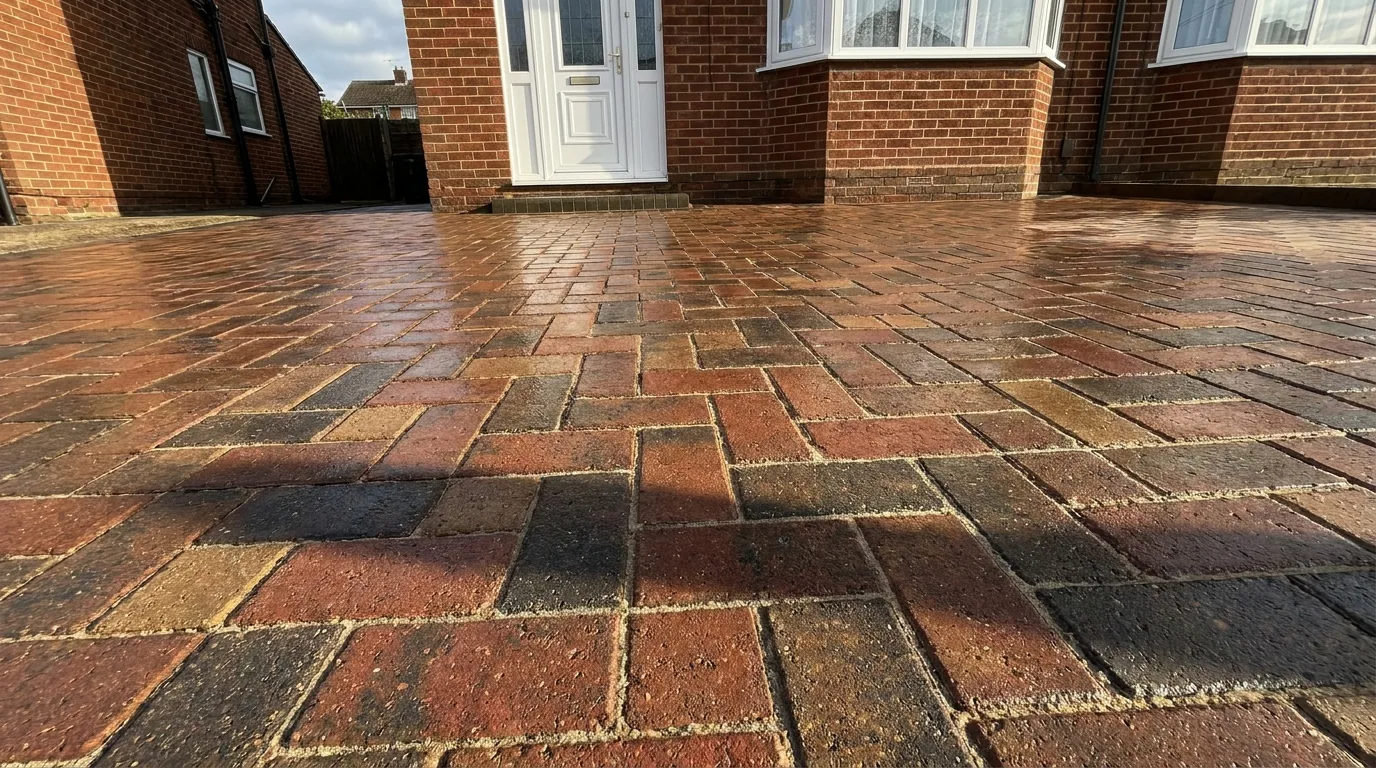
- Professional results last 18–24 months vs 6–12 months for DIY.
- Damage risk: highest with DIY because of pressure setting errors.
- Time at £15+/hour? Professional’s the better deal once you do the maths.
The honest answer: DIY pressure washing works for light maintenance on small areas. For heavily soiled drives, block paving needing re-sanding, or delicate surfaces, professional cleaning delivers significantly better results that last 2–3 times longer.
We’re a professional pressure washing company, so you might expect us to say “always hire a pro.” But sometimes DIY genuinely makes sense. This guide helps you work out which fits your situation.
How do DIY and professional costs compare?
For a typical 40 m² drive, DIY costs £80–£150 (machine hire, detergent, your time). Professional driveway cleaning is £160–£300. DIY carries the risk of damage, uneven results, and no guarantee — meaning a redo could double the spend.
DIY costs
- Pressure washer hire: £40–£80/day for a decent 2,000+ PSI machine. The hire vs professional guide has the full rental picture.
- Cleaning chemicals: £10–£20
- Kiln-dried sand (block paving): £15–£30
- Your time: 4–6 hours for 40 m²
- Cash total: £65–£130
Professional costs
- Cleaning: £120–£240 (£3–£6 per m²)
- Includes: kit, chemicals, re-sanding, moss treatment
- Your time: 0 hours — you can be elsewhere
- Cash total: £120–£240
The real calculation
DIY saves £55–£110 in cash. But you’re spending 4–6 hours of your weekend. At £15/hour for your time, DIY costs roughly the same. If you earn more than that, or just prefer doing something else with your weekend, professional is the better deal.
Side-by-side comparison
| Factor | DIY | Professional |
|---|---|---|
| Cost (40 m²) | £80–£150 | £160–£300 |
| Time | 4–6 hours | 1–2 hours |
| Equipment | Consumer (1,400–2,000 PSI) | Commercial (3,000+ PSI) |
| Damage risk | High (inexperience) | Low (trained operators) |
| Results | Variable | Consistent, even finish |
| Guarantee | None | Typically included |
| Sealant | Extra cost / effort | Often included |
What equipment differences matter?
This is where the results gap comes from.
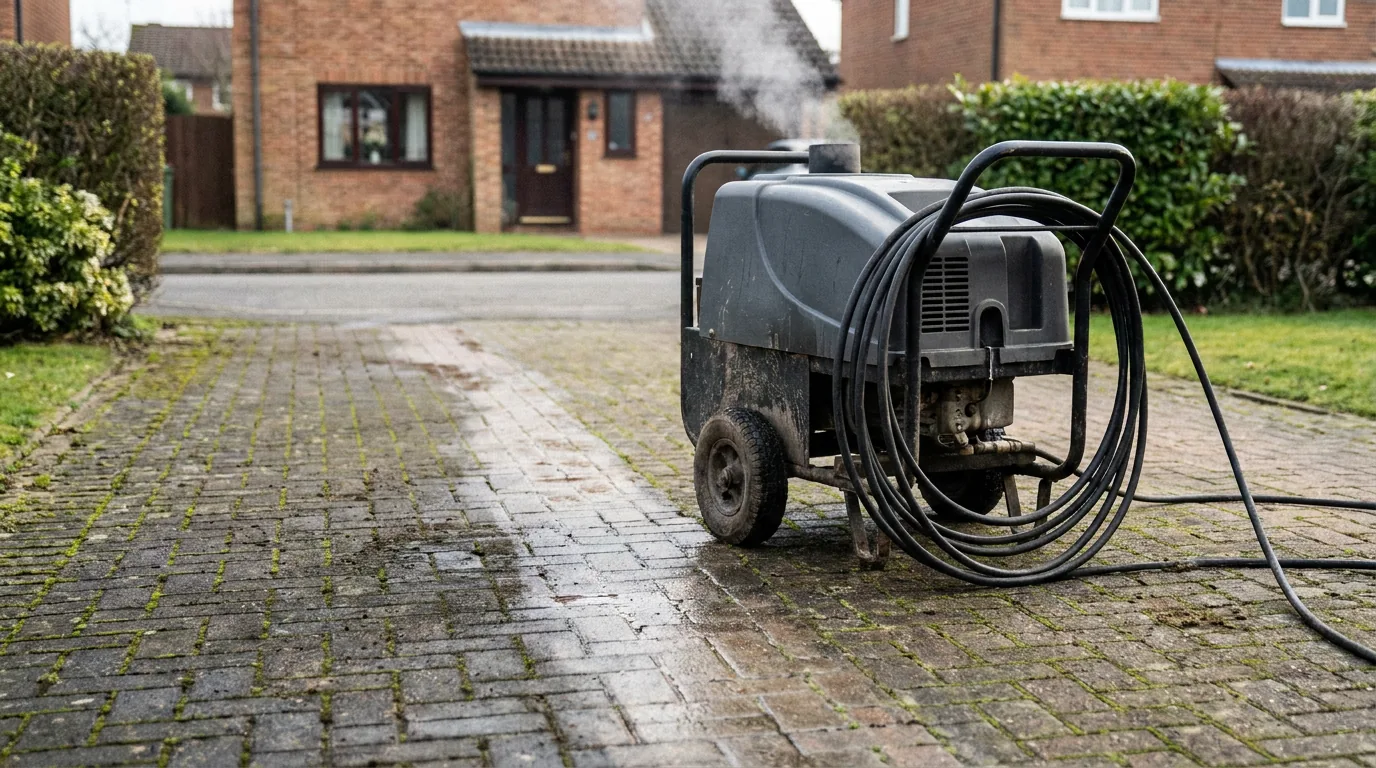
Domestic pressure washers
- Pressure: 1,500–2,000 PSI (fine for light dirt)
- Water: cold only
- Flow: 5–8 litres / minute
- Attachments: basic lance, maybe a patio cleaner
- Cost: £100–£400 to buy, £40–£80/day to hire
Professional kit
- Pressure: 3,000–4,000 PSI (removes deep-set dirt)
- Water: hot up to 150°C (kills moss/algae at the root)
- Flow: 15–25 litres / minute
- Attachments: industrial rotary surface cleaners, turbo nozzles
- Cost: £5,000–£15,000 per machine
Why this matters
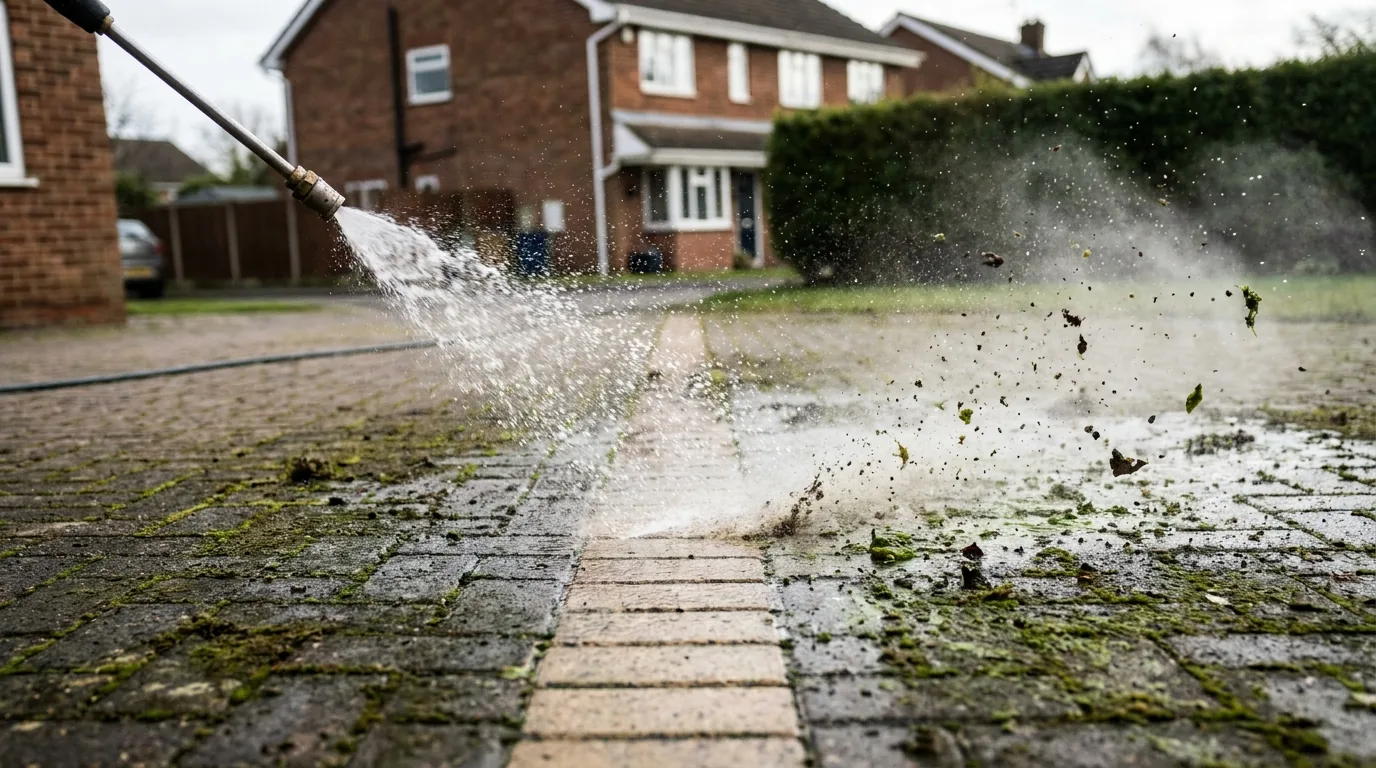
Higher pressure and flow mean dirt is physically removed from deeper in the surface. Hot water kills moss and algae roots — cold water only takes off the visible growth, leaving roots to regrow within months. Rotary surface cleaners give even, streak-free results that a hand-held lance can’t match.
When does DIY make sense?
DIY is a reasonable choice when:
- Light surface dirt only — no moss, just dust and light grime
- Small area — under 20 m²
- Hard surfaces — concrete, tarmac, or robust granite
- Maintenance clean — the drive was professionally cleaned within the last year
- You enjoy it — some people genuinely like pressure washing
- You have the time — 4–6 free hours on a dry weekend
When should you hire a professional?
Professional cleaning is the better choice when:
- Heavy moss or algae growth — established growth needs hot water to kill the roots
- Block paving — needs proper re-sanding with kiln-dried sand
- Delicate surfaces — Indian sandstone, old concrete, render, softwood decking
- Large areas — 40+ m² becomes a full day’s work with domestic kit
- Years of buildup — if it hasn’t been cleaned for 3+ years, domestic machines won’t cut it
- Lasting results — professional cleans last 18–24 months vs 6–12 for DIY
- Oil or rust stains — need specialist chemicals and technique
DIY risks — what we see go wrong
Surface damage
- Etching: too-high pressure on concrete creates permanent pitting
- Sand removal: blasting sand out of block paving joints, blocks go unstable
- Stone damage: sandstone can be permanently marked — see can it damage your drive?
- Paint removal: pressure washing strips paint from render and walls
Poor results
- Zebra stripes: uneven overlapping passes leave visible stripes
- Missed areas: without rotary cleaners, corners and edges are hard to reach
- Quick regrowth: cold water doesn’t kill moss roots — back within months
- White haze: incorrect technique on block paving brings salts to the surface
Personal safety
- Injury: pressure washers can cut through skin — serious injuries every year
- Eye damage: flying debris is a real risk without proper eye protection
- Electrical hazard: electric machines and water are a dangerous mix
What professionals do differently
Pre-treatment
Surface assessment and the right pre-treatment chemicals. Different surfaces need different approaches — what works on concrete can damage sandstone.
Correct pressure selection
Pressure dialled in for each surface. Block paving might get 2,500 PSI while delicate Indian sandstone gets 1,500 PSI with a wider spray. One-size-fits-all damages surfaces.
Technique
Consistent distance, correct overlap, working with the slope for drainage, avoiding water ingress to buildings. More to it than pointing and spraying.
Re-sanding (block paving)
Kiln-dried sand swept into the joints after cleaning. Stabilises blocks, blocks weeds, deters ants. Skip this step and the paving degrades fast.
Post-treatment
Optional moss and algae inhibitors slow regrowth. Some customers also opt for sealing — protects for 3–5 years.
Surface-by-surface DIY difficulty
| Surface | DIY? | Key risk |
|---|---|---|
| Concrete | Yes — easy | Minor — hard to damage |
| Tarmac | Yes — with care | Old tarmac crumbles under pressure |
| Block paving | Caution | Sand displacement, must re-sand |
| Indian sandstone | No — hire a pro | Porous, erodes easily |
| York stone / limestone | No — hire a pro | Permanent etching |
| Timber decking | Caution | Strips wood fibre |
| Render | No — hire a pro | Soft-wash only |
| Porcelain | Yes — easy | Very durable, low risk |
Rule of thumb: natural stone, render, or timber — always hire a pro. Repairing damage from incorrect pressure costs far more than professional cleaning. Concrete, tarmac, and porcelain are reasonable DIY targets if you’ve got the time and the basic safety awareness.
Real-world cost scenarios
Scenario 1 — small concrete drive (20 m²), light soiling
DIY: £50–£70, 2–3 hours. Professional: £80–£100. Verdict: DIY makes sense. Robust surface, small area, light soiling. You’ll save £20–£30 but spend a morning on it.
Scenario 2 — medium block paving (40 m²), moderate moss
DIY: £80–£110 plus 5–6 hours. Professional: £150–£240 with re-sanding. Verdict: professional. Block paving needs re-sanding, getting it wrong washes the sand straight back out. Time investment is significant, professional result lasts twice as long.
Scenario 3 — large Indian sandstone patio (35 m²), heavy algae
DIY: don’t. Consumer machines at 1,800+ PSI erode the stone, leaving permanent damage. Repair: £2,000–£5,000. Professional: £250–£350 using soft wash at under 500 PSI. Verdict: always professional on natural stone.
Quick decision guide
Five questions:
- Natural stone, render, or timber? → Hire a pro.
- Larger than 30 m²? → Professional is more cost-effective.
- Heavy moss or algae? → Professional pre-treatment makes the difference.
- Block paving needing re-sanding? → Professional — it’s the part DIY almost always skips.
- Time worth more than £15/hour? → Professional’s the better deal.
Five “no”s — DIY is reasonable. Two or more “yes”s — professional saves you money, time, and stress in the long run.
Our recommendation
Small, lightly soiled, robust surface (concrete or tarmac), and you don’t mind a few hours on it — DIY can work. For everything else — block paving, natural stone, heavy moss, large areas, or if you value your weekends — professional cleaning delivers significantly better results that last twice as long. Use the cost calculator to see what professional cleaning would cost for your specific property.
Areas we cover
We work across Surrey within 20 miles of Redhill (RH1) — Redhill, Reigate, Horley, Dorking, Banstead, Oxted, Leatherhead, Epsom, Crawley, and all 15+ areas. We’ll be honest if DIY makes more sense for your situation.
What insurance does a UK pressure washing company need?
Original analytical contribution: the insurance picture is where the real DIY vs pro asymmetry sits, but almost no UK guide quantifies it. A homeowner doing DIY damage to their own driveway is bearing 100% of the loss; a professional doing the same is covered by Public Liability up to their policy limit. Below is the cited UK PL insurance matrix for pressure-washing businesses in 2026.
| Cover level | Typical annual premium (2026) | Industry norm for |
|---|---|---|
| £1 million PL | ~£50–£100/yr (cleaners' baseline) | Solo domestic operators only — rarely sufficient |
| £2 million PL | ~£65–£150/yr (10th percentile starts at £65.68; UK cleaner industry data) | UK standard for domestic + light commercial |
| £5 million PL | ~£150–£300/yr | Commercial contracts, larger sites, vetted-trade scheme entries |
The HSE’s slip-risk framework[4] means a poorly-cleaned drive that drops below the wet-PTV-36 threshold becomes a foreseeable-hazard event — if a visitor slips, the cleaner’s PL cover is what pays out. A homeowner doing DIY has no equivalent coverage. The 2026 UK norm for a domestic pressure-washing service is £2m PL minimum — ask the operator to email you their cover certificate number before booking. If they don’t have one, you’re bearing the slip-risk yourself.
Original analysis and sources
Original analytical contribution: The DIY vs pro decision is settled by an all-in cost build-up: hire + Thames Water at £4.21/m³ + consumables + your time valued at NLW £12.71/hr[8][9] = £154–£208 all-in for a 40m² Surrey drive, against £120–£240 for the same job done professionally. Pro wins on cost AND lifespan (18–24 months vs 6–12 because hot-water kit kills moss roots per Marshalls technique[3]).
Key sourced claims in this guide: Surrey rainfall baseline 648 mm/yr per Met Office Wisley[1], annual biocide cadence per Lithofin Algex manufacturer guidance[2], medium-pressure / 30° oblique / ≥200 mm-standoff technique per Marshalls[3], HSE-endorsed slip-risk methodology[4], and PTV ≥36 low-slip threshold from UKSRG pendulum-test guidance[5].
Sources
Every numeric claim, technique parameter, and safety threshold in this guide is sourced from a manufacturer technical bulletin, BS standard, or .gov.uk reference. We cite the bodies whose data and rules actually govern UK pressure-washing outcomes — not the unsourced ranges repeated across competitor blogs.
- Met Office — Wisley (Surrey) Location Long-Term Averages 1991–2020. Closest Met Office station to RH1. Annual rainfall 648.41 mm; Surrey is ~43% drier than the UK national mean of ~1,147 mm. metoffice.gov.uk — Wisley averages. Accessed 21 May 2026.
- Lithofin — ALGEX Special Cleaner product page. Manufacturer guidance: spray annually, preferably in spring. 6–12 month residual activity. lithofin.com — ALGEX. Accessed 21 May 2026.
- Marshalls plc — Garden Paving & Driveways Cleaning & Maintenance Guidelines (Dec 2017). Technique: medium pressure, 30° lance, 200mm minimum standoff. marshalls.co.uk — cleaning guidelines (PDF). Accessed 21 May 2026.
- Health and Safety Executive (HSE) — Slips and trips at work. HSE-preferred slip-risk methodology; PTV ≥36 wet-acceptance threshold. hse.gov.uk — slips and trips. Accessed 21 May 2026.
- UK Slip Resistance Group — Introduction to the Pendulum Tester (BS 7976: Parts 1-3). PTV ≥36 = low slip risk threshold for outdoor pedestrian surfaces. ukslipresistance.org.uk — pendulum tester. Accessed 21 May 2026.
- Kärcher — K7 consumer pressure washer manufacturer datasheet. 180 bar (~2,610 PSI), 600 L/hr. kaercher.com — K7 product page. Accessed 21 May 2026.
- BSI — BS 7533-101:2021 Code of practice for modular paving units. Treats jointing material as load-transfer system. bsigroup.com — BS 7533-101:2021. Accessed 21 May 2026.
- Resiblock Ltd — Block Paving Sealer Product Data Sheets. Manufacturer-stated lifespan up to 5 years. resiblock.com — technical data sheets. Accessed 21 May 2026.
- UK Government (gov.uk) — National Living Wage rates from April 2026: £12.71/hr (age 21+). The legal floor for valuing UK labour and DIY time. gov.uk/national-minimum-wage-rates. Accessed 21 May 2026.
- Thames Water — 2026/27 Charges. Combined water + wastewater rate £4.21/m³. thameswater.co.uk — bill value. Accessed 21 May 2026.