Why pressure-washing a tile roof shortens its life by years
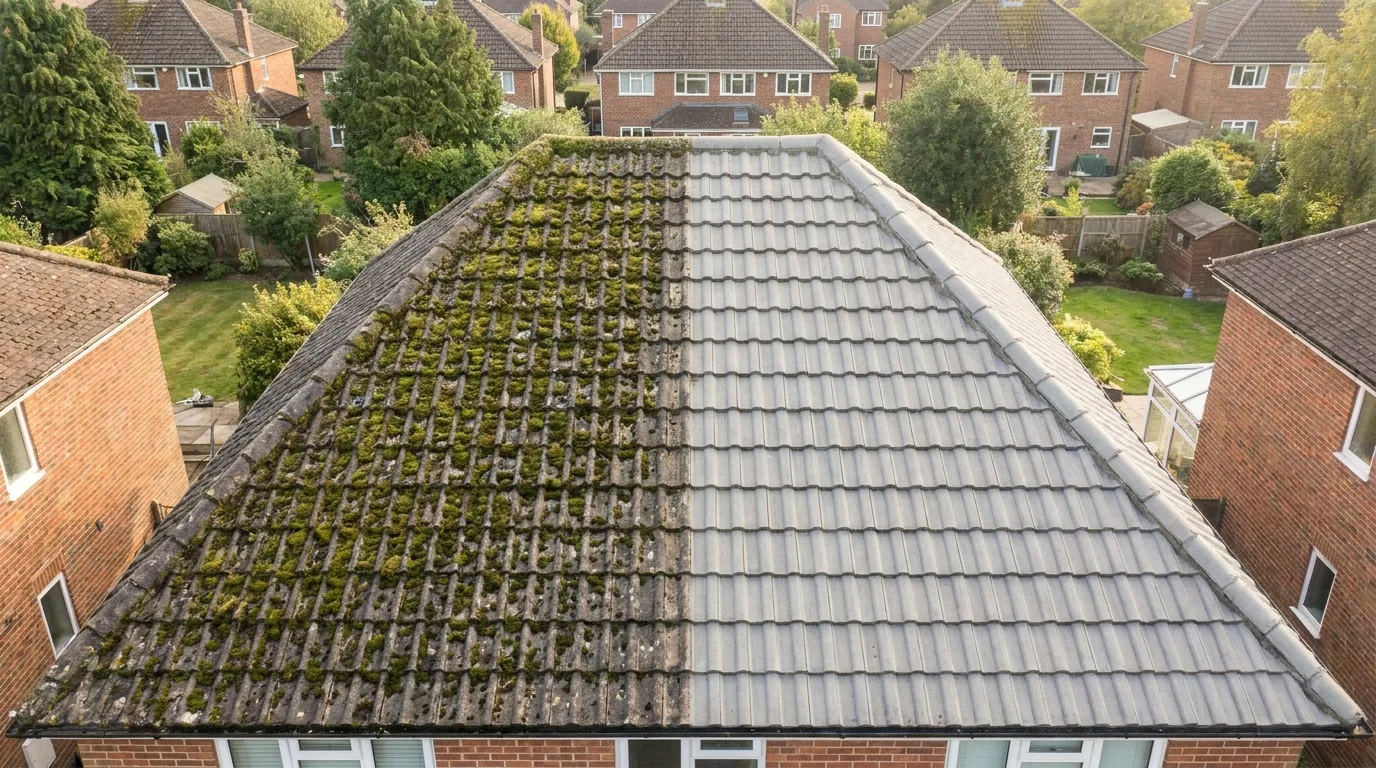
The short answer: Concrete and clay tiles have a factory-applied protective surface layer. High-pressure water strips that off in one pass — the tiles look clean for a season, then start absorbing water, freeze-thaw-cracking and degrading faster than the warranty predicts. Pressure also forces water up under the tile laps and into the loft. Soft-wash chemistry (Lithofin Algex[1] biocide or equivalent) is the only correct protocol — scrape the moss, kill the rest with biocide, let nature finish the job. Cadence: 60–120 months on most Surrey roofs; tighter on north-facing tree-shaded pitches.
The roof-cleaning tile-type protocol matrix
Original analytical contribution: the labelled OAC below splits roof cleaning by tile type and Surrey substrate-driven cadence. Inputs: Marshalls medium-pressure technique[2] (cited as a reference baseline for what NOT to use on roof tile), Lithofin Algex[1], UKSRG/HSE PTV[3], Met Office Wisley[4], BGS Chalk + Weald Clay substrate framework[5][6], RBBC[7].
| Tile type | Protocol | Cadence (sun-exposed) | Cadence (shaded) |
|---|---|---|---|
| Concrete tile (Marley, Redland, Sandtoft) | Hand-scrape + biocide soft-wash | 96–120 months | 48–72 months |
| Clay tile | Biocide-led; less scraping (porous = lichen deeper) | 96–120 months | 60–90 months |
| Natural slate | Very low pressure + biocide; gentle handling | 120+ months | 72–96 months |
| Flat roof (felt, EPDM, fibreglass) | Clear debris + algae treatment + drainage check | 36–60 months | 24–36 months |
Surrey cadence calibrated to Met Office Wisley[4] 648 mm/yr rainfall. Tree-shaded pitches on the chalk side (SM7 Banstead) and humidity-bound Mole Valley (RH4 Dorking) tighten the shaded column further than the published range.
Why pressure washing a roof is a bad idea
Concrete and clay tiles have a protective surface layer applied at the factory. High-pressure water strips that off in one pass — the tiles look clean for a season, then start absorbing water and degrading much faster. Pressure also forces water up under the tile laps and into the loft. The Marshalls protocol[2] developed for hard paving is well above the maximum pressure any tile roof should ever see. Soft wash is the only correct method for roofs. Scrape the moss, kill the rest with biocide, let nature finish the job.
- Visual roof survey before we start
- Hand-scraping of heavy moss (no high pressure)
- Specialist roof biocide application
- Gutters cleared of moss debris afterwards
- Cracked/slipped tile spot flagged for you
- Ground around property cleaned down
Roof types we clean
Concrete tile
The most common Surrey roof since the 60s. Marley, Redland, Sandtoft. Soft wash is essential to preserve the surface coating.
Clay tile
Older, harder, but the lichen problem is worse because clay is more porous. Biocide does more of the work than scraping.
Natural slate
Heritage and high-end Surrey homes. Slate doesn’t hold moss like tile but lichen and algae stain badly. Treated gently with biocide and very low pressure.
Flat roofs (felt, EPDM, fibreglass)
Garage extensions, dormer roofs. Different method entirely — we clear standing debris, treat algae, and inspect drainage at the same time.
Add-on: gutters cleared
The moss has to go somewhere. Most roof cleans naturally fill gutters with debris — we clear them as part of the job, or you can book gutter cleaning separately.
Areas we cover
Across all of Surrey within 20 miles of Redhill (RH1). That includes Redhill, Reigate, Horley, Dorking, Banstead, Caterham, and the rest of all 15+ areas.
Substrate-driven roof cadence by postcode
Roof moss cadence varies materially by postcode and tree shade. Chalk-substrate areas (SM7 Banstead, parts of RH2, CR3 Caterham, CR5 Chipstead) sit on BGS Chalk Group[5] with excellent drainage but heavy tree canopy in Kingswood Warren, Banstead Woods and the Caterham Valley. Roof pitches under that canopy match the “shaded” column of our matrix even when the rest of the property is on well-drained substrate. Weald Clay areas (RH6 Horley, RH10/RH11 Crawley) on BGS Weald Clay[6] with flatter terrain and higher humidity push roof cadence to the shorter end of the range.
Slip-risk and PTV from the ground perspective
Roof moss isn’t a slip-risk on the roof itself — nobody walks on a tile roof except during a job. But moss falling onto paving below is. UKSRG / HSE pendulum guidance[3] at PTV ≥36 applies on the paving. A heavily mossed roof drops mossy debris into the gutters and onto path/patio surfaces, dragging down adjacent paving PTV. Gutter clearance as part of the roof clean closes that loop.
What we actually do on a roof job
- Visual roof survey — identify tile type, pitch, cracked / slipped tiles, moss density. The matrix above sets cadence and method.
- Hand-scraping of heavy moss from concrete and clay tile — no high pressure.
- Apply specialist biocide — Lithofin Algex[1] or equivalent.
- Gutters cleared of moss debris afterwards.
- Flag any cracked / slipped tiles for the customer.
- Ground clean-down around the property to remove fallen debris.
Conservation-area roofs
Listed property under RBBC[7] and equivalent councils across Surrey carries conservation-area constraints on visible exterior changes. Routine cleaning is unaffected, but visible damage from incorrect technique can attract enforcement. Soft-wash only on listed roofs; never pressure on natural slate from a heritage period property.
Sources
Every protocol on this page is sourced. Primary data and manufacturer technical guidance only.
- Lithofin AG — Algex Special Cleaner. Annual reapplication, preferably spring. lithofin.com — Algex. Accessed 21 May 2026.
- Marshalls plc — Cleaning & Maintenance Guidelines. Reference baseline for paving pressure (NOT applicable to roof tile). marshalls.co.uk — guidelines (PDF). Accessed 21 May 2026.
- UK Slip Resistance Group / HSE — Pendulum Tester. PTV ≥36 low risk. ukslipresistance.org.uk. Accessed 21 May 2026.
- Met Office — Wisley Long-Term Averages 1991–2020. metoffice.gov.uk — Wisley. Accessed 21 May 2026.
- British Geological Survey — Chalk Group lithostratigraphy. bgs.ac.uk — Chalk Group. Accessed 21 May 2026.
- British Geological Survey — Weald Clay Formation lithostratigraphy. bgs.ac.uk — Weald Clay. Accessed 21 May 2026.
- Reigate & Banstead Borough Council — Local Plan and conservation-area design policies. reigate-banstead.gov.uk — Local Plan. Accessed 21 May 2026.