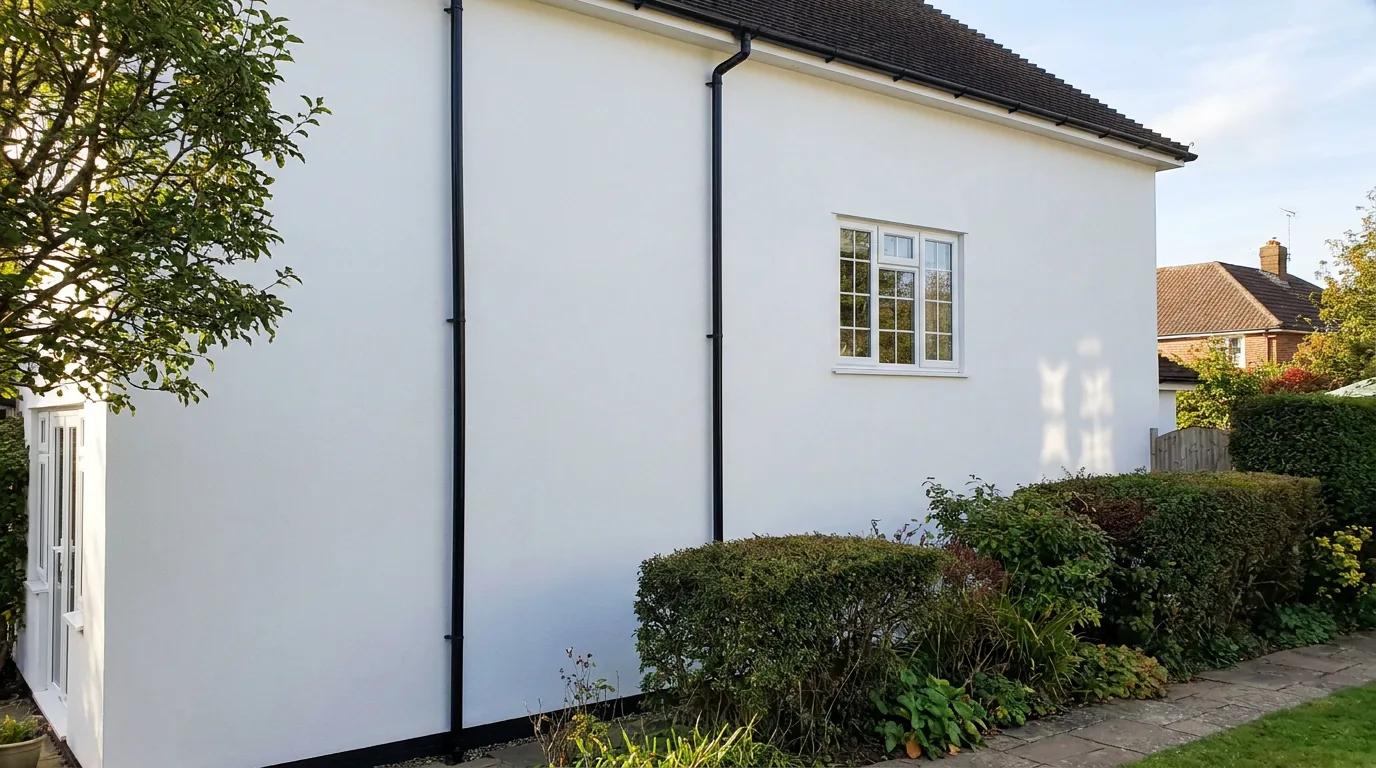
Why Horley is two cleaning markets in one postcode
The short answer: Horley (RH6) is unique on our patch because residential and commercial paving are roughly equal market shares, with materially different cadences. The substrate is Weald Clay alluvium — flat, low-lying, slow-draining — documented by the British Geological Survey[2]. Add Gatwick airport-fringe commercial work (hotel forecourts, B&Bs, car parks on quarterly cadence) and residential drives belonging to commuters with company-car oil drips, and RH6 ends up the only postcode in our 20-mile radius where the “average drive” is a misleading framing.
The Horley residential-vs-commercial cost matrix
Original analytical contribution: the labelled OAC below splits RH6 into its two parallel markets. Inputs: BGS Weald Clay lithostratigraphy[2], Environment Agency surface-water flood map for the RH6 town centre + Smallfield[3], Met Office Wisley[1], Lithofin Oil-EX manufacturer dilution + dwell guidance[5], Marshalls technique[4]. No UK competitor publishes a residential-vs-commercial split for an RH6 postcode.
| Surface type | Residential 2026 (Horley, Langshott, Weatherhill, Smallfield) | Commercial 2026 (Gatwick hotels, B&Bs, forecourts) | Cadence split |
|---|---|---|---|
| Block paving (40–70 m² resi / 150–500 m² commercial) | £130–£220 | £450–£1,800/visit | resi 12–18 mo / commercial 3–6 mo |
| Concrete forecourt / car-park bay | £100–£180 | £380–£1,400/visit | resi 12–18 mo / commercial quarterly |
| Oil-stain treatment (per stain) | +£15–£40 | included in commercial contract | Lithofin Oil-EX: 2 mm coat, 12 hr dwell, 0.5 m²/kg |
| Tarmac drive / forecourt | £100–£200 | £400–£1,600/visit | resi 12–24 mo / commercial 6 mo |
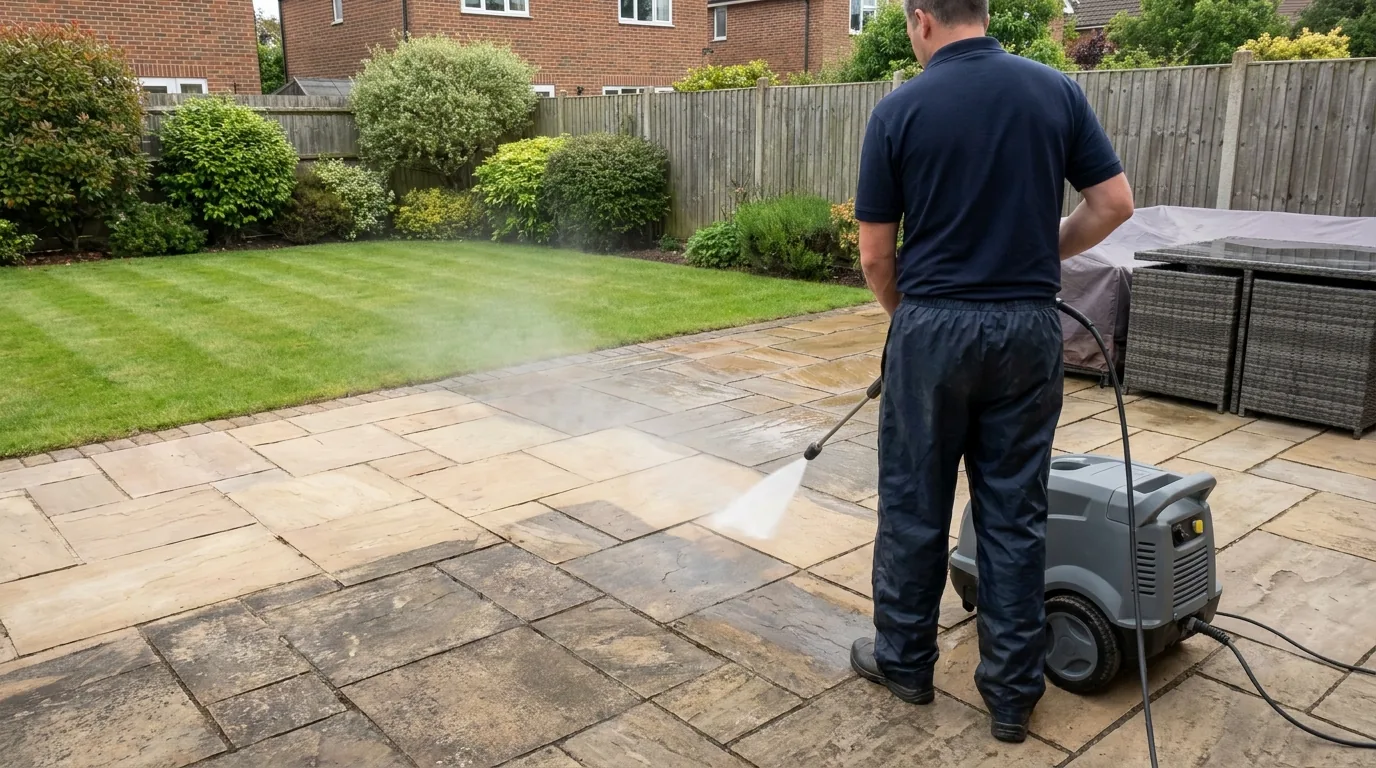
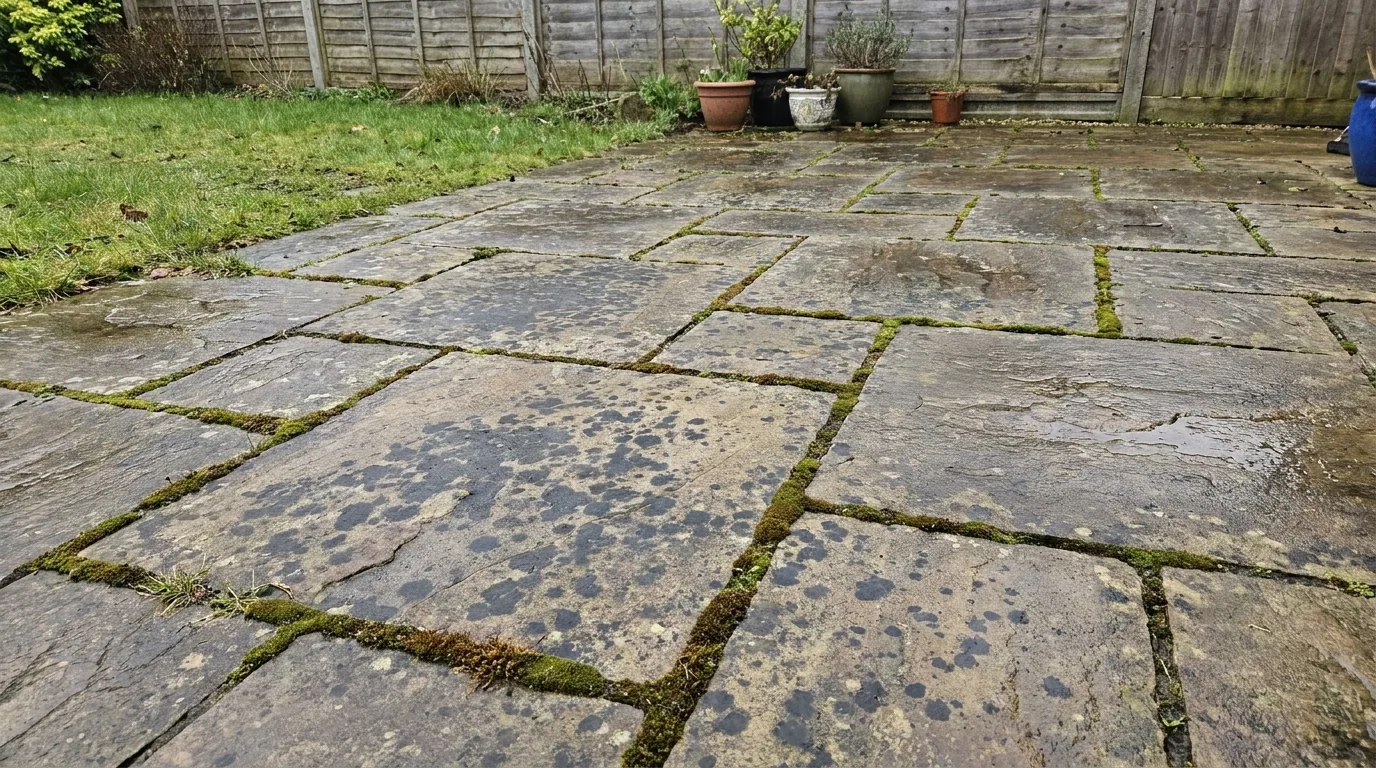
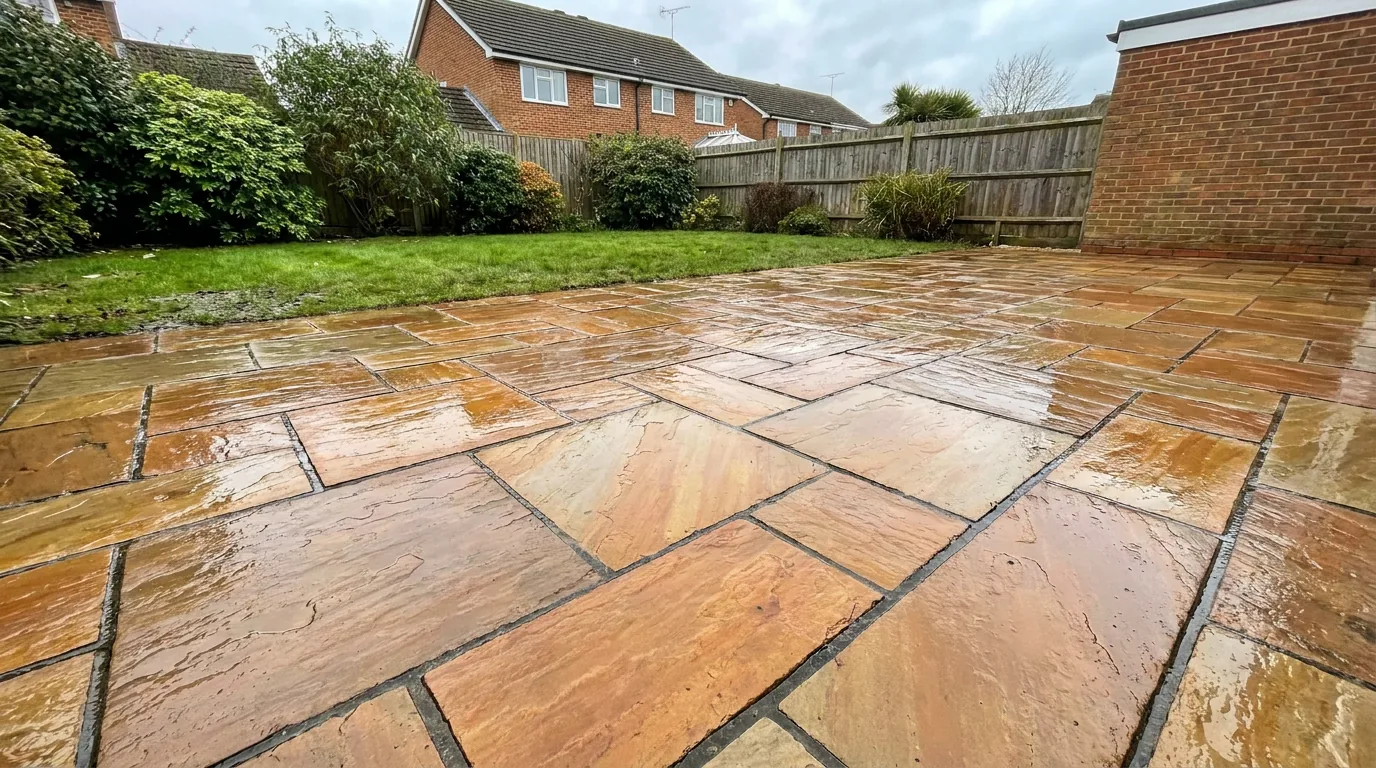
| Sandstone patio (20–35 m²) | £130–£250 | n/a | resi 12–18 mo |
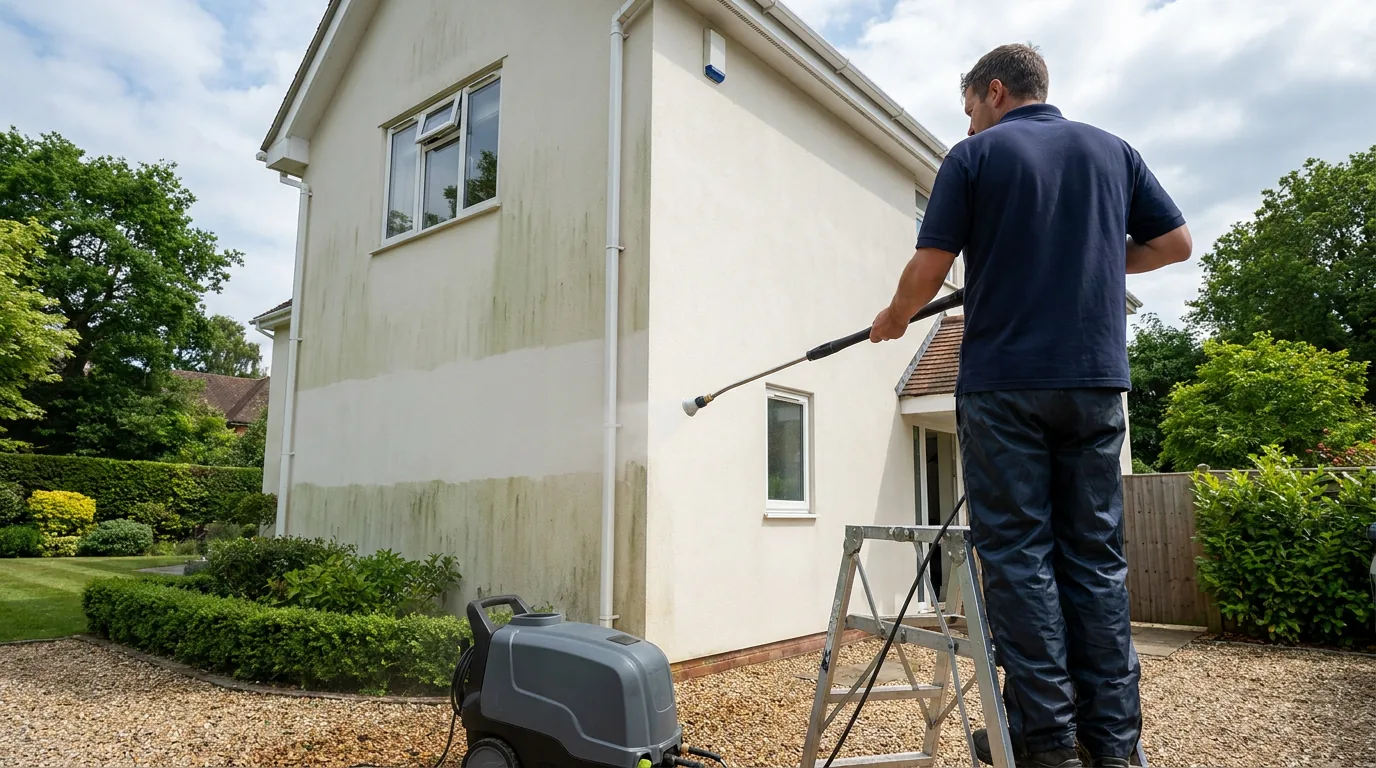
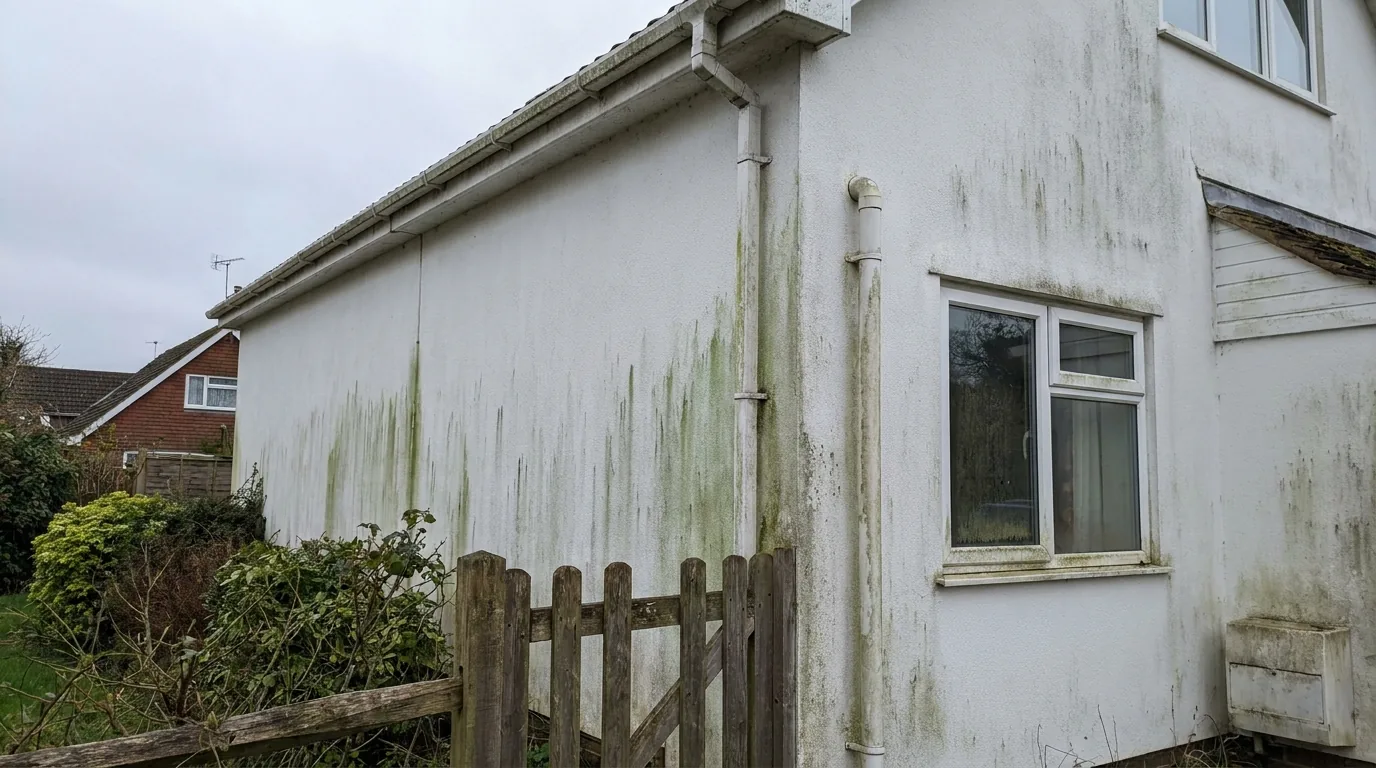
| Render (gable / commercial frontage) | £180–£360 | £500–£1,500/visit | resi 36–48 mo / commercial 12 mo |
2026 client-billed quotes on RH6 work. Commercial bands reflect Gatwick airport-fringe scale (single-visit ticket for a hotel forecourt is typically 5–10× a comparable residential drive). Out-of-hours commercial bookings (early-morning / late-evening to avoid guest disruption) add ~15–25% to commercial bands.
What’s actually under your Horley drive
RH6 sits on Weald Clay Formation alluvium — Lower Cretaceous Wealden Group, BGS-documented[2]. Two practical consequences for paving:
- Drainage is slow. Weald Clay is heavy and impermeable. Rainwater doesn’t move vertically through it the way it does through Banstead chalk; surface-pooling and standing water under unsealed sub-bases are real risks. Hydrostatic lift can show up on poorly-detailed drives in the lower-lying parts of Horley town centre and Smallfield.
- Surface-water flood risk is documented. The Environment Agency long-term flood-risk map[3] shows surface-water risk pockets through central Horley, the Burstow Stream corridor and parts of Smallfield. Biocide runoff and rinse disposal need a bunded-and-foul-drain approach in those postcodes.
Commuter oil staining and Lithofin Oil-EX
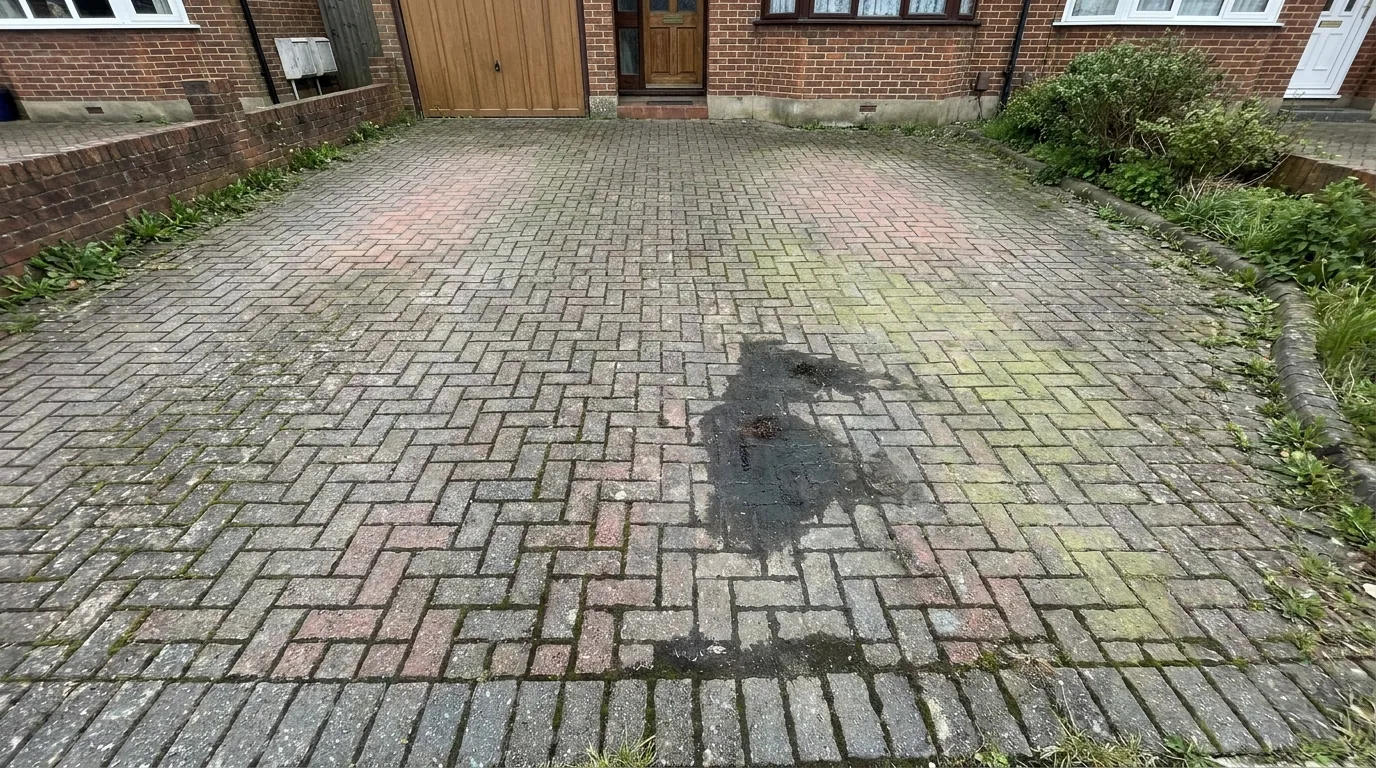
The Horley commuter pattern — company-car ownership clustered around the station and Gatwick — means oil staining is the single most common “not-just-moss” issue on RH6 drives. Lithofin Oil-EX[5] manufacturer guidance specifies: apply at 2 mm coating thickness, allow ~12 hours dry time, coverage ~0.5 m²/kg. We use it as the pre-treatment on every Horley block-paving job that shows oil staining, then surface-clean per Marshalls technique[4]: medium pressure, 30° oblique, ≥200 mm standoff.
Commercial Gatwick-fringe work: out-of-hours, quarterly, contracted
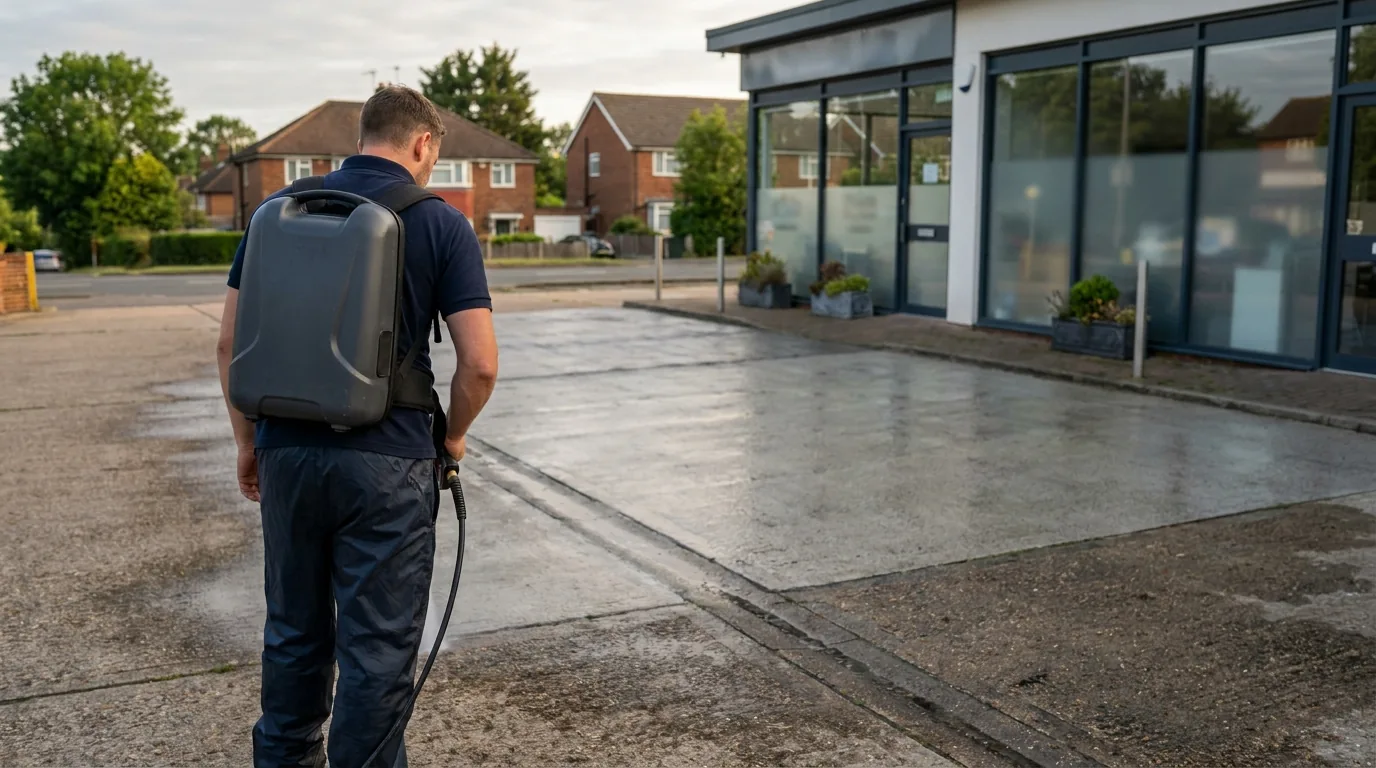
The commercial side of RH6 looks fundamentally different from residential. Hotel forecourts, B&B entrances and car-park bays around Gatwick face year-round footfall, drag-in soiling from luggage trolleys and rolling-suitcase wheels, and pavement-stain liability under HSE PTV slip-risk thresholds[6]. Quarterly contracted cleans (rather than 12–18 month residential cadence) keep commercial surfaces above the PTV ≥36 low-slip threshold and reduce liability exposure. Out-of-hours bookings (early-morning or late-evening) avoid disrupting guests.
Reigate & Banstead Borough Council planning — RH6 SUDS gate
Horley falls under Reigate & Banstead Borough Council[7]. New / replacement front-garden paving >5 m² draining to highway requires permeable surface or soakaway unless planning permission obtained. Cleaning existing surfaces is unaffected. Notable for Horley: replacement commercial forecourts at this scale are common around Gatwick and the SUDS gate often catches commercial owners by surprise.
RH6 mistakes that void warranties
- Turbo nozzles on Marshalls block paving. Marshalls[4] require medium pressure, 30° oblique, ≥200 mm standoff. Turbo / dirt-blaster jets exceed the surface tolerance — common across Langshott and Weatherhill estate installs.
- Skipping Lithofin Oil-EX on commuter drives. Driving a surface cleaner over oil-stained block paving without pre-treatment grinds the contamination into joint sand. Result: stained sand that re-bleeds the next time it rains. Always Oil-EX first on RH6 oil stains.
- High-pressure rinsing into surface-water-risk gullies. Central Horley and Smallfield carry EA-documented surface-water flood pockets[3]. Biocide and degreaser runoff is a watercourse-pollution risk. Bunded rinse, foul-drain disposal only.
What we actually do on a Horley job
- Walk the drive or forecourt — confirm Weald Clay substrate signals, oil-stain count, surface-water-risk proximity (central Horley / Smallfield postcodes).
- Pre-treat oil with Lithofin Oil-EX — 2 mm coat, 12 hr dwell per manufacturer guidance.
- Pre-treat biofilm with biocide — 24–48 hr dwell.
- Surface-clean at medium pressure — 30° oblique, ≥200 mm standoff, no turbo.
- Re-sand block paving — kiln-dried sand, standard.
- Bunded rinse + foul-drain disposal on surface-water-risk postcodes.
- Walk again with the customer — reshoot anything not right. If the result isn’t right, we redo it free.
Pressure washing across RH6 — what we cover
Horley is ten minutes down the A23 from Redhill, sitting just north of Gatwick. The RH6 housing stock is mixed: terraced and semi-detached homes through the town centre and around the station, newer block-paving estates in Langshott and Weatherhill, and larger rural properties out in Smallfield, Charlwood and Hookwood. We cover Redhill (RH1), Crawley (RH10/11), Reigate (RH2), Horsham fringes and the rest of Surrey within 20 miles. Full list of areas here. Or call 01737 652 515.
What we see on Horley drives
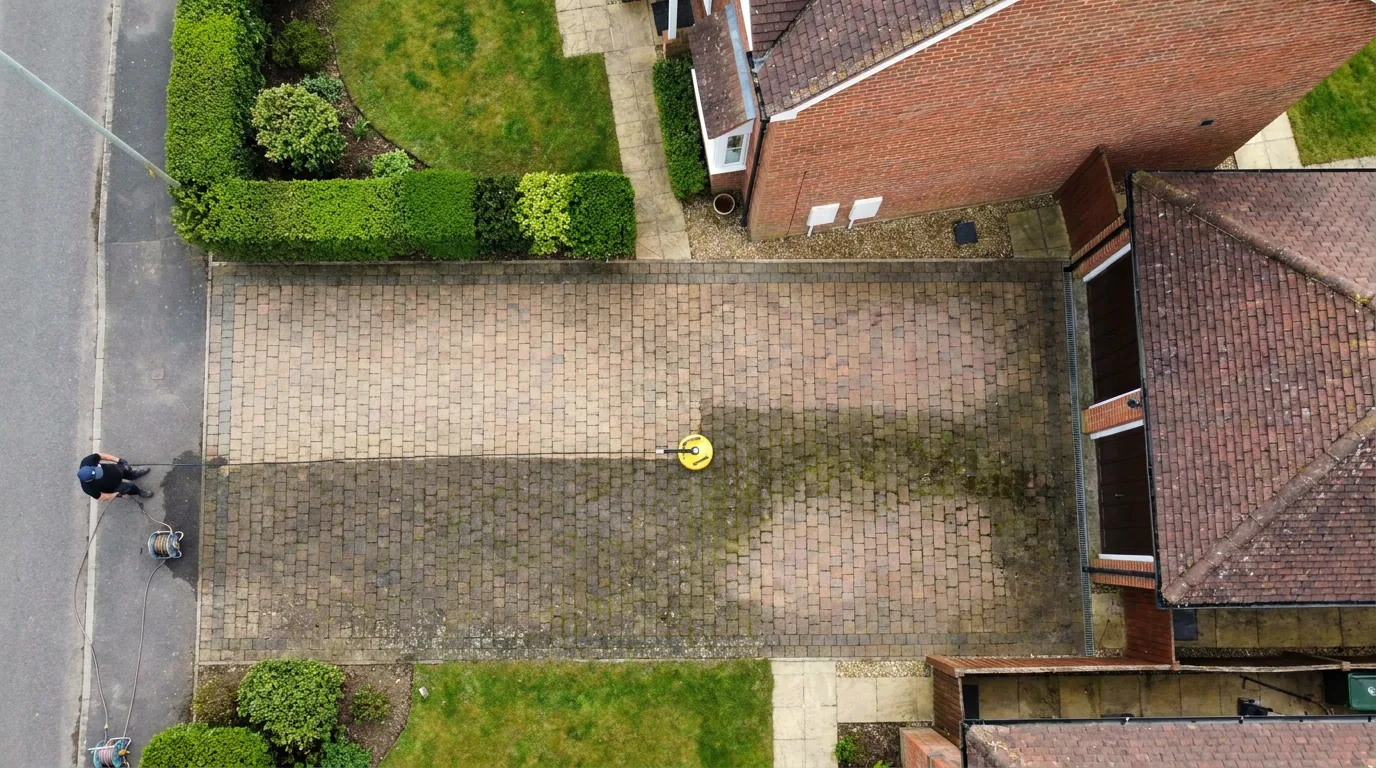
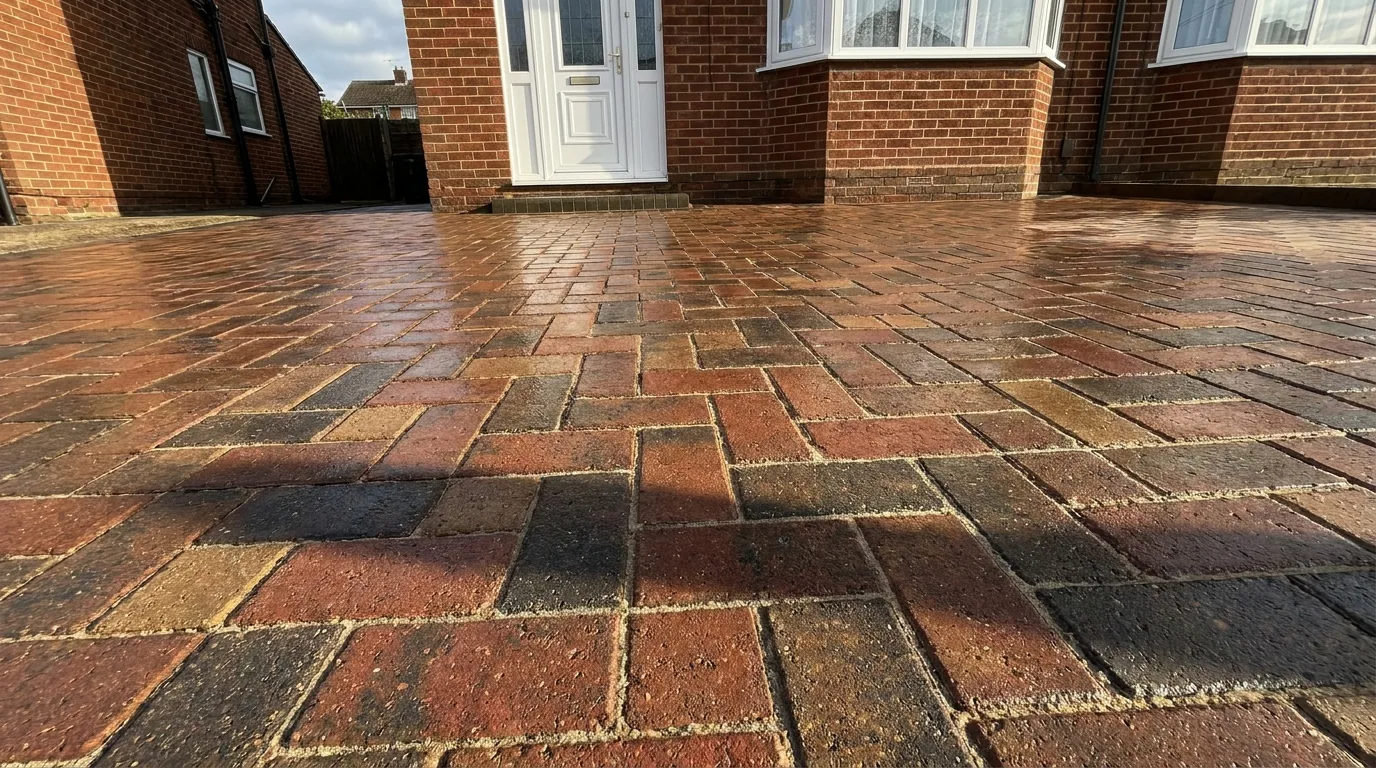
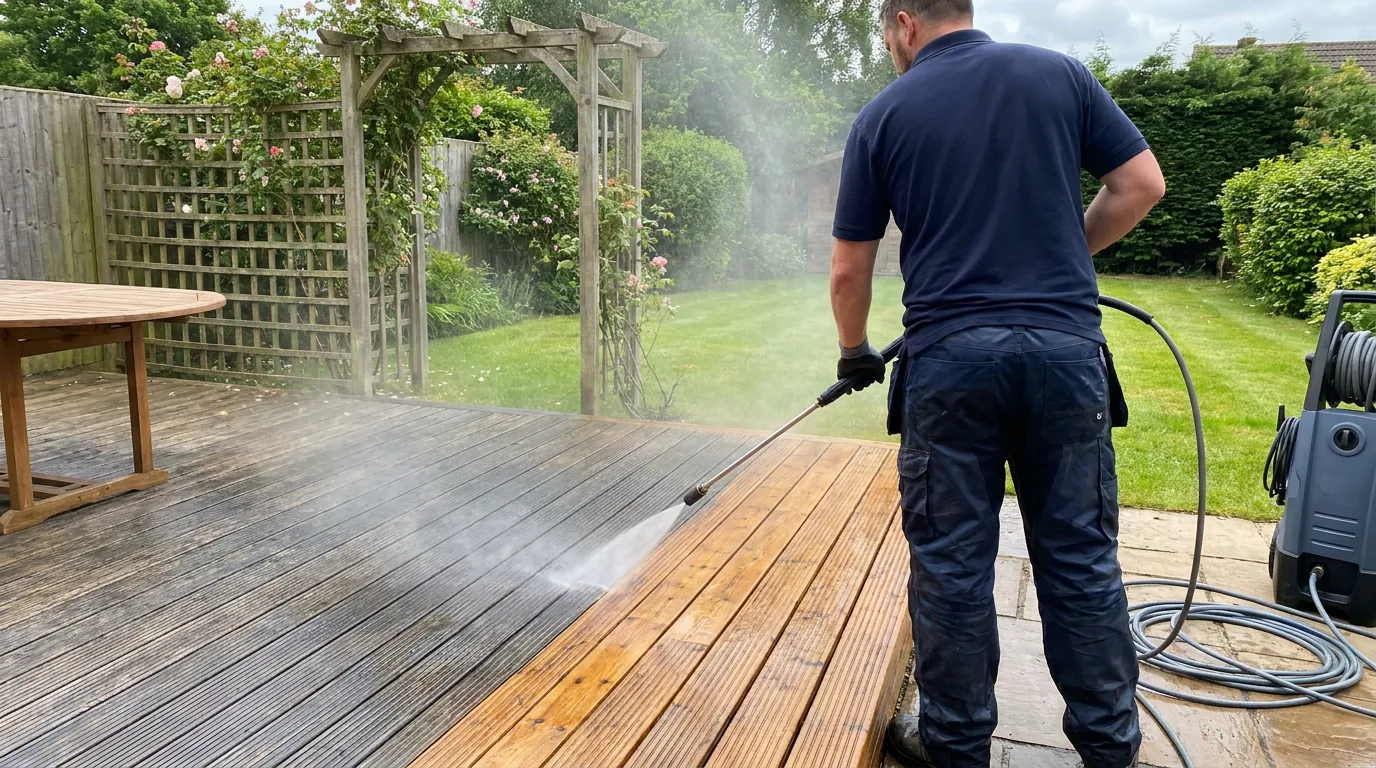
- Block paving with washed-out joints — the dominant surface across the Langshott and Weatherhill estates. Re-sanding included with every clean.
- Oil staining from commuter cars — common around Horley station and the Gatwick-side streets. Hot-water pre-treatment with degreaser handles most of it.
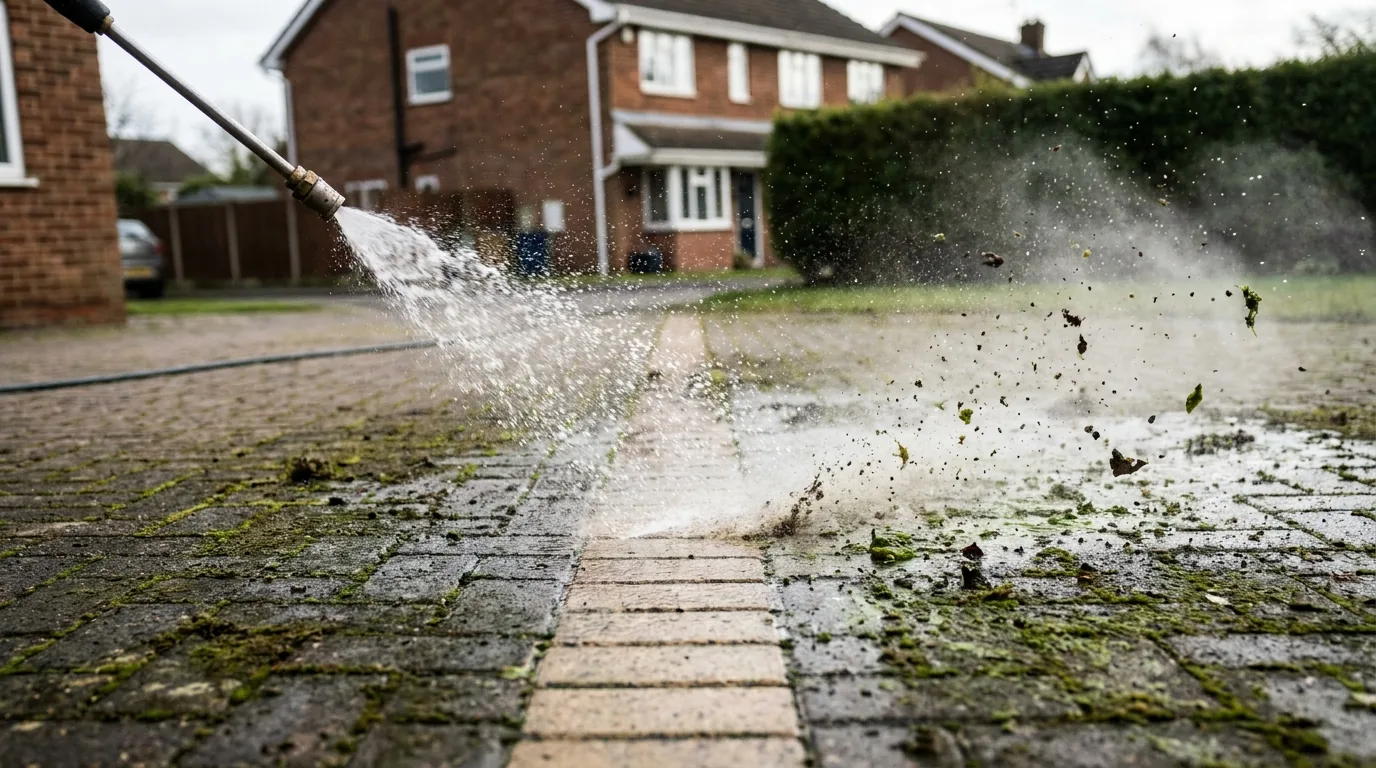
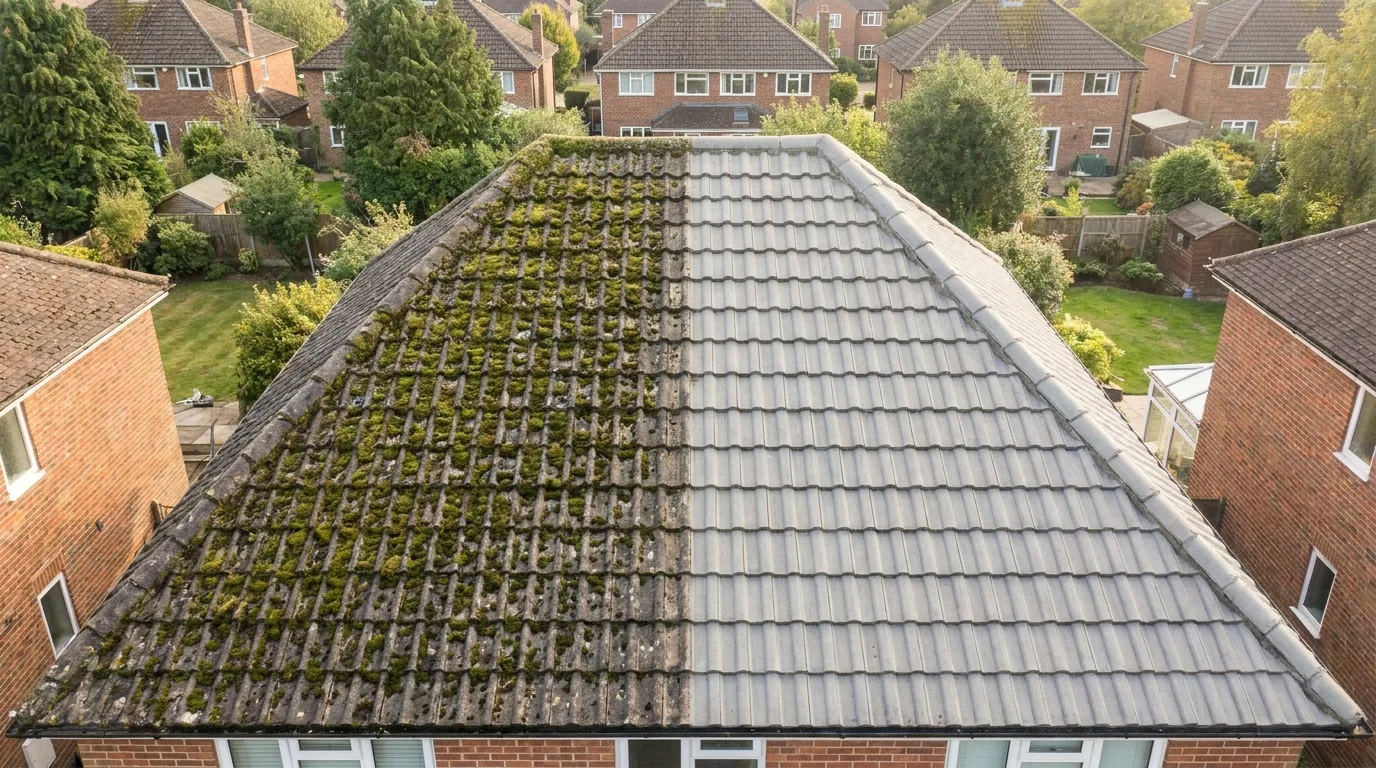
- Heavy moss on shaded drives — the flat, damp microclimate means moss colonises joints fast, especially north-facing front drives.
- Commercial forecourts — airport hotels, B&Bs and car parks. Out-of-hours bookings available.
Helpful guides for Horley homeowners
Driveway cost guide · Oil stain removal · Moss removal · How often you should clean · Commercial pressure washing · RH1 baseline comparison
Sources
Every claim about Horley substrate, surface-water risk, oil-stain treatment, slip-risk and SUDS policy on this page is sourced. We cite primary data (Met Office, BGS, Environment Agency, RBBC) plus manufacturer guidance (Marshalls, Lithofin Oil-EX) and HSE/UKSRG slip guidance. We do not cite competitor pressure-washing blogs.
- Met Office — Wisley (Surrey) Location Long-Term Averages 1991–2020. Annual rainfall 648.41 mm. metoffice.gov.uk — Wisley averages. Accessed 21 May 2026.
- British Geological Survey (BGS) — Weald Clay Formation lithostratigraphy (Lower Cretaceous Wealden Group). Slow-draining substrate underlying Horley town centre, Langshott, Weatherhill, Smallfield. bgs.ac.uk — Weald Clay Formation lexicon. Accessed 21 May 2026.
- Environment Agency / GOV.UK — Long-term flood risk for an area in England. Documents surface-water flood pockets across central Horley, the Burstow Stream corridor and Smallfield. check-long-term-flood-risk.service.gov.uk. Accessed 21 May 2026.
- Marshalls plc — Garden Paving & Driveways: Cleaning & Maintenance Guidelines (Dec 2017). Medium pressure, 30° oblique, ≥200 mm standoff; re-sand if joints are washed out. marshalls.co.uk — cleaning guidelines (PDF). Accessed 21 May 2026.
- Lithofin AG — Oil-EX Oil Stain Remover product page and technical information. Apply at 2 mm coating thickness, ~12 hr dry time, coverage ~0.5 m²/kg. lithofin.com — Oil-EX. Accessed 21 May 2026.
- UK Slip Resistance Group / HSE — Introduction to the Pendulum Tester. PTV ≥36 low risk, 25–35 moderate, ≤24 high — the threshold liability-driven commercial cleans target. ukslipresistance.org.uk — pendulum tester. Accessed 21 May 2026.
- Reigate & Banstead Borough Council — Local Plan and Development Management Plan, including drainage and SUDS policies governing replacement front-garden and commercial-forecourt paving. reigate-banstead.gov.uk — Local Plan. Accessed 21 May 2026.