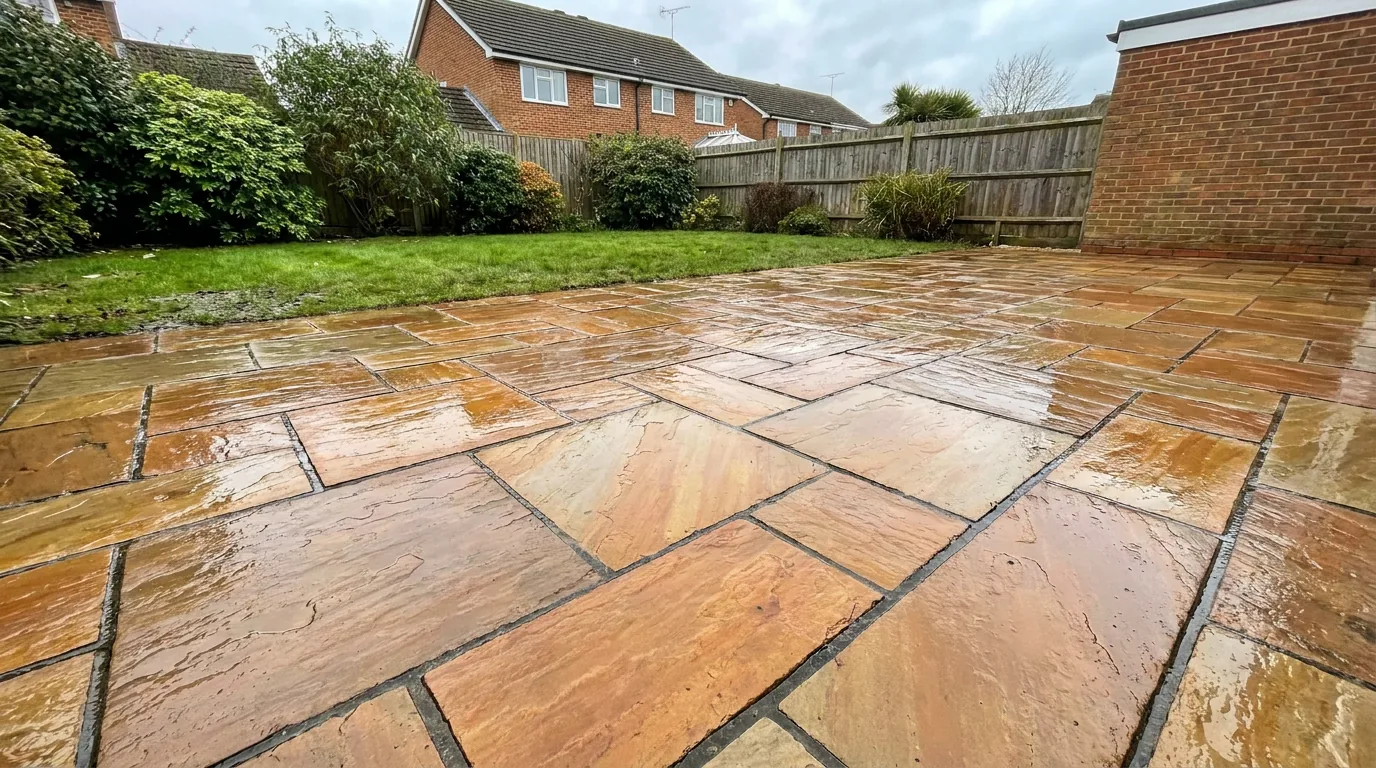
- 50 expert answers covering costs, methods, surfaces, safety, timing, and hiring
- Average UK driveway clean: £150-£350 (£1.50-£3.00 per m²)
- 48,000 ladder injuries per year, hire professionals for height work
- Pressure washing can damage sandstone, render, decking, and roof tiles at wrong PSI
- Best time to clean: March-May (spring) and September-November (autumn)
- Professional results last 12-18 months vs 3-6 months DIY
The quick answer: This guide answers the 50 most common pressure washing questions searched in the UK. Whether you want to know how much driveway cleaning costs, which surfaces are safe to pressure wash, what PSI to use, or how to find a reliable company, every answer is here with specific UK pricing, safety data, and expert recommendations for 2026.
We have organised the questions into six categories so you can jump straight to what you need: Cost & Pricing, Methods & Equipment, Surface-Specific Advice, Safety & Damage, Timing & Frequency, and Hiring & Choosing a Company.
Cost & Pricing (Questions 1-10)
Pricing is the most searched topic in pressure washing. These ten questions cover every angle, from per-m² rates and job totals to seasonal discounts and whether DIY actually saves money. For detailed pricing breakdowns by surface, see our dedicated driveway cleaning cost guide and patio cleaning cost guide.
1. How much does it cost to pressure wash a driveway in the UK?
Pressure washing a driveway in the UK costs £1.50-£3.00 per square metre in 2026. For a typical 50m² driveway, expect to pay £180-£350 depending on surface type, soiling level, and your location. Block paving costs more than concrete because it requires re-sanding after cleaning. Prices in London and the South East tend to be 15-25% higher than the national average. For a full breakdown by driveway type, see our driveway cleaning cost guide.
2. How much does patio cleaning cost?
Professional patio cleaning in the UK costs £195-£490 in 2026, depending on the size and surface material. A typical 30m² patio costs £195-£300, while larger 60m² patios cost £300-£490. Indian sandstone and natural stone patios cost more than concrete slabs because they require lower pressure and more careful technique to avoid surface damage. Our patio cleaning cost guide breaks down pricing by material and size.
3. Is it cheaper to hire a pressure washer or pay a professional?
Hiring a domestic pressure washer costs £45-£80 per day, which seems cheaper than professional cleaning at £150-£350. However, DIY mistakes can cost £200-£3,000+ in surface repairs. Professionals use commercial-grade equipment (3,000+ PSI with adjustable flow), surface cleaners, and proper detergents that deliver better results in half the time. For driveways over 30m² or any delicate surface like sandstone, professional cleaning is almost always better value. We compare the full costs in our DIY vs professional guide.
4. What affects the price of pressure washing?
Six main factors affect pressure washing prices: area size (charged per m²), surface type (block paving costs more than concrete), soiling level (heavy moss or oil stains add 20-50%), access difficulty (rear gardens or steep slopes cost more), optional extras like sealing or re-sanding, and geographic location (South East prices are 15-25% above the national average). Most companies offer free quotes after seeing photos of the area, request yours here.
5. Is pressure washing my driveway worth the money?
Yes. A clean driveway adds up to 5% to your property's perceived value according to estate agent estimates, and prevents long-term damage from moss, algae, and weed root systems that can displace paving and block drainage. A £250 driveway clean every 12-18 months is far cheaper than the £2,000-£5,000 cost of relaying a damaged driveway. It also improves safety by removing slippery algae and moss. For more on whether it is worth the investment, see our guide on pressure washing risks and benefits.
6. How much does driveway sealing cost after pressure washing?
Driveway sealing after pressure washing costs £5-£17 per square metre in the UK, depending on the sealant type. Acrylic sealants cost £5-£8/m² and last 2-3 years. Polyurethane sealants cost £8-£12/m² and last 3-5 years. Resin-based sealants cost £12-£17/m² and last 5-7 years. For a 50m² driveway, expect to pay £250-£850 for sealing on top of the cleaning cost. Our cleaning and sealing cost guide covers all options in detail.
7. Do pressure washing companies charge per hour or per square metre?
Most UK pressure washing companies charge per square metre (£1.50-£4.00/m²) rather than per hour. Per-m² pricing gives you cost certainty before the work starts. Some companies quote a flat rate for standard job sizes. Avoid companies that charge per hour (£30-£60/hour) as this incentivises slow work and makes it impossible to compare quotes accurately. Always ask for a written quote with the total area and price before committing.
8. What is the cheapest time of year for pressure washing?
October to February is the cheapest period for pressure washing, with savings of 15-25% compared to peak season. Demand drops significantly in autumn and winter, so companies offer discounts to fill their schedules. The trade-off is shorter daylight hours and weather delays. Spring (March-May) is peak season with full prices but ideal conditions. If you can be flexible on timing, booking during winter offers the best value.
9. How much does it cost to pressure wash a roof?
Roof cleaning costs £400-£1,000 in the UK, but the NFRC (National Federation of Roofing Contractors) warns against pressure washing roofs. High-pressure water strips protective tile coatings, drives water under laps, and can crack tiles. Soft washing (low-pressure biocide application) is the recommended method, costing £600-£1,200 including biocide treatment. The results last 2-5 years compared to 6-12 months with pressure washing. Read our full roof cleaning cost guide for details.
10. Should I get multiple quotes for pressure washing?
Yes, always get at least 3 quotes. Prices vary by 40-60% between companies for the same job, and comparing quotes helps you identify outliers. Unusually cheap quotes often mean the company will skip re-sanding, use domestic equipment, or lack insurance. Ask each company the same questions about equipment, chemicals, re-sanding, sealing, and insurance to make a fair comparison. You can get a free quote from us here.
Methods & Equipment (Questions 11-18)
Understanding the equipment and techniques behind pressure washing helps you choose the right approach for your surface and avoid costly mistakes. Whether you are deciding between DIY and professional, or just want to know which nozzle to use, these eight questions cover the essentials.
11. What is the difference between pressure washing and jet washing?
In the UK, pressure washing and jet washing mean exactly the same thing. Both terms describe using high-pressure water to clean surfaces. "Jet washing" is more commonly used in everyday British English, while "pressure washing" is the technical and industry term. Some people use "power washing" to mean hot-water pressure washing specifically, but in practice all three terms are used interchangeably. Our pressure washing guide covers the terminology in detail.
12. What PSI do I need for pressure washing?
The PSI you need depends entirely on the surface. Concrete handles 2,000-3,000 PSI safely. Block paving needs 1,500-2,000 PSI to avoid dislodging sand. Indian sandstone should not exceed 1,200-2,000 PSI. Tarmac is limited to 1,300 PSI maximum. Wooden decking requires just 500-600 PSI. Using too high a PSI is the number one cause of pressure washing damage, always start lower and increase gradually. See our surface-specific section below for detailed guidance.
13. Is a Karcher K4 powerful enough for a patio?
Yes. A Karcher K4 produces around 130 bar (1,885 PSI) which is sufficient for most domestic patio cleaning. It handles concrete slabs, porcelain, and moderately soiled block paving effectively. For heavily soiled surfaces or large areas over 40m², a K5 (145 bar) or K7 (180 bar) will be noticeably faster. Pair any Karcher with a T5 surface cleaner attachment for even, streak-free results on flat surfaces.
14. Is hot water pressure washing better than cold?
Hot water pressure washing is approximately 40% faster than cold water and significantly more effective at killing bacteria, removing oil and grease, and eliminating organic growth. However, hot water machines cost £2,000-£10,000 compared to £200-£600 for cold water units. Most professional companies use hot water for commercial work and heavily soiled surfaces, while cold water is adequate for routine domestic cleaning.
15. What is a surface cleaner attachment?
A surface cleaner is a disc-shaped attachment that fits onto a pressure washer lance. It contains two or more spinning nozzles enclosed under a housing, creating even cleaning without the stripe marks a standard lance produces. Surface cleaners halve cleaning time on flat areas and prevent the "zebra stripe" effect. They cost £30-£80 for domestic models and £200-£500 for professional units. They are essential for driveways and patios.
16. What nozzle should I use for pressure washing?
Use the 25-degree green nozzle for general pressure washing of driveways, patios, and paths, it provides a good balance of cleaning power and coverage. The 40-degree white nozzle is safer for delicate surfaces like sandstone and decking. Never use the 0-degree red nozzle on paving, it concentrates all pressure into a pinpoint jet that etches lines into concrete and destroys softer stone. The 15-degree yellow nozzle is for stubborn stains only.
17. Should I use detergent when pressure washing?
Yes, especially for organic growth like moss, algae, and lichen. A dedicated pressure washing detergent (applied at low pressure before the main wash) breaks down biological matter, loosens grime, and delivers a deeper clean than water alone. Use sodium hypochlorite-based solutions for organic growth and alkaline degreasers for oil stains. Always rinse thoroughly after detergent application to prevent residue damage.
18. Should I buy or hire a pressure washer?
Hire if you only need one once a year, hiring costs £45-£80 per day versus £200-£600 to buy a decent domestic unit. Buy if you plan to use it 3 or more times per year, as it pays for itself within the first year. For most homeowners, hiring a professional (£150-£350 per job) is better value than either option because professional equipment and technique delivers superior results with zero risk of damage. Our DIY vs professional guide runs the full cost comparison.
Surface-Specific Advice (Questions 19-28)
Different surfaces need different pressures, nozzles, and techniques. Getting this wrong is the most common cause of pressure washing damage. These ten questions cover every surface you are likely to encounter around a UK home, from block paving and sandstone to roofs and render.
19. Can you pressure wash block paving without removing the sand?
You can minimise sand loss by holding the lance at a 45-degree angle (never directly downward), keeping pressure below 1,500 PSI, and using a surface cleaner attachment rather than a standard lance. However, some kiln-dried sand will always be displaced during cleaning. Budget for re-sanding after every clean, it costs £20-£50 in materials for a typical driveway and is essential for preventing weed regrowth and maintaining structural stability. See our block paving cleaning guide for the full process.
20. Can you pressure wash Indian sandstone?
Yes, but with extreme care. Indian sandstone is a natural stone that can be damaged by excessive pressure. Keep PSI between 1,200-2,000, use a wide fan nozzle (40-degree white), maintain at least 30cm distance from the surface, and never concentrate the jet on one spot. Avoid turbo nozzles entirely. Many professionals prefer to soft wash sandstone with a biocide solution rather than pressure wash it, as this eliminates any risk of surface erosion.
21. Can you pressure wash tarmac?
Tarmac requires very careful pressure washing at a maximum of 1,300 PSI with cold water only. Hot water softens the bitumen binder in tarmac, causing surface breakdown and loose aggregate. Use a wide fan nozzle and keep the lance moving constantly, never hold it in one spot. Tarmac older than 10 years is particularly vulnerable. For heavily soiled tarmac, a detergent pre-treatment followed by gentle pressure washing gives the best results.
22. Can you pressure wash concrete?
Yes, concrete is the most forgiving surface for pressure washing. It handles 2,000-3,000 PSI safely with a 25-degree nozzle. Use a surface cleaner attachment for even results without stripe marks. For oil stains, apply an alkaline degreaser and let it dwell for 10-15 minutes before pressure washing. Concrete driveways and paths are the easiest surfaces for DIY pressure washing, though professional results are still noticeably better.
23. Can you pressure wash wooden decking?
Yes, but softwood decking (pine, spruce) should only be cleaned at 500-600 PSI. Hardwood decking (oak, ipe) can handle up to 1,200 PSI. Always wash along the grain, never across it, and maintain at least 30cm distance. A fan nozzle (40-degree) is essential, a turbo or zero-degree nozzle will gouge furrows into the wood. After pressure washing, allow the deck to dry for 48-72 hours before applying oil or stain. Our decking cleaning guide covers the full process.
24. Can you pressure wash composite decking?
Yes, but keep pressure under 1,500 PSI and always check the manufacturer's cleaning guidelines first. Some composite brands (like Trex and Millboard) have specific pressure limits and approved cleaning products. Use a fan nozzle at 30cm distance and wash in the direction of the grain pattern. Avoid turbo nozzles and concentrated jets. A gentle detergent pre-wash followed by low-pressure rinsing often achieves excellent results without any risk. See our decking cleaning guide.
25. Can you pressure wash roof tiles?
No. The NFRC and major tile manufacturers like Marley explicitly advise against pressure washing roof tiles. High-pressure water strips the factory-applied protective coating, drives water under tile laps causing leaks and rot, and can crack or dislodge tiles. Soft washing (low-pressure biocide application) is the recommended method, it kills moss and algae without damaging tiles and results last 2-5 years. Our roof cleaning cost guide explains why and what to do instead.
26. Can you pressure wash render?
No. K-Rend and similar thin-coat renders are only 9mm thick and will be damaged or completely stripped by a pressure washer. Even traditional sand-and-cement render can be pitted and cracked by high-pressure water. Soft washing with a biocide solution at garden-hose pressure is the only safe method for cleaning rendered walls. Professional render cleaning costs £300-£800 depending on house size and typically lasts 3-5 years. See our render cleaning guide.
27. How do you remove weeds from a patio with pressure washing?
Remove visible weeds manually or with a weed scraper before pressure washing, the washer alone will not kill roots embedded in the joints. After pressure washing, sweep kiln-dried sand into all joints to fill gaps and prevent regrowth. For long-term weed prevention, apply a polymeric sand or joint sealant. Sealing the entire patio surface after cleaning blocks light and moisture from reaching any remaining seeds in the substrate.
28. Can you pressure wash a resin driveway?
Yes, resin-bound driveways can be pressure washed at 1,000-1,500 PSI with a fan nozzle. Keep the lance at least 30cm from the surface and avoid turbo nozzles, which can dislodge resin aggregate. Resin driveways are porous by design, so avoid forcing dirt deeper into the surface by using a sweeping motion rather than concentrating on one spot. Annual pressure washing keeps resin driveways looking new and maintains their permeability.
Safety & Damage (Questions 29-36)
Pressure washers are powerful tools that can cause serious injury and property damage when used incorrectly. These eight questions cover the most important safety considerations, from surface damage and personal injury to environmental regulations and electrical safety.
29. Can pressure washing damage my driveway?
Yes. Using the wrong nozzle is the number one cause of pressure washing damage, followed by excessive PSI for the surface type. Common damage includes etching lines into concrete (zero-degree nozzle), displacing jointing sand from block paving (too much pressure), eroding the surface of natural stone (sandstone, limestone), and stripping sealant. Repair costs range from £200 for re-sanding to £3,000+ for relaying damaged paving. Our damage prevention guide covers every risk and how to avoid it.
30. What are the risks of DIY pressure washing?
The main risks are surface damage from incorrect pressure or nozzle selection (£200-£3,000+ to repair), personal injury from high-pressure jets (130+ bar can cause lacerations), electrical hazards from water near outdoor sockets, and environmental damage from contaminated runoff entering drains. Professional cleaners carry public liability insurance, use commercial equipment with adjustable settings, and understand the safe operating parameters for every surface type. See our DIY vs professional comparison.
31. What is the safe PSI for each surface?
Safe PSI limits by surface: softwood decking 500-600 PSI, Indian sandstone 1,200-2,000 PSI, tarmac 1,300 PSI maximum, block paving 1,500-2,000 PSI, composite decking under 1,500 PSI, resin driveway 1,000-1,500 PSI, concrete 2,000-3,000 PSI. Always start at the lower end and test on an inconspicuous area first. These are maximum recommended pressures, you can always use less, but never more.
| Surface | Safe PSI Range | Recommended Nozzle | Risk Level |
|---|---|---|---|
| Softwood decking | 500-600 | 40-degree (white) | High, gouges easily |
| Resin driveway | 1,000-1,500 | 40-degree (white) | Medium, aggregate loss |
| Indian sandstone | 1,200-2,000 | 40-degree (white) | High, surface erosion |
| Tarmac | Max 1,300 | 25-degree (green) | High, bitumen softening |
| Block paving | 1,500-2,000 | 25-degree (green) | Medium, sand displacement |
| Composite decking | Under 1,500 | 40-degree (white) | Medium, check manufacturer |
| Concrete | 2,000-3,000 | 25-degree (green) | Low, most forgiving |
32. What safety equipment do I need for pressure washing?
Essential safety equipment includes sealed safety goggles (not glasses, spray carries debris and chemicals), waterproof clothing and trousers, steel-toe boots with non-slip soles, and heavy-duty rubber gloves. Ear protection is recommended for petrol-powered machines. Never wear open-toed shoes or shorts. If using chemical detergents, a respirator mask rated for chemical vapour is also recommended, especially for sodium hypochlorite solutions.
33. Can a pressure washer cut through skin?
Yes. A domestic pressure washer at 130 bar (1,885 PSI) can cause lacerations and deep tissue injuries. Professional machines at 200+ bar (2,900+ PSI) can inject water and debris under the skin, causing injuries that require surgical treatment. Water injection injuries are a medical emergency, contaminated water forced under the skin causes rapid infection. Never point a pressure washer at yourself or others, and never use your hand to test the spray.
34. Is pressure washing wastewater harmful?
Yes. Pressure washing wastewater contains dirt, oil, chemicals, moss spores, and cleaning detergents. Allowing contaminated runoff to enter storm drains is illegal under the Water Resources Act 1991 and the Environmental Permitting Regulations 2016. Professional companies contain wastewater using berms or wet vacuums and dispose of it through foul drains or licensed waste carriers. Fines for pollution incidents start at £1,000 and can reach £50,000.
35. Can you pressure wash near windows and doors?
Yes, but maintain at least 60cm distance from glass, angle the spray downward away from seals and frames, and never use a turbo or zero-degree nozzle near glazing. High-pressure water can crack older single-glazed windows, force water past window seals into the wall cavity, and damage UPVC frames. Close all windows and doors before starting work and check that any vents or airbricks are not blocked by spray.
36. Can you pressure wash near electrical sockets?
Only if the pressure washer is plugged into an RCD-protected socket (residual current device). An RCD cuts power within milliseconds if water contacts a live connection, preventing electrocution. Never use a pressure washer in rain, never spray directly at outdoor sockets or junction boxes, and ensure all extension leads are rated for outdoor use and raised off wet ground. If in doubt, consult an electrician before pressure washing near electrical installations.
Timing & Frequency (Questions 37-42)
When you clean matters almost as much as how you clean. The right timing maximises results, reduces costs, and ensures sealants bond properly. These six questions cover optimal scheduling for UK conditions.
37. How often should I pressure wash my driveway?
Once a year is the minimum recommended frequency for most UK driveways. Spring (March-May) is the ideal time, it removes the winter's accumulated moss, algae, and dirt before the growing season. Driveways in shaded areas or under trees may need cleaning twice a year. Sealed driveways stay cleaner longer and may only need cleaning every 18-24 months. Regular cleaning prevents the deep-set staining that is far harder and more expensive to remove.
38. What is the best time of year to clean a patio?
March to May (spring) is the best time to clean a patio in the UK. Winter moisture encourages moss and algae growth, and spring cleaning removes this before it causes staining or makes surfaces dangerously slippery for summer use. Cleaning in spring also allows time for the surface to dry properly before applying sealant. Autumn (September-November) is a good secondary window for pre-winter preparation. Our seasonal cleaning guide covers timing in more detail.
39. How long does a pressure-washed surface stay clean?
Without sealing, a pressure-washed driveway or patio stays clean for 6-12 months in typical UK conditions. With a quality sealant applied after cleaning, results last 2-5 years depending on the sealant type and surface exposure. Shaded, north-facing areas regrow moss faster than sunny, south-facing surfaces. Regular sweeping and removing leaf debris extends the clean appearance significantly between professional washes.
40. How long does it take to pressure wash a driveway?
A professional with commercial equipment cleans a typical 50m² driveway in 1-2 hours, including setup and cleanup. DIY with a domestic pressure washer takes 2-4 hours for the same area because domestic machines have lower flow rates and smaller surface cleaners. Block paving takes longer than concrete due to the need for careful joint work. Add 1-2 hours for re-sanding and 2-3 hours for sealing if included.
41. Can you pressure wash in winter?
Only when the temperature is above freezing (0°C). Pressure washing in sub-zero conditions is dangerous because water freezes on contact with cold surfaces, creating an ice rink on your driveway. Frozen water in machine components can also damage pumps, hoses, and fittings. If you need winter cleaning, choose a day when the temperature will stay above 5°C for several hours after finishing so the surface can drain and dry.
42. Should I seal my driveway straight after pressure washing?
No. The surface must be completely dry before sealing, which takes a minimum of 3 days in warm summer weather and up to 2 weeks in cooler or damp conditions. Sealing a wet or damp surface traps moisture underneath, causing the sealant to cloud, peel, or fail within weeks. Test dryness by taping a plastic sheet to the surface overnight, if condensation appears underneath, it is not dry enough to seal. See our sealing guide for full instructions.
Hiring & Choosing a Company (Questions 43-50)
Choosing the right pressure washing company is the difference between a clean driveway and a damaged one. These eight questions cover everything from insurance requirements and quote red flags to the questions you should ask before any work begins.
43. What should I look for in a pressure washing company?
Look for five key things: public liability insurance of at least £1 million, genuine customer reviews (check Google Maps, not just their website), commercial-grade equipment (not domestic Karcher machines), a written quote that itemises all work, and before-and-after photos of previous jobs on similar surfaces. Avoid companies that cannot provide proof of insurance, quote without seeing the job, or pressure you into immediate booking.
44. Do pressure washing companies need insurance?
Yes. Any reputable pressure washing company should carry a minimum of £1 million public liability insurance. This covers damage to your property (cracked paving, damaged render, broken windows) and injury to third parties during the work. Ask to see a copy of their insurance certificate before work begins, not just a policy number, but the actual certificate showing coverage dates and the insured amount. Some companies also carry employer liability insurance.
45. What should a pressure washing quote include?
A professional quote should include: the total area to be cleaned (in m²), all surfaces and their types, the cleaning method and equipment to be used, whether re-sanding is included (for block paving), whether sealing is included or priced separately, the estimated duration, the total price with VAT, and any access requirements. Quotes should be in writing, valid for at least 30 days, and include the company's insurance details.
46. Is sealing worth it after pressure washing?
Yes, especially for block paving. Sealing after cleaning prevents weed regrowth by blocking light and moisture from reaching joints, inhibits moss and algae growth on the surface, stabilises jointing sand, and enhances the colour of the paving. Sealed block paving stays clean for 2-5 years versus 6-12 months unsealed. The cost (£5-£17/m²) is repaid by eliminating 2-4 interim cleans that would otherwise be needed. Our block paving sealing guide covers all the options.
47. Should I clean my driveway myself or hire a professional?
DIY is reasonable for areas under 20m² with forgiving surfaces like concrete, if you already own or can borrow a pressure washer. For anything larger, block paving, natural stone, or heavily soiled surfaces, hiring a professional is better value. Professionals deliver noticeably better results (commercial equipment produces 3-5x the flow rate of domestic machines), work faster, carry insurance against damage, and handle wastewater disposal legally. Our DIY vs professional guide has the complete comparison.
48. How do I find a good pressure washing company?
Start with Checkatrade, Bark, and Google Maps, look for companies with 4.5+ stars and at least 20 reviews. Read the negative reviews carefully as they reveal how the company handles problems. Ask neighbours and local Facebook groups for recommendations. Verify insurance, check for before-and-after photos, and get at least 3 written quotes. Avoid companies that only advertise on social media without a website or verifiable business address.
49. What questions should I ask before hiring a pressure washing company?
Ask these five questions: Do you have public liability insurance and can I see the certificate? What equipment and PSI will you use on my surface? What chemicals or detergents will you use, and are they safe for my plants? How will you handle wastewater runoff? Do you offer any guarantee on the work? A professional company will answer all five confidently. Evasive or vague answers on insurance and wastewater are red flags.
50. Can a pressure washing company damage my property?
Yes. Common damage includes etching concrete with the wrong nozzle, stripping sand from block paving joints, eroding natural stone surfaces, cracking render, breaking roof tiles, and damaging window seals. This is why insurance is critical, a properly insured company covers the cost of repairs. If damage occurs, document it with photos immediately, report it to the company in writing, and contact their insurer if they do not resolve it promptly.
Got a Question We Haven't Answered?
If your question is not covered in this guide, get in touch. We provide free, no-obligation advice on any pressure washing question, no sales pitch, just honest answers from experienced professionals.
Ask Us a QuestionGet Your Free Pressure Washing Quote
Now you have the answers to the 50 most common pressure washing questions, the next step is getting a quote for your specific property. We provide free, no-obligation quotes for all pressure washing services throughout Surrey and the surrounding area.
We serve Redhill, Reigate, Horley, Dorking, Banstead, Crawley, and all areas within a 20-mile radius of RH1. Whether you have a concrete driveway, block paving, Indian sandstone patio, or composite decking, we use commercial-grade equipment and surface-appropriate techniques to deliver results that last.
If you want to estimate costs before requesting a formal quote, try our interactive cost calculator, it gives instant estimates for all surface types and sizes.
Get My Free Quote Try Cost Calculator
Related guides: Driveway Cleaning Cost UK | Patio Cleaning Cost UK | Block Paving Cleaning Cost | Roof Cleaning Cost | Render Cleaning Guide | Decking Cleaning Guide | DIY vs Professional | Damage Prevention Guide | Pressure Washing Guide
Original analysis and sources
The 50 most-asked pressure-washing questions across UK search resolve to a small set of technique standards: Marshalls (medium pressure / 30° / 200mm)[3], BS 7533-101:2021 (re-sanding)[6], and HSE/UKSRG (wet-PTV ≥36)[4]. The sources, not the questions, are the canonical answer set.
Key sourced claims in this guide: Surrey rainfall baseline 648 mm/yr per Met Office Wisley[1], annual biocide cadence per Lithofin Algex manufacturer guidance[2], medium-pressure / 30° oblique / ≥200 mm-standoff technique per Marshalls[3], HSE-endorsed slip-risk methodology[4], and PTV ≥36 low-slip threshold from UKSRG pendulum-test guidance[5].
Sources
Every numeric claim, technique parameter, and safety threshold in this guide is sourced from a manufacturer technical bulletin, BS standard, or .gov.uk reference. We cite the bodies whose data and rules actually govern UK pressure-washing outcomes, not the unsourced ranges repeated across competitor blogs.
- Met Office, Wisley (Surrey) Location Long-Term Averages 1991–2020. Closest Met Office station to RH1. Annual rainfall 648.41 mm; Surrey is ~43% drier than the UK national mean of ~1,147 mm. metoffice.gov.uk, Wisley averages. Accessed 21 May 2026.
- Lithofin, ALGEX Special Cleaner product page. Manufacturer guidance: spray annually, preferably in spring. 6–12 month residual activity. lithofin.com, ALGEX. Accessed 21 May 2026.
- Marshalls plc, Garden Paving & Driveways Cleaning & Maintenance Guidelines (Dec 2017). Technique: medium pressure, 30° lance, 200mm minimum standoff. marshalls.co.uk, cleaning guidelines (PDF). Accessed 21 May 2026.
- Health and Safety Executive (HSE), Slips and trips at work. HSE-preferred slip-risk methodology; PTV ≥36 wet-acceptance threshold. hse.gov.uk, slips and trips. Accessed 21 May 2026.
- UK Slip Resistance Group, Introduction to the Pendulum Tester (BS 7976: Parts 1-3). PTV ≥36 = low slip risk threshold for outdoor pedestrian surfaces. ukslipresistance.org.uk, pendulum tester. Accessed 21 May 2026.
- Kärcher, K7 consumer pressure washer manufacturer datasheet. 180 bar (~2,610 PSI), 600 L/hr. kaercher.com, K7 product page. Accessed 21 May 2026.
- BSI, BS 7533-101:2021 Code of practice for modular paving units. Treats jointing material as load-transfer system. bsigroup.com, BS 7533-101:2021. Accessed 21 May 2026.
- Resiblock Ltd, Block Paving Sealer Product Data Sheets. Manufacturer-stated lifespan up to 5 years. resiblock.com, technical data sheets. Accessed 21 May 2026.
- UK Government (gov.uk), National Living Wage rates from April 2026: £12.71/hr (age 21+). The legal floor for valuing UK labour and DIY time. gov.uk/national-minimum-wage-rates. Accessed 21 May 2026.
- Thames Water, 2026/27 Charges. Combined water + wastewater rate £4.21/m³. thameswater.co.uk, bill value. Accessed 21 May 2026.