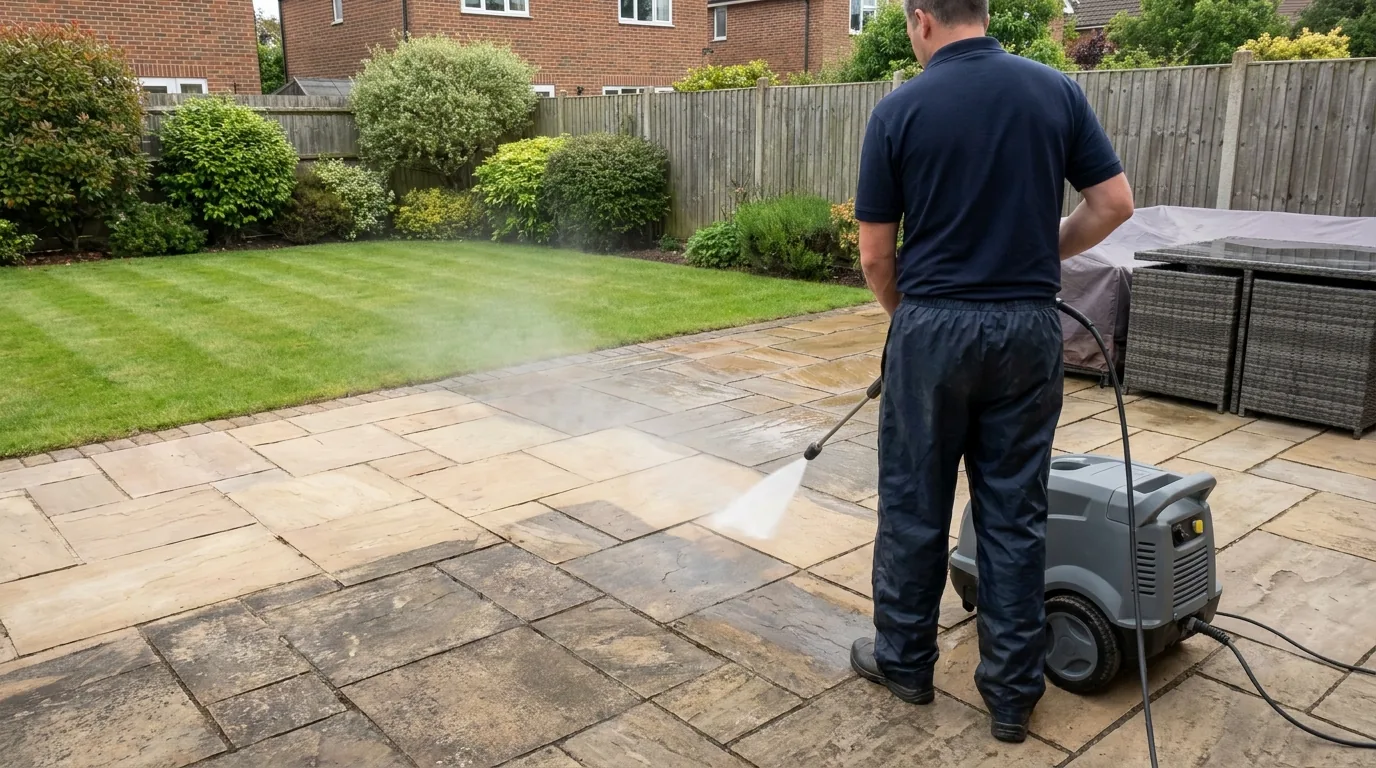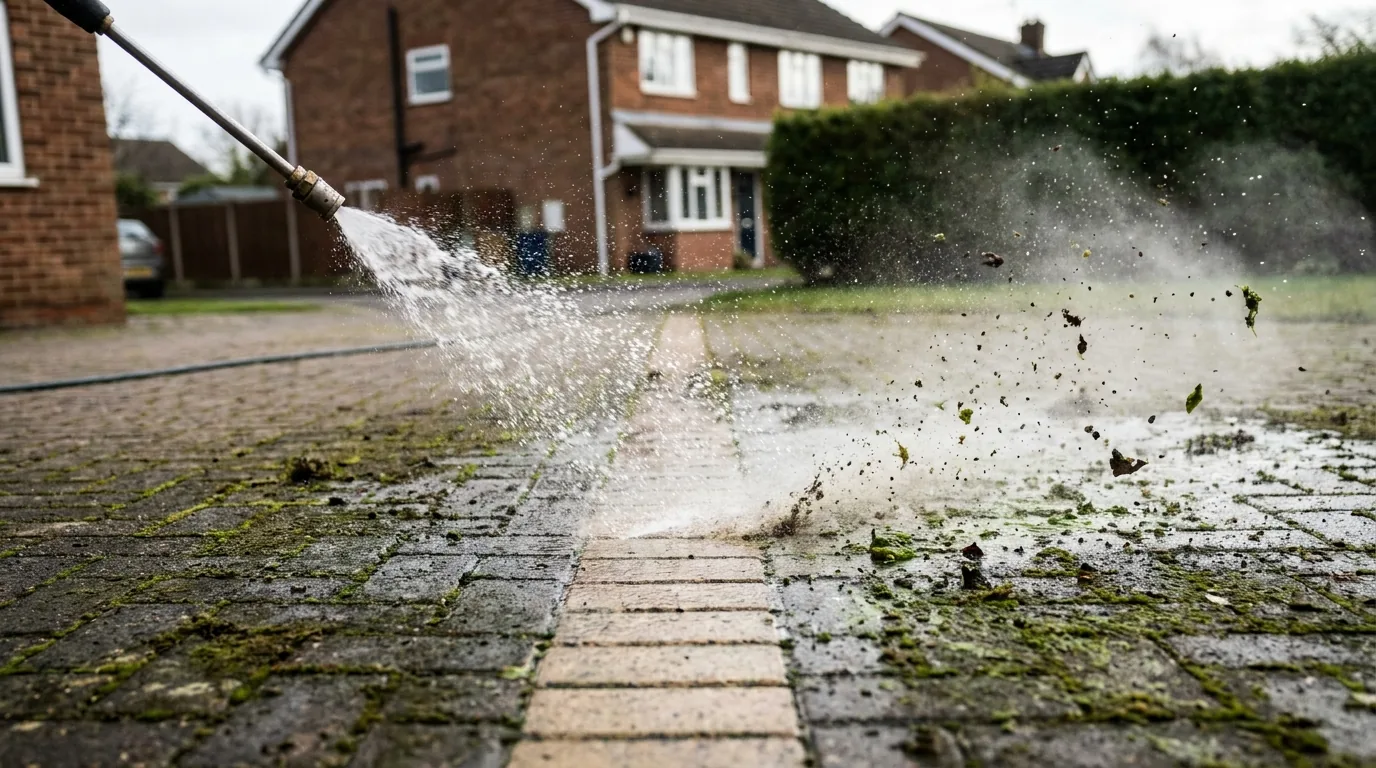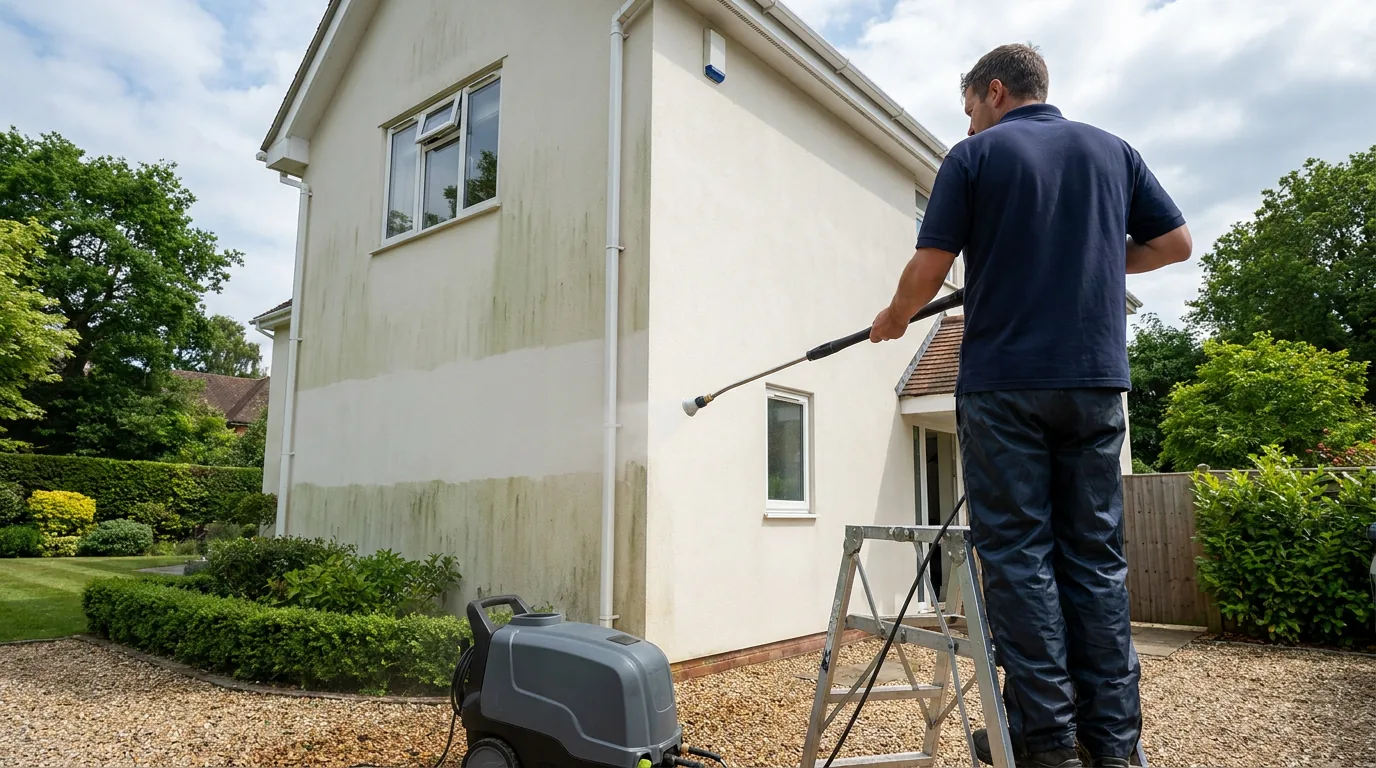
Why decking cleaning needs a per-timber pressure ceiling
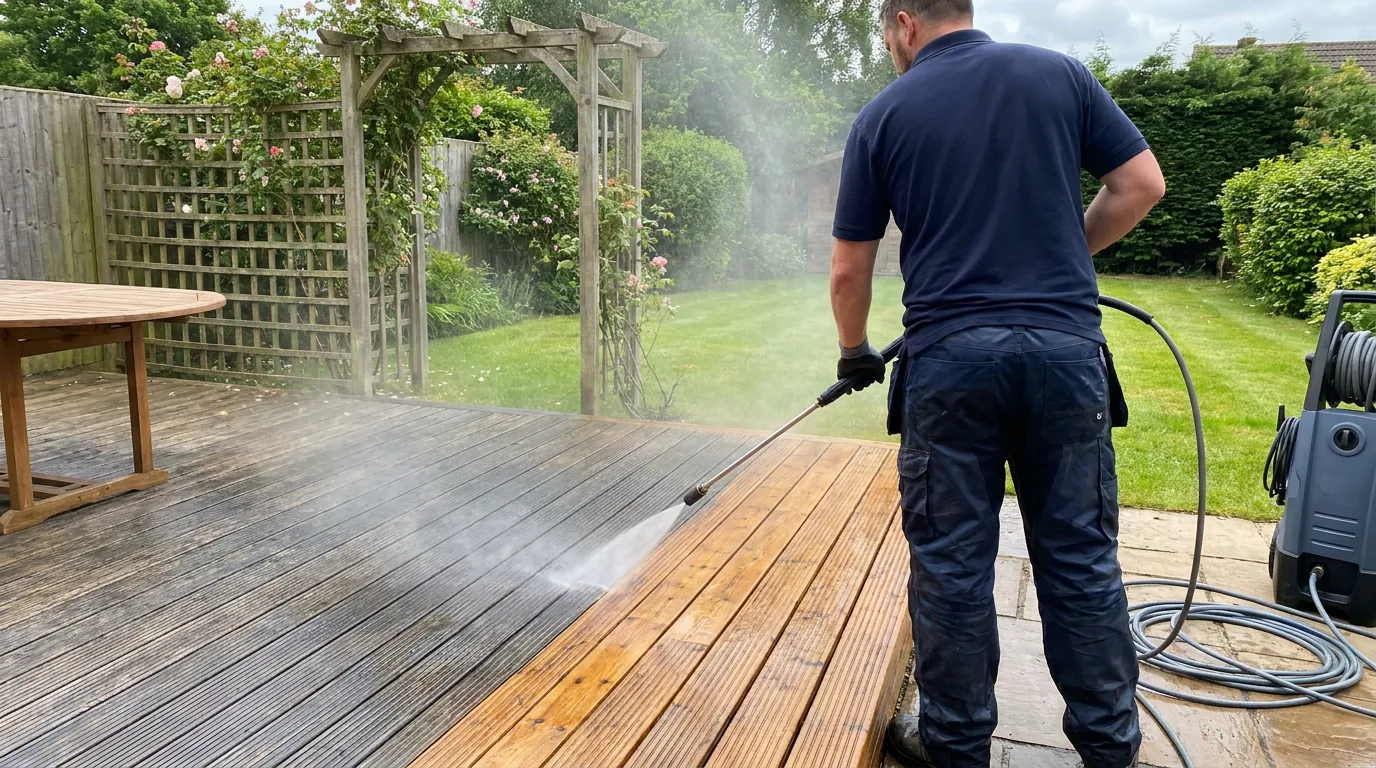
The short answer: Two mistakes ruin decking every time. First, too much pressure — soft pine on a Karcher K7-grade machine at 180 bar (~2,610 PSI)[2] at point-blank range comes off in furry strips. Second, washing across the grain instead of with it — raises the fibres and leaves it splintered. We use a pressure ceiling matched to the timber type and always work with the grain. The deck comes out smoother than it went in. Lithofin Algex[1] biocide handles the algae and lichen; PTV ≥36[3] is the slip-risk threshold because algae on wet decking is the most slippery garden surface.
The decking-cleaning timber-and-pressure matrix
Original analytical contribution: the labelled OAC below maps timber types against pressure ceiling, biocide cadence and key risks. No competitor publishes a per-timber pressure-ceiling matrix.
| Decking type | Pressure ceiling | Cadence | DIY damage risk |
|---|---|---|---|
| Softwood (pine, spruce, treated) | Low; well below Karcher K7 max | 12–18 months | Furry strips, raised grain, splintering |
| Hardwood (iroko, ipe, balau) | Medium; can tolerate more | 18–24 months | Surface marking; usually no oiling needed |
| Composite (Trex, Millboard, WPC) | Low; surface scuffs if pushed | 18–30 months | Visible scuffing; warranty risk on premium brands |
Met Office Wisley[4] 648 mm/yr rainfall baseline. Cadence figures reflect Surrey conditions on shaded north-facing decks; sunny sheltered decks stretch the upper range.
- Plants and garden protected before we start
- Specialist deck cleaner pre-treatment
- Wash with the grain at the right pressure for the wood
- Hand-detailing around posts and balusters
- Final rinse and full clear-up
- Honest assessment if it’s past saving
Decking we clean
Softwood (pine, spruce, treated)
The standard B&Q decking from the early 2000s. Soft, easy to over-pressure. We use the lowest setting that works.
Hardwood (iroko, ipe, balau)
The premium stuff. Tougher, takes a bit more pressure. Comes back to original colour beautifully — usually no oiling needed if it’s in reasonable shape.
Composite decking
Trex, Millboard and the Wickes/Wood Plastic equivalents. Lower pressure than wood — the surface scuffs if pushed. Algae and food stains lift off cleanly.
Oiling and staining after
If you want it oiled or stained, the deck has to be properly dry — 2–3 days of dry weather minimum. We can apply oil or stain ourselves as an extra, or you can DIY that part once we’re done. See our decking cleaning guide for the full maintenance schedule.
Areas we cover
Across all of Surrey within 20 miles of Redhill (RH1). That includes Redhill, Reigate, Horley, Dorking, Banstead, Caterham, and the rest of all 15+ areas.
Useful guides
Full decking guide · Pressure washing guide · Best time of year for outdoor cleaning
Slip-risk on garden decking
UKSRG / HSE pendulum guidance[3] sets PTV ≥36 as the low-slip threshold. Wet decking with algae is the most slippery garden surface in our radius — even on a sunny day, a deck below threshold can put someone in A&E. Annual Lithofin Algex[1] biocide treatment is the cadence we recommend for any household with children, older relatives or routine use.
Surrey context: cadence by aspect and shade
Met Office Wisley[4] 648 mm/yr Surrey rainfall baseline. Decking cadence is driven more by direct-sunlight exposure than postcode — an ipe deck in direct sun in a Reigate Hill garden goes 24+ months between cleans; the same deck in shade in the Mole Valley microclimate (Dorking, Betchworth) tightens to 12–15 months. The Marshalls medium-pressure technique[5] we use on paving is well above the pressure ceiling for any decking; it’s cited here as a reference baseline for what NOT to use on softwood.
Conservation-area constraints
Listed property in Surrey across RBBC[6], Mole Valley, Tandridge and Epsom & Ewell areas often includes period garden decking and balustrading. Soft-wash chemistry only on listed property — no pressure regardless of timber type.
Oiling, staining and the dry-down window
If you want it oiled or stained after the clean, the deck has to be properly dry — 2–3 days of dry weather minimum. In Surrey’s 648 mm/yr Wisley rainfall[4] climate that’s less reliable than it sounds, particularly in the Mole Valley microclimate. We can apply oil or stain ourselves as an extra, or you can DIY that part once we’re done. Either way, never apply a stain or oil to a damp deck — it traps moisture in the timber.
What we actually do on a decking job
- Identify timber type — softwood / hardwood / composite. The pressure ceiling from the matrix above sets the limit.
- Protect plants and garden before starting.
- Pre-treat algae and biofilm with Lithofin Algex[1] — biocide kills at root.
- Wash with the grain, never across it. Pressure within the timber-type ceiling.
- Hand-detail around posts and balusters.
- Walk again with the customer — reshoot anything not right. If the result isn’t right, we redo it free.
Sources
Every protocol on this page is sourced. Primary data and manufacturer technical guidance only.
- Lithofin AG — Algex Special Cleaner. Annual reapplication, preferably spring. lithofin.com — Algex. Accessed 21 May 2026.
- Kärcher — K7 consumer pressure washer datasheet. 180 bar (~2,610 PSI) — well above any decking pressure ceiling. kaercher.com — K7. Accessed 21 May 2026.
- UK Slip Resistance Group / HSE — Pendulum Tester. PTV ≥36 low risk. ukslipresistance.org.uk. Accessed 21 May 2026.
- Met Office — Wisley Long-Term Averages 1991–2020. metoffice.gov.uk — Wisley. Accessed 21 May 2026.
- Marshalls plc — Garden Paving & Driveways: Cleaning & Maintenance Guidelines. Reference baseline for paving pressure (NOT applicable to decking). marshalls.co.uk — guidelines (PDF). Accessed 21 May 2026.
- Reigate & Banstead Borough Council — Local Plan and conservation-area design policies. reigate-banstead.gov.uk — Local Plan. Accessed 21 May 2026.
- British Geological Survey — Chalk Group lithostratigraphy. Reference for the substrate-driven cadence framework applied to garden hardscape across the Surrey radius. bgs.ac.uk — Chalk Group. Accessed 21 May 2026.