Why block paving cleaning is fundamentally a re-sand job
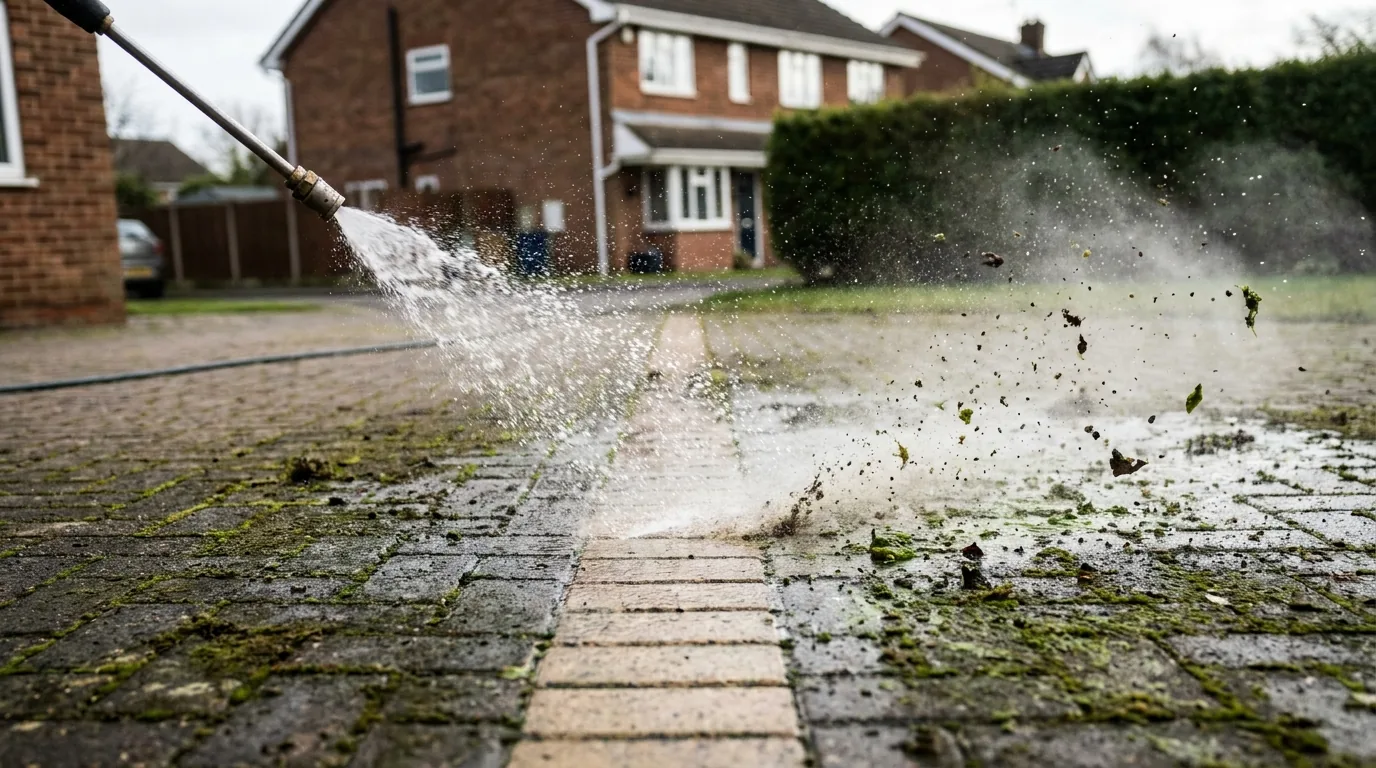
The short answer: BS 7533-101:2021[1] — the UK standard for modular paving construction — treats jointing sand as part of the structural load-transfer system. Pressure washing lifts the old sand out; without re-sanding, the blocks lose lateral support, weeds return within months, and rainwater starts washing the sand bed out from underneath. Tobermore[3] and Marshalls[2] manufacturer installation guidelines agree: kiln-dried sand re-fill is mandatory after any cleaning operation that disturbs joints. Plus the Marshalls medium-pressure / 30° oblique / ≥200 mm-standoff technique applies — turbo / dirt-blaster nozzles risk Marshalls Register warranty rejection.
The block-paving protocol matrix
Original analytical contribution: the labelled OAC below maps block-paving cleaning against substrate-driven cadence (chalk vs Lower Greensand vs Weald Clay), Marshalls warranty constraint, and sealing economics. Inputs are BS 7533-101 jointing-sand load-bearing[1], Marshalls technique[2], Tobermore installation guidelines[3], Resiblock manufacturer sealant lifespan[4], Lithofin Algex biocide cadence[5], UKSRG/HSE PTV[6], Met Office Wisley[7].
| Substrate (Surrey postcode) | Block-paving cadence | Re-sand | Seal cost & lifespan |
|---|---|---|---|
| Chalk (SM7 Banstead, CR3, CR5) | 18–24 months | Every clean (BS 7533-101[1]) | +£2–£3.50/m²; up to 5 yrs[4] |
| Lower Greensand (RH1 baseline, RH2 south) | 12–18 months | Every clean | +£2–£3.50/m²; up to 5 yrs |
| Weald Clay (RH6 Horley, RH10/RH11 Crawley) | 12–18 months | Every clean (joint sand washes out fastest) | Sealing more important on slow-draining clay |
| Mole Valley microclimate (RH4 Dorking, RH3 Betchworth) | 10–15 months | Every clean | Seal only in dry early-summer windows |
| Marshalls warranty constraint | Universal | Medium pressure, 30°, ≥200 mm, no turbo[2] | N/A |
Surrey cadence by substrate framework developed across our area pages (Banstead Cycle 18, Redhill Cycle 19, Horley Cycle 22, Crawley Cycle 23, Dorking Cycle 21, Betchworth Cycle 31).
What you get for the price
The thing that ruins block paving isn’t the dirt — it’s the missing sand. Pressure washing lifts the old jointing sand out, and most cheap quotes leave it that way. Six months later weeds are back, blocks are rocking, and rainwater is washing the sand bed out from underneath. We brush fresh kiln-dried sand into every joint as standard. That’s the difference between a clean drive and a properly restored one.
- Biocide moss & algae treatment
- Weed removal from joints (by the root)
- Surface-cleaner pass on the main slab
- Oil stain pre-treatment if needed
- Fresh kiln-dried sand brushed into every joint
- Final rinse and full clear-up
What we clean
Concrete block paving
The standard Surrey driveway from the 90s onwards. Cleans up beautifully, takes a fair pressure. Sand renewal is the bit that matters most.
Clay pavers
Older, harder-wearing, and the colour comes back even better than concrete. Same process — clean, re-sand, optional seal.
Tumbled / antique blocks
The rough-edged, distressed look. Slightly lower pressure to avoid roughing up the chamfered edges further.
Block paving patios
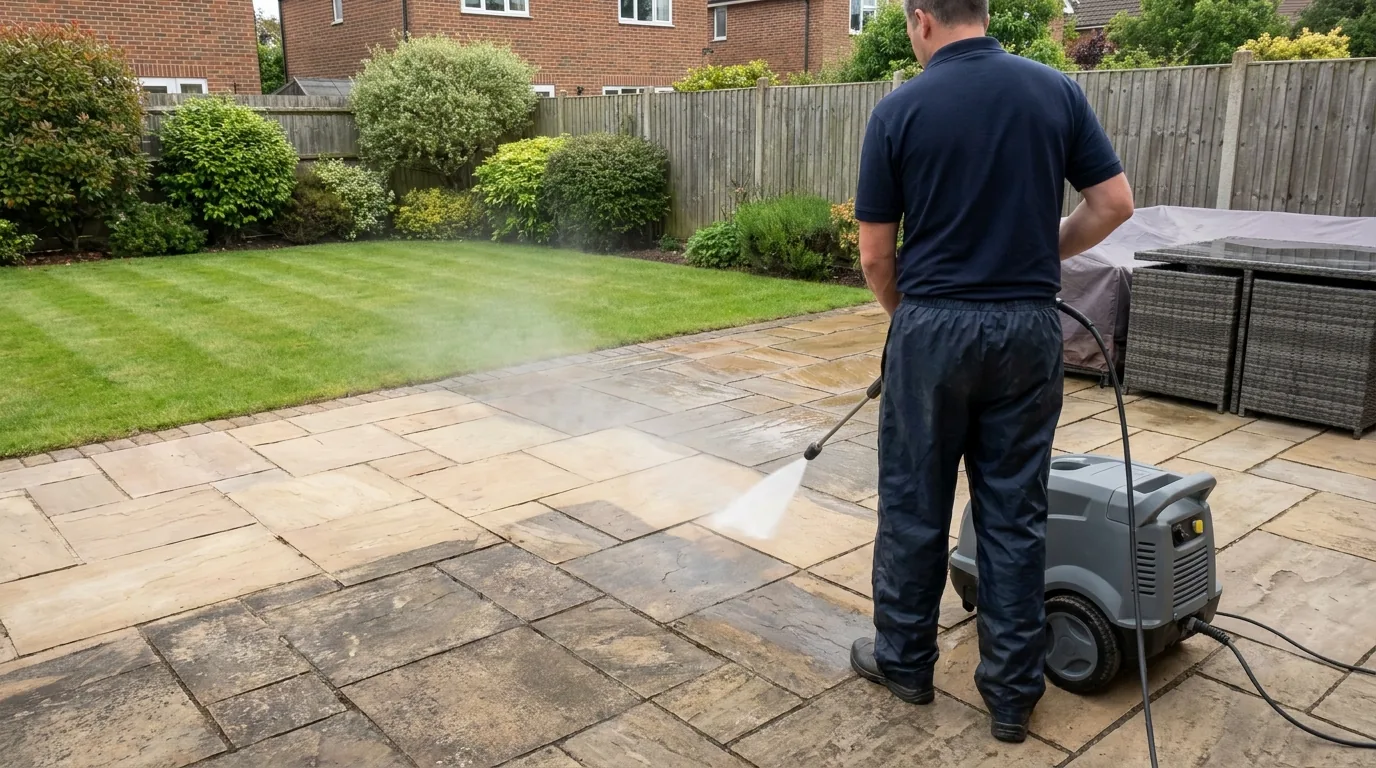
Same job, smaller area. Often combined with the rest of the garden patio — see patio cleaning if you have mixed surfaces.
Should you seal?
For most Surrey drives — yes. Sealing locks the sand in, brings the colour back to factory finish, and blocks oil and tyre marks from soaking in. Costs £2–£3.50 per m² on top of the clean. Read our block paving sealing guide for the full pros and cons.
Areas we cover
Across all of Surrey within 20 miles of Redhill (RH1). That includes Redhill, Reigate, Horley, Dorking, Banstead, Caterham, Godstone, Chipstead, and the rest of all 15+ areas.
Slip-risk and Marshalls Register warranty
HSE-endorsed UKSRG pendulum guidance[6] sets PTV ≥36 as the low-slip threshold. Moss and algae drop block paving below threshold by autumn on most shaded Surrey drives — annual Lithofin Algex[5] spring biocide is the cadence that keeps it above. Marshalls Register installs (Drivesett, Tegula, Symphony) carry warranty obligations that exclude turbo nozzles and excessive pressure: medium pressure, 30° oblique, ≥200 mm standoff[2]. Tobermore[3] manufacturer guidance aligns with the same principles for their range.
Met Office cadence baseline
Surrey rainfall baseline 648 mm/yr at Met Office Wisley[7] (the closest official station to most of our radius). That figure puts Surrey at ~43% drier than the UK 1,147 mm mean — which would suggest longer cadence than national averages, except substrate drainage + tree-canopy shade override the headline number. See our area pages for the per-postcode framework.
Useful guides
Full cost guide · Block paving sealing · Weed removal · Moss removal · Driveway types compared · Efflorescence
Sources
Every claim about block paving substrate cadence, BS-standard requirements, manufacturer protocols and slip thresholds on this page is sourced. Primary data and manufacturer technical guidance only.
- BSI — BS 7533-101:2021 “Pavements constructed with clay, concrete or natural stone paving units — Code of practice for the structural design of pavements using modular paving units.” Treats jointing material as part of the structural load-transfer system. bsigroup.com — BS 7533-101:2021. Accessed 21 May 2026.
- Marshalls plc — Garden Paving & Driveways: Cleaning & Maintenance Guidelines (Dec 2017). Medium pressure, 30° oblique, ≥200 mm standoff. marshalls.co.uk — guidelines (PDF). Accessed 21 May 2026.
- Tobermore — Installation Guidelines for Block Paving (Professional). tobermore.co.uk — professional installation (PDF). Accessed 21 May 2026.
- Resiblock — Block paving sealer technical data sheets. Manufacturer-stated lifespan up to 5 years. resiblock.com. Accessed 21 May 2026.
- Lithofin AG — Algex Special Cleaner. Annual reapplication, preferably in spring. lithofin.com — Algex. Accessed 21 May 2026.
- UK Slip Resistance Group / HSE — Introduction to the Pendulum Tester. PTV ≥36 low risk. ukslipresistance.org.uk. Accessed 21 May 2026.
- Met Office — Wisley Long-Term Averages 1991–2020. Annual rainfall 648.41 mm. metoffice.gov.uk — Wisley. Accessed 21 May 2026.