- Best method: biocide first, pressure wash 24–48 hours later
- Professional cost: £3–£7 per m² (£60–£280 typical)
- DIY biocide: £10–£25 per 5L (Algon, Wet & Forget, Pro-Kleen)
- Combined treatment lasts 6–12 months before regrowth
- Wet algae is the leading slip hazard on UK residential surfaces
The quick answer: kill the algae with a quaternary ammonium biocide, leave it 24–48 hours, then pressure wash off the dead growth. Pressure washing on its own only takes off the top layer — the roots are still in there and the green is back inside a few weeks. Combine the two and you get 6–12 months clean.
Green algae is the single most common reason Surrey homeowners pick up the phone to a pressure washing company. The UK climate, plus shade from trees and buildings, makes almost every outdoor surface a candidate. It looks awful, but the real problem is the slip hazard. This guide covers what causes it, how to remove it properly, what it costs, and how to keep it off.
What causes green algae on driveways and patios?
Algae is a simple plant that needs three things to thrive: moisture, shade, and organic matter. The UK supplies all three for most of the year. North-facing drives, areas under trees, and spots near fences or walls that trap moisture are the worst affected.
- Moisture — UK rainfall keeps surfaces damp for much of the year. Anywhere that doesn’t dry between showers is a candidate.
- Shade — direct sunlight inhibits algae through UV and drying. Less than four hours of sun a day and you’re at risk.
- Nutrients — decomposing leaves, soil, bird droppings, atmospheric dust. Algae feeds on all of it.
Which surfaces are most affected
Some surfaces hold algae far more readily than others.
| Surface | Algae risk | Why |
|---|---|---|
| Indian sandstone | Very high | Highly porous, rough texture traps spores |
| Concrete slabs | High | Porous, especially older weathered concrete |
| Tarmac | High | Textured, dark colour holds moisture |
| Block paving | High | Joints harbour moisture and organic matter |
| Limestone | Moderate-high | Porous but smoother than sandstone |
| Porcelain | Low | Non-porous, algae can’t grip |
| Resin bound | Low-moderate | Good drainage reduces standing moisture |
In Surrey, the combination of tree-lined streets, clay soil, and moderate rainfall makes algae growth particularly common. Properties round Mole Valley near Dorking and along the North Downs are especially prone — damp microclimate, heavy tree cover.
What are the best treatment options?
Three approaches, very different effectiveness.
1. Biocide treatment (best long-term)
Chemical treatment that kills biological growth at the cellular level. Penetrates the root, reaches into the porous stone — somewhere a pressure washer can’t.
- How it works: dilute per the label, apply with a sprayer or watering can, leave it. Dead growth turns brown over 1–2 weeks and rain washes most of it away.
- Popular UK products: Algon Organic Path & Patio Cleaner, Wet & Forget, Pro-Kleen Patio Cleaner, Smartseal Algae Remover.
- Lasts: 3–12 months depending on product and exposure.
- Cost: £10–£25 per 5L (treats 50–200 m² depending on dilution).
- Best for: prevention, light to moderate growth, surfaces you can’t pressure wash.
2. Pressure washing (best immediate)
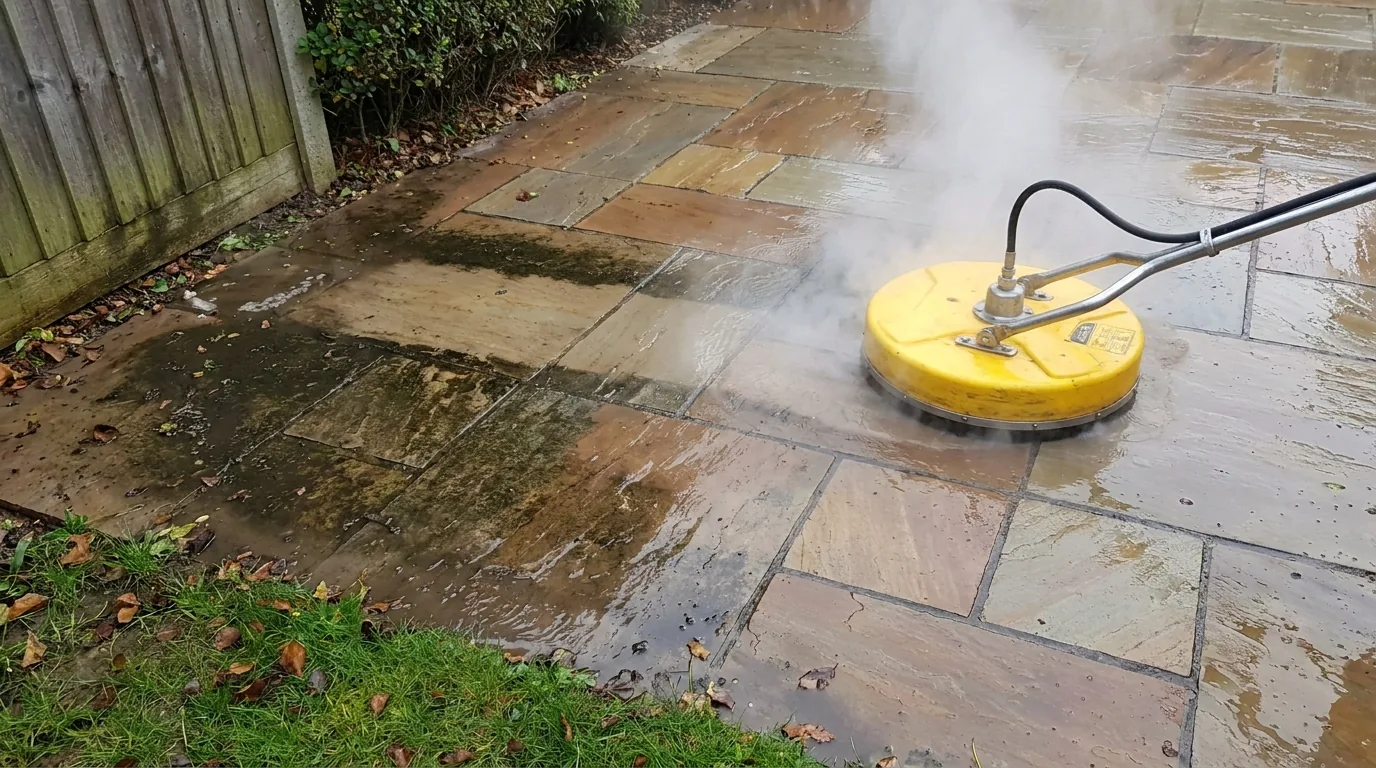
Physically blasts the algae off the surface. Instant visible results, but the roots embedded in porous surfaces survive, so it grows back faster.
- Effectiveness: 90–100% of visible growth gone, immediately.
- Lasts: 4–8 weeks alone (roots regrow).
- Best for: heavy growth that has to come off now.
Pressure has to match the surface. Sandstone and limestone need lower pressure (1500–2000 PSI). Concrete and block paving handle higher (2500–3000 PSI). The pressure washing damage guide covers settings by surface in detail.
3. Biocide + pressure wash (best overall)
The professional approach combines both for the best immediate finish AND the longest-lasting result:
- Apply biocide to the whole surface, leave 24–48 hours.
- Pressure wash to lift the dead growth and surface dirt.
- Optional second biocide pass for maximum prevention.
Combined treatment keeps surfaces algae-free for 6–12 months — significantly longer than either method alone. It’s our standard approach on the driveway cleaning and patio cleaning service.
4. Household remedies
If you’re on a budget or sorting out a small area:
- Diluted bleach (1:10): kills on contact, no residual protection. Rinse thoroughly to protect nearby plants.
- White vinegar: mildly effective on light algae. Apply neat, leave 30 minutes, scrub, rinse.
- Boiling water: kills surface algae but doesn’t reach the roots. Tiny areas only.
- Soda crystals: dissolve in hot water, apply, scrub, rinse. Moderate effectiveness.
How much does professional algae removal cost?
Professional algae removal includes biocide pre-treatment AND pressure washing. Standard 2026 prices.
| Area | Light algae | Heavy algae |
|---|---|---|
| Small patio (10–15 m²) | £50–£90 | £80–£130 |
| Medium patio (15–30 m²) | £80–£160 | £120–£220 |
| Standard drive (30–50 m²) | £100–£250 | £150–£350 |
| Large drive (50–80 m²) | £170–£400 | £250–£560 |
Heavy growth costs more because it needs stronger biocide concentrations, longer treatment times, and more passes with the surface cleaner. Surface type matters too — natural stone takes more care than concrete. Full pricing breakdown in the patio cleaning cost guide and driveway cleaning cost guide.
How do you prevent algae from coming back?
Total prevention is impossible in the UK. But these measures slow it down significantly.
Reduce moisture
- Improve drainage: clear blocked drains, make sure water runs off rather than pooling.
- Fix gutters: overflowing gutters dump water onto the drive and create permanently damp zones.
- Address standing water: low spots that puddle are algae hotspots.
Increase sunlight and airflow
- Trim overhanging branches: more sunlight, faster drying, UV inhibits algae.
- Cut back shrubs: dense planting against walls traps moisture.
- Remove leaf litter: leaves hold moisture and feed algae.
Preventative treatments
- Biocide every 6–12 months: a preventative spray before autumn keeps algae from establishing over winter. Cheaper and easier than removal.
- Surface sealing: sealing porous surfaces (sandstone, concrete, limestone) reduces moisture absorption. See the sealing cost guide.
- Regular sweeping: removing leaves, soil, bird mess starves algae of nutrients.
Preventative biocide schedule
| When | Action | Purpose |
|---|---|---|
| September–October | Apply biocide | Kill early growth before winter |
| March–April | Inspect and spot-treat | Catch anything that survived |
| June–July | Optional booster | Extended summer protection (shaded only) |
Algae vs moss vs lichen — what’s the difference?
People mix these three up. Treatment differs slightly.
- Algae: thin, green, slippery film. The most common UK growth. Responds well to biocide + pressure wash. Worst slip hazard.
- Moss: thicker, raised green cushions, especially in joints. Common on block paving and shaded areas. Needs scraping or vigorous scrubbing before pressure washing — the moss removal guide covers it.
- Lichen: flat, crusty patches in grey, yellow, orange, or black. Slow-growing but stubborn. Needs specialist lichen remover and 24–72 hours treatment time. Common on sandstone.
Most cleaning services treat all three as part of a standard clean. If your problem is mostly lichen (the black spots on Indian sandstone), mention it when you’re getting quotes — different products, longer dwell time.
Is green algae on a driveway dangerous?
Green algae is the leading cause of slip injuries on UK residential hard surfaces. When wet, an algae-covered drive or patio is as slippery as ice.
- Slip and fall injuries — especially serious for elderly residents, children, and visitors.
- Vehicle traction — heavy algae on a sloped drive can cause vehicles to lose grip.
- Liability — you can be liable if a delivery driver or postal worker is injured on a neglected surface.
- Property value — visible algae kills kerb appeal.
For households with elderly residents or young children, regular algae treatment counts as essential maintenance, not cosmetic.
Areas we cover
We work right across Surrey within 20 miles of Redhill (RH1) — Redhill, Reigate, Horley, Dorking, Banstead, Epsom, Crawley, and all 15+ areas.
Original analysis and sources
Original analytical contribution: Algae control in Surrey is a shade-and-biocide problem, not a rainfall problem. Wisley records 648mm/yr[1], 43% drier than the UK average — the dominant 'damp UK' framing for algae regrowth doesn't apply to RH1. Manufacturer-cited maintenance: Lithofin Algex annual spring application[2]. Post-clean wet-PTV ≥36 per HSE[4] is the safety threshold that turns algae from cosmetic into foreseeable hazard.
Key sourced claims in this guide: Surrey rainfall baseline 648 mm/yr per Met Office Wisley[1], annual biocide cadence per Lithofin Algex manufacturer guidance[2], medium-pressure / 30° oblique / ≥200 mm-standoff technique per Marshalls[3], HSE-endorsed slip-risk methodology[4], and PTV ≥36 low-slip threshold from UKSRG pendulum-test guidance[5].
Sources
Every numeric claim, technique parameter, and safety threshold in this guide is sourced from a manufacturer technical bulletin, BS standard, or .gov.uk reference. We cite the bodies whose data and rules actually govern UK pressure-washing outcomes — not the unsourced ranges repeated across competitor blogs.
- Met Office — Wisley (Surrey) Location Long-Term Averages 1991–2020. Closest Met Office station to RH1. Annual rainfall 648.41 mm; Surrey is ~43% drier than the UK national mean of ~1,147 mm. metoffice.gov.uk — Wisley averages. Accessed 21 May 2026.
- Lithofin — ALGEX Special Cleaner product page. Manufacturer guidance: spray annually, preferably in spring. 6–12 month residual activity. lithofin.com — ALGEX. Accessed 21 May 2026.
- Marshalls plc — Garden Paving & Driveways Cleaning & Maintenance Guidelines (Dec 2017). Technique: medium pressure, 30° lance, 200mm minimum standoff. marshalls.co.uk — cleaning guidelines (PDF). Accessed 21 May 2026.
- Health and Safety Executive (HSE) — Slips and trips at work. HSE-preferred slip-risk methodology; PTV ≥36 wet-acceptance threshold. hse.gov.uk — slips and trips. Accessed 21 May 2026.
- UK Slip Resistance Group — Introduction to the Pendulum Tester (BS 7976: Parts 1-3). PTV ≥36 = low slip risk threshold for outdoor pedestrian surfaces. ukslipresistance.org.uk — pendulum tester. Accessed 21 May 2026.
- Kärcher — K7 consumer pressure washer manufacturer datasheet. 180 bar (~2,610 PSI), 600 L/hr. kaercher.com — K7 product page. Accessed 21 May 2026.
- BSI — BS 7533-101:2021 Code of practice for modular paving units. Treats jointing material as load-transfer system. bsigroup.com — BS 7533-101:2021. Accessed 21 May 2026.
- Resiblock Ltd — Block Paving Sealer Product Data Sheets. Manufacturer-stated lifespan up to 5 years. resiblock.com — technical data sheets. Accessed 21 May 2026.
- UK Government (gov.uk) — National Living Wage rates from April 2026: £12.71/hr (age 21+). The legal floor for valuing UK labour and DIY time. gov.uk/national-minimum-wage-rates. Accessed 21 May 2026.
- Thames Water — 2026/27 Charges. Combined water + wastewater rate £4.21/m³. thameswater.co.uk — bill value. Accessed 21 May 2026.