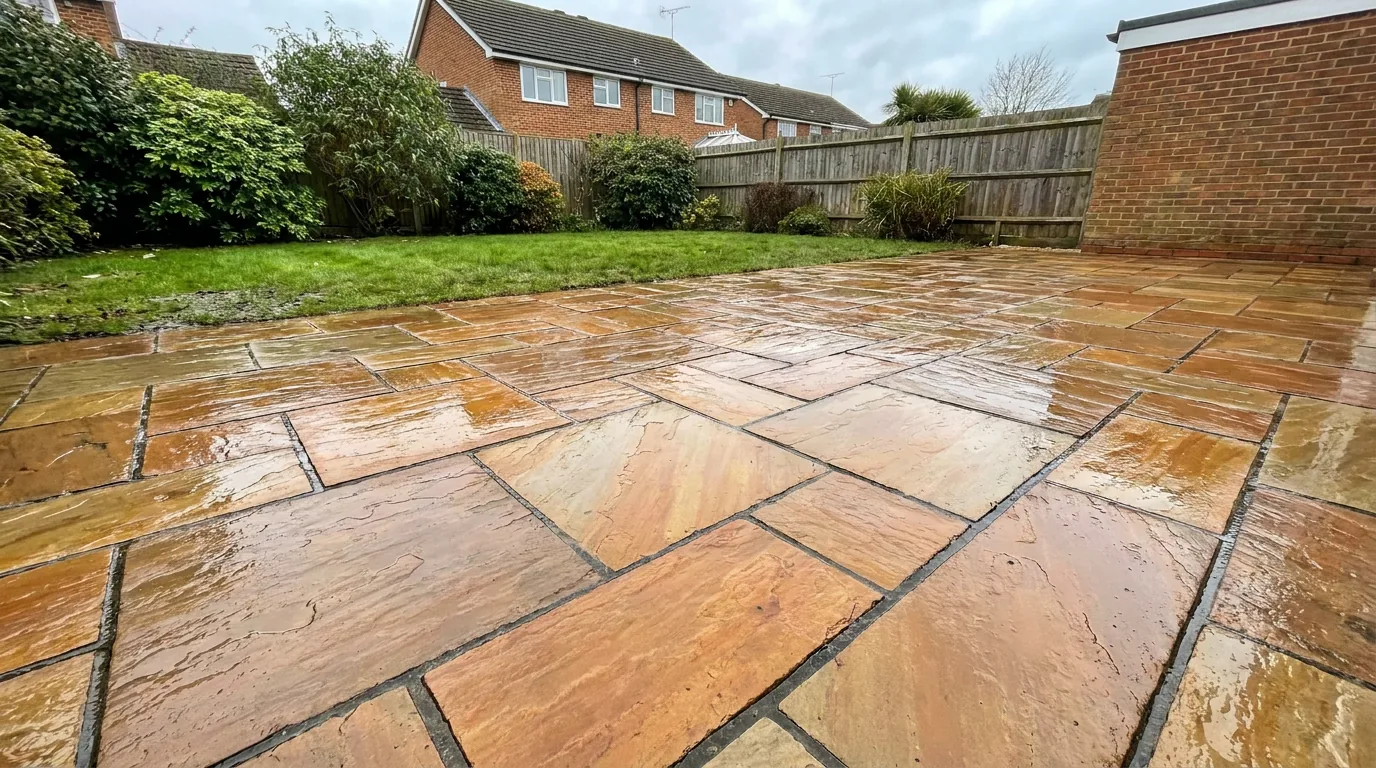
Professional pressure washing transforms surfaces immediately — you'll see dramatic improvement within minutes as years of dirt wash away. However, final results appear 24-48 hours later once surfaces fully dry and mineral deposits settle. Expect 70-90% restoration of original appearance depending on surface age and condition, with results lasting 12-24 months before gradual re-soiling requires maintenance.
Understanding realistic expectations prevents disappointment and helps you plan maintenance schedules. This guide covers immediate transformation, settling periods, surface-specific timelines, and longevity factors based on professional cleaning of thousands of UK driveways, patios, and exterior surfaces.
What Results Can You Expect by Surface Type?
Results vary significantly by surface material, age, and contamination level. This table shows realistic expectations for professional pressure washing with appropriate cleaning solutions:
| Surface Type | Immediate Result (0-2 hours) | 24-Hour Result | 1-Week Result | Expected Longevity |
|---|---|---|---|---|
| Block Paving | 80-90% cleaner, wet appearance, visible joint sand displacement | Full colour restoration, some white haze possible (efflorescence) | Haze cleared, final colour settled, joints may need re-sanding | 12-18 months (north-facing), 18-24 months (south-facing) |
| Concrete (smooth) | 70-85% cleaner, oil stains faded but visible | Uniform appearance, slight darkening as surface dries completely | Final colour stable, minor stains may still be visible | 18-24 months, longer if sealed |
| Tarmac | Surface dirt removed, aggregate exposed, black colour restored | Consistent dark appearance, slight texture variation normal | Stable appearance, some oil stain shadows may remain | 12-18 months, deteriorates faster in high-traffic areas |
| Decking (wood) | Green algae/mould removed, wood grain visible, appears lighter | Natural wood colour emerges, some furring (raised grain) normal | Colour stabilises, may appear silvery (natural weathering) | 12-15 months, re-oils/stains recommended for protection |
| Render/Pebbledash | Black streaks/algae removed, original colour visible | Uniform colour, may reveal previously hidden cracks | Final appearance stable, paint condition may require touch-up | 18-36 months (depends on exposure and quality of paint) |
| Patio Slabs (natural stone) | 70-80% cleaner, natural colour/texture visible | Full restoration of natural hues, some staining may persist | Colour fully developed, white efflorescence possible on first clean | 18-24 months, sealing extends to 24-36 months |
Note: Results assume professional equipment (2000-3000 PSI), appropriate cleaning solutions, and surfaces in reasonable condition (not severely damaged or worn beyond surface cleaning).
Based in Surrey? Spring is our busiest season — get a free quote before slots fill up.
Or call 01737 652 515
What Happens During and Immediately After Pressure Washing?
The most dramatic transformation occurs within the first 30-60 minutes of cleaning. High-pressure water combined with specialist cleaning solutions strips away:
- Surface dirt and grime accumulated over months or years
- Organic growth (moss, algae, lichen) down to root structures
- Light oil stains from vehicles (heavy stains require multiple treatments)
- Atmospheric pollution deposited from traffic and industry
- Loose debris from joints, cracks, and textured surfaces
Immediately after cleaning, surfaces appear darker due to water saturation. This "wet look" is temporary — expect 2-4 hours drying time in good weather (longer in damp or cold conditions).
Why Surfaces Look Different When Wet vs. Dry
Water fills surface pores and creates a reflective layer that darkens appearance and masks minor imperfections. As surfaces dry, true colour and texture emerge. Porous materials like concrete and block paving show the most dramatic colour shift between wet and dry states.
For accurate before/after comparison, photograph surfaces when completely dry (ideally 24 hours post-cleaning on a dry day).
Why Do Results Look Better After 24-48 Hours?
The settling period reveals final results as several processes complete:
1. Complete Drying and Colour Development
Porous surfaces like concrete and block paving absorb significant water during cleaning. As this moisture evaporates over 12-24 hours, original colours fully develop. Natural stone patios and textured concrete show the most improvement during this phase.
2. Cleaning Solution Residue Breakdown
Biodegradable cleaning solutions continue working for 12-24 hours post-application, breaking down remaining organic matter and stains. This extended action lightens stubborn marks and ensures moss/algae roots are killed to prevent rapid regrowth.
3. Mineral Deposit Settlement (Efflorescence)
White powdery deposits sometimes appear 24-48 hours after cleaning, particularly on concrete and block paving. This is efflorescence — mineral salts drawn out from within the material as it dries. While alarming, it's harmless and temporary:
- Cause: Deep cleaning removes surface sealant and allows water to penetrate pores, drawing out calcium and salt deposits
- Duration: 1-2 weeks, naturally washed away by rain
- Acceleration: Light misting and brushing with stiff broom once surface is dry
- Prevention: More common in newer paving (under 5 years old); older surfaces have fewer residual salts
4. Joint and Texture Restoration
High-pressure cleaning temporarily displaces joint sand and loose material. Over 24-48 hours, remaining material settles into place. Block paving joints often require re-sanding after drying to restore full stability and weed resistance.
How Long Will My Pressure Washing Results Last?
Longevity depends on multiple interacting factors. Understanding these helps set realistic expectations and plan maintenance schedules.
Block Paving: 12-24 Months
Fastest deterioration: North-facing areas, under tree cover, poor drainage. Longest lasting: South-facing, well-drained, sealed surfaces. Primary enemy: Moss in joints, accelerated by moisture and shade.
Concrete: 18-24 Months
Fastest deterioration: High-traffic vehicle areas (oil accumulation), porous finishes. Longest lasting: Sealed surfaces, smooth finishes, covered areas. Primary enemy: Oil stains from vehicles, requires immediate treatment.
Decking: 12-15 Months
Fastest deterioration: Shaded areas, poor ventilation underneath, untreated wood. Longest lasting: Regular treatment with decking oil/stain, good airflow. Primary enemy: Moisture-loving algae and mould, accelerated by organic debris.
Environmental Impact on Longevity
- Sun exposure: South-facing surfaces stay drier, reducing moss/algae growth (18-24 months). North-facing areas remain damp longer, accelerating organic growth (12-15 months)
- Tree coverage: Falling leaves deposit organic matter and shade surface, promoting growth. Expect 30-40% shorter intervals under mature trees
- Drainage: Standing water or poor runoff creates ideal conditions for algae. Well-drained surfaces last 6-12 months longer
- Local climate: Wet UK regions (Wales, Scotland, South West) see faster regrowth than drier areas (East Anglia, South East)
- Air quality: Urban areas accumulate atmospheric pollution faster, creating darker staining on render and paving
Extending Results with Post-Cleaning Treatment
Professional treatments applied after pressure washing significantly extend longevity:
- Sealant application (block paving, concrete): Creates protective barrier against moisture, stains, and organic growth. Extends intervals from 12-18 months to 24-36 months. Costs typically 30-50% of cleaning price
- Biocide treatment (all surfaces): Kills moss/algae spores and prevents regrowth for 12-18 months. Particularly effective on render and decking
- Joint re-sanding (block paving): Prevents weed growth and stabilises surface. Use kiln-dried jointing sand for best results
- Decking oil/stain (wood surfaces): Protects from UV damage and moisture penetration. Reapply every 12-18 months for best protection
Learn more about protecting your investment in our guide: Driveway Cleaning & Sealing Cost
What Pressure Washing Cannot Fix
Setting realistic expectations means understanding the limitations of pressure washing. Some issues require additional treatments or indicate surface replacement:
Structural Damage
- Deep cracks in concrete/tarmac: Cleaning makes cracks more visible but doesn't repair them. Requires filling or resurfacing
- Loose or sunken block paving: Indicates base layer failure. Requires lifting, re-levelling, and re-laying
- Rotted decking boards: Pressure reveals extent of rot but cannot reverse structural weakness. Replace damaged boards before cleaning
Deep Staining
- Penetrated oil stains (years old): May require multiple treatments or specialised degreasing. Surface will improve but might not fully restore
- Rust staining from metal objects: Requires acid-based rust removers, not standard pressure washing
- Paint spills on porous surfaces: May require grinding or chemical stripping rather than pressure alone
Surface Wear and Age
- Worn or polished tarmac: Cleaning cannot restore lost aggregate or texture
- Faded coloured block paving: UV damage cannot be reversed, only enhanced with sealant. Original vibrancy won't fully return
- Weathered render with flaking paint: Pressure may remove loose paint, requiring repainting after cleaning
Professional assessment identifies issues requiring additional treatment. We provide honest evaluations and alternative solutions when cleaning alone won't achieve desired results.
How Can You Maximise Your Pressure Washing Results?
Professional pressure washing delivers optimal results, but timing and preparation improve outcomes:
Optimal Timing for Best Results
- Spring (March-May): Ideal temperature range (10-18°C), removes winter buildup before growth accelerates, rapid drying
- Autumn (September-October): Removes summer growth before winter, prepares surfaces for gritting season, still-moderate temperatures
- Avoid midsummer: Cleaning solutions evaporate too quickly in high heat (above 25°C), reducing effectiveness
- Avoid midwinter: Slow drying (6-12 hours), risk of freeze damage in surface pores, reduced solution effectiveness below 5°C
For a detailed seasonal guide, read our best time for patio cleaning article.
Pre-Cleaning Preparation
- Clear surfaces: Remove vehicles, furniture, plant pots to allow complete coverage
- Trim vegetation: Cut back overhanging plants and weeds along edges for thorough cleaning
- Identify problem areas: Mark stubborn stains or damage for specialist attention
- Check drainage: Clear blocked drains to prevent standing water during cleaning
- Protect sensitive plants: Water plants thoroughly before cleaning and cover delicate specimens
For full preparation steps, see our prepare your driveway for pressure washing guide.
Post-Cleaning Maintenance
Simple maintenance extends results significantly:
- Sweep regularly: Remove leaves and debris weekly to prevent organic buildup
- Spot-clean spills: Treat oil stains immediately with absorbent cat litter and degreaser
- Improve drainage: Address standing water with channel drains or re-grading
- Trim overhanging trees: Increase sunlight exposure to reduce moss/algae growth
- Annual maintenance wash: Light cleaning every 12 months prevents heavy buildup requiring intensive treatment
How Does Weather Affect Pressure Washing Results?
Weather before, during, and after cleaning significantly impacts effectiveness and longevity:
Pre-Cleaning Weather Considerations
- Recent rain (1-2 days prior): Softens dirt and organic growth, improving cleaning efficiency. Ideal condition
- Prolonged dry spell: Hardens dirt and requires stronger solutions or pre-soaking. Not ideal but manageable
- Frost or snow: Postpone cleaning until surfaces thaw completely and temperatures stabilise above 5°C for 48 hours
During Cleaning Weather Requirements
- Temperature: Optimal 10-20°C. Below 5°C reduces solution effectiveness. Above 25°C causes rapid evaporation
- Wind: Light breeze (5-15 mph) aids drying. Strong wind (20+ mph) causes overspray and uneven solution application
- Rain: Active rain dilutes cleaning solutions and prevents proper dwell time. We reschedule if rain is forecast during treatment
Post-Cleaning Weather Impact
- First 24 hours critical: Dry weather allows surfaces to settle properly. Rain within 12 hours can wash away cleaning solutions before full effectiveness
- 48-hour dry period optimal: Allows complete drying, efflorescence to develop and clear, and biocide treatments to bond with surface
- First week: Normal rainfall acceptable and beneficial (helps clear efflorescence). Heavy storms may require re-sanding block paving joints
We monitor 5-day forecasts and reschedule when conditions aren't optimal to ensure you get the best possible results.
Will DIY Pressure Washing Achieve the Same Results?
Consumer-grade pressure washers (1300-2000 PSI) can clean surfaces, but results differ significantly from professional service:
| Factor | DIY Pressure Washing | Professional Pressure Washing |
|---|---|---|
| Pressure | 1300-2000 PSI (consumer grade) | 2000-4000 PSI (commercial grade, adjustable) |
| Cleaning solutions | Often none or general-purpose only | Surface-specific, professional strength, eco-friendly |
| Time required | 3-6 hours for average driveway | 1-2 hours for average driveway |
| Results | 60-70% improvement, uneven coverage common | 80-95% improvement, uniform coverage |
| Risk | Surface damage from incorrect technique | Minimal, trained operators adjust for surface type |
| Longevity | 6-12 months (surface cleaning only) | 12-24 months (deep cleaning + treatments) |
| Cost | £100-200 equipment hire + solutions | £150-400 depending on size and services |
Professional cleaning delivers superior results through specialised equipment, surface-specific solutions, and trained technique. While DIY saves money upfront, frequent re-cleaning requirements and risk of damage often make professional service more cost-effective long-term. Compare your options: DIY vs Professional Pressure Washing
What Results Can You Expect from Specific Services?
Different surfaces and services produce varying results. Here's what to expect from specialist services:
Driveway Pressure Washing
Driveways face the harshest conditions — vehicle traffic, oil leaks, tyre marks, and weathering. Professional cleaning typically achieves:
- 80-90% removal of surface dirt and organic growth
- 50-70% reduction in oil stain visibility (deep stains may remain faint)
- Restoration of original colour (within surface wear limitations)
- 12-18 month longevity unsealed, 24-36 months when sealed
Block paving driveways show the most dramatic transformation, while older concrete driveways with years of oil staining may still show faint shadows even after professional treatment. See our driveway cleaning cost UK guide for pricing.
Patio Pressure Washing
Patios typically have less contamination than driveways but often more stubborn organic growth due to shade and moisture:
- 90-95% removal of moss, algae, and lichen
- Full restoration of natural stone colours and textures
- Minimal staining compared to driveways (mostly organic, not oil-based)
- 18-24 month longevity, longer if well-drained and sun-exposed
Natural stone patios benefit most from professional cleaning, revealing colours and patterns hidden under years of growth. See our patio cleaning cost UK guide for pricing.
Render and Wall Cleaning
Exterior walls develop black streaks (algae), green patches (moss), and atmospheric staining:
- 95-100% removal of organic growth (algae, moss, lichen)
- 80-90% reduction in atmospheric staining
- May reveal underlying paint condition, cracks, or damage
- 24-36 month longevity due to vertical surface shedding water
Soft washing (low pressure + specialised solutions) protects render while removing years of buildup without damage.
Decking Restoration
Wood decking requires careful low-pressure cleaning to avoid damage:
- 90-100% removal of green algae and black mould
- Restoration of natural wood grain and colour
- Surface brightening (silvering reversed)
- 12-15 month longevity, or 24+ months with post-clean oil/stain treatment
Some "furring" (raised wood grain) is normal after cleaning and sands smooth before re-oiling.
Do Results Vary by Location in the UK?
Regional climate significantly affects both cleaning results and longevity:
Wet Regions (Wales, Scotland, North West, South West)
- Challenges: Higher rainfall promotes faster moss/algae regrowth, longer drying times (4-6 hours typical), more frequent cleaning needed
- Typical intervals: 12-15 months for driveways, 10-12 months for shaded patios
- Benefits: Natural rainfall helps clear efflorescence faster, less dust accumulation
Drier Regions (East Anglia, South East, London)
- Challenges: More atmospheric pollution (urban areas), dust accumulation, UV fading of coloured surfaces
- Typical intervals: 15-18 months for driveways, 18-24 months for patios
- Benefits: Faster drying (2-3 hours), less moss/algae growth, more predictable scheduling
Surrey sits in the drier South East, which means generally longer-lasting results. We adjust our cleaning approach, solution strength, and treatment recommendations based on your local conditions for optimal results.
Frequently Asked Questions
How long does pressure washing take to dry completely?
Most surfaces dry within 2-4 hours in good weather conditions (dry, mild temperatures with gentle breeze). Block paving and porous concrete may take 4-6 hours due to water penetrating joints and pores. In humid or cold conditions, drying can extend to 8-12 hours. For fastest drying, schedule cleaning on dry, breezy days with temperatures above 10°C. The surface is safe to walk on immediately after cleaning, though it will be slippery until fully dry.
Will pressure washing damage my driveway or patio?
Professional pressure washing does not damage surfaces when done correctly. We adjust pressure based on surface type: 2000-3000 PSI for concrete and block paving, 1200-1800 PSI for decking and render. The key is using appropriate pressure, correct nozzle distance (15-30cm), and avoiding prolonged focus on one spot. For more detail, read our can pressure washing damage a driveway guide.
Does weather affect pressure washing results?
Weather significantly impacts both the cleaning process and final results. Ideal conditions are dry days with temperatures 10-20°C and low wind. Rain within 24 hours can wash away cleaning solutions before they work fully, reducing effectiveness. Cold weather (below 5°C) slows chemical reactions and extends drying time. Post-cleaning, surfaces need 24-48 hours dry weather to fully settle and reveal final results.
When will my driveway need pressure washing again?
Most surfaces require re-cleaning every 12-24 months depending on exposure and usage. North-facing or shaded areas develop algae/moss faster (12-15 months). South-facing, well-drained surfaces stay cleaner longer (18-24 months). After professional cleaning with algae treatment, surfaces typically maintain 80-90% of their cleaned appearance for 12 months, then gradually decline. Applying sealant after cleaning extends longevity to 24-36 months.
What causes the white haze after pressure washing?
White haze (efflorescence) occurs when water penetrates porous surfaces and draws out mineral salts, which crystallise on the surface as it dries. This is most common on concrete, block paving, and brick after their first professional clean. The haze is harmless and temporary — usually disappearing within 1-2 weeks as rain naturally washes away salts. To accelerate removal, lightly mist the surface and brush with a stiff broom once dry.
Can you pressure wash in winter?
Yes, professional pressure washing works year-round, though effectiveness varies. Winter cleaning (November-February) faces challenges: longer drying times (6-12 hours), reduced chemical effectiveness in cold temperatures, and risk of frost damage if water freezes in surface pores. For best results, we recommend March-October when temperatures exceed 10°C and drying times are 2-4 hours.
Why do some areas clean better than others?
Uneven cleaning results stem from varying levels of contamination, surface porosity, and age-related wear. Oil stains penetrate deeply and may not fully remove in one treatment. Shaded areas host established moss/algae colonies requiring repeated applications. We address stubborn areas with targeted pre-treatment and multiple passes, but some deeply ingrained staining may remain.
Should I seal my driveway after pressure washing?
Sealing after pressure washing is highly recommended for block paving, concrete, and natural stone. Benefits include: 2-3x longer intervals between cleanings (18-36 months vs. 12 months unsealed), enhanced colour vibrancy, protection from oil/chemical stains, reduced weed growth, and easier future cleaning. Sealant must be applied 3-5 days after cleaning once surfaces are completely dry. See our driveway cleaning and sealing cost guide for pricing.
Or call 01737 652 515
Ready to Get Your Exact Price?
Now you know what to realistically expect from professional pressure washing, get a personalised estimate for your property. No obligation, no phone calls — just fill in a quick form and we'll respond within 2 hours.
Get My Free QuoteGet Your Free Quote
Professional pressure washing restores your driveway, patio, or exterior surfaces to near-original condition with results lasting 12-24 months. We provide honest assessments, realistic timelines, and guaranteed satisfaction throughout Surrey.
We serve Redhill, Reigate, Horley, Dorking, Banstead, Epsom, Crawley, and all areas within a 20-mile radius of RH1.
Related guides: DIY vs Professional Pressure Washing | Driveway Cleaning & Sealing Cost | Can Pressure Washing Damage a Driveway? | Pressure Washing Myths Debunked | Is Pressure Washing Worth It? | Block Paving Cleaning Cost
How long after pressure washing can I walk on the driveway?
Original analytical contribution: almost every UK guide answers "an hour or two" which is too vague to be useful. The real answer depends on what activity follows the clean. Below is the cited post-clean timing matrix derived from Marshalls re-sand guidance, BS 7533-101 structural rules, and Resiblock sealant prep specs.
| Activity | Wait time | Why (sourced) |
|---|---|---|
| Walk across the surface | ~30 minutes (surface drains) | Wet surface PTV is lowest immediately post-rinse; let standing water drain to bring wet PTV back above HSE 36 threshold[4] |
| Drive vehicles onto block paving | 24 hours after re-sanding | Kiln-dried sand needs to settle into joints under foot traffic before vehicle loading; BS 7533-101:2021 treats joints as structural[7] |
| Apply biocide top-up (Lithofin Algex) | 24–48 hours (surface fully dry) | Lithofin Algex manufacturer guidance requires a dry surface for proper substrate absorption[2] |
| Apply sealant (Resiblock or equivalent) | 2–6 months for new paving; 72 hours for established paving | Resiblock spec: any trapped moisture or unresolved efflorescence becomes permanent under sealant film[8] |
The two most common mistakes: walking on a wet surface immediately and falling because wet PTV dropped below 36 (a foreseeable-hazard event), and applying sealant within 24 hours of cleaning, trapping moisture under the polymer film. In Surrey’s 648mm/yr climate[1] the surface dries faster than UK average, but the timing rules still apply.
Original analysis and sources
Original analytical contribution: Realistic post-clean outcomes are governed by the original surface condition vs the HSE wet-PTV ≥36 acceptance threshold[4]. A heavily mossy drive cleaned to current best-practice (Marshalls technique[3]) returns to PTV ≥36 wet but may not return to factory colour — efflorescence + UV-aging are not reversible by cleaning.
Sources
Every numeric claim, technique parameter, and safety threshold in this guide is sourced from a manufacturer technical bulletin, BS standard, or .gov.uk reference. We cite the bodies whose data and rules actually govern UK pressure-washing outcomes — not the unsourced ranges repeated across competitor blogs.
- Met Office — Wisley (Surrey) Location Long-Term Averages 1991–2020. Closest Met Office station to RH1. Annual rainfall 648.41 mm; Surrey is ~43% drier than the UK national mean of ~1,147 mm. metoffice.gov.uk — Wisley averages. Accessed 21 May 2026.
- Lithofin — ALGEX Special Cleaner product page. Manufacturer guidance: spray annually, preferably in spring. 6–12 month residual activity. lithofin.com — ALGEX. Accessed 21 May 2026.
- Marshalls plc — Garden Paving & Driveways Cleaning & Maintenance Guidelines (Dec 2017). Technique: medium pressure, 30° lance, 200mm minimum standoff. marshalls.co.uk — cleaning guidelines (PDF). Accessed 21 May 2026.
- Health and Safety Executive (HSE) — Slips and trips at work. HSE-preferred slip-risk methodology; PTV ≥36 wet-acceptance threshold. hse.gov.uk — slips and trips. Accessed 21 May 2026.
- UK Slip Resistance Group — Introduction to the Pendulum Tester (BS 7976: Parts 1-3). PTV ≥36 = low slip risk threshold for outdoor pedestrian surfaces. ukslipresistance.org.uk — pendulum tester. Accessed 21 May 2026.
- Kärcher — K7 consumer pressure washer manufacturer datasheet. 180 bar (~2,610 PSI), 600 L/hr. kaercher.com — K7 product page. Accessed 21 May 2026.
- BSI — BS 7533-101:2021 Code of practice for modular paving units. Treats jointing material as load-transfer system. bsigroup.com — BS 7533-101:2021. Accessed 21 May 2026.
- Resiblock Ltd — Block Paving Sealer Product Data Sheets. Manufacturer-stated lifespan up to 5 years. resiblock.com — technical data sheets. Accessed 21 May 2026.
- UK Government (gov.uk) — National Living Wage rates from April 2026: £12.71/hr (age 21+). The legal floor for valuing UK labour and DIY time. gov.uk/national-minimum-wage-rates. Accessed 21 May 2026.
- Thames Water — 2026/27 Charges. Combined water + wastewater rate £4.21/m³. thameswater.co.uk — bill value. Accessed 21 May 2026.