Why patio cleaning splits cleanly into soft-wash and medium-pressure protocols
The short answer: Surrey patios divide into two protocol groups. Soft-wash group: Indian sandstone, York stone, slate, natural stone — all porous and easy to pit under high pressure. The Marshalls guideline[1] for medium-pressure block paving applies in principle (30° oblique, ≥200 mm standoff) but we drop pressure further for soft natural stone. Medium-pressure group: modern outdoor porcelain (joint sand vulnerable, not the slab) and concrete. Both groups need Lithofin Algex[2] annual spring biocide to stay above the HSE PTV ≥36 low-slip threshold[5].
The two-protocol patio-cleaning matrix
Original analytical contribution: the labelled OAC below maps every common UK patio surface against pressure protocol, biocide cadence, slip-risk threshold, and sealing viability. No competitor publishes a per-surface patio protocol matrix with cited technique sources.
| Surface | Pressure protocol | Biocide / cadence | Sealing viability |
|---|---|---|---|
| Indian sandstone | Soft-wash chemistry; fan tip, no turbo | Lithofin Algex annual; 12–18 mo cadence | Yes, dry summer only; never autumn |
| York stone | Soft-wash; oxalic-acid tannin pre-treat | Annual biocide; 12–18 mo | Yes, breathable sealant only |
| Slate / natural stone | Soft-wash; reduced pressure | Annual biocide; 12–18 mo | Yes on slate; check natural stone |
| Porcelain (outdoor) | Medium pressure on slab; soft-wash on joints | Biocide-only; 18–30 mo | Not needed (vitrified, near-impermeable) |
| Concrete slab | Medium-to-higher pressure tolerated | Annual biocide; 12–24 mo | Optional |
| Sealant (where applied) | Resiblock[3] manufacturer lifespan up to 5 years | As per substrate | Re-seal every 4–5 years |
Met Office Wisley[6] rainfall baseline 648 mm/yr. Cadence figures reflect Surrey conditions on shaded north-facing patios; sunny well-drained patios extend the upper range.
What you get for the price
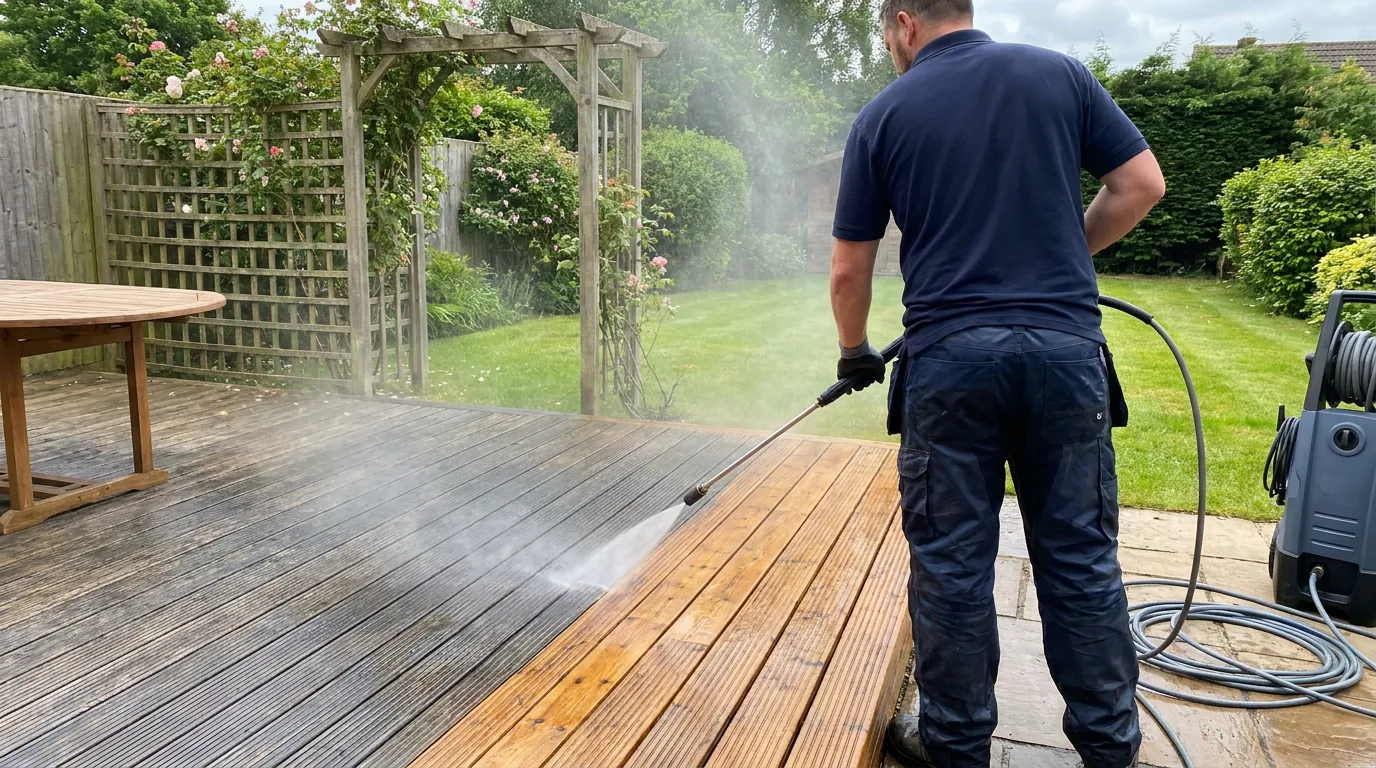
A proper patio clean isn’t just running a pressure washer over the surface. It’s pre-treating organic growth so it doesn’t come back in three months, picking the right pressure for the stone (Indian sandstone is not concrete), and detailing the edges by hand. That’s the whole job — not three of those things and an upsell.
- Biocide treatment for black-spot, lichen & algae (Lithofin Algex[2] manufacturer guidance: annual reapplication, preferably spring)
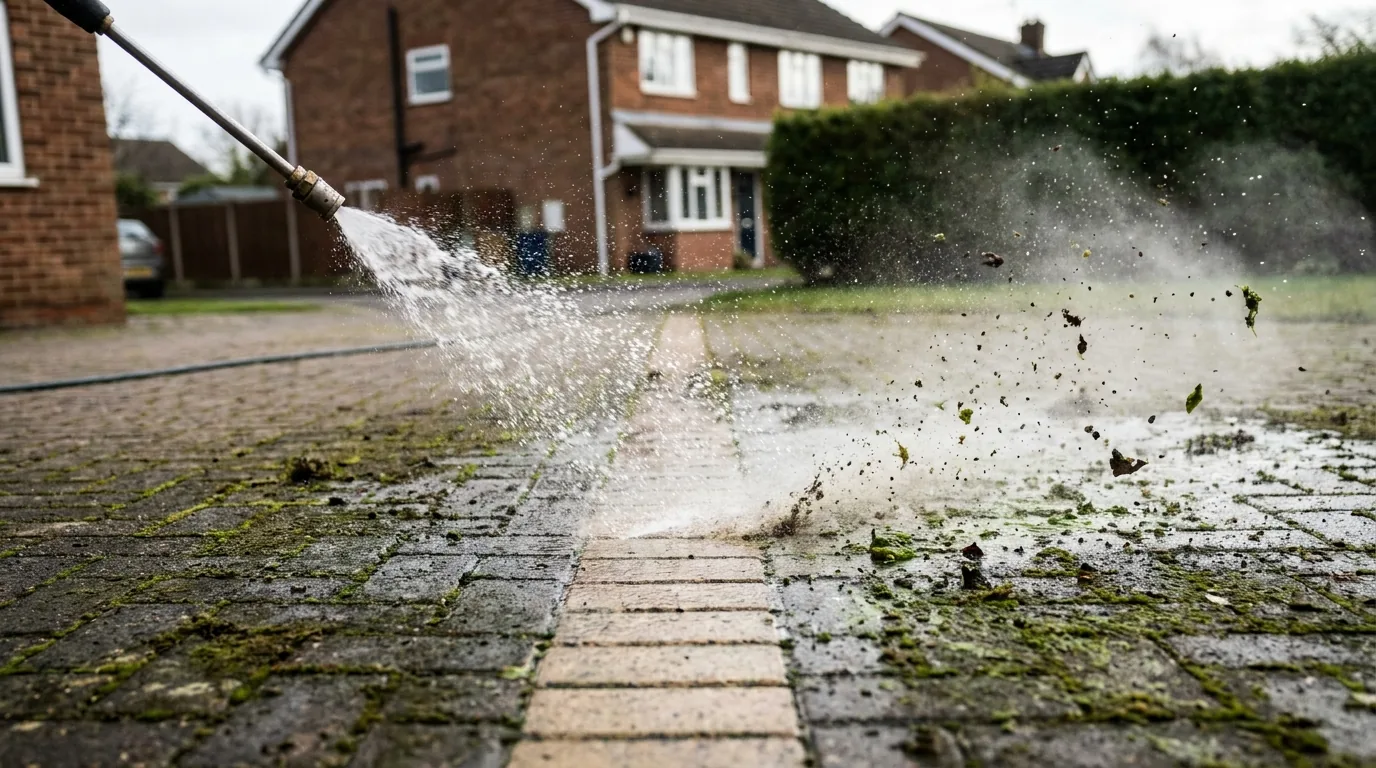
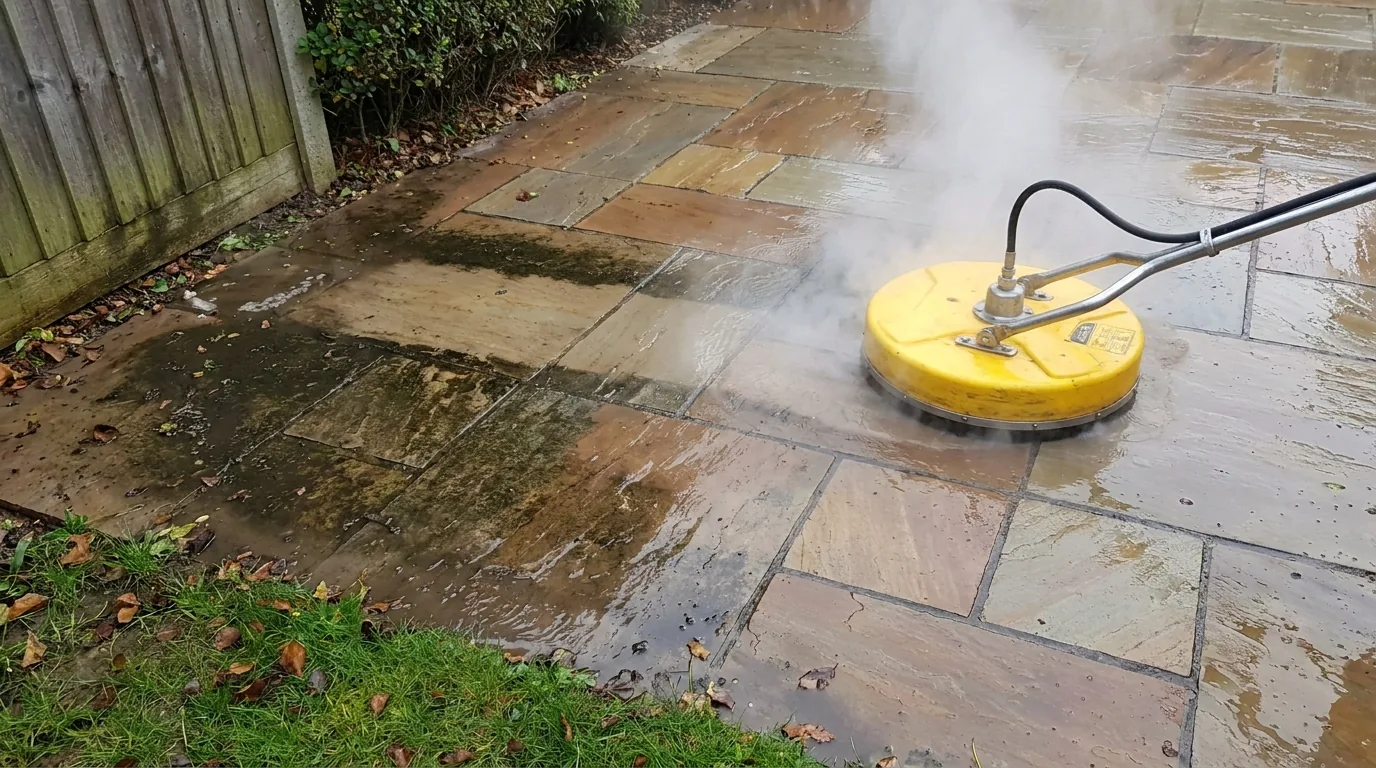
- Surface-cleaner pass at the right pressure for the stone (Marshalls[1] medium-pressure technique as ceiling on block paving; soft-wash on porous stone)
- Hand-finished edges, planters and steps
- Joint brushing where needed
- Final rinse and full clear-up
- Honest assessment of what will and won’t come up
Surfaces we clean
Indian sandstone
The most common Surrey patio of the last 15 years, and the one most likely to be killed by DIY pressure washing. Porous, easy to pit. We drop pressure, use a fan tip, and rely on the biocide to kill black-spot at root level. Looks like new without etching.
Porcelain
Modern outdoor porcelain is tough on the slab itself but the grout lines are vulnerable. We use lower pressure on the joints and a softer wash for general grime — the porcelain doesn’t need much, the joint sand is the bit to protect.
Slate & natural stone
Soft, characterful, easy to over-clean. We treat the same way as sandstone — pre-treat, low pressure, hand-detail. No turbo nozzle anywhere near it.
Concrete slabs & York stone
Tougher, takes a higher pressure for the same result. York stone in older Surrey properties cleans up really well once the moss biocide does its work.
Areas we cover
Across all of Surrey within 20 miles of Redhill (RH1). That includes Redhill, Reigate, Horley, Dorking, Banstead, Caterham, Godstone, Chipstead, and the rest of all 15+ areas.
Slip-risk on shaded patios
HSE-endorsed UKSRG pendulum guidance[5] sets PTV ≥36 as the low-slip threshold. Algae and black-spot lichen are the two contaminants that drop outdoor stone below threshold fastest — a green-looking patio in autumn is almost always below PTV 36. Annual Lithofin Algex[2] spring biocide is the cadence that keeps the threshold met on north-facing Surrey patios where the Mole Valley microclimate and Earlswood / Caterham Valley humidity slow surface drying.
Sealing economics
Resiblock[3] manufacturer lifespan on patio sealants is up to 5 years. Practically, breathable sealants on Indian sandstone and York stone slow re-soiling and ease the next clean. Never seal porous stone in autumn or winter — trapped moisture under the polymer film causes blistering. BS 7533-101[4] applies to modular paving construction and informs the jointing-sand load-bearing rules our re-sand step preserves.
Oil stains and ferrous staining on natural stone
Lithofin Oil-EX[7] manufacturer protocol: 2 mm coating thickness, ~12 hr dry time, coverage ~0.5 m²/kg. Suitable for marble, natural stone, artificial stone and concrete — not for sealed or lacquered surfaces. Oil stains older than ~12 months on porous Indian sandstone lighten significantly but rarely vanish completely (oil penetrates deep into the stone over time). We’ll always tell you up front what’s realistic.
Mole Valley microclimate effect on patio cadence
The same Mole Valley topographic-sheltering effect documented on our Dorking, Betchworth and Earlswood pages applies to patios. RH4 / RH3 / parts of RH1 patios sit damp 3–5 weeks/year longer than Wisley headline rainfall predicts[6]. Practical implication: annual Lithofin Algex[2] spring biocide is non-optional in those postcodes — missing it means hitting PTV slip threshold in autumn rather than the following spring.
Useful guides
Want to dig deeper before you book? Full cost guide · Indian sandstone specifics · Best time of year · Stain removal · Moss removal
Sources
Every protocol on this page is sourced. Primary data and manufacturer technical guidance only.
- Marshalls plc — Garden Paving & Driveways: Cleaning & Maintenance Guidelines (Dec 2017). Medium pressure, 30° oblique, ≥200 mm standoff. marshalls.co.uk — guidelines (PDF). Accessed 21 May 2026.
- Lithofin AG — Algex Special Cleaner. Annual reapplication, preferably in spring. lithofin.com — Algex. Accessed 21 May 2026.
- Resiblock — Block paving sealer technical data sheets. Manufacturer-stated lifespan up to 5 years. resiblock.com. Accessed 21 May 2026.
- BSI — BS 7533-101:2021 Code of practice for the structural design of pavements using modular paving units. bsigroup.com — BS 7533-101. Accessed 21 May 2026.
- UK Slip Resistance Group / HSE — Introduction to the Pendulum Tester. PTV ≥36 low risk. ukslipresistance.org.uk. Accessed 21 May 2026.
- Met Office — Wisley Long-Term Averages 1991–2020. metoffice.gov.uk — Wisley. Accessed 21 May 2026.
- Lithofin AG — Oil-EX Oil Stain Remover. 2 mm coat, ~12 hr dwell, ~0.5 m²/kg coverage. lithofin.com — Oil-EX. Accessed 21 May 2026.