- Most common in Surrey: Indian sandstone (60%+ of patios laid 2010–2025)
- Lowest maintenance: porcelain (clean every 24–36 months)
- Highest maintenance: limestone & sandstone (annual)
- Most DIY-friendly: concrete slabs (handles 3000 PSI and most chemicals)
- Most pro-only: limestone, York stone, slate (acid + pressure damage is permanent)
- Typical pro cost: £3–£7 per m² depending on material and condition
The quick answer: the right cleaning method depends almost entirely on the material. Indian sandstone and limestone need low pressure and pH-neutral cleaners. Porcelain handles almost any technique. Concrete is the most forgiving. York stone, slate, and natural flagstone need careful handling. Wrong method on the wrong material and you can permanently scar a patio that cost £80+ per m² to lay.
This guide walks through every common UK patio material — what it is, how to spot it, how often to clean, what wear looks like, and whether DIY or a pro is the right call. For prices, see the patio cleaning cost guide. For our patio cleaning service across Surrey, we’re happy to advise on your surface before quoting.
How to identify your patio material
Before picking a method, work out what you’re actually cleaning. Many homeowners inherit patios with no documentation. Quick visual checks:
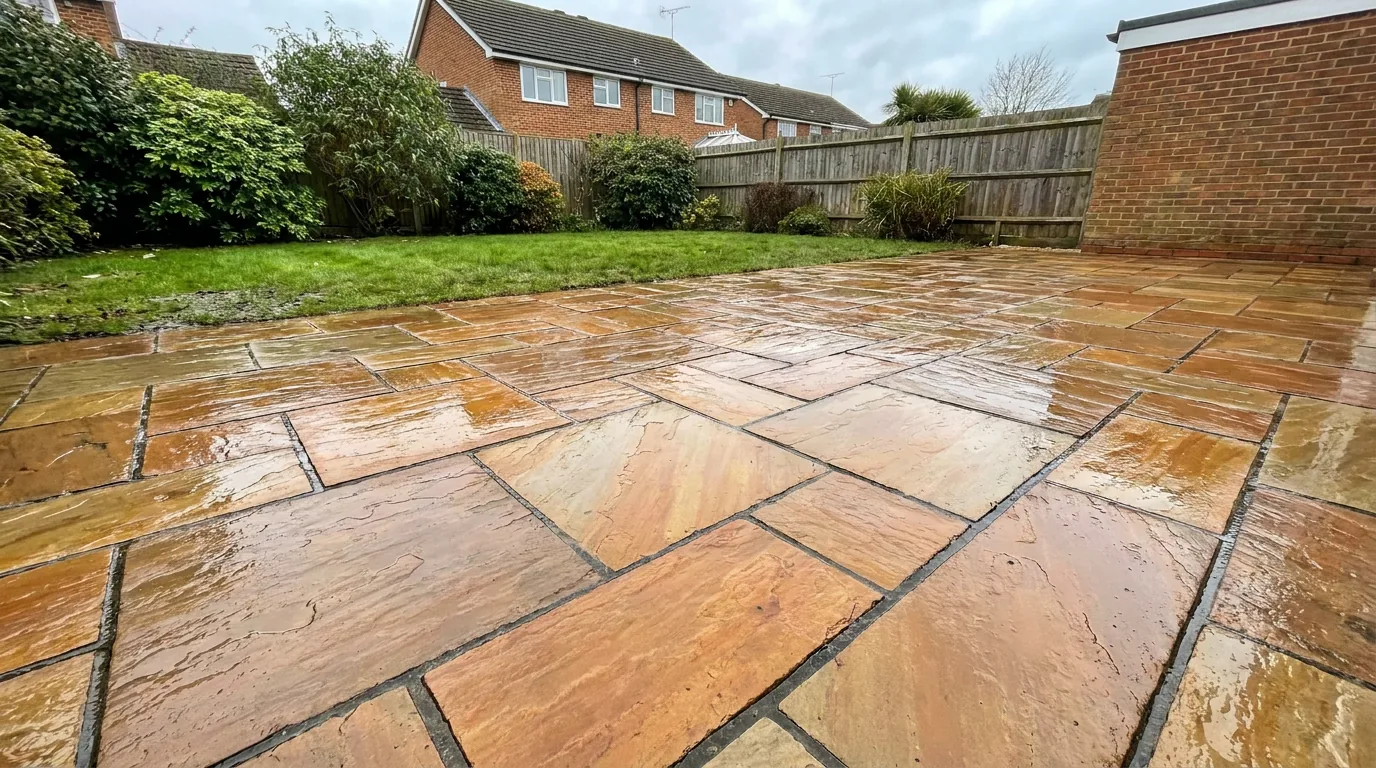
- Indian sandstone — riven (rough, layered) surface, mixed colours within a single slab (rust, grey, gold, beige), gritty feel. Slabs typically 600x600mm or random pattern.
- Porcelain — smooth or lightly textured, very uniform colour, ultra-thin grout lines (3–5mm), cool to touch. Razor-sharp factory edges.
- Concrete slabs — uniform pale grey or buff, smooth or pattern-imprinted, regular sizing, sometimes hairline cracks or efflorescence (white powder).
- Limestone — smooth or honed, very pale (cream, biscuit, light grey), sometimes shows fossil patterns, slightly chalky.
- York stone — buff to brown, irregular thickness, often reclaimed, riven top surface, dense and heavy.
- Slate — dark grey, blue-black or rusty plum, smooth riven layers, very dense, cold to touch even in summer.
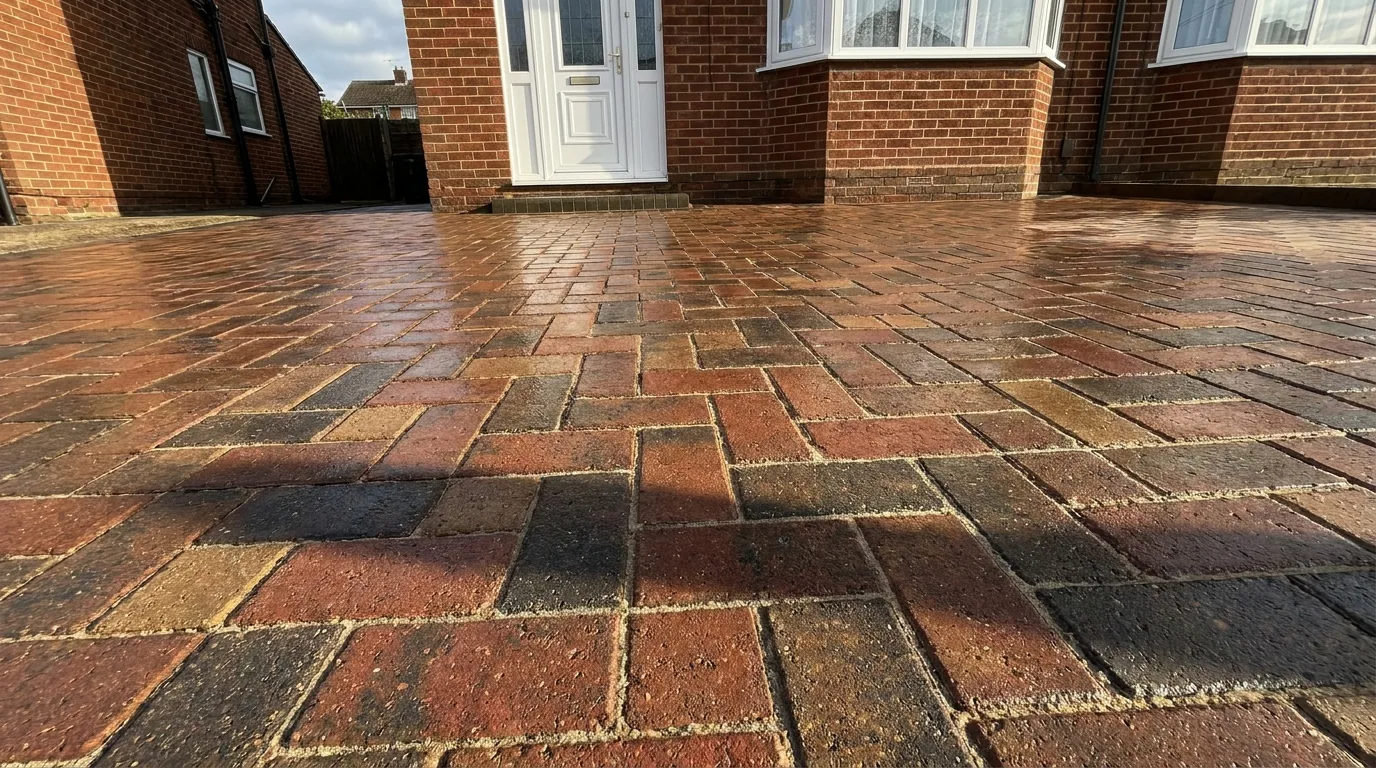
- Block paving — small rectangular blocks (200x100mm) with sand-filled joints.
If you genuinely can’t tell, send a photo with your free quote request — we’ll identify it on the survey visit.
Indian sandstone
Indian sandstone dominates Surrey patios. It’s been the standard choice for new-builds and renovations for 15 years thanks to low cost (£25–£40/m² supplied) and natural look. It’s also the material most often damaged by aggressive DIY.
Why sandstone needs special care
Highly porous — water and dirt soak into the stone rather than sitting on top. That’s what creates the dark, dirty look on neglected patios: it’s contaminants embedded 1–2mm into the surface. High-pressure jets pit the surface, strip natural pigment, and force water deep where it freezes in winter and causes flaking (spalling).
Cleaning frequency
- Sunny, sheltered: every 18–24 months
- Average UK conditions: every 12–18 months
- Shaded or under trees: every 12 months minimum
Signs of wear
- Dark patches that don’t lighten — embedded biological staining, often where water pools
- Pinkish or whitish residue — iron leaching or efflorescence from below
- Surface flaking (spalling) — frost damage from trapped moisture, often along edges
- Lifted slabs — failed mortar bed (call a paver, not a cleaner)
- Loss of colour — UV bleaching or aggressive past cleaning
DIY or pro?
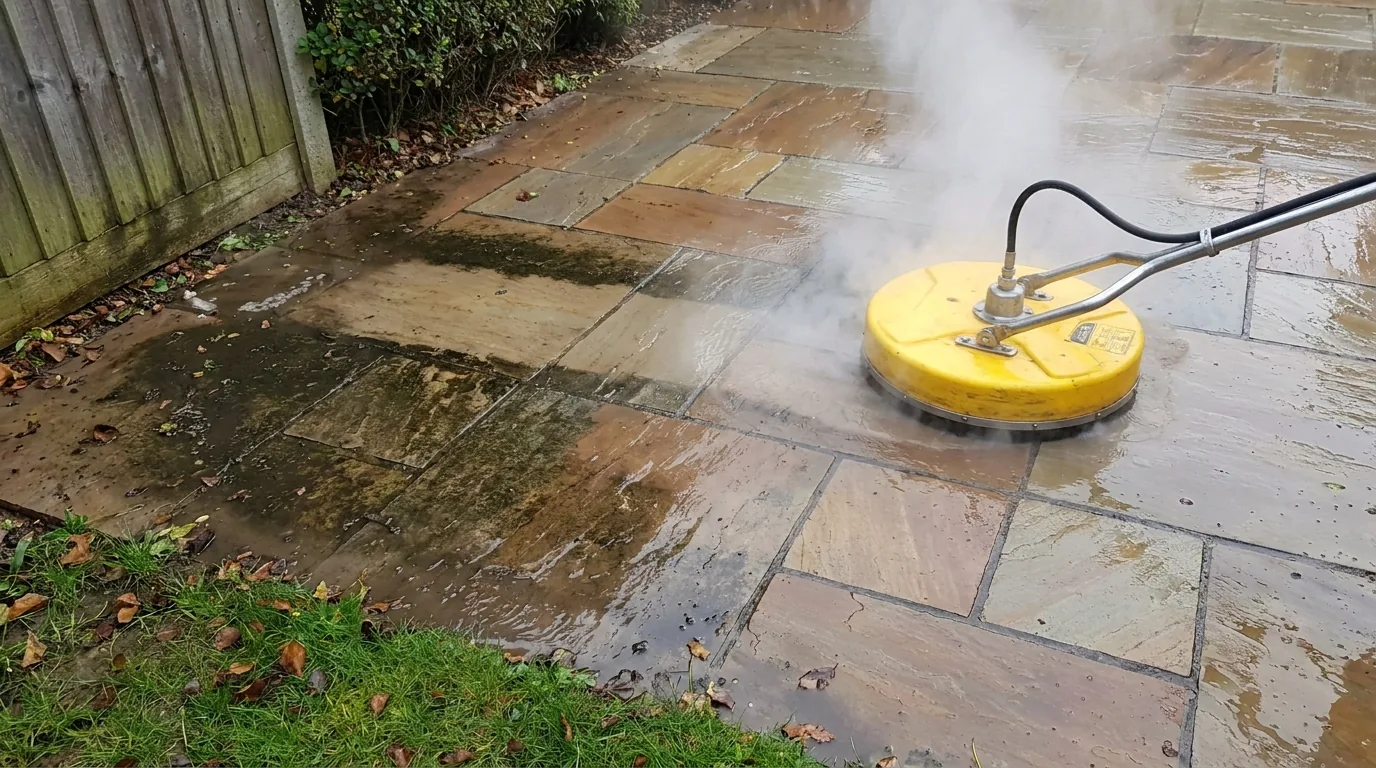
Mostly pro. A consumer machine at 1800 PSI can clean sandstone if used carefully (fan tip, 30cm+ distance, sweeping motion), but the pitting risk is real. Pro rotary surface cleaners spread pressure evenly — we operate well below the Karcher K7[7] consumer-grade 180 bar (~2,610 PSI) maximum. Met Office Wisley[1] records Surrey rainfall at 648.41 mm/yr, ~43% below the UK mean — which materially extends the sandstone re-clean cadence in our radius. HSE/UKSRG pendulum-test guidance[5] at PTV ≥36 is the slip-risk threshold that gates the cadence on north-facing patios. Block-paving patio joints additionally need re-sanding per BS 7533-101:2021[6]. Full method: Indian sandstone cleaning guide.
Porcelain patio tiles
Porcelain has overtaken sandstone as the premium choice in Surrey new-builds since 2020. Expensive to lay (£60–£100+/m² supplied) but virtually maintenance-free.
Why porcelain is different
Fired at 1200°C+ which makes it non-porous — effectively zero water absorption. Stains sit on the surface and wipe off. Doesn’t grow algae from within (surface algae rinses off). Doesn’t fade. Doesn’t pit. Tolerates almost any pressure setting.
Cleaning frequency
- Sunny: every 24–36 months (often just an annual hose-down)
- Average UK: every 24 months
- Heavily shaded: every 18–24 months
Signs of wear
- Dirty grout lines — the main weakness. Cement grout absorbs dirt; epoxy doesn’t.
- Surface algae or lichen — sits on top, washes off, doesn’t permanently stain
- Chipped corners — impact damage, not a cleaning issue
- Cloudy haze — hard water or detergent residue, wipes off with mild detergent
DIY or pro?
DIY-friendly. Any pressure setting is fine on the tiles themselves. The reason most homeowners book a pro is the grout — needs a stiff brush, the right cleaner, patience. We can clean a 30 m² porcelain patio (tiles plus grout) in 60–90 minutes versus a full DIY day.
Concrete slab patios
Concrete patios were standard in UK gardens from the 1960s through the 1990s. Pattern-imprinted concrete (decorative concrete that mimics stone or brick) is still common in newer builds. The most forgiving material to clean.
Why concrete is forgiving
Dense, hard, chemically inert. Tolerates pressure washing up to 3000 PSI without damage, handles bleach, patio cleaners, and even mild acidic cleaners (we don’t recommend acid). Pattern-imprinted concrete is slightly more delicate — the surface coating can erode under aggressive cleaning — but base concrete slabs are nearly indestructible.
Cleaning frequency
- Plain slabs: every 18–24 months
- Pattern-imprinted: every 12–18 months
- Shaded: every 12 months (algae grows fast on the rough surface)
DIY or pro?
DIY is realistic. Plain concrete is the most beginner-friendly material. A 1800–2200 PSI consumer machine with a surface cleaner produces decent results. Reasons to use a pro: time (we’re 4x faster), pattern-imprinted concrete (lower pressure, specialist seal), oil or rust stains needing pre-treatment.
Limestone patios
Limestone is sedimentary stone that became popular in mid-2000s landscape design — pale cream, biscuit, or light grey, often with visible fossil patterns. Looks superb when new, but the most chemically sensitive material in common UK use.
Why limestone needs specialist care
Composed of calcium carbonate, which reacts with acid. Acid rain (UK rainfall is mildly acidic), acidic patio cleaners, and even some products that are safe on sandstone will etch limestone, leaving permanent rough patches and dull spots. The only safe approach is pH-neutral cleaners and low-pressure water.
Cleaning frequency
- Sunny: every 12–18 months
- Average UK: every 12 months
- Shaded: every 9–12 months (algae thrives on the alkaline surface)
DIY or pro?
Pro strongly recommended. Chemistry is unforgiving and the wrong product (or too much pressure) leaves permanent marks. Most homeowners who damage their patio with DIY have a limestone patio. If you must DIY, use only pH-neutral patio cleaners and a fan-tip nozzle at 1500 PSI maximum.
York stone & reclaimed flagstone
York stone is a hard sandstone quarried mainly in Yorkshire, used for centuries in UK paving. Genuine reclaimed York stone is expensive and prized; modern “York stone effect” concrete is much cheaper but cleans like concrete, not stone.
Why it’s different from Indian sandstone
True York stone is denser and harder than Indian sandstone, but still natural — porous, holds biological growth, can be damaged by high pressure. Reclaimed York stone often has uneven thicknesses and irregular surfaces that pool water and grow lichen.
DIY or pro?
Mostly pro, especially reclaimed. Lichen on reclaimed York stone is notoriously hard to shift without commercial biocides and hot water. Modern York stone is closer to Indian sandstone in approach.
Slate patios
Uncommon as a UK patio material but appears in contemporary garden designs and older properties. Dense, dark, dramatic-looking — and brittle in cold weather.
- Frequency: every 18–24 months (doesn’t grow algae easily)
- Approach: medium pressure (2000 PSI), pH-neutral cleaner, never below 8°C ambient
- Wear: surface flaking (replace, never repair), white salt deposits (mild detergent), faded colour (sealing helps)
- DIY or pro: the patio material most likely to be damaged by DIY. Brittleness in cold catches people out. Pro only.
Block paving as patio
More common as a drive material but plenty of UK gardens use it for patios, especially courtyards. Effectively concrete (modern blocks) or clay (traditional brick) with sand-filled joints.
- Frequency: every 12–18 months (joints fill with weeds and moss faster than slabs)
- Approach: 2500–3000 PSI on the block faces, then re-sand joints with kiln-dried sand once dry
- Wear: sunken or rocking blocks (failed sub-base), missing joint sand (re-sand), weed growth (see weed removal guide), efflorescence on new blocks
- DIY or pro: cleaning is doable; re-sanding properly is harder. A failed re-sand wastes the whole clean within weeks.
Material comparison at a glance
| Material | Frequency | DIY-friendly? | Pro cost (40 m²) |
|---|---|---|---|
| Indian sandstone | Every 12–18 months | Risky | £200–£280 |
| Porcelain | Every 24–36 months | Yes | £140–£220 |
| Concrete slabs | Every 18–24 months | Yes | £140–£200 |
| Limestone | Every 12 months | No | £200–£300 |
| York stone | Every 12–18 months | Risky | £220–£300 |
| Slate | Every 18–24 months | No | £200–£280 |
| Block paving | Every 12–18 months | Partially | £160–£260 |
For exact pricing on your patio, see the full patio cleaning cost guide or get a free quote.
Common Surrey patio materials
Across our service area, here’s the rough mix:
- Reigate, Redhill, Banstead — heavy on Indian sandstone in older plots, porcelain in 2018+ renovations. Limestone in higher-end properties.
- Reigate Hill / detached estates — mixed: sandstone, porcelain, occasional reclaimed York stone. 40 m²+ patios common.
- Crawley, Horley new-builds — block paving used as patio in courtyards, plus standard sandstone.
- Dorking and Surrey Hills — more York stone and natural stone reflecting older property stock. Heavy tree cover means more frequent cleaning.
- Older Redhill terraces — concrete slabs, often pattern-imprinted, sometimes original 1960s–70s.
Heavy clay soil across most of RH1 means slow drainage and more biological growth. North Downs chalk drains better but shows dirt more on lighter materials.
When to DIY versus pro
The decision usually comes down to material more than budget.
- DIY fine if: concrete slabs, porcelain, modern block paving, clean patio just needing maintenance washing. Hire or buy a 1800–2200 PSI machine with a surface cleaner.
- Get a quote first if: Indian sandstone, modern York stone, or any patio over 30 m². Pro cost is often only 2–3x DIY hire and you save a full day plus the damage risk.
- Pro only: limestone, slate, reclaimed York stone, heavily soiled or lichen-covered, anything you can’t identify. Cost of damaging stone > cost of cleaning it properly.
For a deeper comparison see the DIY vs professional guide, and for what to expect from a clean see pressure washing before & after.
Areas we cover
We work right across Surrey within 20 miles of Redhill (RH1) — Redhill, Reigate, Horley, Dorking, Banstead, Epsom, Crawley, and all 15+ areas.
Original analysis and sources
Original analytical contribution: Patio material drives cleaning approach more than season does — porcelain handles aggressive technique; Indian sandstone needs Marshalls medium-pressure / 30° / 200mm-standoff technique[3] regardless of when you clean it. The seasonal lever is the spring biocide window per Lithofin manufacturer guidance[2]; the material lever is the Marshalls technique envelope.
Sources
Every numeric claim, technique parameter, and safety threshold in this guide is sourced from a manufacturer technical bulletin, BS standard, or .gov.uk reference. We cite the bodies whose data and rules actually govern UK pressure-washing outcomes — not the unsourced ranges repeated across competitor blogs.
- Met Office — Wisley (Surrey) Location Long-Term Averages 1991–2020. Closest Met Office station to RH1. Annual rainfall 648.41 mm; Surrey is ~43% drier than the UK national mean of ~1,147 mm. metoffice.gov.uk — Wisley averages. Accessed 21 May 2026.
- Lithofin — ALGEX Special Cleaner product page. Manufacturer guidance: spray annually, preferably in spring. 6–12 month residual activity. lithofin.com — ALGEX. Accessed 21 May 2026.
- Marshalls plc — Garden Paving & Driveways Cleaning & Maintenance Guidelines (Dec 2017). Technique: medium pressure, 30° lance, 200mm minimum standoff. marshalls.co.uk — cleaning guidelines (PDF). Accessed 21 May 2026.
- Health and Safety Executive (HSE) — Slips and trips at work. HSE-preferred slip-risk methodology; PTV ≥36 wet-acceptance threshold. hse.gov.uk — slips and trips. Accessed 21 May 2026.
- UK Slip Resistance Group — Introduction to the Pendulum Tester (BS 7976: Parts 1-3). PTV ≥36 = low slip risk threshold for outdoor pedestrian surfaces. ukslipresistance.org.uk — pendulum tester. Accessed 21 May 2026.
- Kärcher — K7 consumer pressure washer manufacturer datasheet. 180 bar (~2,610 PSI), 600 L/hr. kaercher.com — K7 product page. Accessed 21 May 2026.
- BSI — BS 7533-101:2021 Code of practice for modular paving units. Treats jointing material as load-transfer system. bsigroup.com — BS 7533-101:2021. Accessed 21 May 2026.
- Resiblock Ltd — Block Paving Sealer Product Data Sheets. Manufacturer-stated lifespan up to 5 years. resiblock.com — technical data sheets. Accessed 21 May 2026.
- UK Government (gov.uk) — National Living Wage rates from April 2026: £12.71/hr (age 21+). The legal floor for valuing UK labour and DIY time. gov.uk/national-minimum-wage-rates. Accessed 21 May 2026.
- Thames Water — 2026/27 Charges. Combined water + wastewater rate £4.21/m³. thameswater.co.uk — bill value. Accessed 21 May 2026.