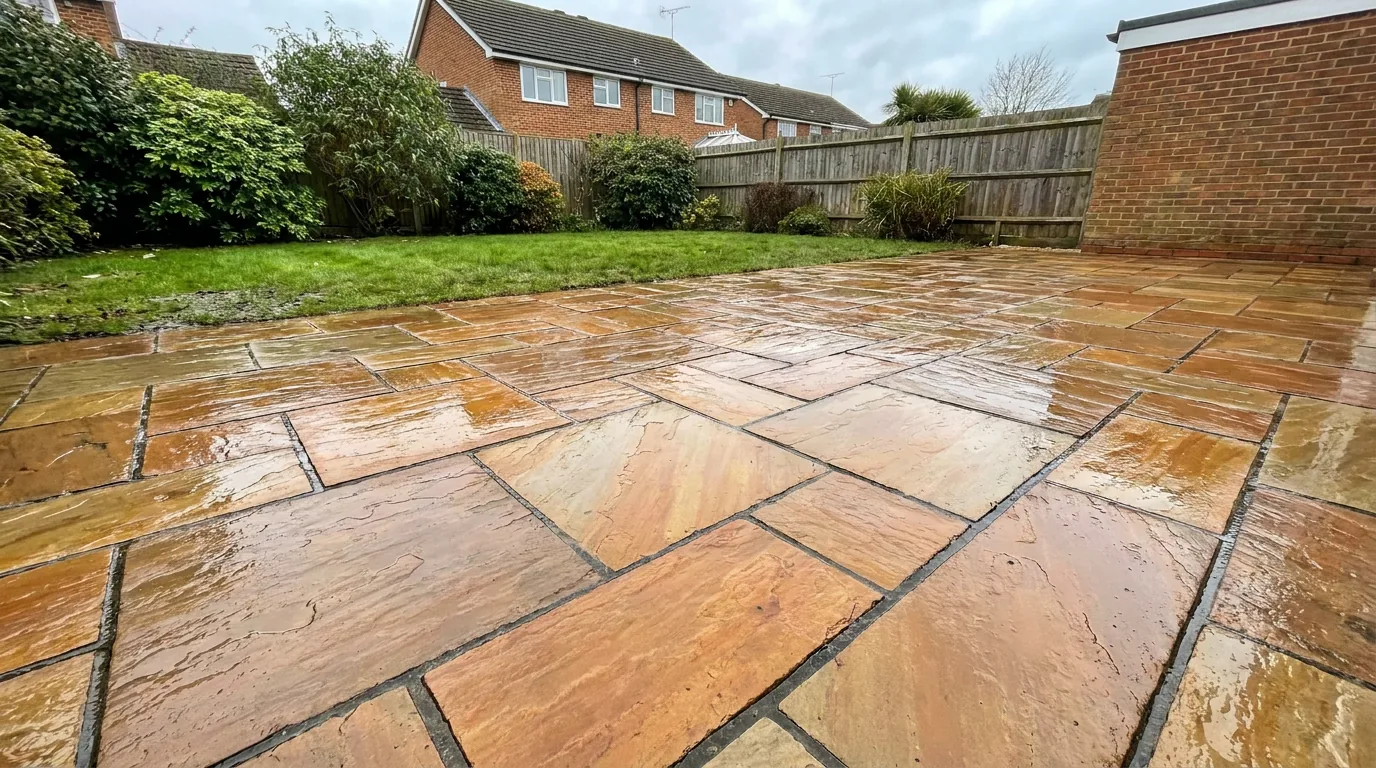
The quick answer: Remove weeds from block paving by applying a systemic weed killer (glyphosate-based), waiting 7-14 days for weeds to die completely, then pressure washing to clear dead growth and old sand from joints. Finish by re-sanding all joints with kiln-dried sand or polymeric sand. Polymeric sand hardens in the joints and prevents weed regrowth for 5-10 years, making it the most effective long-term solution.
Weeds growing through block paving joints are one of the most common complaints from UK homeowners. Block paving is a popular driveway and patio surface — it looks excellent when well-maintained, but the joints between blocks create the perfect environment for weed seeds to germinate. Left unchecked, weeds destabilise the paving, trap moisture, and make your driveway look neglected. This guide covers every effective removal method, prevention strategy, and the real costs involved.
Why Do Weeds Grow in Block Paving?
Understanding the cause helps you choose the right prevention strategy. Weeds grow in block paving because:
- Sand loss: Over time, the kiln-dried sand between blocks washes out from rain, use, and traffic. Empty or partially-filled joints create pockets where wind-blown seeds settle and germinate.
- Organic buildup: Decomposing leaves, dust, and soil particles accumulate in joints, creating a thin layer of nutrient-rich compost — ideal growing medium for weeds.
- Moisture retention: Block paving joints hold moisture longer than the block surfaces, providing the water weeds need to establish.
- Dormant seeds: The original bedding sand may contain weed seeds that germinate over time as conditions become favourable.
The key takeaway: weeds are a symptom of depleted joint sand. Addressing the sand is the long-term solution, not just killing the weeds.
Based in Surrey? Spring is our busiest season — get a free quote before slots fill up.
Or call 01737 652 515
What Are the Best Weed Removal Methods?
1. Systemic Weed Killer (Best for Killing Roots)
A systemic (glyphosate-based) weed killer is absorbed by the leaves and transported down to the roots, killing the entire plant. This is the most effective chemical method.
- Products: Roundup, Resolva, Weedol (look for "systemic" or "root kill" on the label)
- Application: Spray directly onto weed foliage on a dry day when rain isn't expected for 6+ hours
- Results: Weeds yellow and die within 7-14 days
- Cost: £5-15 for enough to treat a standard driveway
- Note: Contact weed killers (vinegar, fast-acting sprays) only burn the leaves — roots survive and regrow within weeks
2. Manual Removal (Best for Small Areas)
For a small number of weeds, manual removal is simple and chemical-free:
- Block paving weed scraper: An L-shaped tool designed to scrape weeds from narrow joints. Available for £5-10 from garden centres.
- Old screwdriver or knife: Works for individual weeds. Dig out the root as completely as possible.
- Patio weeding tool: A long-handled version that saves bending down. Good for larger areas.
Manual removal is labour-intensive for large areas but gives immediate results and avoids chemicals entirely. The key is removing the root — if you just snap off the top growth, the weed returns within days.
3. Pressure Washing (Best for Heavy Weed Growth)
Pressure washing blasts weeds out of joints along with old sand, moss, and dirt. It's the fastest method for heavily weeded driveways but must be followed by re-sanding.
- Pressure: 2000-2500 PSI for standard block paving
- Technique: Use a rotary surface cleaner for even results, or a fan nozzle angled along the joints
- Important: Pressure washing removes joint sand, so you MUST re-sand afterwards to prevent rapid weed regrowth and block movement
The professional approach is to apply weed killer first, wait 7-14 days, then pressure wash. This ensures roots are dead before the physical removal, preventing regrowth from root fragments left in the joints.
4. Thermal Weeding (Chemical-Free Alternative)
A flame weeder or hot foam applicator kills weeds with heat. The heat destroys cell structure, causing the plant to die. This method is chemical-free but needs multiple applications to exhaust root systems.
- Flame weeder: Pass the flame slowly over the weeds for 2-3 seconds. Don't try to burn them — the heat shock is enough to kill the cells.
- Repeat: Weeds regrow from roots after a single treatment. Repeat every 2-3 weeks for 2-3 months to exhaust the root system.
- Cost: £20-40 for a gas-powered flame weeder
What Is Polymeric Sand and Is It Worth It?
Polymeric sand is the single most effective product for preventing weeds in block paving. It's a specially engineered jointing sand that contains polymers which harden when activated with water, creating a semi-rigid joint that weeds cannot penetrate.
Benefits of Polymeric Sand
- Weed prevention: Hardened joints prevent weed seeds from reaching soil and germinating
- Ant resistance: Ants cannot burrow through set polymeric sand (a common problem with standard sand)
- Washout resistance: Unlike kiln-dried sand, polymeric sand doesn't wash out in heavy rain
- Block stability: Locked joints reduce block movement from vehicle traffic
- Longevity: Lasts 5-10 years vs 6-12 months for kiln-dried sand
Polymeric Sand vs Kiln-Dried Sand
| Feature | Kiln-Dried Sand | Polymeric Sand |
|---|---|---|
| Cost per sqm | £0.50-1 | £3-6 |
| Lifespan | 6-12 months | 5-10 years |
| Weed prevention | Minimal | Excellent |
| Ant resistance | None | Excellent |
| Rain washout | Washes out gradually | Stays in place |
| Application difficulty | Easy (sweep and compact) | Moderate (requires dry conditions, water activation) |
| Cost over 5 years (40sqm) | £100-200 (re-sand 5+ times) | £120-240 (one application) |
Over 5 years, polymeric sand actually costs about the same as kiln-dried sand when you factor in repeated re-sanding and weed treatment. The upfront cost is higher, but the dramatically reduced maintenance makes it worthwhile for most homeowners. For a full cost comparison, see our block paving cleaning cost guide.
How to Apply Polymeric Sand
Polymeric sand application requires clean, dry conditions:
- Clean thoroughly: Pressure wash all joints to remove old sand, weeds, moss, and debris. Joints must be at least 6mm wide and 25mm deep.
- Dry completely: The paving and joints must be bone dry. Wait 24-48 hours after cleaning in summer, longer in winter.
- Sweep sand into joints: Pour polymeric sand onto the surface and sweep into all joints using a stiff broom. Ensure joints are filled to within 3mm of the block surface.
- Remove excess: Blow or sweep ALL loose sand off the block surfaces. Any sand left on top will stain the paving when activated.
- Activate with water: Gently mist the entire area with a fine spray. The water activates the polymers, causing the sand to set. Avoid heavy water flow that could wash sand out of joints before it sets.
- Allow to cure: Keep the area dry for 24 hours (cover if rain is expected). Full cure takes 24-48 hours.
How Much Does Professional Weed Removal Cost?
Professional block paving weed removal typically includes weed treatment, pressure washing, and re-sanding as a complete service.
| Service | Cost per sqm | Typical Driveway (40sqm) |
|---|---|---|
| Clean + kiln-dried sand | £4-7 | £160-280 |
| Clean + polymeric sand | £7-12 | £280-480 |
| Clean + seal + kiln-dried sand | £8-14 | £320-560 |
The initial clean with polymeric sand is the most cost-effective long-term option because you won't need repeated weed treatments or re-sanding for 5-10 years. For a detailed cost breakdown, see our block paving cleaning cost UK guide.
How to Prevent Weeds from Growing Back
Prevention is far cheaper and easier than repeated removal. Here's a maintenance plan that keeps weeds under control:
- Keep joints filled: Check joint sand levels every 3-6 months. Top up any areas where sand has washed out or compacted. Empty joints are an open invitation for weeds.
- Sweep regularly: A quick sweep every 2-3 weeks removes organic debris before it decomposes into soil that supports weed growth.
- Apply preventative weed killer: A biannual application (March and September) of residual weed killer keeps joints clear. Look for products labelled "path and patio weed preventer".
- Clear edges: Weeds often spread from garden borders into paving. Keep a clean gap between soil and paving edges.
- Act early: Remove weeds when they first appear (tiny seedlings in joints). Once established, roots grow deep and become much harder to fully remove.
Annual Block Paving Maintenance Schedule
| Month | Action |
|---|---|
| March | Apply residual weed killer, inspect and top up joint sand |
| May-June | Remove any breakthrough weeds manually, sweep debris |
| September | Apply second weed killer treatment before autumn leaf fall |
| November | Clear fallen leaves, inspect joints after autumn rain |
| Annually (spring) | Professional clean with full re-sanding (if using kiln-dried sand) |
Block paving is the most popular driveway surface in Surrey's suburban areas, found throughout Redhill, Reigate, Banstead, and Epsom. Our block paving cleaning service includes weed treatment, pressure washing, and re-sanding as standard.
Frequently Asked Questions
What is the best way to remove weeds from block paving?
Apply a systemic weed killer (glyphosate-based), wait 7-14 days for weeds to die completely, then pressure wash to remove dead growth and old sand. Finish by re-sanding all joints with kiln-dried or polymeric sand. This three-step approach removes existing weeds and prevents rapid regrowth.
How do you stop weeds growing in block paving permanently?
Polymeric sand is the most permanent solution. It hardens in joints after water activation, preventing weed seeds from germinating. It lasts 5-10 years and dramatically reduces maintenance. For a cheaper option, keep joints filled with kiln-dried sand and apply residual weed killer twice yearly.
How much does professional weed removal from block paving cost?
Professional weed removal with cleaning and re-sanding costs £4-7 per sqm with kiln-dried sand, or £7-12 per sqm with polymeric sand. A typical 40sqm driveway costs £160-280 (kiln-dried) or £280-480 (polymeric). Polymeric sand is more cost-effective long-term due to its 5-10 year lifespan.
What is polymeric sand and is it worth it?
Polymeric sand contains polymers that harden when wet, creating semi-rigid joints that prevent weeds, ants, and sand washout. It costs £3-6/sqm compared to £0.50-1/sqm for kiln-dried sand, but lasts 5-10 years. Over 5 years, it costs about the same when you factor in repeated kiln-dried sand applications and weed treatments.
Can you use salt or vinegar to kill weeds in block paving?
Vinegar kills weed leaves on contact but doesn't reach roots, so regrowth is rapid. Salt kills weeds effectively but damages paving, mortar, and surrounding soil — never use salt on block paving. Boiling water kills visible growth only. For lasting results, a systemic weed killer that travels to the roots is far more effective and won't damage your paving.
How often should you re-sand block paving joints?
With kiln-dried sand, joints need topping up every 6-12 months as sand washes out. With polymeric sand, re-sanding is only needed every 5-10 years. Inspect joints after heavy rain and top up any gaps promptly to prevent weed establishment.
Or call 01737 652 515
Ready to Get Your Exact Price?
Now you know how professionals tackle weed removal from block paving, get a personalised estimate for your property. No obligation, no phone calls — just fill in a quick form and we'll respond within 2 hours.
Get My Free QuoteGet Your Free Quote
We provide professional block paving weed removal and cleaning throughout Surrey. Our service includes systemic weed treatment, pressure washing with rotary surface cleaners, and re-sanding with your choice of kiln-dried or polymeric sand.
We serve Redhill, Reigate, Horley, Dorking, Banstead, Epsom, Crawley, and all areas within a 20-mile radius of RH1.
Related guides: Block Paving Cleaning Cost UK | Algae Removal Guide | Moss Removal from Driveways | Driveway Cleaning Cost UK | Driveway Cleaning & Sealing Cost | DIY vs Professional
Original analysis and sources
Original analytical contribution: Weed control on block paving is a jointing-sand-integrity problem, not a herbicide problem — BS 7533-101:2021 treats the jointing material as part of the structural load-transfer system[6]. Intact kiln-dried sand blocks weed germination mechanically; Lithofin Algex annual spring application[2] handles any residual spore load.
Key sourced claims in this guide: Surrey rainfall baseline 648 mm/yr per Met Office Wisley[1], annual biocide cadence per Lithofin Algex manufacturer guidance[2], medium-pressure / 30° oblique / ≥200 mm-standoff technique per Marshalls[3], HSE-endorsed slip-risk methodology[4], and PTV ≥36 low-slip threshold from UKSRG pendulum-test guidance[5].
Sources
Every numeric claim, technique parameter, and safety threshold in this guide is sourced from a manufacturer technical bulletin, BS standard, or .gov.uk reference. We cite the bodies whose data and rules actually govern UK pressure-washing outcomes — not the unsourced ranges repeated across competitor blogs.
- Met Office — Wisley (Surrey) Location Long-Term Averages 1991–2020. Closest Met Office station to RH1. Annual rainfall 648.41 mm; Surrey is ~43% drier than the UK national mean of ~1,147 mm. metoffice.gov.uk — Wisley averages. Accessed 21 May 2026.
- Lithofin — ALGEX Special Cleaner product page. Manufacturer guidance: spray annually, preferably in spring. 6–12 month residual activity. lithofin.com — ALGEX. Accessed 21 May 2026.
- Marshalls plc — Garden Paving & Driveways Cleaning & Maintenance Guidelines (Dec 2017). Technique: medium pressure, 30° lance, 200mm minimum standoff. marshalls.co.uk — cleaning guidelines (PDF). Accessed 21 May 2026.
- Health and Safety Executive (HSE) — Slips and trips at work. HSE-preferred slip-risk methodology; PTV ≥36 wet-acceptance threshold. hse.gov.uk — slips and trips. Accessed 21 May 2026.
- UK Slip Resistance Group — Introduction to the Pendulum Tester (BS 7976: Parts 1-3). PTV ≥36 = low slip risk threshold for outdoor pedestrian surfaces. ukslipresistance.org.uk — pendulum tester. Accessed 21 May 2026.
- Kärcher — K7 consumer pressure washer manufacturer datasheet. 180 bar (~2,610 PSI), 600 L/hr. kaercher.com — K7 product page. Accessed 21 May 2026.
- BSI — BS 7533-101:2021 Code of practice for modular paving units. Treats jointing material as load-transfer system. bsigroup.com — BS 7533-101:2021. Accessed 21 May 2026.
- Resiblock Ltd — Block Paving Sealer Product Data Sheets. Manufacturer-stated lifespan up to 5 years. resiblock.com — technical data sheets. Accessed 21 May 2026.
- UK Government (gov.uk) — National Living Wage rates from April 2026: £12.71/hr (age 21+). The legal floor for valuing UK labour and DIY time. gov.uk/national-minimum-wage-rates. Accessed 21 May 2026.
- Thames Water — 2026/27 Charges. Combined water + wastewater rate £4.21/m³. thameswater.co.uk — bill value. Accessed 21 May 2026.