- Cost: £3–£8 per m² (£120–£320 for a typical 40 m² drive)
- Lifespan: 3–5 years, longer on patios than driveways
- Stops 80–90% of weed regrowth in joints
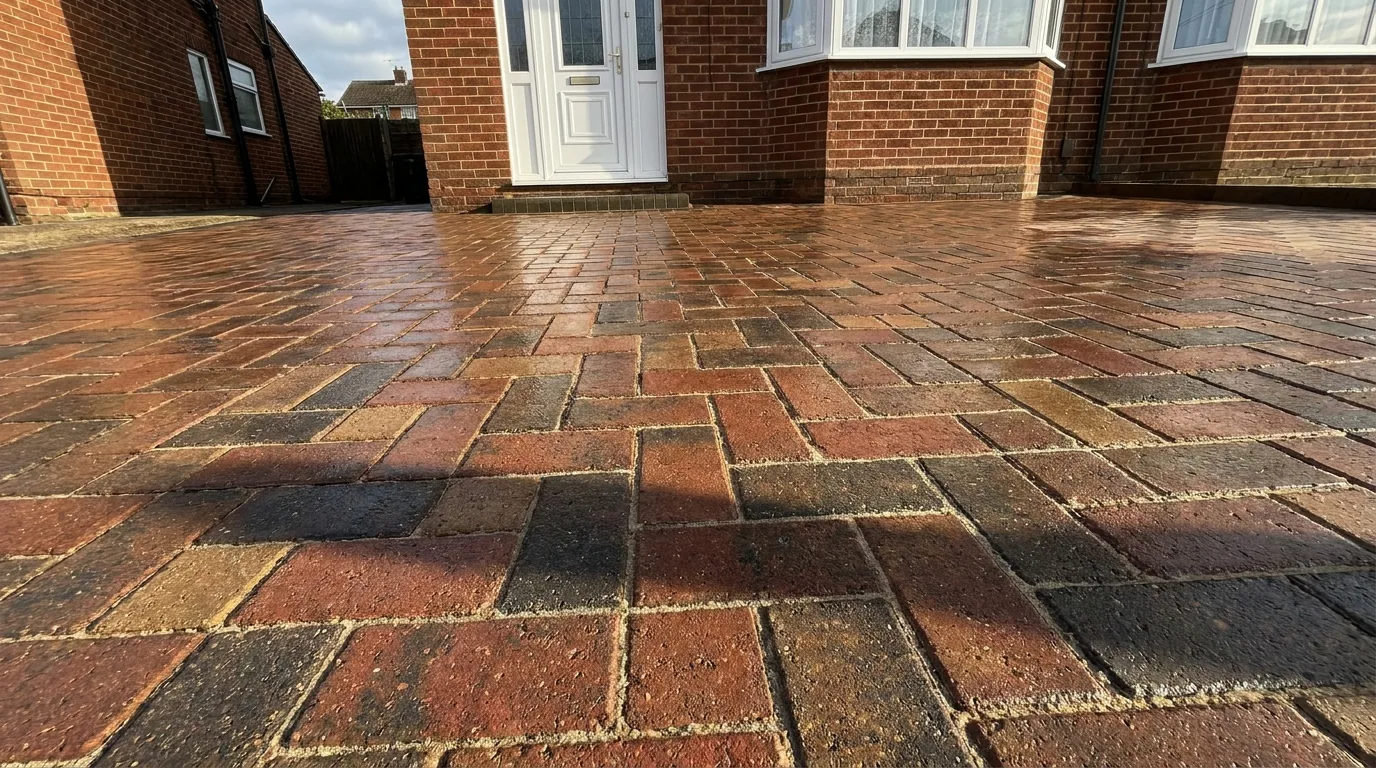
- Two main finishes: matt (natural look) or wet look (gloss)
- Paving must be cleaned, re-sanded, and bone dry first
The quick answer: sealing block paving costs £3–£8 per square metre (£120–£320 for a typical 40 m² drive) and lasts 3–5 years. It’s optional but worthwhile if you’ve got ants, weeds, or oil-stain problems — or if you just want the drive to stay cleaner longer.
This guide covers what sealer actually does, the different types, real costs, and whether it’s right for your driveway. For cleaning costs without sealing, see the block paving cleaning cost guide.
What does block paving sealer actually do?
Sealer creates a protective layer over the blocks and binds the sand in the joints. Here’s what that buys you.
Key benefits
- Stops ants & insects — ants love nesting in kiln-dried sand. Sealer locks the sand in place. This is the number-one reason customers go for it.
- Prevents weed growth — seeds can’t germinate in sealed joints. Existing weeds must be removed first — sealer doesn’t kill them.
- Makes oil stains easier to clean — oil sits on the surface rather than soaking into the blocks. Fresh spills wipe away.
- Reduces moss & algae — sealed surfaces hold less moisture, slowing biological growth.
- Enhances appearance — depending on the type, colours can be deepened and the surface can have a subtle sheen.
- Stabilises sand — joints stay full, not washed out by rain or kicked out by traffic.
What sealing doesn’t do
- Doesn’t make old paving look new — sealer locks in whatever’s there. Dirty or faded paving will look dirty and faded under sealer.
- Doesn’t fix damaged blocks — cracked, chipped, or sunken blocks need sorting first.
- Doesn’t last forever — expect 3–5 years before resealing.
- Doesn’t eliminate cleaning — sealed surfaces still need a wash, just less often.
Types of block paving sealer
Wet look sealer
Appearance: glossy, darkens colours, looks like the paving is permanently wet.
Best for: red, orange, and buff blocks where you want enhanced colour. Popular for driveways.
Considerations: shows tyre marks more readily. Can look artificial on some paving. Glossy finishes can be slippery when wet — look for anti-slip versions.
Price: £4–£6/m² applied.
Matt / invisible sealer
Appearance: no visible change — paving looks natural, just protected.
Best for: natural-stone-effect blocks, grey paving, or anyone who doesn’t want a glossy look.
Considerations: all the protection, no colour enhancement. Good safe choice if you’re unsure.
Price: £3–£5/m² applied.
Colour-enhancing sealer
Appearance: deepens and enriches faded colours without heavy gloss.
Best for: older paving that’s lost its colour. Brings back some of the original look.
Considerations: results vary depending on how faded the original is. Won’t restore heavily worn blocks.
Price: £4–£7/m² applied.
Solvent-based vs water-based
Solvent-based: penetrates deeper, more durable, stronger smell during application, longer dry time. Generally higher performance.
Water-based: lower odour, faster drying, easier to apply, more environmentally friendly. Good for occupied properties where smell’s a concern.
Sealer types compared
| Sealer type | Finish | Lifespan | £/m² | Best for |
|---|---|---|---|---|
| Wet look (solvent) | Glossy, deeper colour | 3–5 yrs | £4–£6 | Red/buff drives wanting vivid colour |
| Matt / invisible | Natural, no sheen | 3–5 yrs | £3–£5 | Grey or natural-effect paving |
| Colour-enhancing | Slight sheen, richer tone | 3–5 yrs | £4–£7 | Faded older paving needing a refresh |
| Polyurethane (premium) | High gloss, very tough | 5–7 yrs | £6–£9 | High-traffic or commercial drives |
Not sure which finish suits your paving? Get a free quote — we’ll recommend the right sealer for your blocks and budget.
Block paving sealing costs (2026 UK prices)
Professional application
- Sealing only: £3–£8/m²
- Typical 40 m² drive: £120–£320
- Typical 60 m² drive: £180–£480
- Small 20 m² patio: £80–£160
What moves the price?
- Sealer type: wet look and colour-enhancing cost more than matt.
- Number of coats: some sealers need two coats for best results.
- Condition: more prep work means higher cost.
- Size: larger areas get a lower per-m² rate.
Cleaning + sealing packages
Most sealing happens straight after a professional block paving clean. Package prices:
- Clean only: £3–£6/m²
- Clean + matt seal: £6–£10/m²
- Clean + wet look seal: £7–£12/m²
For a 40 m² drive, cleaning and sealing together is typically £280–£480.
How long does sealer last?
Quality block paving sealer typically lasts:
- Driveways (regular traffic): 3–4 years
- Patios (foot traffic only): 4–5 years
- High-traffic areas: 2–3 years
- Wheel tracks specifically: 2–3 years (wear faster than the rest)
What shortens the lifespan
- Heavy vehicle traffic
- Power-steering turning on the spot
- Direct sunlight (UV degradation)
- Poor cleaning before sealing
- Cheap sealer products
- Application when too cold or damp
The sealing process: what to expect
Step 1 — professional cleaning
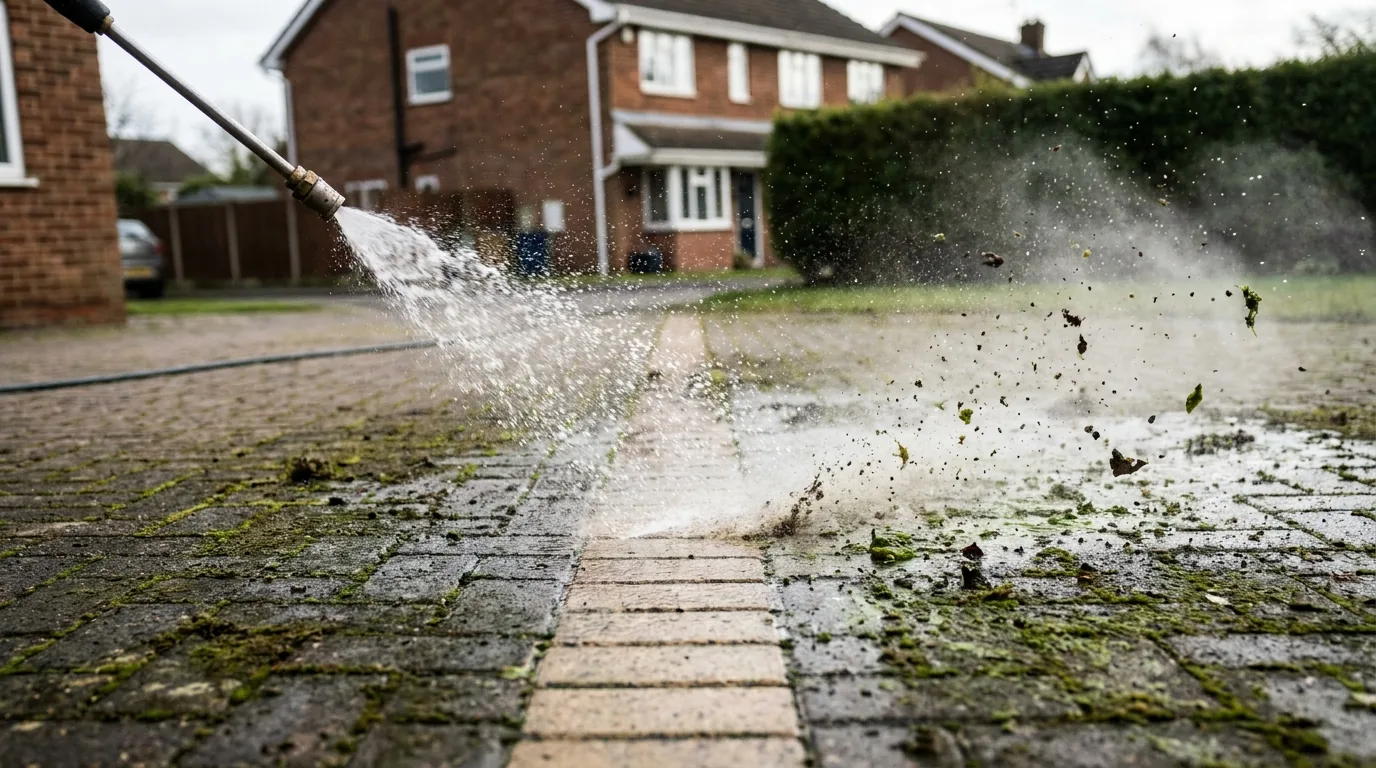
Paving thoroughly pressure-washed to clear dirt, moss, algae, and any old failed sealer. 2–4 hours for a typical drive.
Step 2 — re-sanding
Kiln-dried sand swept into all joints. Has to happen before sealing — the sealer locks the sand in.
Step 3 — drying time
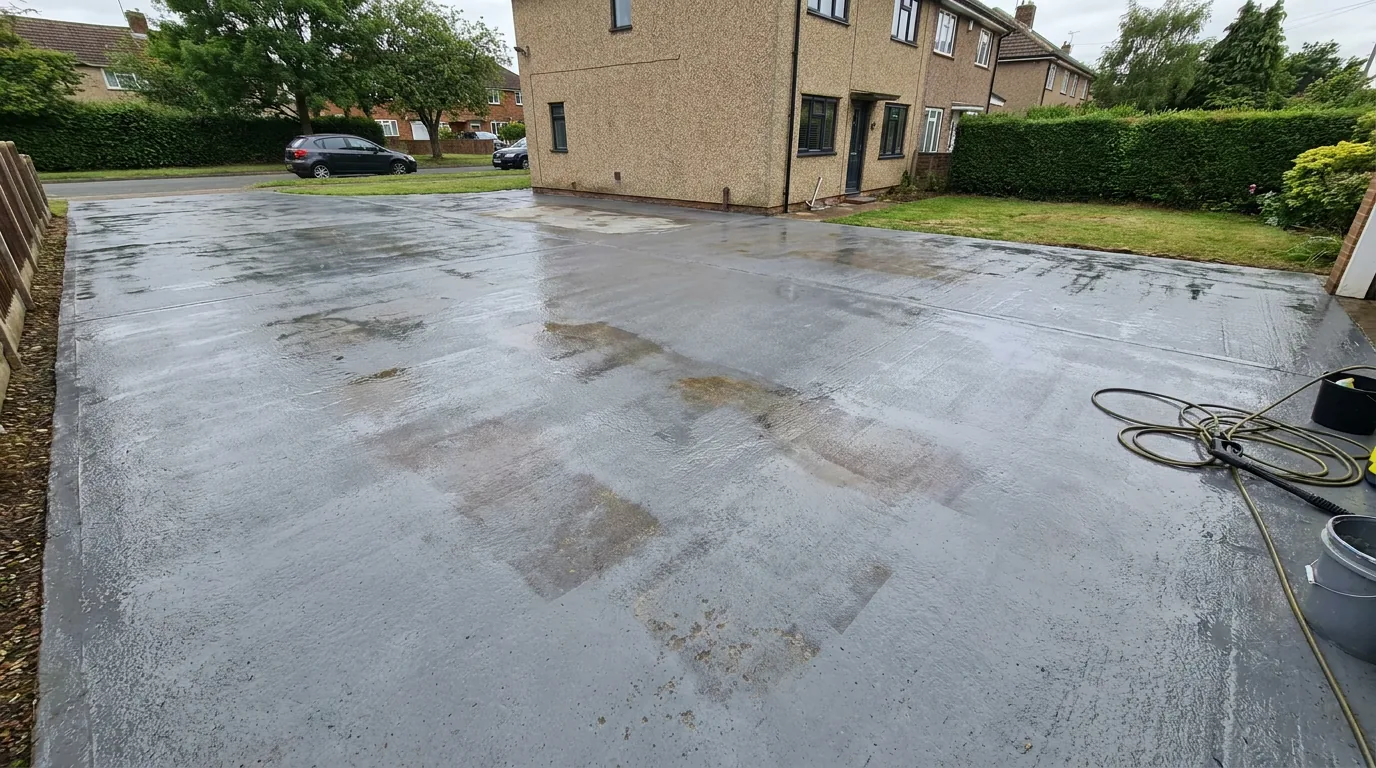
Paving must be completely dry. Minimum 24–48 hours of dry weather. Sealing damp paving causes white hazing that’s very hard to fix.
Step 4 — sealer application
Applied with low-pressure sprayer or roller. Even, consistent coverage is essential. Most sealers need two coats for durability.
Step 5 — curing
Keep off for 24 hours minimum. Full cure takes 48–72 hours. No vehicles for at least 48 hours.
Can I seal block paving myself?
DIY sealing is possible, but the most common reason sealer fails is poor preparation.
What you’ll need
- Properly cleaned paving — professional pressure washing recommended.
- Re-sanded joints — kiln-dried sand only, never builders sand.
- Bone-dry surface — 48 hours minimum dry weather before sealing.
- Quality sealer — £60–£120 for 40 m². Don’t buy cheap unbranded products.
- Low-pressure sprayer or roller — £20–£50.
- Dry weather forecast — no rain for 24–48 hours after application.
Common DIY mistakes
- Sealing over dirt: locks staining in permanently.
- Sealing when damp: causes white cloudy patches that can’t be removed.
- Uneven application: creates a blotchy appearance.
- Cheap sealer: yellows, peels, fails within months.
- Wrong type for surface: some sealers aren’t compatible with certain blocks.
Is block paving sealing worth it?
Sealing is worth it if:
- You’ve got ant problems
- Weeds keep coming back despite removal
- You park vehicles that might drip oil
- You want to reduce cleaning frequency
- You like the wet-look appearance
- The paving’s in good condition and you want to keep it that way
Sealing may not be worth it if:
- The paving’s old and heavily worn
- There’s significant damage that needs fixing first
- You don’t have ant or weed problems
- Budget’s very tight (cleaning alone still helps a lot)
- The paving sits in heavy shade (less sun = slower sealer degradation, but also slower benefit)
Areas we cover
We seal block paving across Surrey within 20 miles of Redhill (RH1) — Redhill, Reigate, Horley, Dorking, Banstead, Oxted, Leatherhead, Epsom, Crawley, and all 15+ areas. We’ll tell you honestly whether sealing is worthwhile for your specific situation — sometimes cleaning alone is the smarter move.
Original analysis and sources
Original analytical contribution: Resiblock manufacturer-stated sealant lifespan is up to 5 years[7]; Surrey's drier 648mm/yr rainfall[1] pushes wear to the upper end, putting true annual cost at £0.60–£1.50/m²/yr for concrete block paving. The sealing economics are favourable for block paving; not always for Indian sandstone where non-breathable sealants trap moisture against a 6–9% porous substrate.
Key sourced claims in this guide: Surrey rainfall baseline 648 mm/yr per Met Office Wisley[1], annual biocide cadence per Lithofin Algex manufacturer guidance[2], medium-pressure / 30° oblique / ≥200 mm-standoff technique per Marshalls[3], HSE-endorsed slip-risk methodology[4], and PTV ≥36 low-slip threshold from UKSRG pendulum-test guidance[5].
Sources
Every numeric claim, technique parameter, and safety threshold in this guide is sourced from a manufacturer technical bulletin, BS standard, or .gov.uk reference. We cite the bodies whose data and rules actually govern UK pressure-washing outcomes — not the unsourced ranges repeated across competitor blogs.
- Met Office — Wisley (Surrey) Location Long-Term Averages 1991–2020. Closest Met Office station to RH1. Annual rainfall 648.41 mm; Surrey is ~43% drier than the UK national mean of ~1,147 mm. metoffice.gov.uk — Wisley averages. Accessed 21 May 2026.
- Lithofin — ALGEX Special Cleaner product page. Manufacturer guidance: spray annually, preferably in spring. 6–12 month residual activity. lithofin.com — ALGEX. Accessed 21 May 2026.
- Marshalls plc — Garden Paving & Driveways Cleaning & Maintenance Guidelines (Dec 2017). Technique: medium pressure, 30° lance, 200mm minimum standoff. marshalls.co.uk — cleaning guidelines (PDF). Accessed 21 May 2026.
- Health and Safety Executive (HSE) — Slips and trips at work. HSE-preferred slip-risk methodology; PTV ≥36 wet-acceptance threshold. hse.gov.uk — slips and trips. Accessed 21 May 2026.
- UK Slip Resistance Group — Introduction to the Pendulum Tester (BS 7976: Parts 1-3). PTV ≥36 = low slip risk threshold for outdoor pedestrian surfaces. ukslipresistance.org.uk — pendulum tester. Accessed 21 May 2026.
- Kärcher — K7 consumer pressure washer manufacturer datasheet. 180 bar (~2,610 PSI), 600 L/hr. kaercher.com — K7 product page. Accessed 21 May 2026.
- BSI — BS 7533-101:2021 Code of practice for modular paving units. Treats jointing material as load-transfer system. bsigroup.com — BS 7533-101:2021. Accessed 21 May 2026.
- Resiblock Ltd — Block Paving Sealer Product Data Sheets. Manufacturer-stated lifespan up to 5 years. resiblock.com — technical data sheets. Accessed 21 May 2026.
- UK Government (gov.uk) — National Living Wage rates from April 2026: £12.71/hr (age 21+). The legal floor for valuing UK labour and DIY time. gov.uk/national-minimum-wage-rates. Accessed 21 May 2026.
- Thames Water — 2026/27 Charges. Combined water + wastewater rate £4.21/m³. thameswater.co.uk — bill value. Accessed 21 May 2026.