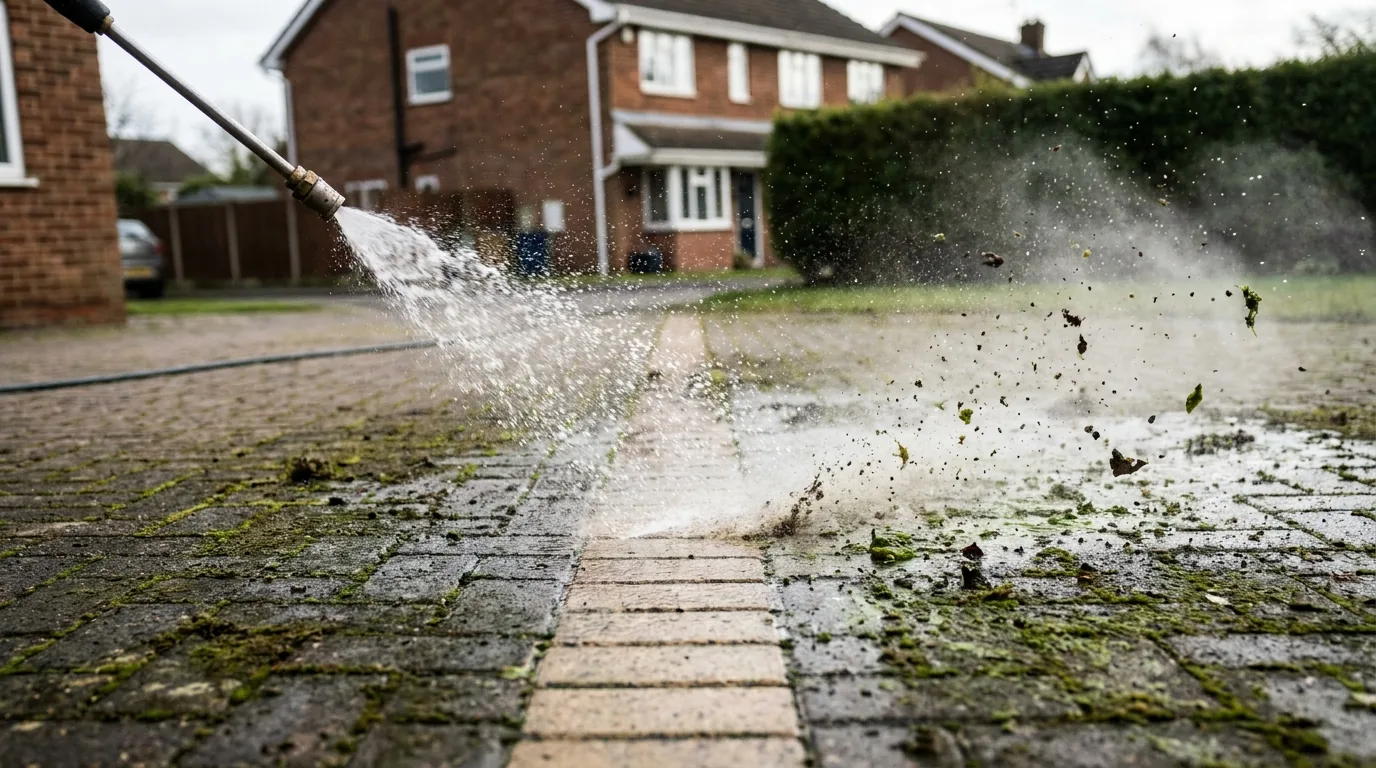
Why the same “driveway clean” means four different protocols
The short answer: A driveway clean done right is four different jobs depending on the surface. Block paving (the Surrey default) needs Marshalls medium-pressure technique[1] (30° oblique, ≥200 mm standoff) plus mandatory re-sand per BS 7533-101[2]. Tarmac needs reduced pressure to avoid lifting bitumen. Concrete tolerates higher pressure. Indian sandstone and natural stone need soft-wash chemistry only — high pressure pits the surface. Behind all of it, biocide cadence per Lithofin Algex annual guidance[4] and HSE PTV ≥36 slip-risk threshold[6] set the re-clean interval at 12–24 months depending on substrate and aspect.
The four-surface driveway-cleaning protocol matrix
Original analytical contribution: the labelled OAC below isolates the four UK residential driveway surface types and maps named manufacturer/standard constraints against each. No competitor publishes a per-surface protocol matrix with cited technique sources; they default to a single “driveway cleaning” pricing tier.
| Surface | Marshalls / Karcher constraint | Re-sand? | Cadence (months) |
|---|---|---|---|
| Block paving | Medium pressure, 30° oblique, ≥200 mm standoff (Marshalls[1]); no turbo | Yes (BS 7533-101 load-bearing[2]) | 12–24 |
| Tarmac | Reduced pressure, wide-fan nozzle; avoid lifting bitumen | No | 12–24 |
| Concrete (plain) | Higher pressure tolerated; Karcher K7 spec 180 bar, 600 L/hr[3] | No | 12–18 (oil-stained urban) / 18–30 (rural) |
| Concrete (patterned / imprinted) | Reduced pressure to preserve print pattern | No | 18–30 |
| Indian sandstone / natural stone | Soft-wash chemistry only; pressure pits porous stone | Joint-pointing care only | 12–18 |
Cadence figures reflect Surrey conditions with Met Office Wisley[7] rainfall baseline of 648 mm/yr. Annual Lithofin Algex[4] spring biocide is the manufacturer-stated minimum for sustained PTV ≥36 slip threshold[6] on shaded north-facing drives.
What you get for the price
A proper driveway clean isn’t just running a pressure washer over the surface. It’s pre-treatment for organic growth, the right pressure for the surface type, hand-detailing the edges, and putting the joints back together properly when we’re done. That’s the whole job — not three of those things plus an upsell.
- Biocide moss & algae treatment (Lithofin Algex[4] or equivalent; 24–48 hr dwell)
- Surface-cleaner pass on the main slab (Marshalls technique[1]: medium pressure, 30° oblique, ≥200 mm standoff)
- Hand-finished edges and kerb lines
- Oil stain pre-treatment with Lithofin Oil-EX[5] (2 mm coat, 12 hr dwell, ~0.5 m²/kg coverage)
- Re-sanding block paving joints with kiln-dried sand (BS 7533-101 load-bearing requirement[2])
- Final rinse and full clear-up
Surfaces we clean
Block paving
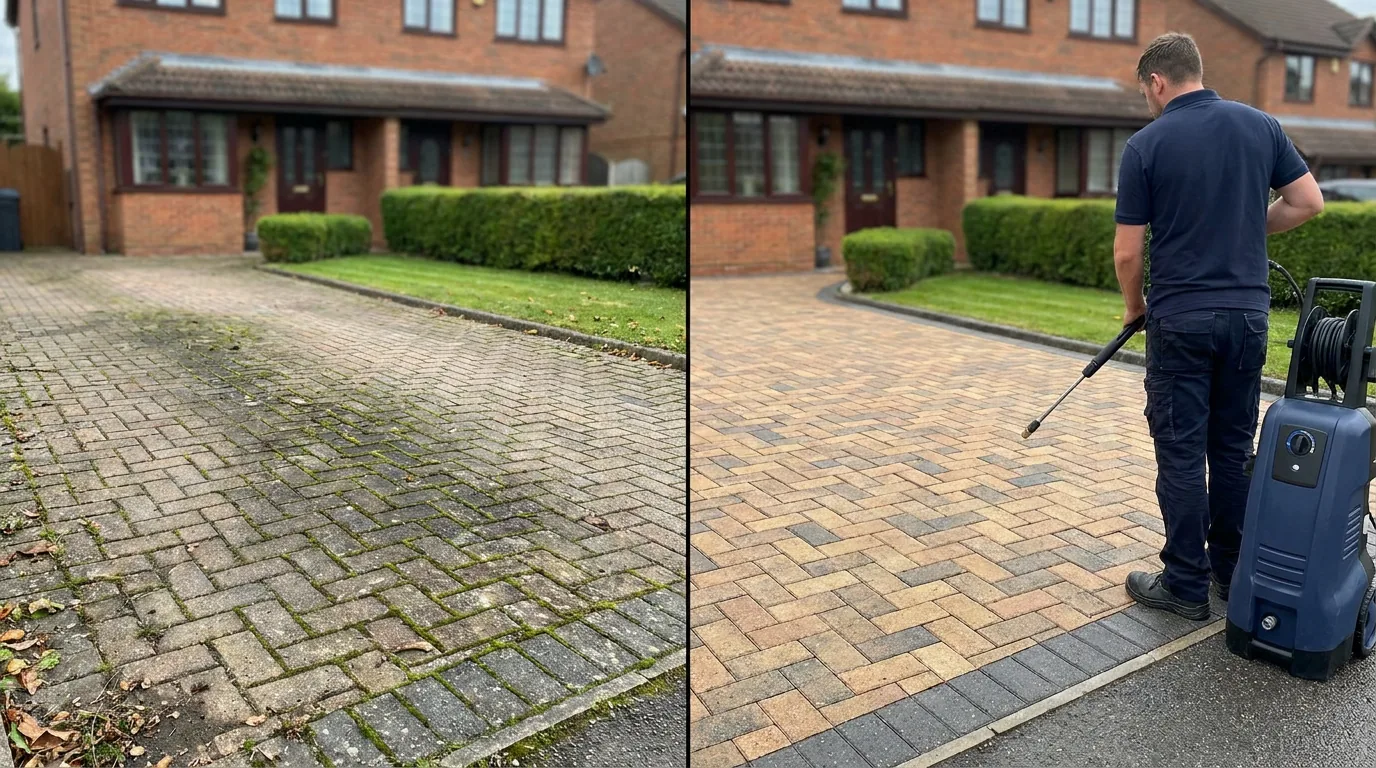
The most common Surrey driveway, and the one most people don’t realise needs re-sanding after pressure washing. BS 7533-101:2021[2] treats the jointing sand as part of the structural load-transfer system — lose it, and the surface starts to creep under tyre load within 18 months. We clean, brush in fresh kiln-dried sand, and rinse to lock it in. Marshalls cleaning guidelines[1] specify medium pressure, 30° oblique angle, ≥200 mm standoff — never turbo / dirt-blaster nozzles, which risk Marshalls Register warranty rejection on Drivesett and Tegula installs.
Tarmac
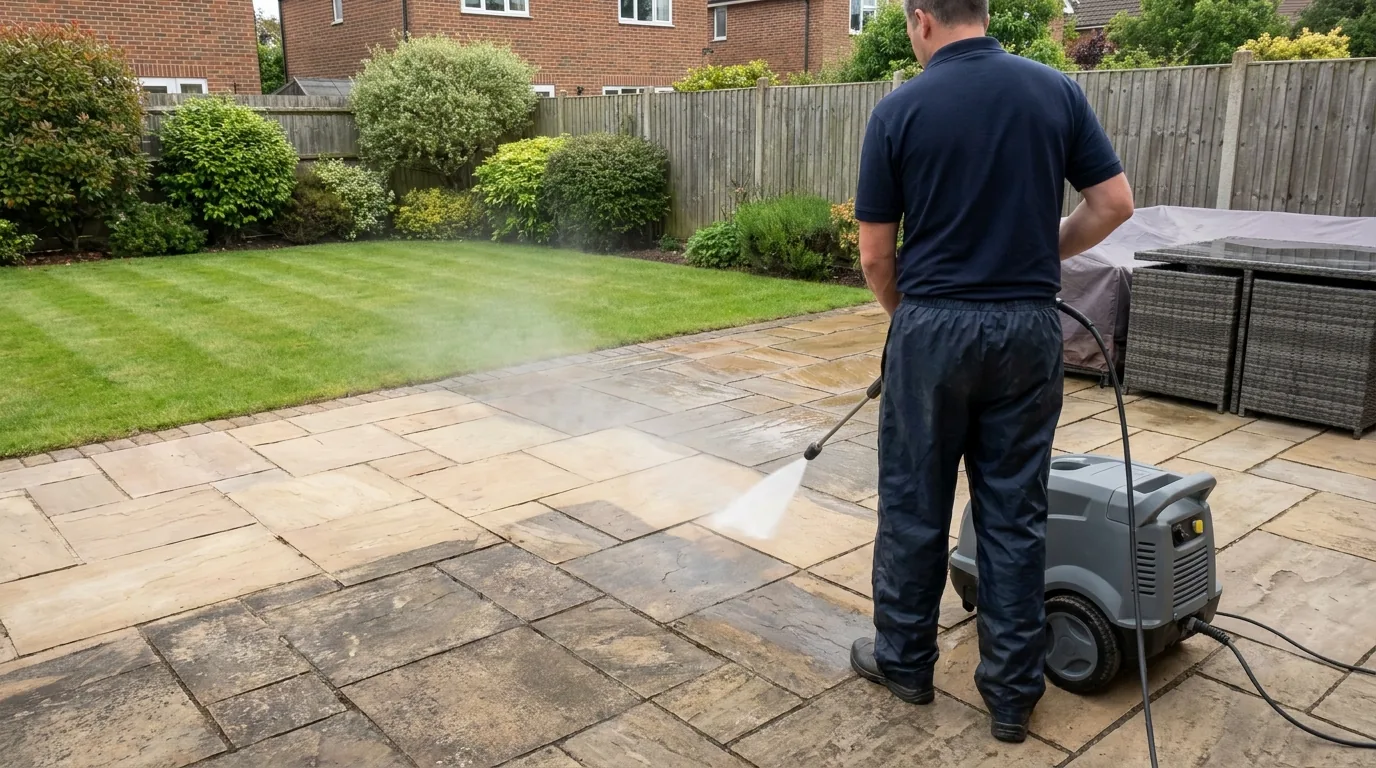
Lower pressure, careful technique. Tarmac done badly looks worse afterwards — we use a wide-fan nozzle and the surface cleaner at reduced pressure to avoid lifting the bitumen.
Concrete
Tougher surface, takes a higher pressure. The Karcher K7 consumer flagship[3] at 180 bar (~2,610 PSI) and 600 L/hr is the spec we approximate. Patterned or imprinted concrete is the exception — we work that more carefully to avoid damaging the print pattern.
Indian sandstone & natural stone
Porous and easy to over-clean. We drop the pressure and use a soft-wash treatment for moss and black-spot rather than blasting it out of the surface. Annual Lithofin Algex[4] spring biocide is the manufacturer-stated cadence.
Slip-risk and PTV thresholds
HSE-endorsed UKSRG pendulum guidance[6] sets PTV (Pendulum Test Value) ≥36 as the low-slip threshold for outdoor pedestrian surfaces. Algae and moss are the two contaminants that drop outdoor paving below threshold fastest. The implication for cadence: north-facing shaded drives across Surrey cross PTV 36 in autumn even on chalk-substrate areas like Banstead and Reigate Hill, which is why annual biocide is non-negotiable not an upsell.
Surrey substrate context: cadence varies by postcode
Met Office Wisley[7] records 648 mm/yr rainfall — ~43% below the UK average. But cadence isn’t driven by total rainfall; it’s driven by substrate drainage + tree shade. SM7 Banstead chalk drives stretch to 18–24 months; RH6 Horley Weald Clay drives tighten to 12–18; the Mole Valley RH4/RH5 microclimate tightens further to 10–15. See our area pages for the per-postcode framework.
Areas we cover
Across all of Surrey within 20 miles of Redhill (RH1). That includes Redhill, Reigate, Horley, Dorking, Banstead, Caterham, Godstone, Chipstead, and the rest of all 15+ areas.
Useful guides
Want to dig deeper before you book? Full cost guide · Can it damage your driveway? · Moss removal guide · Tarmac specifics · Weeds in block paving · Efflorescence
Sources
Every protocol on this page is sourced. Primary data and manufacturer technical guidance only. We do not cite competitor pressure-washing blogs.
- Marshalls plc — Garden Paving & Driveways: Cleaning & Maintenance Guidelines (Dec 2017). Medium pressure, 30° oblique, ≥200 mm standoff. Re-sand if joints are washed out. marshalls.co.uk — cleaning guidelines (PDF). Accessed 21 May 2026.
- BSI — BS 7533-101:2021 “Pavements constructed with clay, concrete or natural stone paving units — Code of practice for the structural design of pavements using modular paving units.” Treats jointing material as part of the structural load-transfer system. bsigroup.com — BS 7533-101:2021. Accessed 21 May 2026.
- Kärcher — K7 consumer pressure washer manufacturer datasheet. 180 bar (~2,610 PSI), 600 L/hr (~2.65 GPM) flow rate. kaercher.com — K7 product page. Accessed 21 May 2026.
- Lithofin AG — Algex Special Cleaner product page and technical information. Annual reapplication interval, preferably in spring. lithofin.com — Algex. Accessed 21 May 2026.
- Lithofin AG — Oil-EX Oil Stain Remover product page. 2 mm coating thickness, ~12 hr dry time, coverage ~0.5 m²/kg. lithofin.com — Oil-EX. Accessed 21 May 2026.
- UK Slip Resistance Group / HSE — Introduction to the Pendulum Tester. HSE-endorsed slip-risk method using BS 7976 Parts 1–3. Widely adopted thresholds: PTV ≥36 low risk, 25–35 moderate, ≤24 high. ukslipresistance.org.uk — pendulum tester. Accessed 21 May 2026.
- Met Office — Wisley (Surrey) Location Long-Term Averages 1991–2020. Closest station to RH1. Annual rainfall 648.41 mm. metoffice.gov.uk — Wisley averages. Accessed 21 May 2026.