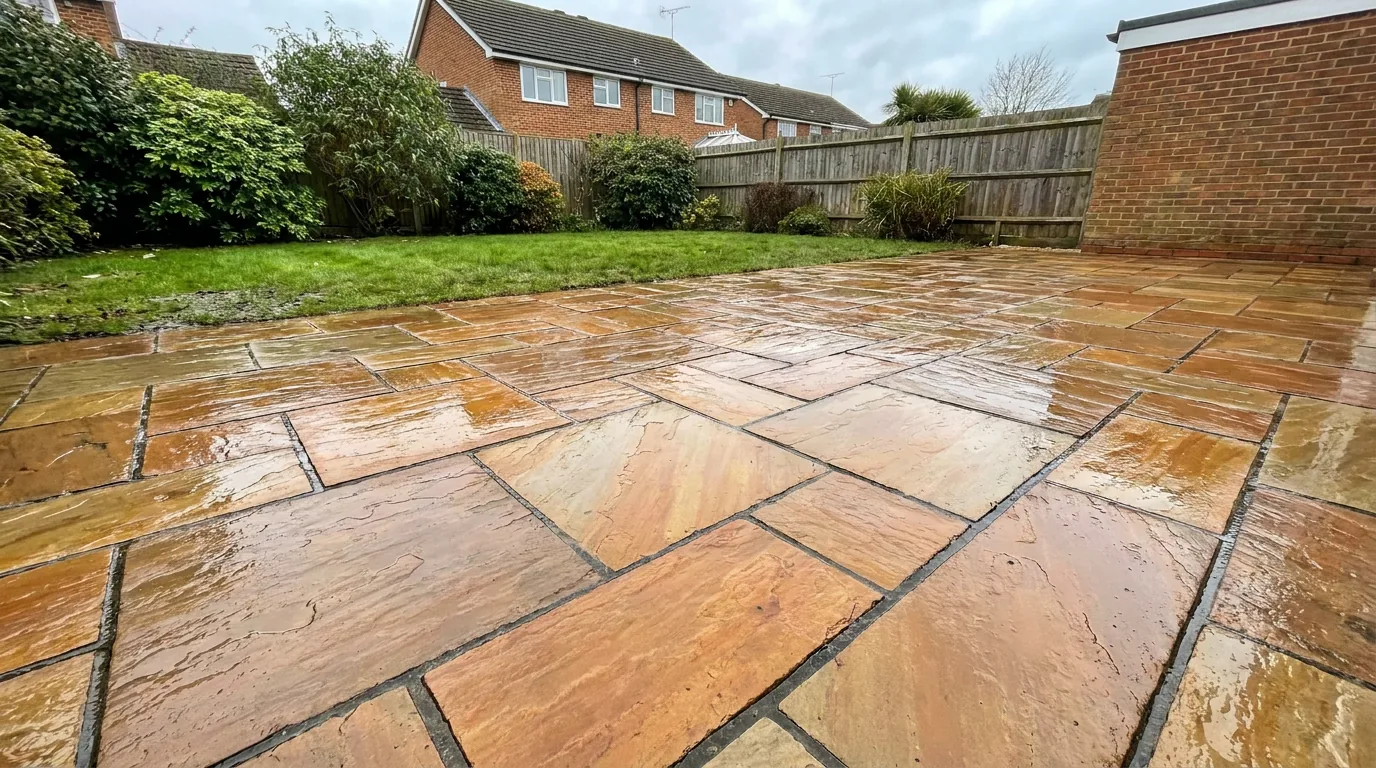
The quick answer: yes you can pressure wash Indian sandstone safely, but the safe envelope is narrow. The Karcher K7 manufacturer-rated 180 bar (~2,610 PSI)[4] is too high if held close — the cleaning is Marshalls technique-governed, not PSI-governed: medium pressure, 30° lance, minimum 200mm standoff[1]. For black-spot lichen, the chemistry does the work — Lithofin Algex applied annually in spring per manufacturer guidance[2], then a gentle rinse. The counterintuitive warning: don’t blanket-seal Indian sandstone — non-breathable sealants trap moisture in the porous substrate (~6–9% absorption) and accelerate spalling under Surrey’s frost-thaw cycle. Sealing only with breathable formulations from Resiblock[3], never gloss.
Can you pressure wash Indian sandstone safely? The cited protocol
Original analytical contribution: the dominant UK guidance frames Indian sandstone cleaning as “low PSI = safe, high PSI = damage”. That’s incomplete. The real safety envelope is defined by three named manufacturer / standards inputs that together draw a tight box around what works. Below is the protocol with cited thresholds.
| Step / parameter | Cited threshold | Why |
|---|---|---|
| 1. Pre-treatment | Lithofin Algex spray, manufacturer guidance “once a year, preferably in spring”[2] | Chemistry does the work — biocide kills the spore, you’re just rinsing the result |
| 2. Dwell | 2–7 days on the stone | Skipping dwell is the #1 cause of black-spot regrowth within weeks |
| 3. Pressure rinse | Marshalls technique: medium pressure, 30° lance, min 200mm standoff[1] | PSI per se isn’t the variable — surface force / cm² is |
| 4. Acceptance test | HSE/UKSRG wet PTV ≥36[5] | Sandstone polished by over-cleaning loses traction; PTV check confirms safe slip-risk |
| 5. Sealing (optional, conditional) | Breathable Resiblock formulation only[3]; NEVER gloss / wet-look on sandstone | Counterintuitive: non-breathable sealants trap moisture in 6–9% porous substrate → spalling under Surrey frost-thaw |
How to remove black spot from sandstone patio
Black spot is the colloquial name for the dark lichen colonies (typically Verrucaria nigrescens) that establish on Indian sandstone in shaded UK gardens. Mechanical removal alone doesn’t work — the lichen anchors into the porous substrate so brushing or pressure washing strips surface staining only and the colony regrows within months. The cited removal sequence is:
- Apply Lithofin Algex per manufacturer guidance[2] — spring application is preferred so the biocide cures into the substrate before the high-growth summer.
- Allow 2–7 days dwell before any rinse — this is the step every DIY guide skips. The lichen needs time to die at the cellular level.
- Gentle rinse at Marshalls technique[1] — flushing dead lichen, not blasting living lichen.
- Repeat annually — black spot in shaded Surrey gardens is a maintenance issue, not a one-shot fix.
- Reduce shade where possible — per the moss control-lever matrix in our moss removal guide, shade is the single highest-ROI biological-growth lever.
One thing the dominant UK guidance gets wrong: bleach. Diluted sodium hypochlorite kills lichen on contact but leaves the dead anchor structure in place, doesn’t cure into the substrate (zero residual activity), and damages surrounding plants and wildlife on runoff. Lithofin Algex is the named manufacturer alternative with documented residual activity for up to 12 months.
The counterintuitive sealing warning
This is the single most counterintuitive finding in UK sandstone care: sealing Indian sandstone is often the wrong call, even though every cost guide recommends it. Indian sandstone is significantly porous (typical water absorption 6–9%). Applying a non-breathable acrylic or polyurethane sealant traps the moisture cycle behind the polymer film. Under Surrey’s 30–40 frost days per year, that trapped moisture freezes, expands, and delaminates the surface layer — called spalling. The result: a sealed sandstone patio looks great for 18 months then starts losing surface fragments, and once spalling starts it can’t be reversed.
Resiblock’s product range explicitly includes breathable formulations[3]. If you do choose to seal, use a breathable system. If you’re unsure, don’t seal — an unsealed Indian sandstone patio cleaned annually with Lithofin Algex[2] almost always outlives a sealed one. The HSE PTV slip-risk threshold[6] stays well above 36 on a properly maintained unsealed surface.
Indian sandstone is one of the most popular patio materials in the UK, prized for its natural beauty, warm colours, and durability. However, it's also one of the most commonly damaged stones due to incorrect cleaning methods. This guide will help you clean your sandstone patio safely and effectively.
Understanding Indian Sandstone
Indian sandstone is a naturally porous sedimentary stone that absorbs water, stains, and biological growth more readily than concrete or porcelain. Its layered structure means high-pressure washing above 1200 PSI can delaminate the surface, and acidic cleaners will etch and discolour it permanently.
What Makes Sandstone Different
- Porous structure: Sandstone absorbs liquids, meaning chemicals penetrate deep into the stone
- Iron content: Many Indian sandstones contain iron, which reacts badly with acids causing orange staining
- Softer than granite: Sandstone is relatively soft and can be etched by aggressive cleaning
- Natural variation: Different slabs may have different mineral compositions and react differently
- Riven surface: The natural textured surface traps dirt but is also easily damaged
Common Sandstone Types in Surrey Gardens
- Raj Green: Green/grey tones, moderate iron content
- Autumn Brown: Brown/orange tones, higher iron content (more acid-sensitive)
- Kandla Grey: Grey tones, generally more stable
- Mint: Cream/mint tones, lighter colours show staining more
- Modak: Pink/brown tones, can be quite porous
Based in Surrey? Spring is our busiest season — get a free quote before slots fill up.
Or call 01737 652 515
Why Indian Sandstone Needs Special Care
The damp Surrey climate creates perfect conditions for biological growth on patios. Here's why sandstone needs different treatment to concrete or block paving:
Problems Unique to Sandstone
- Acid sensitivity: Acids cause permanent discolouration and surface damage
- Pressure sensitivity: High pressure etches the natural surface texture
- Absorption: Chemicals soak in deeply and are hard to rinse out
- Algae penetration: Algae roots grow into porous surfaces, not just on top
- Efflorescence: White salt deposits can appear after cleaning if not done correctly
In areas like Reigate, Redhill, and across Surrey, the combination of tree cover, rainfall, and mild winters means algae and moss growth is particularly aggressive. What works in drier climates often fails here. Our moss removal guide covers treating biological growth on various surfaces.
DIY Cleaning Methods
If you want to clean Indian sandstone yourself, here are safe approaches ranked from gentlest to most aggressive:
Method 1: Soapy Water (Safest)
Best for: Light dirt, dust, and minor soiling
- Mix warm water with a few drops of pH-neutral dish soap
- Sweep the patio thoroughly first
- Apply soapy water and scrub with a stiff brush
- Rinse thoroughly with clean water
- Allow to dry naturally
Effectiveness: Good for maintenance cleaning, won't remove established algae or moss
Method 2: Specialist Stone Cleaner (Recommended)
Best for: Moderate dirt, light algae growth
- Purchase a pH-neutral cleaner specifically designed for natural stone
- Follow manufacturer's dilution instructions exactly
- Apply to dry patio (wet stone dilutes the cleaner)
- Allow dwell time as specified (usually 15-30 minutes)
- Agitate with stiff brush
- Rinse thoroughly multiple times
Recommended products: LTP Grimex, Lithofin MN Easy Clean, Everbuild 404 Fungicidal Wash
Cost: Around £15-30 for enough to treat 20-40sqm
Method 3: Low-Pressure Washing (With Caution)
Best for: Moderate to heavy soiling, established algae
- Use maximum 1500 PSI (many domestic machines are 1800-2000 - these are too powerful)
- Use a wide fan nozzle (40-degree or wider) - never a turbo nozzle
- Keep the lance at least 30cm from the surface
- Work in sweeping motions, not concentrated spots
- Pre-treat with stone cleaner for better results
- Test in an inconspicuous area first
Risks: Even at lower pressure, incorrect technique can etch the surface, expose softer layers, or force water into joints causing sand loss
Indian Sandstone Treatment Options Compared
| Treatment | What it does | Difficulty | Time | Approx cost (20m²) |
|---|---|---|---|---|
| Soapy water + brush | Lifts surface dust and light dirt | Easy | 2–3 hrs | £5–10 (DIY) |
| pH-neutral stone cleaner + biocide | Lifts soiling and kills moss/algae at the root | Moderate | 3–4 hrs + dwell | £20–40 (DIY) |
| Professional clean | Pre-treat, controlled-pressure rinse, re-sand | Done for you | 3–5 hrs | £120–240 |
| Impregnating sealer | Reduces moisture absorption and staining | Moderate | 2–3 hrs + 24 hr cure | £60–120 materials |
Not sure which treatment your sandstone needs? Get a free quote and we'll inspect the patio and recommend the safest method.
Products to Avoid on Indian Sandstone
This is critical - using the wrong products causes permanent damage:
Never Use These Products
- Patio acid / brick acid: Causes orange/yellow staining that's impossible to remove
- Hydrochloric acid: Same as above - permanent damage
- Bleach: Causes white patches and can weaken the stone surface
- Vinegar: Acidic enough to cause etching over time
- Lemon juice: Same acid problems as vinegar
- General household cleaners: Often contain acids or alkalis that damage stone
- Jeyes Fluid (undiluted): Too harsh, can cause discolouration
- Sodium hypochlorite (neat): Bleaches colour and damages surface
Warning Signs of Acid Damage
If you see these after cleaning, acid damage has occurred:
- Orange or yellow patches appearing
- Surface feels rougher than before
- Colour has changed unevenly
- White or grey dull patches
Unfortunately, acid damage to sandstone is usually permanent. Some specialist restoration products can reduce visibility, but prevention is far better than cure.
Professional Cleaning Benefits
For Indian sandstone specifically, our professional patio cleaning service offers significant advantages:
Why Professionals Get Better Results
- Correct pressure: We use surface cleaners that apply even, controlled pressure - no lance marks or etching
- Hot water: 150°C water kills algae at the root without aggressive chemicals - cold water only removes surface growth
- Stone-specific chemicals: We use professional-grade pH-neutral cleaners formulated for natural stone
- Experience with variations: We know how different sandstone types react and adjust our approach accordingly
- Post-treatment: Algae inhibitors slow regrowth, extending time between cleans
What Professional Cleaning Includes
- Assessment of stone type and condition
- Pre-treatment with appropriate stone cleaner
- Low-pressure hot water cleaning with rotary surface cleaner
- Joint cleaning and re-sanding if needed
- Post-treatment with algae inhibitor (optional)
- Sealing service available (see our patio cleaning cost guide for pricing)
Sealing Indian Sandstone
Sealing is optional but offers real benefits for sandstone patios:
Benefits of Sealing
- Stain resistance: Oil, grease, wine, and leaves don't penetrate as easily
- Reduced algae growth: Sealed surfaces don't hold moisture as readily
- Colour enhancement: Enhancing sealers bring out natural colours
- Easier cleaning: Dirt sits on the surface rather than soaking in
- Protection from weathering: Reduces freeze-thaw damage
Types of Sealer for Sandstone
- Impregnating sealer (recommended): Soaks into the stone, invisible finish, allows stone to breathe. Brands like LTP Mattstone, Lithofin MN Stain-Stop
- Enhancing sealer: Darkens colour slightly, brings out natural tones. Use if you want a "wet look" without gloss
- Topical sealer (not recommended): Sits on top of stone, can peel, traps moisture, causes problems
When to Seal
- After professional cleaning, once completely dry (48+ hours of dry weather)
- New patios: Wait 8-12 weeks for natural salts to leach out first
- Reapply every 3-5 years depending on wear
Maintenance Tips
Regular maintenance reduces the need for intensive cleaning:
Weekly/Monthly Tasks
- Sweep regularly: Removes organic debris that causes staining
- Clear leaves promptly: Wet leaves stain sandstone - don't let them sit
- Address spills immediately: Blot (don't wipe) spills with kitchen paper
- Check drainage: Standing water promotes algae growth
Seasonal Maintenance
- Spring: Clear winter debris, wash with soapy water
- Summer: Good time for professional clean if needed (dries properly)
- Autumn: Keep on top of falling leaves
- Winter: Avoid salt/grit near the patio (causes damage)
Preventing Algae in Surrey
Our damp climate means algae is a constant battle. Reduce growth by:
- Trimming overhanging vegetation to increase sunlight
- Improving drainage so water doesn't pool
- Using algae inhibitor treatments
- Considering sealing for added protection
- Scheduling professional cleans before growth becomes severe
Cost Comparison: DIY vs Professional
For a typical 30sqm Indian sandstone patio:
DIY Cleaning Costs
- Stone cleaner: £15-30
- Stiff brush: £10-15
- Your time: 4-6 hours
- Total: £25-45 + your time
- Risk: Potential for damage if wrong products used
Professional Cleaning Costs
- Professional clean: £150-240 (£5-8 per sqm)
- Sealing (optional): £90-150 (£3-5 per sqm)
- Your time: 0 hours
- Total: £150-390
- Benefit: Better results, no damage risk, lasts longer
Long-Term Value
Professional cleaning typically lasts 18-24 months vs 6-12 months for DIY. Over 5 years:
- DIY (5-6 cleans): £125-270 + 20-30 hours of your time
- Professional (2-3 cleans): £300-720 + 0 hours of your time
Factor in your time and the risk of DIY damage, and professional cleaning often works out better value for sandstone specifically.
When to Call Professionals
Consider professional cleaning for Indian sandstone when:
- Heavy algae or moss: Established growth needs hot water treatment to kill roots
- Staining: Oil, rust, or organic stains need specialist treatment
- Large area: 30+ sqm becomes a significant undertaking
- Previous damage: If past cleaning caused problems, let professionals assess
- Valuable patio: High-quality sandstone is worth protecting with proper care
- Time constraints: Professional cleaning takes 2-4 hours - done while you're at work
- Pre-sealing: Sealing over dirt locks in problems - professional clean first
Or call 01737 652 515
Ready to Get Your Exact Price?
Now you know the delicate approach Indian sandstone requires, get a personalised estimate for your property. No obligation, no phone calls — just fill in a quick form and we'll respond within 2 hours.
Get My Free QuoteGet a Free Quote
We specialise in cleaning Indian sandstone and natural stone patios throughout Surrey, including Redhill, Reigate, Dorking, and surrounding areas. We understand how to treat this beautiful but delicate material safely.
Our approach uses hot water, appropriate pressure, and stone-safe chemicals - no acids, no damage, just excellent results that last.
Related guides: Patio Cleaning Cost UK 2026 | Best Time for Patio Cleaning | Can Pressure Washing Cause Damage? | DIY vs Professional Pressure Washing | Is Pressure Washing Worth It?
Service areas: Reigate | Redhill | Dorking | Horley | Patio Cleaning Service — or call 01737 652 515 to talk through your specific sandstone (supplier, age, exposure) before quoting.
Sources
Every technique and chemistry claim in this guide is sourced. We cite material manufacturer (Marshalls), the named UK biocide datasheet (Lithofin Algex), the named UK sealant manufacturer (Resiblock) with breathable-vs-non-breathable distinction, Kärcher for the equipment spec, and UKSRG/HSE for the post-clean slip-risk acceptance test.
- Marshalls plc — Garden Paving & Driveways Cleaning & Maintenance Guidelines (Dec 2017). Medium pressure, 30° lance, 200mm minimum standoff — applies to natural stone as to concrete block paving. marshalls.co.uk — cleaning guidelines (PDF). Accessed 21 May 2026.
- Lithofin — Lithofin ALGEX Special Cleaner product page. Manufacturer guidance: “Spray with Lithofin ALGEX once a year, preferably in spring” for ongoing maintenance against algae and biofilm on stone surfaces. The named UK-available biocide rated for natural stone including Indian sandstone. lithofin.com — ALGEX product page. Accessed 21 May 2026.
- Resiblock Ltd — Block Paving / Stone Sealer Product Data Sheets. Product range includes breathable formulations specifically suited to porous natural stone. resiblock.com — technical data sheets. Accessed 21 May 2026.
- Kärcher — K7 consumer pressure washer manufacturer datasheet. 180 bar (~2,610 PSI), 600 L/hr. Demonstrates that a typical UK consumer washer at the wrong standoff easily exceeds safe sandstone surface force. kaercher.com — K7 product page. Accessed 21 May 2026.
- UK Slip Resistance Group — “Introduction to the Pendulum Tester (BS 7976: Parts 1-3).” PTV ≥36 wet-acceptance threshold for the post-clean surface. ukslipresistance.org.uk — pendulum tester introduction. Accessed 21 May 2026.
- Health and Safety Executive (HSE) — Slips and trips at work. HSE-preferred slip-risk methodology for pedestrian surfaces. hse.gov.uk — slips and trips. Accessed 21 May 2026.