- Realistic price floor: ~£3/m² (~£120 for a 40m² drive) — built from NLW labour + Thames Water tariff + Karcher water-draw
- Market range: £3–£6/m² — the upper end reflects sealing, larger area, or premium surfaces
- Surrey water-cost premium: Thames Water charges £4.21/m³ combined (April 2026), ~18% above the UK average
- Surrey is ~43% drier than the UK average — Wisley (RH1’s closest Met Office station) records 648mm/yr vs UK 1,147mm
- NLW from 1 April 2026 (age 21+): £12.71/hr — the legal floor for any UK labour cost calc
The quick answer: £3/m² is the realistic floor for professional driveway cleaning in the UK in 2026, not the bottom of a normal market range. A first-principles build-up (NLW labour at £12.71/hr[3] + Thames Water at £4.21/m³[2] + Karcher K7 water-draw of 600 L/hr[5]) puts the direct cost of a 40m² Surrey job at about £84 — meaning ~£120–£150 (£3.00–£3.75/m²) is the lowest price at which the cleaner is insured, paying themselves legally, and using a surface cleaner with re-sanding. Quotes significantly below that imply something is being skipped.
This guide gives you the full build-up so you can budget properly and spot a quote that doesn’t add up. If you’re weighing it up against doing it yourself, the DIY versus professional pressure washing guide covers the full comparison.
The £/m² build-up: where the £3 floor comes from
Original analytical contribution: below is a first-principles cost build-up for a typical 40m² block paving driveway in Surrey, 2026, using only sourced inputs — manufacturer datasheets, gov.uk wage data, the local Thames Water tariff, and material-manufacturer cleaning guidance. No UK competitor publishes this calculation; most simply assert “£3–£6/m²” with no source.
| Input | Value | Source |
|---|---|---|
| National Living Wage (April 2026, age 21+) | £12.71/hr | gov.uk[3] |
| Realistic skilled tradesperson rate to client | £25–£40/hr | Phoenix Gray UK construction rates 2026[7] |
| Karcher K7 water flow rate | 600 L/hr (~2.65 GPM) | Kärcher manufacturer datasheet[5] |
| Thames Water 2026/27 tariff (Surrey) | £4.21/m³ combined | Thames Water[2] |
| Kiln-dried sand for 40m² | ~25 kg bag, ~£8 | UK builders’ merchant retail (avg.) |
| Pre-treatment biocide | ~£3/job amortised | Lithofin / Resiblock retail |
| Public liability insurance (amortised) | ~£3–£8/job | £350–£500/yr ÷ ~150 jobs |
The maths for a 40m² Surrey drive
- Labour (2 hrs @ £30/hr): £60
- Water (Karcher K7 @ 600 L/hr × 2 hrs = 1.2 m³ × £4.21): £5.05
- Consumables (kiln-dried sand + biocide): £11
- Insurance & overhead amortised: £8
- Direct cost: ~£84 (£2.10/m²)
- + 25% margin (the absolute minimum for a viable business): ~£105 (£2.63/m²)
- + travel, VAT considerations, contingency: realistic floor ~£120–£150 (£3.00–£3.75/m²)
So the £3–£6/m² range you see everywhere is real — but £3 is the floor, not the bottom of a normal market. The upper end of the range buys you sealing, larger areas with more setup, or premium surfaces (Indian sandstone, decorative concrete) that need careful technique.
How to spot a sub-floor quote
If you’re offered the same 40m² job for £60–£90 — below the direct cost we just calculated — the cleaner is either operating without one or more of these:
- Public liability insurance — ~£3–£8 amortised per job. If they trip your slabs, crack a window with stones, or flood your neighbour, you have no recourse without it.
- A rotary surface cleaner — a wand-only clean takes 3–4× longer and rarely passes evenly. Streaks are the giveaway.
- Pre-treatment biocide — without it, moss looks gone for a fortnight then returns from the spore.
- Re-sanding (block paving) — if you don’t see kiln-dried sand brushed back in, the joints will erode, weeds will sprout within 4–6 weeks, and the blocks lose stability. BS 7533-101:2021[6] treats the jointing material as part of the structural system, not a cosmetic detail.
- National Living Wage compliance — sub-£12.71/hr is illegal for solo-trader employees[3], but it’s common for owner-operators to effectively pay themselves less to undercut the market.
None of this means cheap is always bad — an established owner-operator with paid-off kit and a local round can run lean. But ask the question. A reputable cleaner will be happy to confirm their insurance certificate number, the kit they bring, and what’s included.
How much does driveway cleaning cost by size?
Size is the biggest single factor. Bigger drives get a lower per-square-metre rate because the setup time is the same whether the drive is small or huge. Here’s what to expect in 2026.
Small drive (15–25 m²)
Single car space, terraced house.
- Basic clean: £60–£100
- With re-sanding: £80–£120
- With sealing: £140–£200
Small drives are common in older terraces and town-centre properties around Redhill, Reigate, and Horley. Minimum call-out charges mean the per-m² rate looks higher on small jobs — a £80 minimum on a 15 m² drive works out at £5.30 per m² even though the drive itself isn’t expensive.
Medium drive (25–45 m²)
Two-car drive, semi-detached.
- Basic clean: £100–£180
- With re-sanding: £120–£200
- With sealing: £200–£350
The most common drive size across suburban Surrey. Semi-detached houses in Banstead, Epsom, and Dorking mostly land here. At this size you start to see proper economy of scale on the per-metre rate.
Large drive (45–70 m²)
Three-car drive, detached house.
- Basic clean: £150–£280
- With re-sanding: £180–£320
- With sealing: £300–£500
Detached properties in places like Reigate Hill, Oxted, and Leatherhead often have drives this size. Bigger area, better rate per m².
Extra-large drive (70+ m²)
Large detached, multiple vehicles, turning area.
- Basic clean: £250–£450
- With re-sanding: £300–£500
- With sealing: £450–£700+
Premium properties round the Surrey Hills and the Cobham/Esher belt. On a drive this size, ask for a package that bundles in the patio, paths, and any rendered walls — it’s usually 10–20% cheaper than booking each separately.
If you’re in Surrey and reading this in March or April, book early. Spring is our busiest stretch and slots disappear fast.
How do prices vary by driveway material?
Different surfaces need different equipment, pressures, and follow-up work. That’s why the per-metre rate moves up and down depending on what your drive is made of.
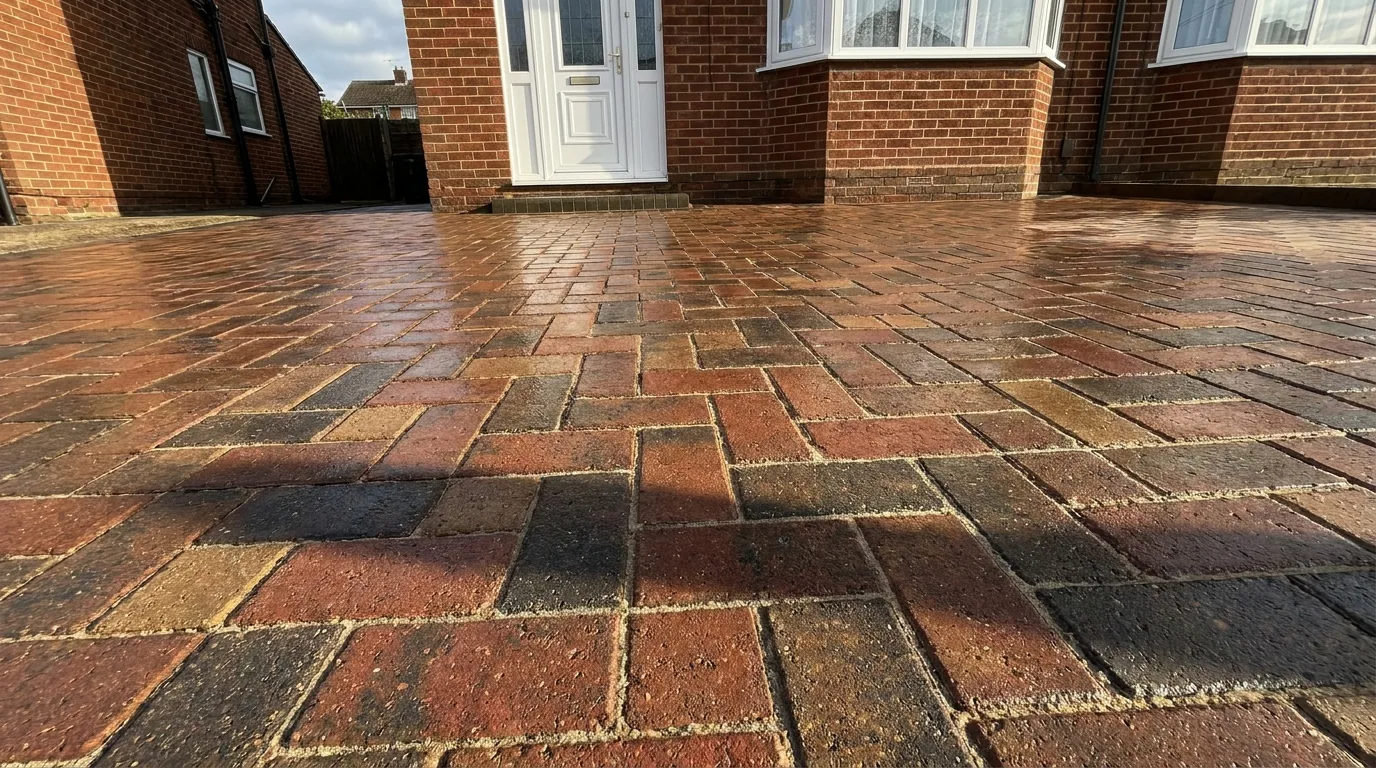
Block paving — £3.50–£6 per m²
The most common drive type in the UK and slightly more expensive to clean because the joints need re-sanding with kiln-dried sand afterwards. The block paving cleaning cost guide covers it in more detail. The sand isn’t cosmetic — BS 7533-101:2021[6], the UK code of practice for modular paving pavements, treats jointing material as part of the load-transfer system. Skip the re-sand and weeds come back in a few weeks — sometimes faster.
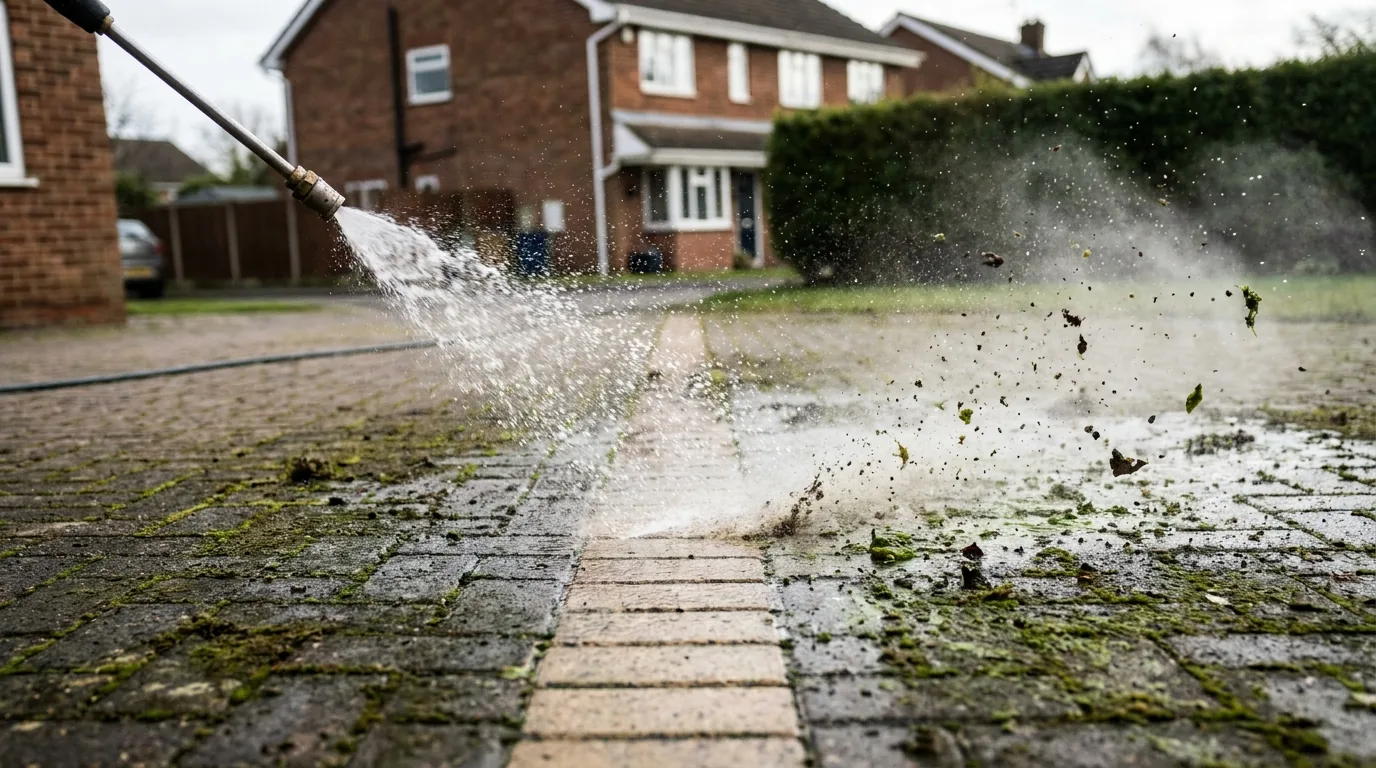
Block paving is everywhere in Surrey new-builds. The job is: lift the moss out of the joints with biocide, surface-clean the slab, hand-detail the kerb, then sweep fresh kiln-dried sand back into every joint and rinse it in. Marshalls’ own cleaning & maintenance guidelines[4] specify “no more than medium pressure” with the lance held “at an oblique angle to the paving and at least 200mm (8″) from the surface” — using a turbo / dirt-blaster nozzle violates that guidance and can compromise warranty arguments on Marshalls-branded paving.
Tarmac & asphalt — £2.50–£4 per m²
The cheapest surface to clean: no joints, no re-sanding. The catch is that old tarmac needs lower pressure or you’ll lift the bitumen and make it look worse. Common on older properties around Redhill, Croydon, and Crawley. The tarmac driveway cleaning guide covers technique and what to ask for.
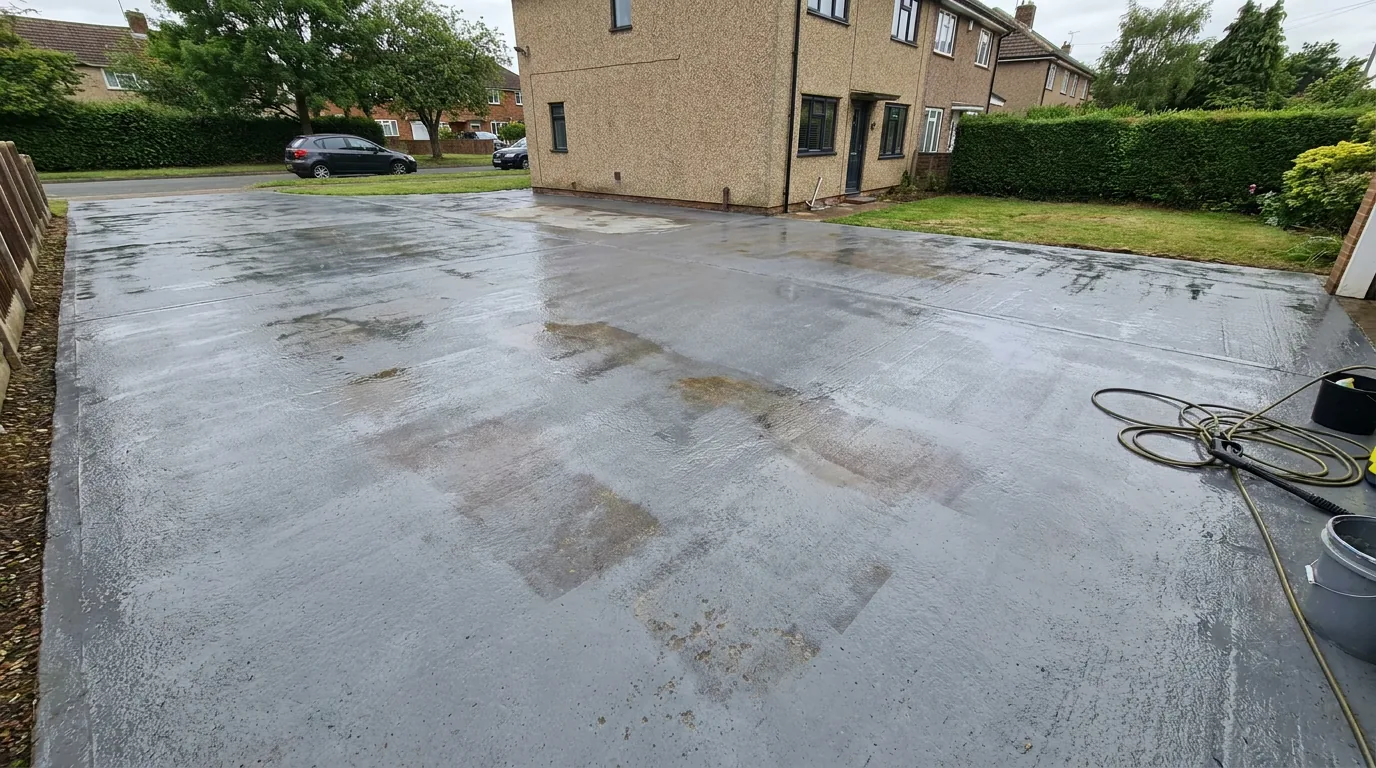
Concrete — £3–£5 per m²
Tougher surface, holds up to higher pressure. Older concrete is porous and may benefit from sealing afterwards — the driveway cleaning and sealing cost guide has the figures. Patterned or imprinted concrete is the exception: work it gently or you’ll wreck the print pattern. Decorative concrete that mimics stone or brick is common in Surrey new-builds and needs a careful hand.
Indian sandstone & natural stone — £4–£7 per m²
Porous and easy to over-clean. Sandstone in particular needs lower pressure and a bit more time. Indian sandstone is hugely popular round Reigate Hill and Redstone Hill, and the classic problem is black-spot lichen — better handled with a soft-wash treatment and biocide than blasted out. Granite and slate are tougher but still benefit from professional kit.
Resin bound — £3–£5 per m²
Easy to clean, stays cleaner longer. No joints means no re-sanding. The smooth surface resists moss better than block paving, which is why resin has taken off in Surrey over the last decade. Cleaning has to be gentle — too much pressure damages the resin — but they rarely need anything intensive.
Quick reference: cost by surface
Typical 2026 prices for a standard 40 m² drive.
| Surface | Per m² | Typical 40 m² job |
|---|---|---|
| Concrete | £3–£5 | £120–£200 |
| Block paving | £4–£7 | £160–£280 |
| Tarmac | £3–£5 | £120–£200 |
| Indian sandstone | £5–£8 | £200–£320 |
| Resin bound | £4–£6 | £160–£240 |
What’s included in the price?
A proper quote should be transparent about what’s in and what’s out. Here’s what to expect.
Standard cleaning includes
- Pre-treatment — biocide on moss and algae to loosen growth before the wash.
- High-pressure cleaning — professional 3000+ PSI machine, hot water on stubborn jobs.
- Rotary surface cleaner — spinning flat-head tool that gives even, streak-free coverage on the main slab.
- Edge detailing — hand-finishing around walls, kerbs, drain covers, anything the surface cleaner can’t reach.
- Re-sanding (block paving) — fresh kiln-dried sand brushed and rinsed back into every joint.
- Clear-up — debris and run-off cleaned away before we leave.
Usually extra
- Oil stain treatment: £10–£30 per stain depending on size and age. The oil stain removal guide covers what’s realistic.
- Sealing: £3–£8 per m². Protects block paving and brings the colour back for 3–5 years.
- Heavy weed clearance: £15–£40 if there’s significant growth before we can clean. See the weed removal guide.
- Heavy moss treatment: £20–£50 for drives with extensive moss needing repeat biocide passes.
- Efflorescence treatment: £30–£60 for white salt staining on block paving — it needs a specialist remover, pressure alone won’t shift it.
- Gutter clearing: £30–£60 if bundled with the drive job.
What pushes the price up?
Six things move the quote.
1. Condition
A drive cleaned last year takes less time than one with five years of moss. Heavy soiling adds 20–30% because of extra pre-treatment, multiple passes, and longer surface-cleaner time. Our driveway cleaning service includes pre-treatment and re-sanding as standard — no surprise add-ons. Maintenance cleans every 12–18 months are a lot cheaper than restoration jobs.
2. Access
Equipment that can park next to the drive keeps cost down. Carrying kit through a house, up a slope, or far from the outside tap costs time. Steep drives, narrow lanes, no easy water supply — expect a £20–£50 surcharge.
3. Location
Prices are higher in London and the South East (£4–£7 per m²) than the North (£2.50–£4.50 per m²). Surrey sits at £3–£6, reflecting affluence and operating costs. Within Surrey, Crawley tends to be a touch cheaper than Reigate Hill or the Cobham/Esher belt, though differences are usually modest.
4. Time of year
Spring is peak: prices firm, slots tight. Summer stays busy on good weather. Winter is quieter and weather can delay jobs — some companies pull back operations in the coldest months. Late autumn and late winter can sometimes get you a better rate. The seasonal guide goes into this in more detail.
5. Bundling other surfaces
Cleaning the drive, patio, paths, and rendered walls in one visit usually saves 10–20% versus separate jobs. The setup time is the same; you just split it across more work.
6. Insurance & reputation
An established outfit with public liability insurance, professional kit, and reviews charges more than a man with a hose. Worth it for the cover — if something goes wrong on your property, you want a paper trail.
How much does it cost in Surrey?
Surrey sits at the top end of the UK average because of property values and operating costs. Rough guide:
- Redhill / Reigate area: £3.50–£5.50 per m²
- Horley / Crawley area: £3–£5 per m²
- Dorking / Leatherhead: £4–£6 per m²
- Banstead / Epsom: £4–£6 per m²
- Oxted / Caterham: £3.50–£5.50 per m²
Higher-property-value pockets (Reigate Hill, the Surrey Hills, Cobham/Esher) tend to support the upper end. More competitive markets — Crawley, parts of Croydon — tend to come in lower.
One thing the cost guides get wrong about Surrey
Almost every UK driveway-cleaning guide opens with “in our wet UK climate, moss returns quickly.” For most of England that’s fair. For Surrey, it isn’t. The closest Met Office station to RH1 is Wisley, which records an annual rainfall of 648.41 mm on the 1991–2020 30-year average[1] — against a UK national average of around 1,147 mm. Surrey is roughly 43% drier than the UK average.
Practical implication for cost: RH1–RH9 driveways can typically extend their cleaning interval by 4–6 months over the generic UK guidance, which means most homes here are well served by a maintenance clean every 18–24 months rather than the 12-monthly cadence pushed by national guides. Your £-per-year cost is lower in Surrey than the national £3–£6/m² range implies, simply because the frequency is lower. Use Thames Water’s combined 2026/27 tariff of £4.21/m³[2] for any DIY water-cost calc — it’s ~18% above the UK average.
How to measure your drive
To get an accurate quote you need the area in square metres. There are three ways.
Simple rectangle
Length (m) × width (m) = m². Example: 8 m × 4 m = 32 m².
L-shaped or irregular
Break it into rectangles, work out each one, add them up. An L-shape might be 6 m × 3 m (18 m²) plus 4 m × 3 m (12 m²) = 30 m² total.
Google Maps
Right-click the satellite view and select “Measure distance” to trace the perimeter. Close enough for a quote without going outside with a tape. Or just use our cost calculator — tap in size, surface, and condition for an instant estimate.
Common sizes at a glance
- Single car space: 15–25 m²
- Double width: 35–50 m²
- Large family driveway: 50–80 m²
- Large with turning area: 80–120 m²
Is it worth getting a pro in?
Honest comparison. The full breakdown is in the DIY vs pro guide, but here’s the short version.
Cost comparison (40 m² drive) — break-even maths
- Professional clean: £150–£240, done in 2–3 hours.
- DIY hire + materials: day rate ~£40 for a domestic petrol washer + ~£8 kiln-dried sand + ~£6 biocide + ~£5 water (1.2 m³ × £4.21/m³, Thames Water[2]) ≈ £60, plus 4–6 hours of your time.
Break-even on your time: at the realistic skilled tradesperson rate of £25–£40/hr from the UK construction labour data[7], a 5-hour DIY day priced at £30/hr is £150 of your time. Add the £60 hire/materials and DIY costs you roughly £210 in time-equivalent — before factoring in the result lasting half as long (6–12 months for DIY vs 18–24 for pro) because a domestic 2,000 PSI washer can’t consistently kill the moss at the root the way pro kit does. DIY makes sense if you genuinely enjoy the work or your drive is small enough that the pro minimum charge stings; otherwise the maths favours the pro.
Why a professional usually wins on value
- Lasts longer — 18–24 months versus 6–12 for DIY, because the equipment kills moss at the root.
- Better kit — hot water, higher pressure, surface cleaner does the slab evenly with no streaking.
- No risk of damage — the wrong pressure on tarmac or imprinted concrete is expensive. The can pressure washing damage your drive guide covers what to watch for.
- Re-sanding included — DIY almost always skips this and the weeds are back inside a month.
- Insurance — if something goes wrong, you’re covered.
- Your time — a pressure washer hire and four hours on a Saturday is a real cost most people don’t price in.
When DIY makes sense
- Very small area (under 15 m²) where the minimum charge stings.
- Light surface dirt only — no moss, no algae, no oil.
- You already own a decent pressure washer (2000+ PSI).
- Tarmac or concrete (no re-sanding needed).
- You enjoy outdoor jobs and have the afternoon.
How to get an accurate quote
For a useful quote, give the cleaner this:
- Size — rough dimensions or m².
- Material — block paving, tarmac, concrete, natural stone, or resin.
- Condition — when it was last cleaned, how much moss or staining is on it.
- Access — can the van park next to it, is there an outside tap.
- Extras — sealing, oil stains, paths, patio, render.
A smartphone photo helps a lot. Most reputable companies will quote on photos and confirm on site if needed.
Questions to ask before you book
- Is everything in the quote, or are there potential extras?
- Have you got public liability insurance?
- What kit do you use? (Look for 3000+ PSI and a rotary surface cleaner.)
- Is re-sanding included for block paving?
- How long will it take?
- What guarantee do you give if I’m not happy with the result?
Areas we cover
We work right across Surrey within 20 miles of Redhill (RH1) — Redhill, Reigate, Horley, Dorking, Banstead, Caterham, Oxted, Leatherhead, Epsom, Crawley, and all 15+ areas.
Quote within minutes, callback within two hours during business hours (Mon–Sat 8am–6pm). If the result isn’t right, we redo it free. Or call 01737 652 515 — we’ll talk through your drive in five minutes.
Sources
Every numeric claim in this guide is sourced. We cite primary data (manufacturer datasheets, BS standards, gov.uk wage data, Met Office climate records, utility-company tariffs) and avoid the £3–£6/m² range repeated unsourced across competitor blogs.
- Met Office — Wisley (Surrey) Location Long-Term Averages 1991–2020. Closest Met Office station to Redhill (RH1). Annual rainfall 648.41 mm. metoffice.gov.uk — Wisley averages. Accessed 21 May 2026.
- Thames Water — 2026/27 Charges (effective 1 April 2026). Combined water + wastewater rate of £4.21/m³ (clean water £2.7346/m³ + wastewater £1.4721/m³) for Surrey domestic customers. thameswater.co.uk — bill value. Accessed 21 May 2026.
- UK Government (gov.uk) — National Minimum Wage and National Living Wage Rates. NLW from 1 April 2026 (age 21+): £12.71/hr. The legal floor for any UK labour cost calculation. gov.uk/national-minimum-wage-rates. Accessed 21 May 2026.
- Marshalls plc — Marshalls Garden Paving & Driveways: Cleaning & Maintenance Guidelines (Dec 2017 publication, hosted on Marshalls media library). “No more than medium pressure should be applied when washing paving, with the power-washing lance held at an oblique angle to the paving and at least 200mm (8″) from the surface.” marshalls.co.uk — cleaning guidelines (PDF). Accessed 21 May 2026.
- Kärcher — K7 consumer pressure washer manufacturer datasheet. 180 bar (~2,610 PSI), 600 L/hr (~2.65 GPM) flow rate. Positioned for heavy-duty driveway use. kaercher.com — K7 product page. Accessed 21 May 2026.
- BSI — BS 7533-101:2021 “Pavements constructed with clay, concrete or natural stone paving units — Code of practice for the structural design of pavements using modular paving units.” Treats jointing material as part of the structural load-transfer system. bsigroup.com — BS 7533-101:2021. Accessed 21 May 2026.
- Phoenix Gray Recruitment — UK Construction Labour Rates 2026. General labourer £13–£18/hr; skilled tradesperson £22–£60/hr (pressure washing sits in the lower-skilled-tradesperson band, realistic client-billed rate £25–£40/hr). phoenixgrayrec.com — UK construction rates 2026. Accessed 21 May 2026.