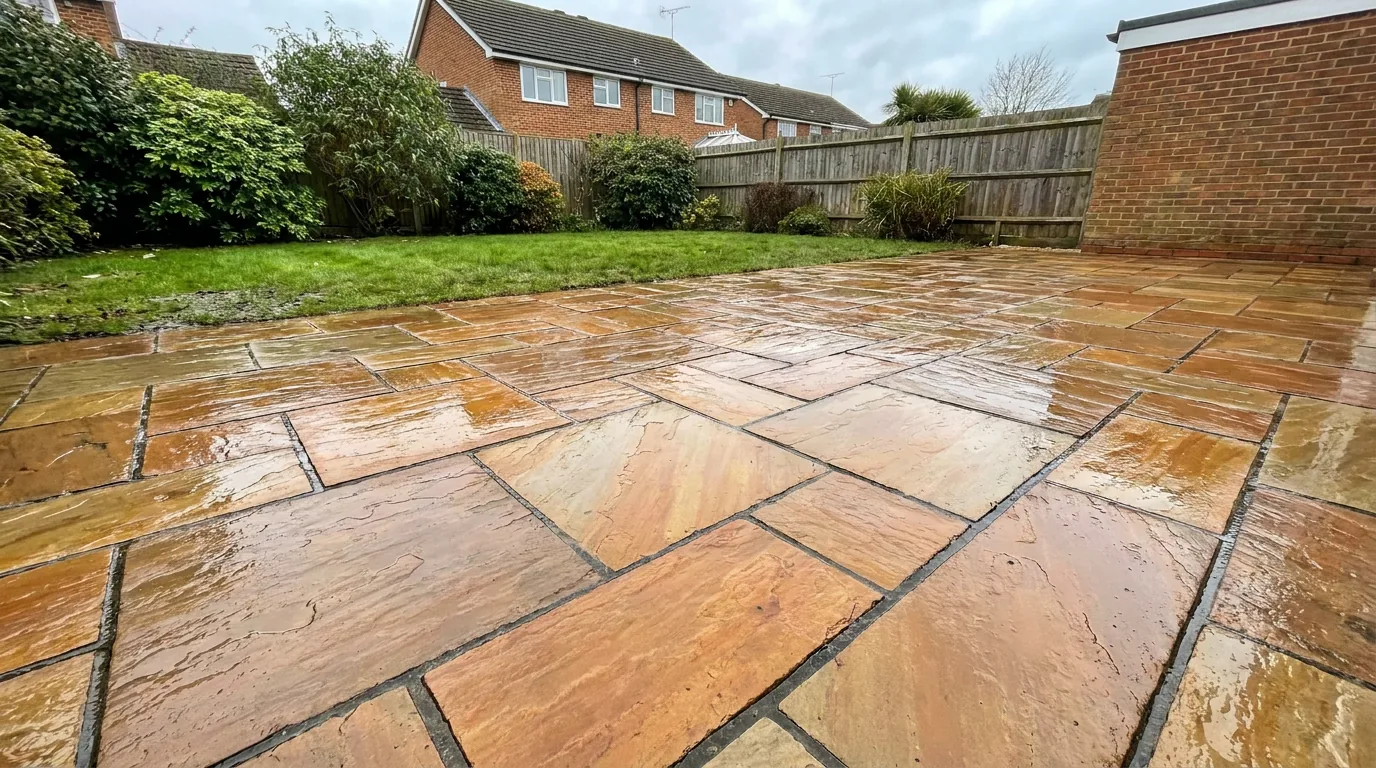
To prepare your driveway for pressure washing, start by removing all vehicles and moveable objects from the area. Sweep away loose debris, pre-treat stubborn stains like oil or rust, protect surrounding plants and surfaces, and inspect for any damage that needs attention before cleaning begins.
Proper preparation is the difference between a satisfactory clean and a truly transformative result. Whether you are doing it yourself or hiring a professional, these steps apply. When you take the time to prepare your driveway correctly, you enable the cleaning process to work more effectively, protect your property from potential damage, and ultimately achieve a finish that lasts longer.
Step 1: Clear the Area of All Vehicles and Objects
Move all vehicles, bikes, plant pots, bins, furniture, and loose items off the driveway before cleaning begins. Anything left on the surface will block the pressure washer, leave uncleaned patches, and risk water damage to belongings. Check for small items like doormats, shoes, and garden ornaments near edges.
What to Remove
- Vehicles: Move all cars, motorcycles, and bicycles well away from the driveway
- Plant pots and containers: Relocate all potted plants and garden ornaments
- Garden furniture: Move any chairs, tables, or benches nearby
- Children's toys: Bikes, scooters, footballs, and other outdoor toys
- Bins and recycling containers: Move wheelie bins temporarily
- Doormats and welcome signs: Often forgotten but can be damaged
Based in Surrey? Spring is our busiest season — get a free quote before slots fill up.
Or call 01737 652 515
Step 2: Remove Loose Debris and Surface Material
Once the area is clear of larger items, address the loose debris covering your driveway surface.
How to Clear Debris Effectively
- Start with a stiff broom: Sweep the entire driveway surface, working from top towards the road
- Pay attention to edges: Debris tends to accumulate along edges where the driveway meets walls or flower beds
- Clear drainage channels: Remove any blockages from drainage gullies
- Address moss and weed growth: Scrape away larger clumps and pull out significant weed growth
- Remove loose gravel: Sweep back any stones that have migrated onto the surface
Step 3: Pre-Treat Stubborn Stains
Some stains require special attention before pressure washing. Pre-treating these problem areas significantly improves your final results.
Oil and Grease Stains
- Apply a commercial degreaser or dedicated driveway cleaner to the affected area
- For fresh spills, cover with cat litter or sawdust first to absorb excess oil. Our guide on removing oil stains from driveways has more detail
- Allow the treatment to soak in for at least 15-30 minutes before washing
- For particularly stubborn stains, scrub with a stiff brush
Rust Stains
- Use a specialist rust remover suitable for your driveway material
- Apply according to the product instructions, typically allowing 10-20 minutes
- Avoid using bleach on rust stains as it can set them permanently
Organic Stains
- A solution of oxygen-based cleaner mixed with water works well
- Specialised algae and mould removers for green or black organic growth
Always test any cleaning product on an inconspicuous area first to ensure it won't damage or discolour your driveway surface.
Step 4: Protect Surrounding Areas
Pressure washing is highly effective, but it can cause unintended damage to nearby plants, surfaces, and fixtures if you don't take precautions.
Protecting Plants and Garden Beds
- Cover with tarpaulins: Drape plastic sheeting over flower beds and shrubs adjacent to the driveway
- Water plants beforehand: Thoroughly watering plants helps dilute any cleaning chemicals that might reach them
- Create barriers: Position boards or plastic sheeting to redirect water flow away from planted areas
Protecting Surfaces and Fixtures
- Cover electrical outlets: Cover outdoor sockets with plastic and tape
- Protect exterior lights: Low-level lighting fixtures should be covered or shielded
- Shield wooden surfaces: Adjacent wooden fences or gates can be damaged by high-pressure water
- Close windows and doors: Ensure all nearby windows and doors are firmly closed
Step 5: Check for Damage and Repair Needs
Before any pressure washing takes place, inspect your driveway carefully for existing damage. High-pressure water can worsen existing problems if they're not addressed beforehand. Our guide on whether pressure washing can damage driveways explains the risks in detail.
What to Look For
- Loose or missing pointing: Check joints between blocks, slabs, or bricks
- Cracked or damaged slabs: Note areas that may need gentler treatment
- Sunken or raised areas: Uneven surfaces can affect water drainage
- Loose edges: Check that edging stones or blocks are secure
- Damaged sealant: Check for areas where sealant has worn away
Driveway Prep Checklist at a Glance
| Step | What to do | Time | Why it matters |
|---|---|---|---|
| 1. Clear the area | Move vehicles, bins, planters, toys | 15–20 min | Prevents overspray damage and lets the washer reach every block |
| 2. Remove loose debris | Sweep leaves, pull surface weeds | 20–30 min | Stops debris clogging drains and being driven into joints |
| 3. Pre-treat stains | Degrease oil, treat rust, apply biocide | 15–30 min + dwell | Pressure alone won't lift set-in stains |
| 4. Protect surroundings | Cover plants, close doors/windows, mask brick | 10–15 min | Avoids splash damage to render, paint and borders |
| 5. Inspect & brief | Note loose blocks, cracks; share with cleaner | 10–15 min | Existing faults must be flagged before high-pressure work |
Want us to handle the prep too? Get a free quote — full prep is included in our driveway cleaning service.
What to Tell Your Cleaning Professional
If you've booked a professional driveway cleaning service, clear communication ensures the best results:
- Problem areas: Point out any particularly stubborn stains or areas of concern
- Previous treatments: Mention if the driveway has been sealed, painted, or treated
- Drainage issues: Inform them of any drainage problems or areas where water pools
- Fragile areas: Highlight sections with damage or areas requiring gentle treatment
- Access considerations: Ensure they know about water supply access and where to park
Frequently Asked Questions
How long before pressure washing should I prepare my driveway?
Ideally, complete most preparation tasks the day before your scheduled clean. This gives any pre-treatment products time to work on stubborn stains. However, clearing vehicles and loose items can be done on the morning of the clean.
Do I need to wet my driveway before pressure washing?
Light pre-wetting can help, particularly on hot days when surfaces dry quickly, but it's not essential. Your cleaning professional will typically wet the surface as part of their process. What's more important is ensuring adequate drainage so water can flow away during the clean.
Should I remove weeds before pressure washing?
Yes, removing larger weeds by hand before pressure washing is recommended. While the jet wash will remove surface growth, pulling out established weeds with their roots gives a cleaner result and slows regrowth. For significant weed problems, consider applying a weed killer a week or two before the scheduled clean.
What if it rains before my scheduled pressure washing?
Light rain before pressure washing isn't usually a problem—your driveway will be getting wet anyway. However, heavy rain might wash away pre-treatment products you've applied. If rain is forecast, you might delay applying stain treatments until closer to the cleaning time.
Can I pressure wash my driveway myself instead of hiring a professional?
While DIY pressure washing is possible, professional services typically achieve superior results due to commercial-grade equipment and expertise. Incorrect pressure washing can damage surfaces, strip pointing from block paving, or create uneven cleaning patterns. For valuable or delicate driveways, professional cleaning is usually the wiser investment.
Or call 01737 652 515
Ready to Get Your Exact Price?
Now you know how to prepare your driveway for professional cleaning, get a personalised estimate for your property. No obligation, no phone calls — just fill in a quick form and we'll respond within 2 hours.
Get My Free QuoteReady for a Spotless Driveway?
Taking the time to properly prepare your driveway for pressure washing makes a genuine difference to the final result. By following these five steps—clearing the area, removing debris, pre-treating stains, protecting surroundings, and checking for damage—you're setting the stage for a truly effective clean.
Get Your Free Quote Today
Our experienced team provides professional jet washing services using commercial-grade equipment to deliver outstanding results. Request Free Quote
Related guides: Can Pressure Washing Damage My Driveway? | Driveway Cleaning Costs UK | How Often to Clean Your Driveway | Is Pressure Washing Worth It? | Remove Oil Stains | Best Pressure Washers UK 2026 | 50 Pressure Washing Questions Answered
Biocide dwell-time matrix — how long does pre-treatment actually need?
Original analytical contribution: the dominant UK content on pre-treatment quotes vague dwell times ("leave for a few days"). The actual answer is contaminant-specific and ambient-temperature-dependent, governed by the manufacturer datasheet. Below is the cited dwell matrix for the two named UK biocides we use, plus the cited oil-stain remover.
| Product | Contaminant | Manufacturer-cited dwell | Temperature gate |
|---|---|---|---|
| Lithofin Algex[2] | Algae, biofilm, lichen (incl. black spot) | 2–7 days on the surface; full cure into substrate within 12 months | ≥8°C ambient for activation (biocide chemistry baseline) |
| Lithofin OIL-EX paste | Oil, grease, hydrocarbon stains | ~12 hours for paste to dry, drawing oil from substrate | Apply to dry surface; coverage 0.5 m²/kg at 2mm thickness |
| pH-neutral detergent (Marshalls technique)[3] | Routine surface dirt | Apply & brush, then rinse — no extended dwell needed | Hot detergent solution + vigorous brushing |
Two cited Surrey-specific gotchas: (1) the 8°C biocide activation threshold means November–February pre-treatment fails in RH1 even though Surrey is mild — Wisley Met Office data[1] shows overnight temperatures regularly drop below 8°C through winter; (2) the OIL-EX 12-hour dwell can’t happen in rain, so plan the application on a 24-hour dry weather window from the Met Office forecast. Skipping the dwell entirely is the single biggest driver of needing more frequent cleans — the chemistry, not the pressure, does the work.
Original analysis and sources
Key sourced claims in this guide: Surrey rainfall baseline 648 mm/yr per Met Office Wisley[1], annual biocide cadence per Lithofin Algex manufacturer guidance[2], medium-pressure / 30° oblique / ≥200 mm-standoff technique per Marshalls[3], HSE-endorsed slip-risk methodology[4], and PTV ≥36 low-slip threshold from UKSRG pendulum-test guidance[5].
Sources
Every numeric claim, technique parameter, and safety threshold in this guide is sourced from a manufacturer technical bulletin, BS standard, or .gov.uk reference. We cite the bodies whose data and rules actually govern UK pressure-washing outcomes — not the unsourced ranges repeated across competitor blogs.
- Met Office — Wisley (Surrey) Location Long-Term Averages 1991–2020. Closest Met Office station to RH1. Annual rainfall 648.41 mm; Surrey is ~43% drier than the UK national mean of ~1,147 mm. metoffice.gov.uk — Wisley averages. Accessed 21 May 2026.
- Lithofin — ALGEX Special Cleaner product page. Manufacturer guidance: spray annually, preferably in spring. 6–12 month residual activity. lithofin.com — ALGEX. Accessed 21 May 2026.
- Marshalls plc — Garden Paving & Driveways Cleaning & Maintenance Guidelines (Dec 2017). Technique: medium pressure, 30° lance, 200mm minimum standoff. marshalls.co.uk — cleaning guidelines (PDF). Accessed 21 May 2026.
- Health and Safety Executive (HSE) — Slips and trips at work. HSE-preferred slip-risk methodology; PTV ≥36 wet-acceptance threshold. hse.gov.uk — slips and trips. Accessed 21 May 2026.
- UK Slip Resistance Group — Introduction to the Pendulum Tester (BS 7976: Parts 1-3). PTV ≥36 = low slip risk threshold for outdoor pedestrian surfaces. ukslipresistance.org.uk — pendulum tester. Accessed 21 May 2026.
- Kärcher — K7 consumer pressure washer manufacturer datasheet. 180 bar (~2,610 PSI), 600 L/hr. kaercher.com — K7 product page. Accessed 21 May 2026.
- BSI — BS 7533-101:2021 Code of practice for modular paving units. Treats jointing material as load-transfer system. bsigroup.com — BS 7533-101:2021. Accessed 21 May 2026.
- Resiblock Ltd — Block Paving Sealer Product Data Sheets. Manufacturer-stated lifespan up to 5 years. resiblock.com — technical data sheets. Accessed 21 May 2026.
- UK Government (gov.uk) — National Living Wage rates from April 2026: £12.71/hr (age 21+). The legal floor for valuing UK labour and DIY time. gov.uk/national-minimum-wage-rates. Accessed 21 May 2026.
- Thames Water — 2026/27 Charges. Combined water + wastewater rate £4.21/m³. thameswater.co.uk — bill value. Accessed 21 May 2026.