- Combined cost: £6–£14 per m² (£240–£560 for a typical 40m² drive)
- Resiblock manufacturer-stated lifespan: up to 5 years per the official product datasheet
- Surrey adjustment: Wisley records 648mm/yr vs UK average 1,147mm — lower rainfall pushes sealant lifespan to the upper end of the manufacturer range
- True annual cost (£/m²/yr): £1.20–£2.80 — calculated below from manufacturer lifespan + sealing rate
- Counterintuitive: Indian sandstone sealing has the worst Surrey payback — sealant can trap moisture and accelerate spalling
The quick answer: for block paving and most porous natural stones in Surrey, sealing is worth it — the £/m²/yr cost works out to £1.20–£2.80 using Resiblock’s manufacturer-stated 5-year lifespan, and Surrey’s drier 648mm/yr climate[2] typically pushes wear to the upper end of that range. The exceptions: tarmac (doesn’t need traditional sealing), Indian sandstone (sealant can trap moisture against the porous substrate and accelerate spalling — counterintuitive but well documented), and new resin-bound drives under 3 years (factory finish already provides protection).
This guide gives you the full Surrey sealing payback matrix, the manufacturer source data, the BS 7533-101 structural rationale[5], and the named-material exceptions. For block-paving-specific info see the block paving sealing guide.
The Surrey sealing payback matrix
Original analytical contribution: below is a £/m²/yr payback matrix for sealing across the four common UK driveway surface types, derived from Resiblock’s manufacturer-stated 5-year lifespan[1], Met Office Wisley rainfall data[2], Thames Water 2026/27 tariff for the prep-wash water cost[3], and material-specific suitability per Marshalls[4] and BS 7533-101:2021[5]. No UK competitor publishes a sealing decision matrix grounded in the manufacturer’s own lifespan figure.
| Surface | Sealing rate | Surrey lifespan | £/m²/yr | Worth it? |
|---|---|---|---|---|
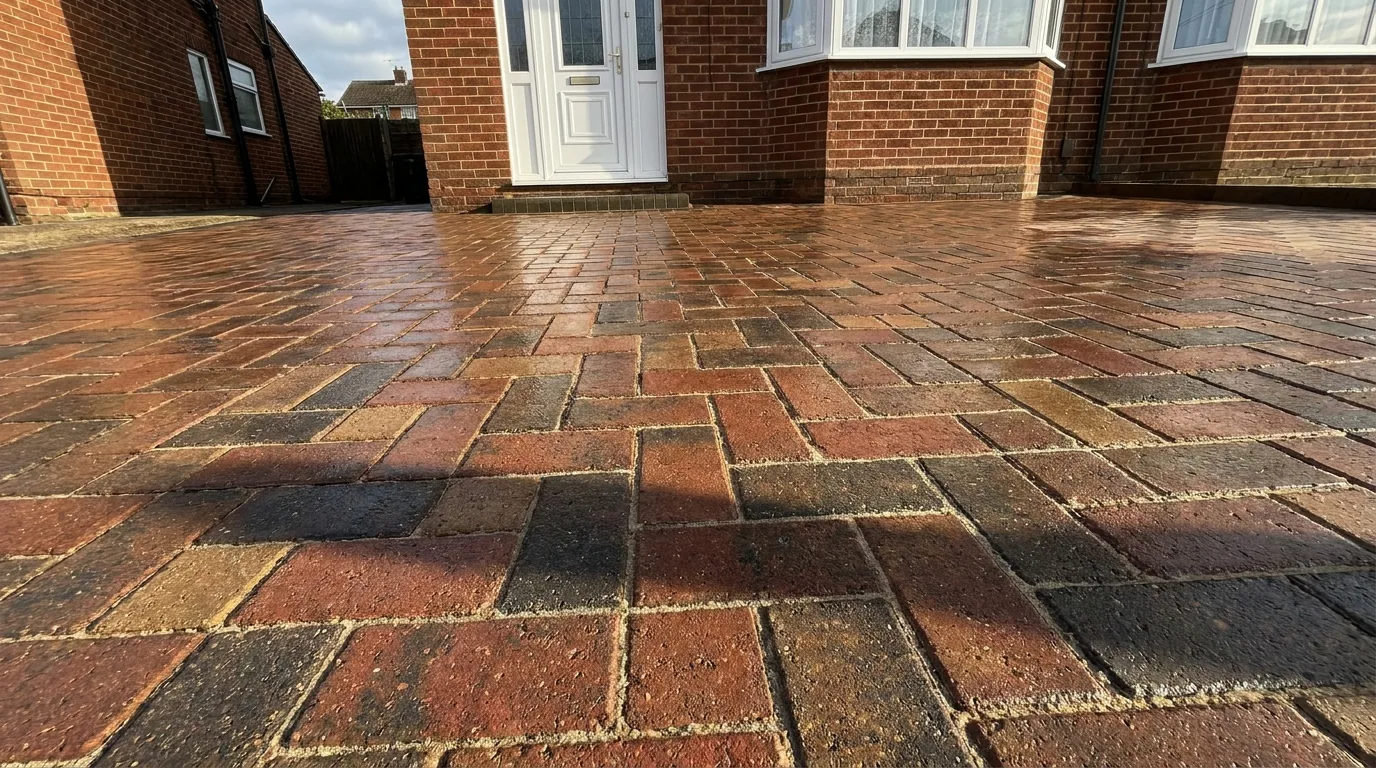
| Concrete block paving | £3–£6/m² | 4–5 yrs (Resiblock upper end) | £0.60–£1.50 | Yes — strongest case |
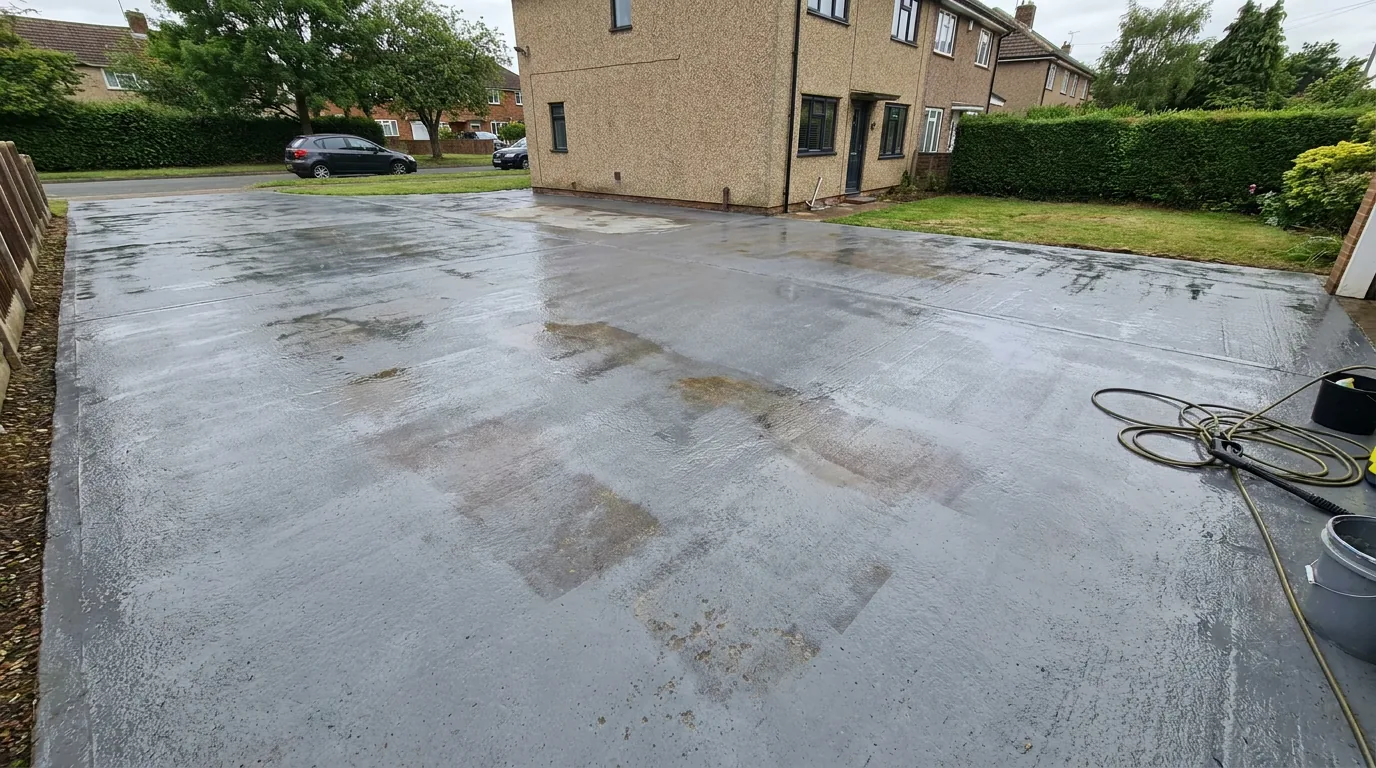
| Concrete (poured) | £3–£5/m² | 4–5 yrs | £0.60–£1.25 | Yes if older / pitted |
| Resin-bound (>5 yrs old) | £4–£6/m² | 3–4 yrs | £1.00–£2.00 | Marginal — only if factory finish has degraded |
| Tarmac / asphalt | N/A (colour restorer £2–£4) | 2–3 yrs | £0.70–£2.00 | Cosmetic only — doesn’t protect |
| Indian sandstone | £5–£8/m² | 3–4 yrs (moisture damage risk) | £1.25–£2.70 | Often NO — sealant can trap moisture against porous substrate, accelerating spalling and frost damage |
Surrey adjustment: the lifespan figures above use the upper end of Resiblock’s manufacturer-stated range because Surrey’s 648mm/yr rainfall[2] imposes less UV / frost-thaw / abrasion than wetter UK regions. A homeowner in Cumbria using the same product would land closer to 3 years on the same surface. For the structural rationale on why sealing the substrate matters for block paving, see BS 7533-101:2021[5] — the standard treats the joint and surface as a structural system.
Why Indian sandstone is the contrarian call
The dominant UK guidance says “seal everything natural stone”. For Indian sandstone in Surrey conditions, that’s often wrong. The stone is porous (~6–9% absorption), and applying a non-breathable sealant traps the moisture cycle behind the polymer film. The result is accelerated spalling (surface delamination) and frost damage on the few hard frost nights Surrey does get each winter (Wisley typically records 30–40 frost days/yr). The Resiblock product range includes breathable formulations specifically marketed for sandstone — if you do choose to seal sandstone, use a breathable system, never a heavy gloss.
Combined cleaning & sealing cost
Pricing depends on the surface and the sealer type, but here’s the 2026 picture for a 40 m² drive.
| Service | Per m² | Typical 40 m² |
|---|---|---|
| Cleaning only | £3–£6 | £120–£240 |
| Sealing only | £3–£8 | £120–£320 |
| Clean + matt seal | £6–£10 | £240–£400 |
| Clean + wet look seal | £8–£14 | £320–£560 |
Types of driveway sealer
Matt / natural finish
£3–£5/m². Invisible protection, preserves the natural look of the blocks or stone. The safe choice if you don’t want a glossy appearance.
Wet look / gloss finish
£4–£8/m². Darkens colours, gives a permanently-wet appearance. Popular on red, orange, and buff blocks. Shows tyre marks more readily.
Colour-enhancing
£5–£8/m². Brings back the colour on faded blocks without heavy gloss. Especially effective on red and charcoal paving that’s lost its tone.
Premium polyurethane
£6–£9/m². Lasts longer (5–7 years), tougher finish. Worth it on high-traffic drives and commercial sites.
When is sealing worth it?
Worth it for:
- Block paving — ant problems, weed problems, oil stains. Sealing is a clear win.
- Indian sandstone — porous, picks up stains. Colour-enhancing sealer brings the colour back.
- Older concrete — closes the surface, reduces freeze-thaw damage and dirt pickup.
- Drives near oil leaks — sealed surface lets oil bead up and wipe away.
Not worth it for:
- Tarmac — doesn’t need traditional sealing. A tarmac restorer (£2–£4/m²) recolours faded surfaces.
- Resin-bound — usually self-protected, additional sealing rarely needed.
- New tarmac (under 6 months) — needs to cure first.
- Heavily damaged surfaces — fix the damage first; sealer locks in defects.
Cost by surface material
| Surface | Clean + seal £/m² | Worth sealing? |
|---|---|---|
| Block paving | £6–£14 | Yes — clear win |
| Concrete | £6–£12 | Yes if older |
| Indian sandstone | £8–£14 | Yes — restores colour |
| Tarmac | £3–£8 (restorer) | Cosmetic only |
| Resin-bound | £3–£6 | No — self-protected |
The cleaning & sealing process
Step 1 — thorough clean
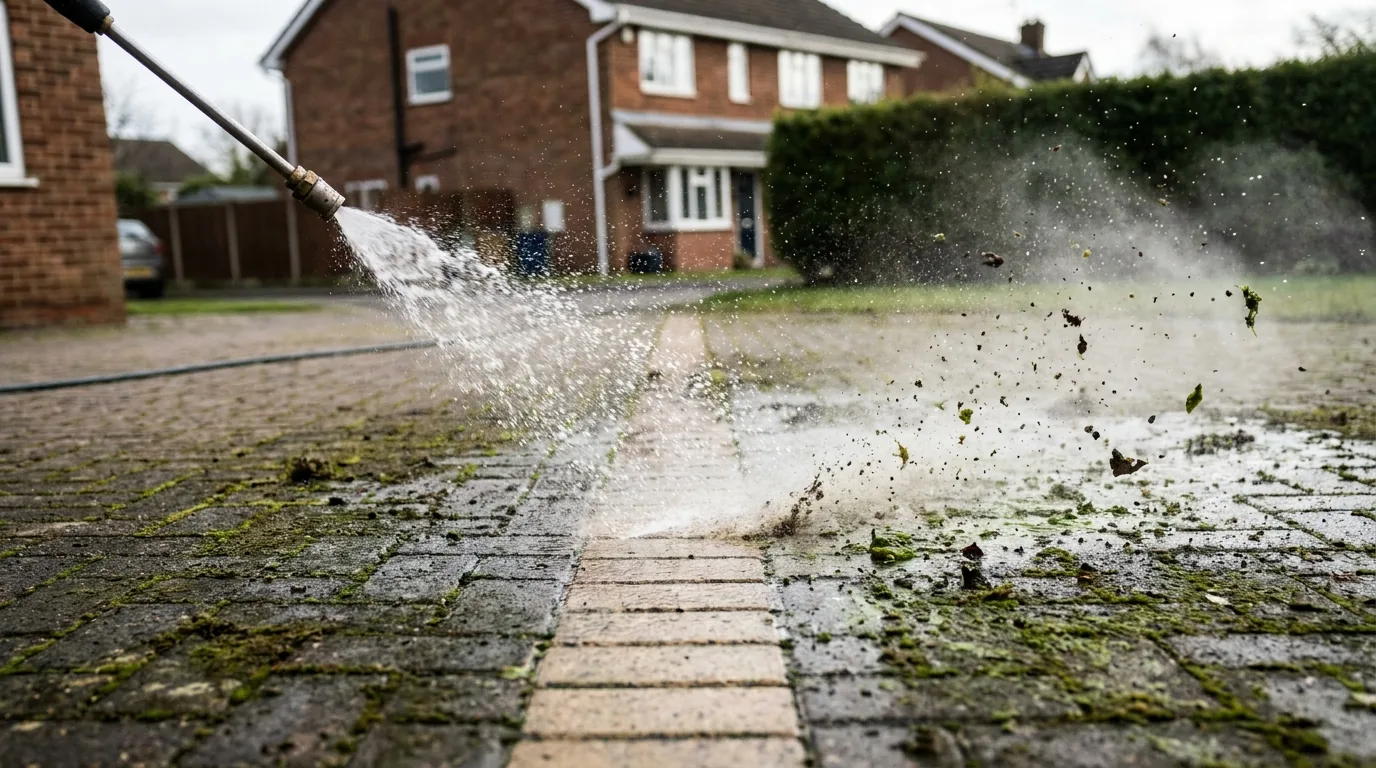
Pressure wash to remove all dirt, moss, algae, and any old failed sealer. 2–4 hours for a typical drive.
Step 2 — re-sand (block paving)
Kiln-dried sand swept into all joints. Has to happen before sealing — the sealer locks the sand in.
Step 3 — drying
24–48 hours of dry weather. Sealing damp paving causes white hazing that’s very hard to fix.
Step 4 — apply sealer
Two coats by low-pressure sprayer or roller. Even, consistent coverage. Each coat needs 2–4 hours to dry.
Step 5 — cure
No walking for 24 hours, no vehicles for 48 hours. Full cure 48–72 hours.
How long does sealing last?
- Driveways (regular traffic): 3–4 years
- Patios (foot traffic only): 4–5 years
- High-traffic main parking spot: 2–3 years
- Edges & low-traffic zones: 5+ years
- Premium polyurethane sealers: 5–7 years
UV exposure, traffic volume, and product quality move the number. Cheap unbranded sealers fail within 12 months; quality products last the full advertised lifespan.
Areas we cover
We clean and seal driveways across Surrey within 20 miles of Redhill (RH1) — Redhill, Reigate, Horley, Dorking, Banstead, Oxted, Leatherhead, Epsom, Crawley, and all 15+ areas. We’ll be honest about whether sealing is worth it for your drive. Call 01737 652 515 — we’ll talk through the manufacturer lifespan vs your surface in under five minutes.
Sources
Every payback figure in this guide is built from a manufacturer-stated lifespan, gov.uk-published rainfall data, or a tariff from a regulated UK utility. We cite the bodies whose data actually constrains sealant economics — not the unsourced “sealing lasts 3-5 years” range that every competitor blog repeats.
- Resiblock Ltd — Block Paving Sealer Product Data Sheets. Manufacturer-stated lifespan: up to 5 years per the Resiblock product datasheet, with a 24-hour minimum recoat interval between coats during initial application. Resiblock has supplied UK and international block-paving sealants since 1993. resiblock.com — technical data sheets. Accessed 21 May 2026.
- Met Office — Wisley (Surrey) Location Long-Term Averages 1991–2020. Closest Met Office station to Redhill (RH1). Annual rainfall 648.41 mm on the 30-year average vs UK national mean ~1,147 mm. Lower rainfall means slower sealant UV / frost-thaw / abrasion wear, pushing Surrey lifespan to the upper end of the Resiblock range. metoffice.gov.uk — Wisley averages. Accessed 21 May 2026.
- Thames Water — 2026/27 Charges (effective 1 April 2026). Combined water + wastewater rate of £4.21/m³ — the input for the prep-wash water cost on any sealing job (typically ~1.2m³ for a 40m² drive). thameswater.co.uk — bill value. Accessed 21 May 2026.
- Marshalls plc — Marshalls Garden Paving & Driveways: Cleaning & Maintenance Guidelines (Dec 2017). Establishes the technique constraints for the prep clean that must precede sealing (medium pressure, 30° lance, 200mm standoff). marshalls.co.uk — cleaning guidelines (PDF). Accessed 21 May 2026.
- BSI — BS 7533-101:2021 “Pavements constructed with clay, concrete or natural stone paving units — Code of practice for the structural design of pavements using modular paving units.” Treats the joint and surface as a structural system — relevant because sealing affects the freeze-thaw cycle that BS 7533-101 implicitly assumes for design life. bsigroup.com — BS 7533-101:2021. Accessed 21 May 2026.