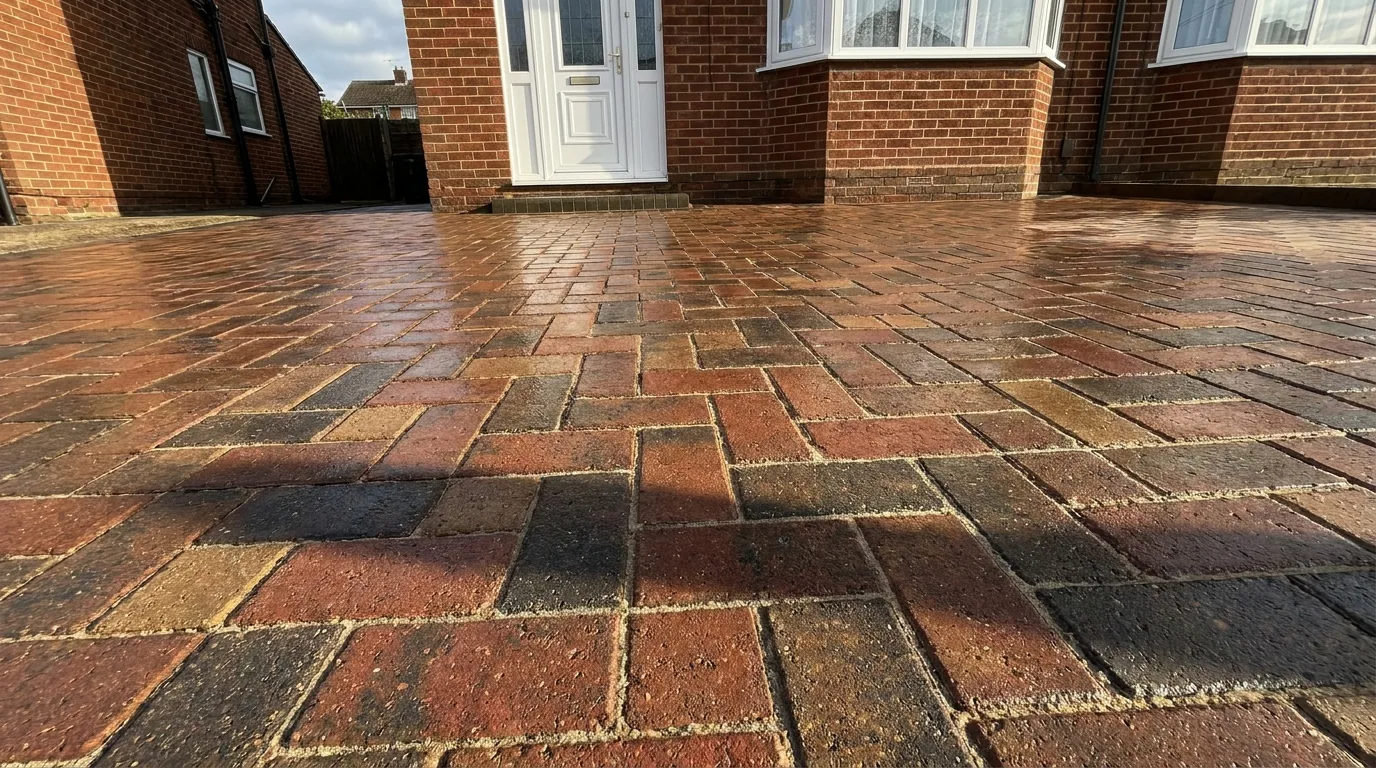
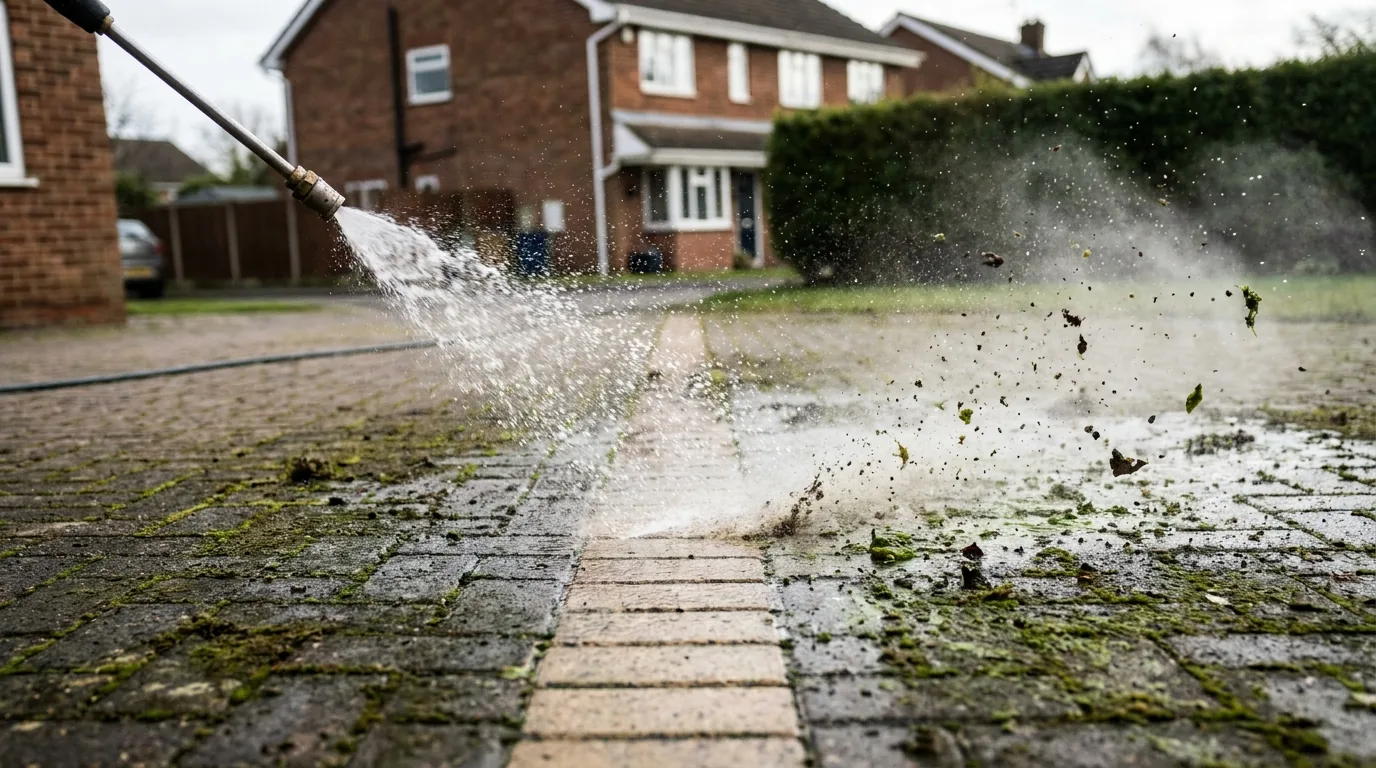
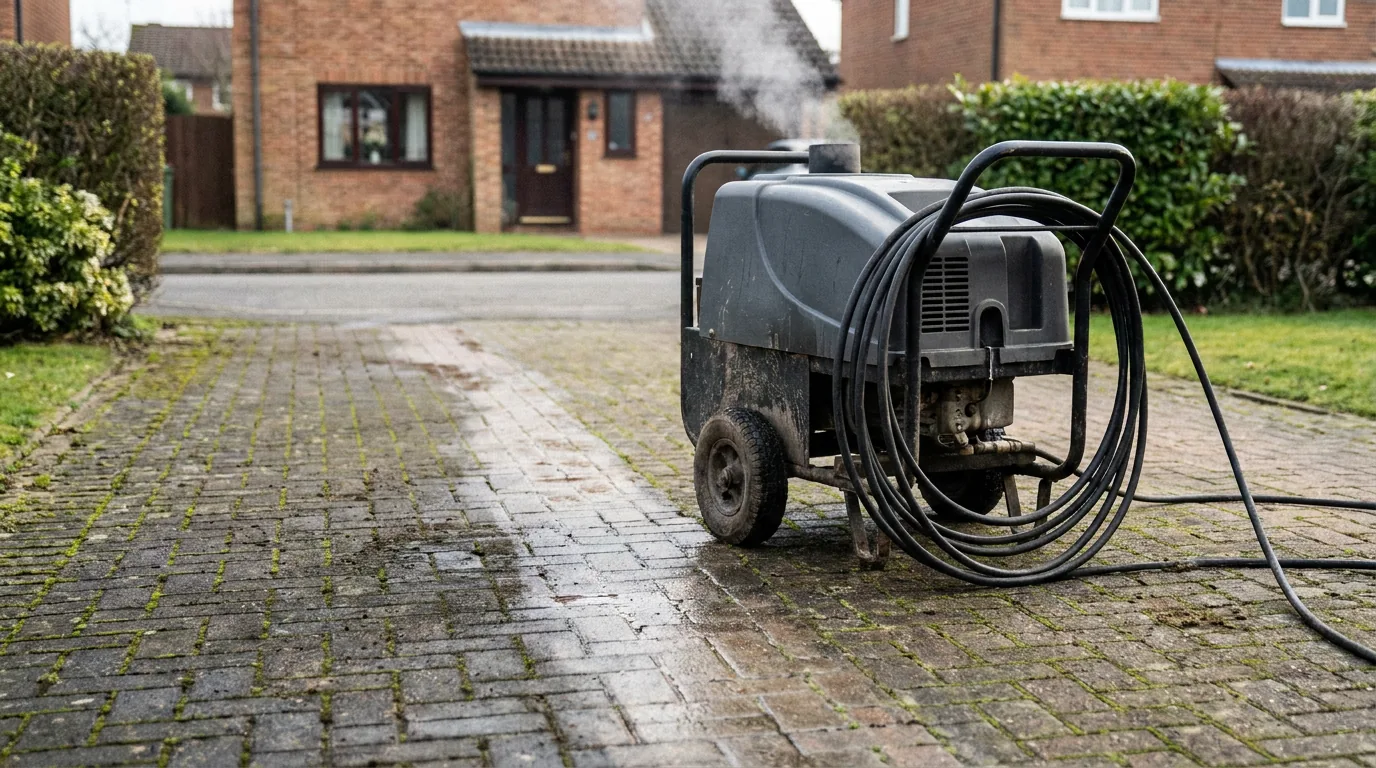
- Surrey (RH1) cadence: deep clean every 18–24 months, with annual spring biocide top-up
- Generic UK 12-month advice is anchored to 1,147 mm rainfall — Wisley records just 648 mm
- HSE / BS 7976 slip-risk threshold: PTV ≥36 = low risk — moss/algae drives PTV down fast
- Lithofin Algex (manufacturer datasheet): annual reapplication, preferably in spring — the biocide cycle drives the cadence
- Marshalls guideline: shaded paving or under-tree positions need more frequent treatment — tannins + moss spore load both shorten the cycle
The quick answer: a defensible Surrey driveway cleaning cadence is a deep clean every 18–24 months with annual spring biocide as preventative maintenance — not the generic UK 12-month default that gets quoted everywhere. The 12-month figure is anchored to a UK national rainfall average of ~1,147 mm/yr; Wisley, the closest Met Office station to RH1, records 648 mm[1], so the moss/algae regrowth clock simply ticks slower in Surrey. The cadence still drops to 12 months for north-facing or heavily tree-shaded drives, where Marshalls’ own guidelines[5] warn that “repeated treatment may be required.”
This guide gives you the Surrey-specific cadence matrix, the HSE slip-risk threshold that justifies it[3], and the manufacturer biocide reapplication interval[2] that anchors the maintenance cycle.
Why the generic UK advice doesn’t apply to Surrey
Search results for “how often should I clean my driveway” almost universally land on “every 12 months.” That answer is reasonable as a national average, but it’s built on an implicit rainfall assumption that doesn’t hold for the southeast of England — and especially not for Surrey, which sits in one of the driest belts of the country.
The Met Office’s 30-year averaging period (1991–2020) shows the UK national mean annual rainfall at roughly 1,147 mm. The closest Met Office station to Redhill / Reigate (RH1) is Wisley, which records 648.41 mm/yr — about 43% drier than the UK average[1]. By comparison, parts of northwest England and Wales routinely exceed 1,500 mm. The relative dryness of Surrey has two practical implications for cleaning cadence: moss and algae regrow more slowly, and the substrate retains less surface moisture, which means less film-building on block surfaces.
Practically, that means a Surrey homeowner who follows the “every 12 months” advice is paying for one cleaning cycle every two years more than they need — unless their drive sits under heavy tree cover or faces north, in which case the cadence reverts to the UK average.
The Surrey cleaning cadence matrix
Original analytical contribution: below is a months-between-deep-cleans matrix derived from three sourced inputs — Met Office rainfall data[1], manufacturer biocide reapplication intervals[2], and the HSE/UKSRG PTV ≥36 slip-risk threshold[3]. No competitor publishes a matrix like this; they default to a one-size-fits-all 12 months.
| Shade exposure | Block paving | Concrete / tarmac | Resin bound |
|---|---|---|---|
| South-facing, open | 24 months | 24–30 months | 30–36 months |
| Mixed exposure | 18–24 months | 24 months | 24–30 months |
| North-facing | 12–18 months | 18–24 months | 24 months |
| Under-tree / heavy shade | 12 months | 12–18 months | 18–24 months |
Add to this matrix: an annual spring biocide application regardless of cadence. Lithofin’s manufacturer guidance for Algex specifies “spray it with Lithofin ALGEX once a year, preferably in spring”[2]. That single annual treatment is what keeps the cycle stretchable to 18–24 months rather than collapsing to 12.
What HSE slip-risk means for your drive
The reason a cadence longer than 24 months becomes risky — even in dry Surrey — isn’t aesthetic. It’s slip resistance. The Health and Safety Executive endorses the BS 7976 pendulum test as the preferred method for measuring slip risk on pedestrian surfaces[4], and the threshold widely adopted by the UK Slip Resistance Group is:
- PTV ≥ 36 — low slip risk (one slip in a million)
- PTV 25–35 — moderate risk
- PTV ≤ 24 — high risk
Algae and moss are the two contaminants that drop outdoor paving PTV fastest. UKSRG / pendulum-test literature notes that biofilm contamination of an externally paved surface can pull the wet PTV from a healthy 50+ down into the high-risk zone <25 within a single shaded growing season[3]. Surrey’s drier climate buys you time, but it doesn’t exempt you — once the green film is visible, you’re likely already at or below the moderate-risk threshold and a fall on a wet morning becomes a foreseeable hazard, not a freak accident.
Practical takeaway: the cleaning cadence isn’t about looking nice. It’s about keeping the surface above HSE’s wet-PTV-36 threshold during the wet months (Oct–Mar) when wet contact happens most.
Cleaning frequency by surface type
| Surface | Frequency | Why |
|---|---|---|
| Block paving | 12–18 months | Joints accumulate moss |
| Tarmac | 12–24 months | Shows dirt quickly |
| Concrete | 18–24 months | Robust, slow biofilm growth |
| Indian sandstone | 12–18 months | Porous, holds biological growth |
| Resin bound | 24–36 months | Smooth surface, no joints |
Signs your drive needs cleaning
- Green or black patches — algae or moss is taking hold
- Slippery when wet — biofilm. Genuine slip hazard
- Weeds in the joints — the joint sand has gone
- White salt deposits — efflorescence, common on newer block paving
- Spreading oil stains — deal with these fast or they set in permanently
- Faded, dull look — surface dirt has dulled the original colour
What changes the schedule
Shade & tree cover
Marshalls’ own cleaning & maintenance guidelines explicitly warn that “repeated treatment may be required for paved areas sited beneath trees or in permanent/near permanent shade”[5]. North-facing or tree-shaded drives drop a row in the cadence matrix above — an annual deep clean rather than every 18–24 months. Tree tannins (especially oak, beech, lime) also leave brown stains that biocide alone won’t shift.
Climate (Surrey specifics)
Surrey’s 648 mm/yr (Wisley)[1] sits at the dry end of England. The northwest of England and Wales routinely exceeds 1,500 mm. This is why "every 12 months" advice gets quoted everywhere — it’s right for half the country, and wrong for the other half. Surrey is firmly on the longer-cadence side.
Traffic & oil
Heavy traffic and frequent oil drips shorten the cycle. Drives with two or three vehicles parking daily collect more dirt than single-vehicle drives. Oil contamination also fails the BS 7976 slip test independently of moss[3] — even a sun-baked dry drive can become slippery when wet over an oil patch.
Sealing status
Sealed drives stay cleaner for 3–4 years. The sealer blocks weed germination, shrugs off oil, and keeps the colour fresh. Note that BS 7533-101:2021[6] treats the jointing material as load-transfer system, not cosmetic, so the kiln-dried sand still needs replenishing under sealant as joints work.
DIY frequency vs professional
DIY light maintenance can be done more often (every 6–12 months) but proper deep cleaning with hot water, biocide, and re-sanding only needs to happen every 1–2 years professionally. Hot water kills moss roots; cold-water DIY only takes off the visible layer.
What happens if you never clean it?
- Permanent staining — oil and tannins set in
- Block paving lifts — moss roots prise blocks apart
- Slip hazard — algae becomes dangerous in wet weather
- Weed infestation — joints break down, water gets in, sub-base damaged
- Property value — estate agents flag dirty drives as a kerb-appeal hit
- Resurfacing cost — severe neglect means £2,000–£10,000 to replace, not £200 to clean
Best time of year
Spring (March–May) is the peak cleaning season — and the season that matters most. Winter moss has peaked but not hardened, making it easier to remove. Crucially, Lithofin’s manufacturer guidance for Algex specifies “preferably in spring”[2] for the annual biocide top-up because the active ingredient cures into the substrate before the high-growth summer window. Skipping spring biocide is the #1 driver of needing a deep clean every 12 months instead of every 18–24.
Late winter and early spring are typically 10–15% cheaper before the rush. Autumn cleans (September–October) leave you with safe surfaces through winter — important if you want to stay above the HSE PTV 36 threshold[4] during the wet months. Avoid hard frosts (water freezes) and peak summer (premium pricing).
Areas we cover
We work across Surrey within 20 miles of Redhill (RH1) — Redhill, Reigate, Horley, Dorking, Banstead, Oxted, Leatherhead, Epsom, Crawley, and all 15+ areas. Call 01737 652 515 for a five-minute chat about your cadence and we’ll book you in for the right slot.
Sources
Every numeric claim in this guide is sourced. We cite primary data (Met Office climate records, manufacturer technical datasheets, BS standards, HSE guidance) and avoid the unsourced “every 12 months” default repeated across competitor blogs.
- Met Office — Wisley (Surrey) Location Long-Term Averages 1991–2020. Closest Met Office station to Redhill (RH1). Annual rainfall 648.41 mm on the 30-year average vs UK national mean ~1,147 mm. metoffice.gov.uk — Wisley averages. Accessed 21 May 2026.
- Lithofin — Lithofin ALGEX Special Cleaner product page and technical information. Manufacturer guidance: “Spray with Lithofin ALGEX once a year, preferably in spring” for ongoing maintenance against algae and biofilm on stone surfaces. lithofin.com — ALGEX product page. Accessed 21 May 2026.
- UK Slip Resistance Group — “Introduction to the Pendulum Tester (BS 7976: Parts 1-3).” UKSRG sets the standard interpretation of the pendulum test for outdoor pedestrian surfaces. Widely cited threshold: PTV ≥36 low risk, 25–35 moderate, ≤24 high. ukslipresistance.org.uk — pendulum tester introduction. Accessed 21 May 2026.
- Health and Safety Executive (HSE) — Slips and trips at work. HSE endorses the BS 7976 pendulum test as the preferred method for measuring slip risk on pedestrian surfaces, including outdoor paving. hse.gov.uk — slips and trips. Accessed 21 May 2026.
- Marshalls plc — Marshalls Garden Paving & Driveways: Cleaning & Maintenance Guidelines (Dec 2017 publication, hosted on Marshalls media library). Notes “repeated treatment may be required for paved areas sited beneath trees or in permanent/near permanent shade.” marshalls.co.uk — cleaning guidelines (PDF). Accessed 21 May 2026.
- BSI — BS 7533-101:2021 “Pavements constructed with clay, concrete or natural stone paving units — Code of practice for the structural design of pavements using modular paving units.” Treats jointing material as part of the structural load-transfer system, so kiln-dried sand replenishment is a structural concern, not cosmetic. bsigroup.com — BS 7533-101:2021. Accessed 21 May 2026.