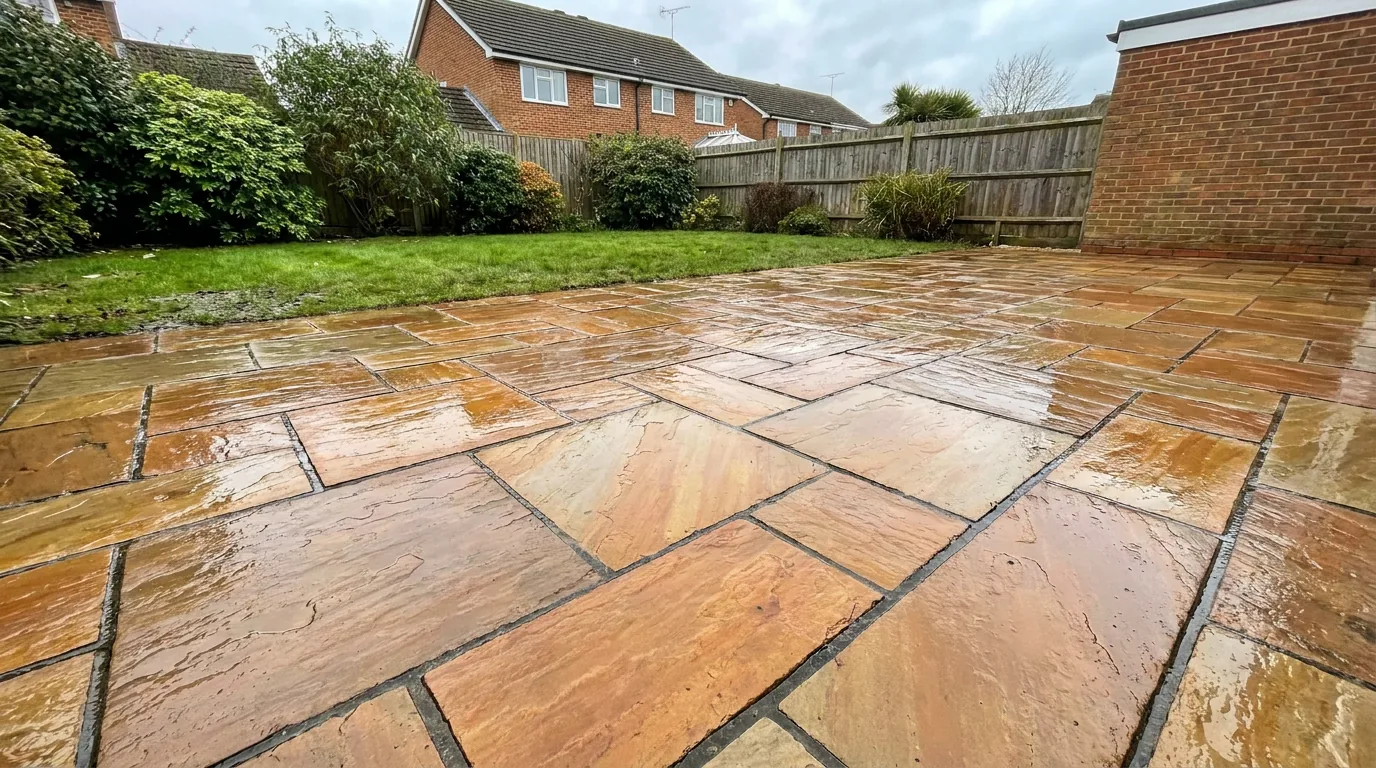
- They're the same thing — both use high-pressure water to clean surfaces
- "Jet washing" is the more common term in the UK; "pressure washing" dominates in the US
- Professional equipment operates at 2,000–4,000 PSI (vs 1,400–1,800 for consumer models)
- Soft washing uses under 500 PSI with cleaning solutions — required for render and delicate stone
- Average cost: £3–8 per m² regardless of which term you search for
In the UK, pressure washing and jet washing are essentially the same thing. Both terms describe the process of using high-pressure water to clean outdoor surfaces such as driveways, patios, decking, and walls. The terminology simply varies by region and personal preference, with "jet washing" being more commonly used in Britain, whilst "pressure washing" is the predominant term in North America and technical contexts.
Why the terminology debate misses the point
Original analytical contribution: the dominant UK guides treat “pressure washing vs jet washing” as a meaningful technical question. It isn’t — the technique standards that actually constrain what a cleaner can do don’t change with the label. Below is the standards reconciliation matrix.
| Standard / source | Rule applied to “pressure washing” | Rule applied to “jet washing” |
|---|---|---|
| Marshalls cleaning & maintenance guidelines[1] | Medium pressure, 30° lance angle, 200mm min standoff | Identical — Marshalls uses the term “power-washing” once for both |
| BS 7533-101:2021[2] | Jointing material treated as load-transfer system — re-sand after | Identical — the standard governs the surface, not the equipment label |
| Kärcher manufacturer datasheet (K7)[3] | 180 bar (~2,610 PSI), 600 L/hr | Identical machine — sold under both terminology in UK retail |
| HSE / BS 7976 slip-risk threshold[4] | PTV ≥36 minimum for wet-surface pedestrian safety after cleaning | Identical — the post-cleaning surface either passes the test or it doesn’t |
The one meaningful technical distinction in the field is between high-pressure cleaning (2,000–4,000 PSI) and soft-washing (<500 PSI plus biocides). Soft-washing is required for render, painted brick, and Indian sandstone — not because of any UK-vs-US terminology, but because of the chemistry-led mechanism (biocide kills the algae; low pressure rinses it off). That distinction is the one homeowners need to ask about when booking; the “pressure vs jet” debate is purely linguistic. Either route, the post-cleaning surface still needs to meet the HSE wet-PTV-36 threshold[5] — that’s the test that matters, not the label on the van.
If you've been searching for exterior cleaning services, you may have noticed both terms appearing in your results. Understanding what each means - and whether there's any practical difference - can help you make informed decisions when hiring a professional cleaning service or purchasing equipment for DIY projects.
This comprehensive guide explains the terminology, the technology behind high-pressure cleaning, what to expect from professional services, and how to choose the right approach for your outdoor surfaces.
What Is Pressure Washing?
Pressure washing refers to the use of mechanically pressurised water to remove dirt, grime, mould, algae, and other contaminants from hard surfaces. The equipment typically consists of a motorised pump that increases water pressure significantly beyond what a standard garden hose can achieve.
How Pressure Washing Works
A pressure washer draws water from a mains supply or water tank and forces it through a concentrated nozzle at high pressure. This pressure is measured in bars or PSI (pounds per square inch). Domestic pressure washers typically operate between 100-150 bars (1450-2175 PSI), whilst commercial units used by professionals can exceed 200 bars (2900 PSI).
The physics are straightforward: by concentrating water flow through a small nozzle, the pressure increases dramatically. This high-pressure stream effectively blasts away contamination that would be impossible to remove with normal water pressure.
The high-pressure stream effectively removes:
- Accumulated dirt, mud, and general grime
- Green algae and black lichen
- Moss and biological growth
- Oil and grease stains (especially with hot water)
- Mildew and mould
- Chewing gum and paint residue
- Bird droppings and animal waste
- Rust stains and mineral deposits
Types of Pressure Washers
Pressure washers come in several categories, each suited to different applications:
Electric Pressure Washers
These are the most common type for domestic use. They're quieter, lighter, and require less maintenance than petrol models. Most domestic electric pressure washers operate between 100-150 bars. They're suitable for occasional use on patios, garden furniture, and vehicles, but lack the power for heavy-duty cleaning.
Petrol Pressure Washers
Petrol-powered units offer more power and portability. They're not dependent on mains electricity, making them suitable for larger properties or locations without power access. Professional cleaners often use petrol washers as portable backup units.
Commercial/Industrial Units
Professional-grade machines operate at 200+ bars with flow rates of 15-25 litres per minute. They often include water heating systems and are mounted on trailers or vans. These machines deliver results that domestic equipment simply cannot match.
Based in Surrey? Spring is our busiest season — get a free quote before slots fill up.
Or call 01737 652 515
What Is Jet Washing?
Jet washing is the British colloquial term for exactly the same cleaning process. The name derives from the powerful "jet" of water that emerges from the machine's lance or wand. In everyday UK conversation, you're far more likely to hear someone say they need their driveway "jet washed" rather than "pressure washed."
The Origins of the Term
The phrase "jet washing" became popular in the UK partly due to branding. Several leading manufacturers marketed their machines as "jet washers," and the terminology stuck in common parlance. Much like how Britons often say "hoover" instead of "vacuum cleaner" or "sellotape" instead of "adhesive tape," jet washing has become the default British term for high-pressure water cleaning.
The term is particularly entrenched in the domestic market. When UK homeowners think about cleaning their driveway or patio, they typically think "jet wash" rather than "pressure wash." Professional services often use both terms interchangeably in their marketing to capture searches for either phrase.
Regional Variations
Interestingly, there are subtle regional variations in terminology even within the UK:
- Southern England: "Jet washing" is most common
- Northern England: Both terms are used equally
- Scotland: "Pressure washing" is somewhat more common
- Trade professionals: Tend to use "pressure washing" in formal contexts
In Surrey and the South East, "jet washing" is the predominant term among homeowners, though professional companies often use "pressure washing" in their formal documentation and quotes. Our driveway cleaning and patio cleaning services cover the Redhill and Reigate area and all of Surrey.
Key Differences: Comparison Table
| Aspect | Pressure Washing | Jet Washing |
|---|---|---|
| Definition | High-pressure water cleaning | High-pressure water cleaning |
| Equipment Used | Pressure washer machine | Identical equipment (jet washer) |
| Water Pressure | 100-200+ bars | 100-200+ bars |
| Typical Applications | Driveways, patios, decking, walls | Driveways, patios, decking, walls |
| Common Usage Region | North America, technical contexts | United Kingdom, casual speech |
| Cost | Identical pricing | Identical pricing |
| Professional Use | Formal quotes and documentation | Marketing and customer conversations |
Hot vs Cold Pressure Washing
While "pressure washing" and "jet washing" mean the same thing, there is an important distinction that does affect results: the difference between hot and cold water pressure washing.
Cold Water Pressure Washing
Most domestic pressure washers use cold water - they simply pressurise water from the mains supply without heating it. Cold water is effective for removing loose dirt, mud, and light contamination. However, it's less effective against grease, oil, and biological growth like moss and algae.
Cold water cleaning relies entirely on mechanical force to remove contamination. While this works for surface dirt, stubborn contaminants and deep-rooted biological growth often resist cold water treatment.
Hot Water Pressure Washing
Professional-grade pressure washers often include heating systems that raise water temperature to 60-90 degrees Celsius. Hot water offers several advantages:
- Better grease and oil removal: Heat breaks down oils and greases far more effectively than cold water alone
- Kills biological growth: Hot water destroys moss, algae, and lichen at the root level, preventing rapid regrowth
- Sanitisation: High temperatures kill bacteria and germs on the surface
- Faster cleaning: Heat accelerates the cleaning process, reducing time on site
- Better detergent activation: Cleaning chemicals work more effectively at higher temperatures
This is one of the key reasons professional cleaning delivers longer-lasting results than DIY. The hot water kills biological growth at its source, whereas cold water merely removes visible growth while leaving roots and spores intact.
Steam Cleaning
Some professional services offer steam cleaning for outdoor surfaces. This uses water heated to even higher temperatures (100+ degrees Celsius), producing steam. Steam cleaning is particularly effective for sensitive surfaces where high pressure might cause damage, and for sanitisation applications.
Related Terms You Might Encounter
When researching exterior cleaning services, you may encounter several related terms. Here's what they mean:
Power Washing
"Power washing" is another term you'll see, particularly in North American content. In the US, "power washing" specifically refers to hot water pressure washing, while "pressure washing" means cold water. In the UK, these terms are often used interchangeably, though strictly speaking, power washing should involve heated water.
Soft Washing
Soft washing is a different technique that uses lower pressure combined with specialised cleaning solutions. It's used for delicate surfaces like roofs, render, and painted surfaces where high pressure would cause damage. The cleaning chemicals do the work rather than mechanical pressure.
Surface Cleaning
Surface cleaning refers to the use of rotary surface cleaners - attachments that spin at high speed to provide even coverage on flat surfaces like driveways and patios. Professional services use these to achieve streak-free results without the striping that can occur with lance-only cleaning.
Driveway Cleaning
This is simply a service description rather than a technique. Driveway cleaning typically involves pressure/jet washing combined with appropriate pre-treatments and, for block paving, re-sanding with kiln-dried sand.
Which Term Should You Use When Hiring a Professional?
When searching for cleaning services in the UK, you can confidently use either term. Professional exterior cleaning companies will understand exactly what you need regardless of whether you ask for pressure washing or jet washing services.
That said, using "jet washing" in casual conversation or local searches may yield more relevant results, as this is how most UK homeowners and local businesses describe the service.
Tips for Finding the Right Service
To ensure you hire a reputable professional, consider these factors:
- Check for insurance: Ensure the company has public liability insurance. This protects you if they accidentally damage your property.
- Read reviews: Look for verified customer testimonials on Google, Facebook, or Checkatrade. Consistent positive reviews indicate reliable service.
- Ask about equipment: Professional-grade machines (3000+ PSI with hot water capability) deliver superior results. Ask what equipment they use.
- Request a quote: Get written estimates before work begins. Reputable companies provide clear pricing without hidden extras.
- Enquire about techniques: Different surfaces require different approaches. A good professional will ask about your surface type and adjust their technique accordingly.
- Check what's included: For block paving, re-sanding with kiln-dried sand should be included. Ask specifically if this is part of the service.
When Is High-Pressure Cleaning the Best Choice?
High-pressure cleaning (whether you call it pressure washing or jet washing) is ideal for certain surfaces and situations:
Perfect for Hard Surfaces
- Concrete driveways: Handles heavy staining and ingrained dirt. Concrete is robust enough for high-pressure treatment.
- Block paving: Removes moss from joints and restores original colour. Combined with re-sanding, provides excellent results.
- Natural stone patios: Cleans effectively when pressure is correctly adjusted for the stone type.
- Tarmac and asphalt: Removes surface contamination safely when appropriate pressure is used.
- Brick walls and paths: Effective for removing algae and biological growth from brickwork.
Situations Requiring Care
- Softwood decking: Lower pressure prevents surface damage. Too much pressure can splinter the wood.
- Older brickwork: Excessive pressure can erode mortar joints. Soft washing may be more appropriate.
- Painted surfaces: May strip paint if pressure is too high. Test in an inconspicuous area first.
- Roof tiles: Often better cleaned using soft washing methods to avoid dislodging tiles or damaging surfaces.
- Indian sandstone: Requires lower pressure due to its porous nature. Professionals adjust technique accordingly.
- Old concrete: Weathered concrete can be porous and fragile. Lower pressure prevents surface erosion.
Professional vs DIY: What's the Real Difference?
Beyond terminology, the more important question for most homeowners is whether to hire a professional or tackle cleaning themselves. Here's an honest comparison:
Professional Advantages
- Superior equipment: 3000+ PSI machines with hot water and rotary surface cleaners
- Expertise: Knowledge of correct pressure settings for different surfaces
- Longer-lasting results: Hot water kills biological growth at the root
- Complete service: Including re-sanding, pre-treatment, and debris removal
- Insurance: Protection against accidental damage
- Time savings: Professional equipment works 3-5x faster
DIY Considerations
- Lower initial cost: Equipment hire is cheaper than professional service
- Equipment limitations: Domestic machines lack power for heavy soiling
- Time investment: Expect to spend a full day on a medium driveway
- Risk of damage: Incorrect technique can damage surfaces
- Shorter-lasting results: Cold water doesn't kill moss at the root
Cost Comparison
For a typical 40sqm driveway:
- Professional service: £120-200 (results last 18-24 months)
- DIY hire: £50-80 plus a day of your time (results last 6-12 months)
When you factor in time, equipment quality, and result longevity, professional cleaning often represents better value, particularly for larger areas or heavily soiled surfaces.
Pricing for Pressure/Jet Washing in Surrey
Understanding local pricing helps you budget appropriately and identify quotes that seem too good (or expensive) to be true. Here's what you can expect to pay in Surrey in 2026:
Standard Pricing
- Driveways: £3-6 per square metre
- Patios: £3-6 per square metre
- Decking: £4-7 per square metre (requires careful technique)
- Walls and render: £5-10 per square metre
Typical Job Prices
- Small driveway (20sqm): £80-120
- Medium driveway (40sqm): £120-200
- Large driveway (60sqm): £180-300
- Small patio (15sqm): £60-100
- Medium patio (30sqm): £100-150
For detailed pricing information, see our complete driveway cleaning cost guide.
Environmental Considerations
Pressure/jet washing is generally considered environmentally friendly compared to chemical cleaning methods. However, there are some considerations:
Water Usage
Professional pressure washers use 15-25 litres per minute - less than a garden hose but still significant. A typical driveway clean uses 200-500 litres of water. Responsible companies manage water usage efficiently and ensure runoff doesn't enter storm drains inappropriately.
Chemical Use
Most cleaning can be achieved with water pressure alone. When chemicals are needed (for oil stains or heavy biological growth), professional services use biodegradable, eco-friendly products that break down safely.
Runoff Management
Contaminated runoff (containing oil, chemicals, or biological matter) should be managed appropriately. Professional cleaners understand local regulations and ensure water doesn't pollute waterways.
Frequently Asked Questions
Is jet washing the same as pressure washing?
Yes, in the UK, jet washing and pressure washing refer to exactly the same cleaning method. Both use high-pressure water to clean outdoor surfaces. The only difference is terminology - jet washing is the common British term, whilst pressure washing is more widely used in North America and technical contexts.
How much does professional jet washing cost in the UK?
Professional jet washing services in the UK typically cost between £3 and £8 per square metre, depending on the surface type, level of soiling, and your location. A standard driveway clean usually ranges from £80 to £200, whilst larger areas or heavily stained surfaces may cost more.
Can I jet wash my own driveway?
Yes, you can hire or purchase a jet washer for DIY driveway cleaning. However, professional services often deliver superior results due to commercial-grade equipment and expertise. Incorrect technique can damage surfaces, strip sealants, or force water under paving.
How often should I have my driveway jet washed?
Most UK driveways benefit from professional cleaning every 12 to 24 months, depending on conditions. Properties surrounded by trees, in shaded areas, or in regions with high rainfall may require more frequent cleaning due to faster algae and moss growth. See our complete guide to cleaning frequency for more details.
Is jet washing environmentally friendly?
Jet washing uses only water and mechanical pressure to clean, making it more environmentally friendly than chemical-heavy alternatives. Professional services can further reduce environmental impact by using eco-friendly detergents when necessary.
What is the difference between hot and cold pressure washing?
Cold pressure washing uses unheated water and relies purely on pressure to remove dirt. Hot pressure washing heats water to 60-90 degrees Celsius, which is more effective at removing grease, oil, and killing moss and algae at the root. Professional services typically use hot water for superior, longer-lasting results.
Can pressure washing damage my driveway?
Yes, incorrect pressure washing can damage surfaces. Using too high pressure on soft materials like sandstone or old concrete can erode the surface. Professional cleaners adjust their technique for each surface to prevent damage.
Ready to Transform Your Outdoor Spaces?
When it comes to pressure washing vs jet washing, the bottom line is simple: they're the same thing. Whether you search for jet washing services or pressure washing professionals in the UK, you'll find companies offering identical high-pressure water cleaning for driveways, patios, decking, and other exterior surfaces.
The most important factor isn't the terminology - it's choosing a reliable, experienced professional who uses quality equipment and understands how to clean different surfaces safely and effectively.
We provide professional pressure washing (or jet washing, if you prefer!) services throughout Surrey, including Redhill, Reigate, Horley, Dorking, Banstead, Crawley, and all areas within a 20-mile radius. Our commercial-grade equipment with hot water capability delivers results that last 18-24 months.
Or call 01737 652 515
Ready to Get Your Exact Price?
Now you know the difference between pressure washing and jet washing, get a personalised estimate for your property. No obligation, no phone calls — just fill in a quick form and we'll respond within 2 hours.
Get My Free QuoteGet Your Free Quote Today
Ready to restore your driveway or patio to its former glory? Get in touch for a free, no-obligation quote. Request Free Quote
Related guides: Driveway Cleaning Costs UK | Is Pressure Washing Worth It? | DIY vs Professional | How Often to Clean Your Driveway | Block Paving Sealing Guide | UK Jet Washing Prices | Pressure Washing Myths Debunked
Or call 01737 652 515 — regardless of which term you searched, you’ll reach the same Reigate team.
Sources
Every technical claim in this guide is anchored to a UK manufacturer datasheet, BS standard, or HSE/UKSRG guidance. The point of the article is that those sources don’t change with the “pressure” vs “jet” terminology — they govern the surface, the technique, and the post-cleaning slip-risk profile equally either way.
- Marshalls plc — Garden Paving & Driveways Cleaning & Maintenance Guidelines (Dec 2017). “No more than medium pressure should be applied when washing paving, with the power-washing lance held at an oblique angle to the paving and at least 200mm (8″) from the surface.” marshalls.co.uk — cleaning guidelines (PDF). Accessed 21 May 2026.
- BSI — BS 7533-101:2021 “Pavements constructed with clay, concrete or natural stone paving units — Code of practice for the structural design of pavements using modular paving units.” Treats jointing material as part of the structural load-transfer system. bsigroup.com — BS 7533-101:2021. Accessed 21 May 2026.
- Kärcher — K7 consumer pressure washer manufacturer datasheet. 180 bar (~2,610 PSI), 600 L/hr. kaercher.com — K7 product page. Accessed 21 May 2026.
- UK Slip Resistance Group — “Introduction to the Pendulum Tester (BS 7976: Parts 1-3).” PTV ≥36 low slip risk threshold for post-cleaning surface acceptance. ukslipresistance.org.uk — pendulum tester introduction. Accessed 21 May 2026.
- Health and Safety Executive (HSE) — Slips and trips at work. HSE-preferred slip-risk methodology for pedestrian surfaces. hse.gov.uk — slips and trips. Accessed 21 May 2026.