Why render cleaning is soft-wash only — never pressure
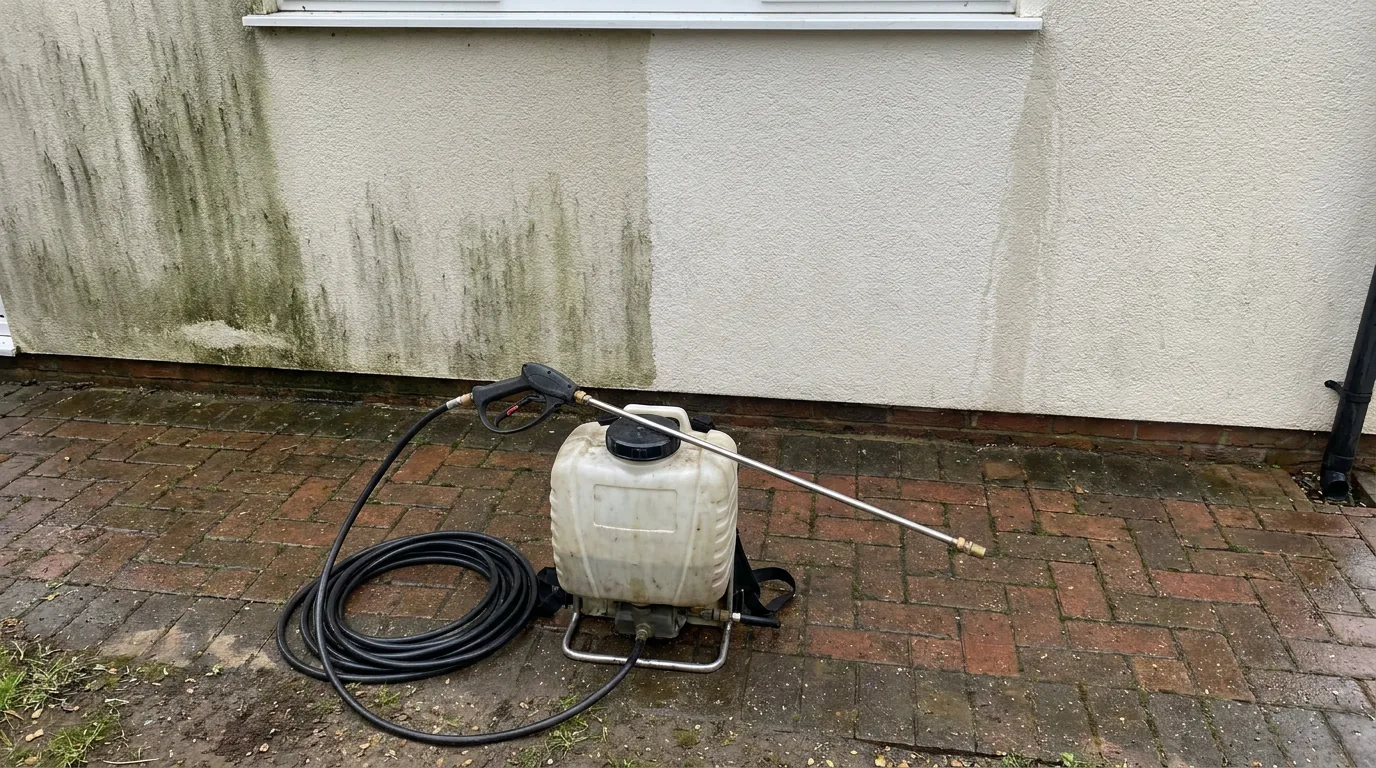
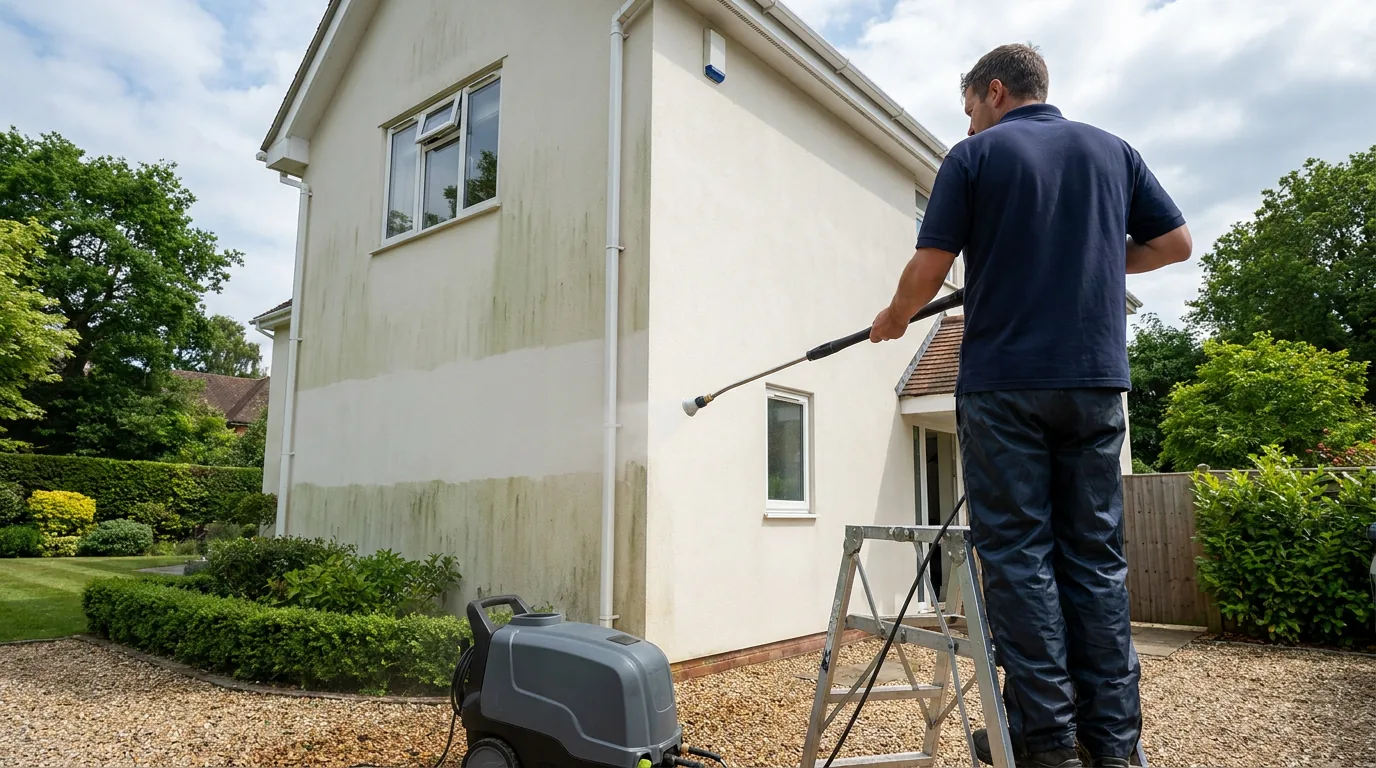
The short answer: Render — especially K-Rend and other modern silicone renders — is not a surface that takes pressure. Hit it with a normal pressure washer and you’ll strip the texture, force water in behind the render, and end up with a worse problem six months later when the algae is back. Soft wash is the only correct method. Low pressure, biocide, dwell, rinse. The biocide (Lithofin Algex or equivalent[1]) does the killing at root level — not the water. Results last 2–4 years, vs 6 months on a high-pressure clean.
The render-cleaning protocol matrix
Original analytical contribution: the labelled OAC below maps each render type against pressure protocol, biocide cadence and risk of damage. No competitor publishes a per-render-type protocol matrix.
| Render type | Protocol | Cadence | Damage risk under high pressure |
|---|---|---|---|
| K-Rend / modern silicone | Soft-wash chemistry, low-pressure rinse | 36–48 months | Texture stripped; water forced behind surface |
| Pebbledash | Soft-wash; biocide gets into the dimples | 36–60 months | Aggregate loss / loosening |
| Painted render / sand-cement | Soft-wash; won’t lift sound paint | 36–48 months | Paint stripped, render scored |
| Acrylic / through-coloured | Soft-wash; restores original colour | 36–48 months | Streaking, colour loss |
| Lime render (period property) | Soft-wash with extra care; conservation-area constraints | 24–48 months | Severe erosion; listed-building enforcement risk |
Surrey-side cadences reflect rainfall + tree-canopy factors. North-facing render and gables under tree shade need cleaning at the shorter end of the range; south-facing rendered elevations stretch to the longer end.
Why pressure doesn’t work on render
Render is a thin, textured cementitious or polymer-modified coating bonded to a wall. Algae and lichen colonise the textured surface; full-pressure water doesn’t reach the root, knocks the visible growth off the surface only, and physically damages the texture — particularly on silicone-modified renders that rely on a hydrophobic surface layer for their water-repellent behaviour. Once the surface is breached, water can penetrate behind the render where it shouldn’t. The Marshalls medium-pressure technique[2] developed for hard paving is not appropriate for render. Soft-wash biocide chemistry kills at root level — that’s why results last 2–4 years rather than 6 months.
Surrey substrate context: why north-facing render goes green faster
Met Office Wisley[4] records 648 mm/yr rainfall across the Surrey radius. North-facing render across the chalk dip-slope (Banstead, Reigate Hill, Caterham — BGS Chalk Group[5]) and the Lower Greensand valley (RH1 baseline — BGS Lower Greensand[6]) loses direct sunlight for most of the day. Combined with mature tree shade, the surface stays damp long enough for algae and lichen to colonise — particularly visible under gutters where dripping moisture sustains continuous colonies. Annual Lithofin Algex[1] spring application (applied at manufacturer dilution, allowed to dwell, then rinsed at low pressure) is the cadence that gives 36-48 month re-clean intervals on render.
Slip-risk under rendered gables
HSE-endorsed UKSRG pendulum guidance[3] at PTV ≥36 is rarely the gating concern on the rendered wall itself — but the paving immediately beneath rendered north-facing gables routinely drops below threshold because dripping moisture from the wall keeps the paving damp. We always check paving-level PTV implications when quoting render cleans on shaded properties.
Conservation-area constraints on lime render and listed property
Period property with traditional lime render or lime mortar is subject to conservation-area and listed-building consent considerations. Reigate & Banstead Borough Council[7] and equivalent councils (Tandridge for Oxted, Mole Valley for Dorking, Crawley BC for Crawley) all apply conservation-area design policies. Soft-wash chemistry is materially less risky than any pressure-washing on listed render — an additional reason the protocol is universal for render across our radius.
Why the 2–4 year cadence holds
The Lithofin Algex[1] biocide kills algae and lichen at root level rather than just removing the visible surface growth. Combined with low-pressure rinse that doesn’t damage the render texture, the colonising organisms have to re-establish from spores rather than regrow from surviving root structures. The 2–4 year cadence holds because regrowth from spores is materially slower than regrowth from surviving roots. Surrey conditions (Met Office Wisley[4]) extend the upper end on south-facing sun-exposed elevations; north-facing shaded surfaces hit the lower end of the range.
- Plants and garden protected before we start
- Specialist soft-wash biocide application
- Low-pressure rinse from top down
- Algae killed at root — not just knocked off
- Honest assessment if anything won’t come up
- Final clear-up and rinse-down of paths
Render types we clean
K-Rend & modern silicone render
The most common new-build render in Surrey, and the one most often ruined by the wrong cleaning method. Soft wash is manufacturer-recommended. We clean to spec.
Pebbledash
The tricky one — lots of texture for algae and lichen to sit in. Biocide gets right into the dimples in a way pressure can’t. Comes up beautifully.
Painted render & sand-cement
Older Surrey homes. Same soft wash method. Won’t lift sound paint, will not strip the render itself.
Acrylic & through-coloured render
Soft wash safe. Colour comes back to original. No risk of streaking or lifting.
Areas we cover
Across all of Surrey within 20 miles of Redhill (RH1). That includes Redhill, Reigate, Horley, Dorking, Banstead, Caterham, Godstone, and the rest of all 15+ areas.
Useful guides
Full render cost guide · Pressure washing guide · Pressure vs jet washing · More on soft washing
Sources
Every protocol claim about render cleaning is sourced. Primary data and manufacturer technical guidance only.
- Lithofin AG — Algex Special Cleaner. Annual reapplication, preferably in spring. lithofin.com — Algex. Accessed 21 May 2026.
- Marshalls plc — Garden Paving & Driveways: Cleaning & Maintenance Guidelines. Cited as the medium-pressure protocol that is NOT applicable to render. marshalls.co.uk — guidelines (PDF). Accessed 21 May 2026.
- UK Slip Resistance Group / HSE — Introduction to the Pendulum Tester. PTV ≥36 low risk. ukslipresistance.org.uk. Accessed 21 May 2026.
- Met Office — Wisley Long-Term Averages 1991–2020. metoffice.gov.uk — Wisley. Accessed 21 May 2026.
- British Geological Survey — Chalk Group lithostratigraphy. bgs.ac.uk — Chalk Group. Accessed 21 May 2026.
- British Geological Survey — Lower Greensand Group lithostratigraphy. bgs.ac.uk — Lower Greensand. Accessed 21 May 2026.
- Reigate & Banstead Borough Council — Local Plan and conservation-area design policies. reigate-banstead.gov.uk — Local Plan. Accessed 21 May 2026.