- Average cost: from £5/m² (~£145 minimum)
- Small deck £100–£200, medium £200–£400, large £350–£500+
- 300,000 garden injuries/yr (RoSPA), slippery decking is a major cause
- Timber needs annual cleaning + oil; composite is much lower-maintenance
- Cleaning + oiling extends timber lifespan from 5–10 to 10–15 years
- UK decking market: £476M by 2028
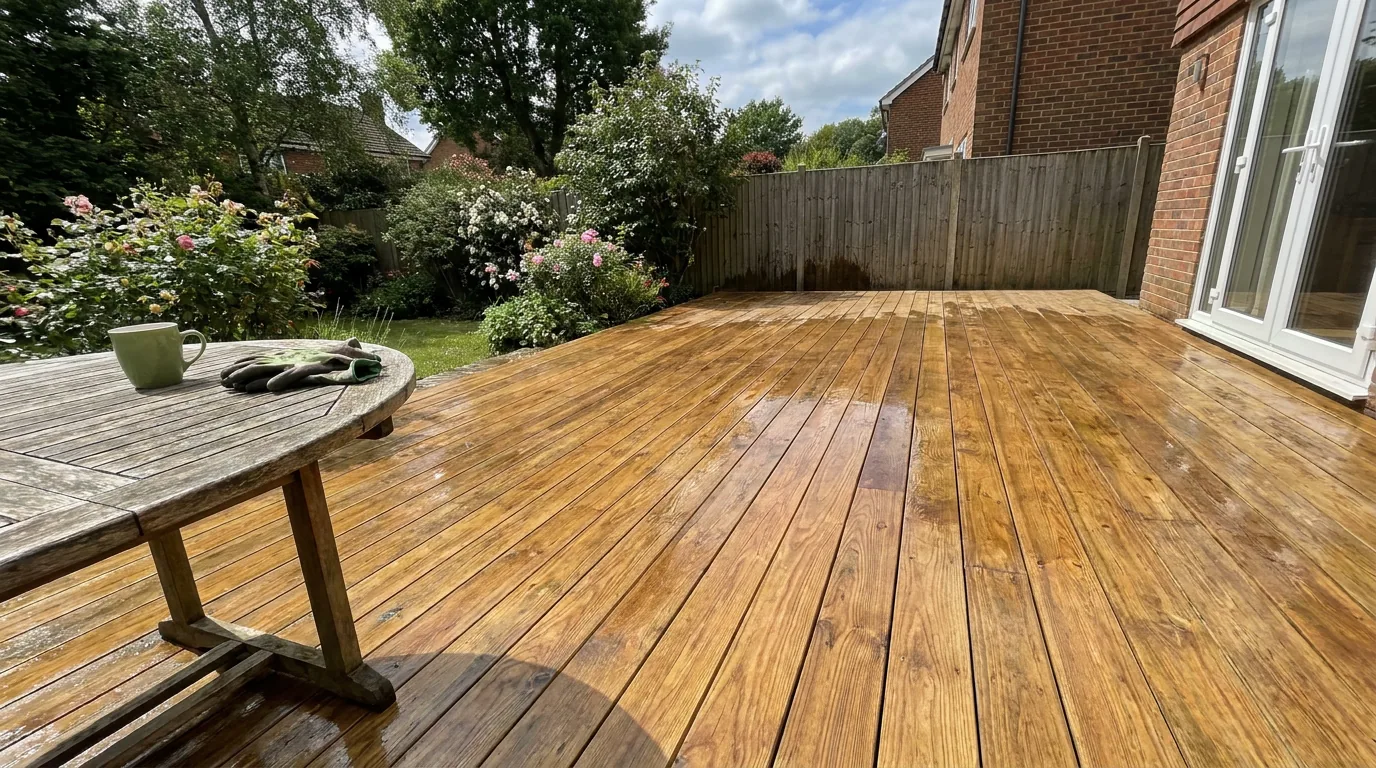
The quick answer: professional decking cleaning costs from £5 per m² in 2026, with most companies charging a ~£145 minimum. Small deck £100–£200, medium £200–£400, large £350–£500+. Adding oil or stain roughly doubles the price.
Beyond cost, there’s a serious safety case for keeping decking clean. RoSPA reports 300,000 garden injuries a year, with slippery decking cited as a major cause. This guide covers costs, methods, timber vs composite, oiling products, and how regular cleaning can double the deck’s lifespan.
Cost by deck size
Deck size is the main cost driver. Most cleaners charge per m² with a minimum call-out.
| Size | Area | Clean only | With oil/stain |
|---|---|---|---|
| Small deck | 5–10 m² | £100–£200 | £250–£400 |
| Medium deck | 10–20 m² | £200–£400 | £400–£700 |
| Large deck | 20–40 m² | £350–£500+ | £700–£1,000+ |
| Very large | 40 m²+ | £500+ | £1,000+ |
Hourly rates £50–£100. Average job £135 for a standard deck clean. Adding stain or oil treatment adds £350–£800 depending on size and coats.
Per m² breakdown
| Service | Per m² | Notes |
|---|---|---|
| Pro pressure wash | From £5/m² | £145 minimum |
| Soft wash | £5–£10/m² | Gentler, suits all timber |
| Full restoration (clean + sand + oil) | £10–£20/m² | Comprehensive |
Surrey and the South East sit at the higher end, Redhill, Reigate, Dorking reflect the region’s operating costs.
Slippery decking: the safety case
Cost aside, the strongest argument for regular cleaning is safety. RoSPA / HSE numbers:
- 300,000 garden injuries/year (over 100,000 children)
- 115,000 garden falls, slips, trips annually
- 35% of slip injuries happen on wet surfaces, mostly Oct–Mar
- At least 1 death/week from a slip, trip, or fall in the UK
- Someone breaks a bone every 25 minutes from slips, trips, falls
Slippery decking is specifically cited by both RoSPA and HSE as a major hazard. Algae and moss thrive on damp wood and create a slick biofilm, invisible dry, dangerously slippery wet. In shaded gardens common across Surrey’s tree-lined suburbs, timber decking rarely dries out completely Oct–Mar.
Financial cost of injuries
- Hip/pelvis from falls: £2,175–£76,350 compensation
- Severe knee from falls: £15,500–£56,000
- Total cost to UK employers: ~£512M/year
- Total societal cost: ~£800M/year
£200–£400 for a pro deck clean is a fraction of the cost of a serious injury. With elderly relatives or young children using the garden, clean decking isn’t optional.
Timber vs composite: the comparison
| Factor | Timber | Composite |
|---|---|---|
| Lifespan | 10–15yr softwood, 20–25 hardwood | 25–30yr, 50yr capped |
| Annual upkeep | Power wash + 1–2 coats oil/stain | Occasional wash, soapy water |
| Annual cost | £40–£80 product (16 m²) + a weekend | ~£10/yr products |
| 5-yr cost | £200–£400 product + 10+ days time | Near zero |
| 25-yr cost | £500–£750+ products plus possible replacement | ~£250 total |
| Risks | Rot, warping, splitting, splintering, slippery algae | Leaf/bird staining if left |
| Treatment after clean | Oil or stain every year | None |
| Replacement | Often year 12–18 | Rarely within 25yr |
Timber is cheaper to install but far more expensive to maintain. Over 25 years, a timber deck can cost more in maintenance products alone than a composite deck costs to keep clean, before factoring in your time and a likely replacement. That said, with proper annual maintenance, timber gives 10–15+ good years. Skip even one year of oiling and deterioration accelerates dramatically.
Cleaning methods
Pressure washing
- Pressure-treated softwood: 1,000–1,200 PSI maximum
- Cedar & soft softwoods: 500–600 PSI maximum
- Composite: 500–1,000 PSI max, fan tip
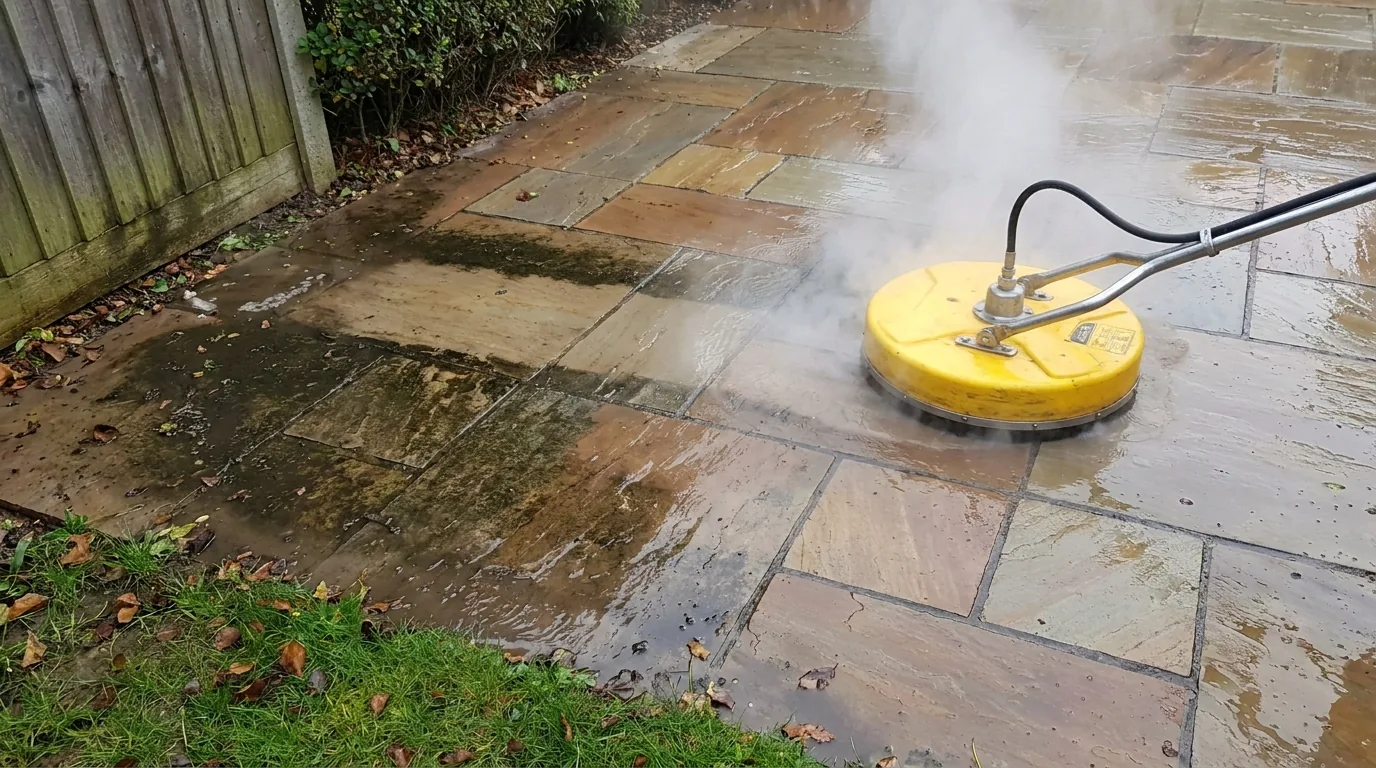
Higher pressure raises the grain, splinters fibres, damages the surface. Pros use rotary surface cleaners for even coverage without the striping you get from a lance. £150–£350 for a pro wash.
Soft washing / chemical
Gentler alternative for fragile or older timber. Pre-treat with sodium percarbonate (oxy bleach), gentle rinse, brightener or neutraliser. Kills organisms at the root without mechanical force. Pre-treatment dwell 5–10 minutes for heavy soiling.
Sanding
Needed after pressure washing to smooth raised fibres, before re-staining, and on heavily weathered boards. 80–120 grit, work along the grain.
Full restoration sequence
- Clear furniture, sweep debris
- Chemical pre-treatment (kill algae and moss at root)
- Gentle pressure wash or soft wash
- Dry 24–48 hours
- Light sanding to smooth
- Apply oil/stain (1–2 coats per product instructions)
£10–£20/m² full restoration is the most comprehensive service, best for neglected timber not maintained for years.
Oils & stains: products & costs
| Product | Size | Price | Coverage |
|---|---|---|---|
| Cuprinol Anti-Slip Decking Stain | 2.5L | £32.99–£35 | 12–14 m²/L |
| Ronseal Quick Drying Decking Oil | 2.5L | £24.99 | 8–10 m²/L |
| Ronseal Decking Oil (Natural Oak) | 2.5L | £29.99 | 8–10 m²/L |
| Cuprinol Decking Oil | 5L | ~£33 | 12–14 m²/L |
| Liberon Superior Decking Stain | 5L | £41 | Varies |
Which? rates Cuprinol Anti-Slip highly for durability. For a 16 m² deck with two coats, expect £40–£80 in product. Always clean and fully dry before applying any oil or stain, ideally 24–48 hours of dry weather. Apply at 10°C+ day and night for proper cure.
How often to clean in the UK
| Situation | Frequency |
|---|---|
| General maintenance | At least once a year |
| Best practice | Twice a year, spring + autumn |
| High-traffic decks | 3–4 times/year |
| Shaded / damp | More frequently, moss builds faster |
| Composite | 2–3 times/year |
Spring is ideal, restores the deck after winter and preps for summer. Autumn clean clears leaves before winter moisture causes rot. Composite still needs cleaning despite the “low maintenance” marketing, soap, hot water, soft brush, but neglected composite still develops mould and leaf marks.
Warning signs
| Sign | What it means | Urgency |
|---|---|---|
| Slippery when wet | Biofilm/moss, SAFETY HAZARD | HIGH, immediate |
| Splintering | Advanced weathering, wood breaking down | High, structural |
| Black spots/streaks | Mould or black algae | Medium-High |
| Visible moss/lichen | Established organic growth | Medium-High |
| Green film/patches | Algae colonisation | Medium |
| Grey weathered look | UV + moisture damage | Medium |
| Rough/fuzzy texture | Wood fibres separating | Medium |
| Leaf staining | Tannin staining from organics | Low-Medium |
Slippery when wet, don’t wait. Genuine safety hazard. Pro clean can usually be arranged within days.
Lifespan: with vs without maintenance
| Decking type | With maintenance | Without |
|---|---|---|
| Softwood (pressure treated) | 10–15 yr | 5–10 yr |
| Hardwood | 25–50 yr | 15–20 yr |
| Composite (capped) | 25–50 yr | 20–30 yr |
| Composite (uncapped) | 15–25 yr | 10–15 yr |
UK temperate maritime climate = prolonged moisture exposure = rot, warping, splitting in untreated timber. Most timber decks reach end of life year 12–18. Untreated timber can warp and rot within 2–3 years. Eventually it’s cheaper to replace than patch, doubling the original investment. £200–£500/year professional cleaning + oiling delays or prevents this.
Best time of year
| Season | Suitability | Notes |
|---|---|---|
| Early spring (Mar–Apr) | IDEAL | Restore after winter, warming above 10°C |
| Late spring (May) | Excellent | Warm enough for oil/stain to cure |
| Summer (Jun–Aug) | Good | Warm and dry, deck in heavy use |
| Early autumn (Sep–Oct) | Good | Pre-winter clean |
| Late autumn / winter | Poor | Too cold for cure, constant moisture |
Spring is consistently best. Temperature must stay above 10°C day and night for oil/stain to cure. Avoid treating just before rain, allow 24–48 hours drying. Two-clean approach (spring + autumn) is best practice for UK timber decking.
Want it done professionally? See our decking cleaning service or request a free quote.
Areas we cover
We work right across Surrey within 20 miles of Redhill (RH1), Redhill, Reigate, Horley, Dorking, Banstead, Epsom, Crawley, and all 15+ areas.
Original analysis and sources
UK timber decking cleaning has one realistic annual window: late April to mid-May, when ambient temperatures exceed 8°C for biocide activation and 48–72 hours of dry weather allows oil/stain cure. Lithofin biocide manufacturer guidance specifies spring application[2]; Wisley climate data[1] sets the local schedule.
Key sourced claims in this guide: Surrey rainfall baseline 648 mm/yr per Met Office Wisley[1], annual biocide cadence per Lithofin Algex manufacturer guidance[2], medium-pressure / 30° oblique / ≥200 mm-standoff technique per Marshalls[3], HSE-endorsed slip-risk methodology[4], and PTV ≥36 low-slip threshold from UKSRG pendulum-test guidance[5].
Sources
Every numeric claim, technique parameter, and safety threshold in this guide is sourced from a manufacturer technical bulletin, BS standard, or .gov.uk reference. We cite the bodies whose data and rules actually govern UK pressure-washing outcomes, not the unsourced ranges repeated across competitor blogs.
- Met Office, Wisley (Surrey) Location Long-Term Averages 1991–2020. Closest Met Office station to RH1. Annual rainfall 648.41 mm; Surrey is ~43% drier than the UK national mean of ~1,147 mm. metoffice.gov.uk, Wisley averages. Accessed 21 May 2026.
- Lithofin, ALGEX Special Cleaner product page. Manufacturer guidance: spray annually, preferably in spring. 6–12 month residual activity. lithofin.com, ALGEX. Accessed 21 May 2026.
- Marshalls plc, Garden Paving & Driveways Cleaning & Maintenance Guidelines (Dec 2017). Technique: medium pressure, 30° lance, 200mm minimum standoff. marshalls.co.uk, cleaning guidelines (PDF). Accessed 21 May 2026.
- Health and Safety Executive (HSE), Slips and trips at work. HSE-preferred slip-risk methodology; PTV ≥36 wet-acceptance threshold. hse.gov.uk, slips and trips. Accessed 21 May 2026.
- UK Slip Resistance Group, Introduction to the Pendulum Tester (BS 7976: Parts 1-3). PTV ≥36 = low slip risk threshold for outdoor pedestrian surfaces. ukslipresistance.org.uk, pendulum tester. Accessed 21 May 2026.
- Kärcher, K7 consumer pressure washer manufacturer datasheet. 180 bar (~2,610 PSI), 600 L/hr. kaercher.com, K7 product page. Accessed 21 May 2026.
- BSI, BS 7533-101:2021 Code of practice for modular paving units. Treats jointing material as load-transfer system. bsigroup.com, BS 7533-101:2021. Accessed 21 May 2026.
- Resiblock Ltd, Block Paving Sealer Product Data Sheets. Manufacturer-stated lifespan up to 5 years. resiblock.com, technical data sheets. Accessed 21 May 2026.
- UK Government (gov.uk), National Living Wage rates from April 2026: £12.71/hr (age 21+). The legal floor for valuing UK labour and DIY time. gov.uk/national-minimum-wage-rates. Accessed 21 May 2026.
- Thames Water, 2026/27 Charges. Combined water + wastewater rate £4.21/m³. thameswater.co.uk, bill value. Accessed 21 May 2026.