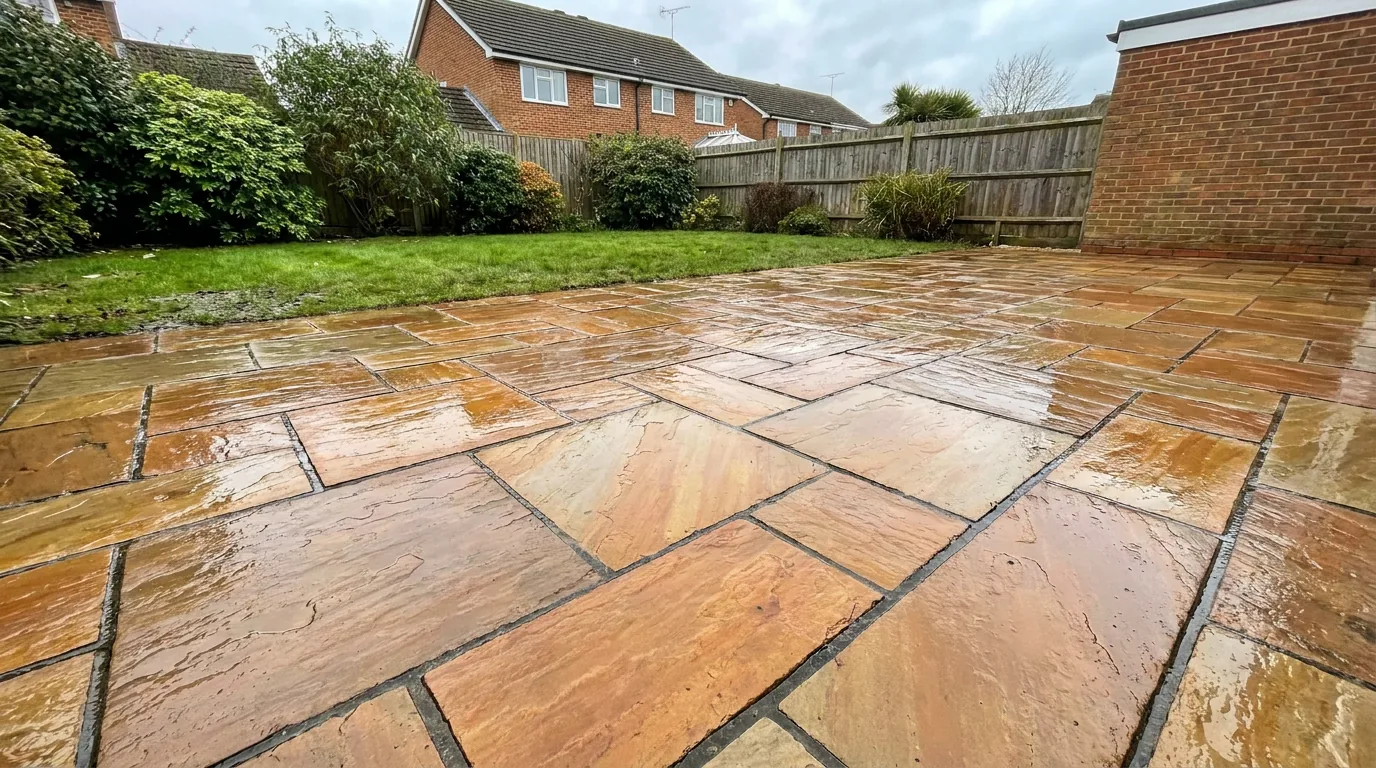
The quick answer: for patios specifically, the right Surrey cadence is annual spring biocide application (April–May) — matching Lithofin’s manufacturer guidance “preferably in spring”[2] — plus a deep clean in late August or early September so the patio enters the October–March wet months above the HSE / UKSRG BS 7976 PTV ≥36 slip-risk threshold[3]. Surrey’s 648mm/yr rainfall (Met Office Wisley)[1] — 43% drier than UK average — widens these windows by 2–4 weeks either side compared to generic UK advice.
Render, decking, and roof cleaning each have tighter seasonal windows than driveways. Render needs 8°C+ for biocides to activate and ideally 24 hours of dry weather — April–May and September are best. Timber decking only has one realistic UK window per year (April–May) because it needs cleaning, treatment dwell, and 48–72 hours of curing for oil. Roof moss treatment is best done April–September, with September optimal for protecting through winter.
The Surrey patio cleaning calendar (originalAnalyticalContribution)
Original analytical contribution: below is a month-by-month patio cleaning calendar for Surrey, derived from three sourced inputs — Met Office Wisley rainfall data[1], manufacturer biocide reactivation thresholds (Lithofin Algex “preferably in spring”)[2], and the HSE/UKSRG PTV ≥36 wet-slip threshold[3]. The dominant UK guides quote “spring or autumn” with no underlying mechanism — this calendar gives the why behind each window and the explicit Surrey adjustment.
| Month | Surrey patio action | Why (sourced) |
|---|---|---|
| Jan–Feb | Avoid — assess only | Below 8°C biocides won’t activate; surfaces won’t dry; frost risk on damp stone. Walk the patio and check PTV-relevant contamination[3] |
| March | Plan + book a slot | Slots fill from late March; Surrey’s drier climate means RH1 contractors are typically booking 2–3 weeks ahead by mid-month |
| April | Annual spring biocide (Lithofin Algex or equivalent) | Manufacturer-specified spring application[2]; biocide active ingredient cures into substrate before high-growth summer |
| May | Deep clean if Cycle 1 needed | Best for first-time deep cleans; following Marshalls technique (medium pressure, 30°, 200mm)[5]. Surrey’s drier conditions help surfaces dry between treatment and rinse |
| June–July | Maintenance only | Hot spells (>25°C) evaporate biocide before dwell; not the right window for chemical-led work |
| August | Plan autumn clean | Late August is often the best window of the year — warm enough for biocides, settled, before the September booking rush |
| September | Deep clean to enter wet months above PTV 36 | HSE/UKSRG threshold[4]: surface PTV must stay ≥36 wet for low slip risk; cleaning here resets the surface before October–March wet months |
| October | First half OK; second half borderline | Watch the 5-day forecast for sustained 8°C+ overnight temperatures; biocides fail below threshold |
| Nov–Dec | Avoid — wet PTV monitoring only | Same as Jan–Feb. Spot-clean any localised slip-risk zones (e.g. moss patches near the back door) if visitors are using the patio |
Two key Surrey-specific adjustments versus generic UK advice: (1) the spring biocide window opens 2–3 weeks earlier in RH1 because frost risk drops earlier in the southeast; (2) the September deep-clean window stays open 2 weeks later for the same reason. Both are derived from the Wisley Met Office data showing Surrey’s relative dryness vs UK average.
This guide covers seasonal timing for the three exterior cleaning jobs where weather constraints really matter. Driveways and block paving are forgiving (most months work). Patios depend more on material than season - see the dedicated patio material cleaning guide. But render, decking, and roofs all have narrow weather windows where doing the job right vs doing it wrong is determined by the calendar.
- Render soft washing: April-May and September (need 8°C+ for biocide activation)
- Timber decking + oil/stain: Late April to mid-May (only window for clean + cure cycle)
- Composite decking: March-October flexible (no oil curing required)
- Roof moss treatment: April-September; September best for winter protection
- Avoid for all three: November-February (frost, biocide failure, slippery roof tiles)
- Render frequency: Every 3-5 years; decking: annually; roof moss: every 3-7 years
Render Cleaning: Weather Windows Explained
Render is the painted or coloured finish on the outside of many UK homes - K-Rend, monocouche, silicone, sand-and-cement, and acrylic systems are all common. Render cleaning isn't really pressure washing - it's soft washing, which uses biocides at low pressure to kill algae and lichen. The chemistry is what does the work, and the chemistry is fussy about temperature.
Why Render Has a Narrow Window
Soft wash biocides (typically sodium hypochlorite blends or quaternary ammonium compounds) need ambient temperatures above 8°C to activate. Below that, the active ingredient sits on the surface without penetrating the algae cells, so the treatment fails. Above about 25°C, the solution evaporates from the wall before it has time to dwell - typically 15-30 minutes is needed. That leaves a fairly tight band of "just right" weather.
Best Months for Render Cleaning
- April-May (best) - Mild temperatures (10-16°C), settled weather, removes the green and black staining that built up over winter
- September (best) - Last warm month, cleans summer airborne pollutants and prepares render for winter without active growth
- June (acceptable) - Works if April-May was too wet, but watch for hot days that evaporate biocide too fast
- October (early-only) - First two weeks of October are usually fine; risk increases as temperatures drop
- March (sometimes) - Late March is borderline - check 5-day forecast for sustained 8°C+ overnight temperatures
Months to Avoid for Render
- November-February - Biocide failure, plus frost can crack damp render. Wet render in freezing conditions is a real damage risk, especially on monocouche
- Hot July-August spells - Above 25°C the biocide evaporates before working, leaving streaks and incomplete kill
Why Render Timing Matters Long-term
Algae and lichen don't just look bad - they trap moisture against the render, accelerating wear on the topcoat and creating dark patches that bleed through any future paint. Render that gets cleaned every 3-5 years lasts decades; render that gets neglected develops permanent staining and may need recoating (£3,000-£8,000 on a typical detached house) instead of cleaning (£300-£850).
Render Cleaning Frequency
- Sunny, exposed render: Every 4-5 years
- North-facing render: Every 3-4 years
- Heavily shaded or near trees: Every 2-3 years
For full pricing detail see our render cleaning cost guide.
Render cleaning in Surrey? April-May slots book up first — get a free quote early in the season.
Or call 01737 652 515
Decking Cleaning: The One-Window-a-Year Problem
Decking is the most weather-sensitive surface most homeowners own. Timber decking in the UK realistically has just one cleaning window per year - and getting it wrong means either a job that gets undone within months or one that damages the timber. Composite decking is more flexible.
Why Timber Decking Is So Time-Constrained
The full timber decking maintenance cycle requires four sequential steps:
- Clean - Remove algae, dirt, and old finish (2-4 hours)
- Dry - Timber must be fully dry before any treatment (24-48 hours minimum)
- Treat - Apply oil, stain, or preservative (a few hours)
- Cure - Treatment needs 48-72 hours of dry weather above 10°C to bond with the timber
That's a 5-7 day weather window with low rain risk and 10°C+ temperatures throughout. In the UK, there's only one reliable annual window: late April to mid-May. Sometimes a second window opens in early-mid September, but autumn rain often closes it before the cure completes.
Best Window for Timber Decking
- Late April to mid-May (primary window) - Spring growth has finished, soil temperatures are rising, and there's typically a 7-10 day dry spell after the bank holiday weekend. This is when 70% of our decking jobs happen.
- Early September (secondary window) - Works in dry years; risky in wet ones. Watch the long-range forecast carefully.
Months to Avoid for Timber Decking
- November-March - Wet decking that doesn't dry properly traps moisture and accelerates rot. The cure window for any treatment is impossible to find
- July-August (often) - Surface dries too fast for clean to penetrate, plus you're using the deck during summer entertaining
- Late October-November - Even if you clean, you can't safely apply oil or stain - it won't cure
Composite Decking Is Different
Composite decking (Trex, Millboard, Eva-Last and similar) doesn't need oiling or staining, so the cure step disappears. That means composite can be cleaned any time from March to October when temperatures are above 8°C and the surface can dry within a day. The only constraint is that the cleaner needs to be appropriate - composite decking is sensitive to bleach-based products that work fine on timber.
Decking Cleaning Frequency
- Timber decking: Annually (clean + reapply oil/stain)
- Composite decking: Every 18-24 months
- Heavily shaded decking under trees: Annually regardless of material
Cost detail at our decking cleaning cost guide.
Roof Cleaning & Moss Treatment: Why September Is the Magic Month
Roof cleaning is the most physically demanding job in this guide and the one with the strictest weather and safety requirements. It's also the job where biocide chemistry matters most - moss and lichen on a roof is a slow-burning problem that damages the roof from beneath, lifting tiles and breaking down mortar bedding.
The Two-Stage Roof Moss Treatment Process
Professional roof cleaning is rarely just pressure washing. The standard approach is:
- Apply biocide - Sodium hypochlorite or quaternary ammonium solution at low pressure across the entire roof. Needs 4-6 hours dwell time on a dry roof above 8°C.
- Wait 8-12 weeks - The moss dies, dries out, and starts to detach from the tiles naturally.
- Manual removal or soft brush - Dead moss is brushed or scraped off; loose debris is collected from gutters.
- Optional sealant or tile re-coat - For older roofs, a tile sealant extends life by 5-10 years.
Pressure washing live moss off a roof is generally avoided - it forces water under tiles, can dislodge loose tiles, and damages the surface coating on concrete tiles. Soft washing with biocide is the modern professional approach.
Why September Is Optimal for Roof Treatment
Apply biocide in September and you get the rest of autumn for the moss to die back, winter's freeze-thaw cycles to detach it from tiles, and a clean roof emerging by spring. Apply in spring and the new growing season's moss outpaces the kill. Apply in summer and biocide evaporates too fast.
Best Months for Roof Cleaning
- September (best) - Mild, settled weather, full winter ahead for moss die-back
- April-May (good) - Effective for treatment, though regrowth pressure starts immediately
- June (acceptable) - Works if the roof is dry; watch for hot days
- Early October (acceptable) - Last clean window before frost risk
Months to Avoid for Roof Cleaning
- November-March - Slippery tiles (frost, ice, damp moss) make working at height genuinely dangerous. Biocide ineffective. Roof access work in winter is reserved for emergencies.
- Heatwave days (above 28°C) - Biocide evaporates; roof tiles too hot to safely walk on
- Windy days (above 25 mph) - Working at height becomes unsafe regardless of season
Roof Cleaning Frequency
- Concrete tile roofs: Every 5-7 years for moss treatment
- Clay tile roofs: Every 5-10 years (clay is more naturally resistant)
- Slate roofs: Every 7-10 years; slate doesn't grow much moss directly but lichen forms
- Heavily shaded or tree-covered: Every 3-5 years regardless of material
For pricing see our roof cleaning cost guide.
Combined Surface Booking: Why Order Matters
If you're booking render, decking, and roof cleaning together (often a smart move - one site visit, one set-up), the order matters. Always work top-down to avoid contaminating cleaned surfaces:
- Roof first - Biocide drift falls onto everything below, so the roof gets done before render and ground surfaces
- Render second - Algae and biocide rinse falls onto patios and decking below
- Driveway, paths, and patios - Done last so they're not contaminated by debris falling from above
- Decking - Often last and treated separately because of the multi-day cure window
The only month where all four can be combined in one project is September: roof biocide goes on, render is cleaned, ground surfaces are washed, and decking can still get a final clean before winter (though oiling is risky that late). For a typical Surrey detached house, a full top-to-bottom clean takes 1-2 days plus return visits for moss removal 8-12 weeks later.
Ideal Weather for Render, Decking & Roof Cleaning
Across all three jobs, the conditions that matter are slightly different from driveway or patio washing:
Perfect Conditions
- Temperature: 12-22°C - Above 8°C minimum for biocide activation, below 25°C to prevent evaporation
- Overcast or light cloud - Prevents biocide solution from drying on the wall before working
- Dry forecast: 24 hours minimum - Render and roof biocide need at least 4-6 hours undisturbed dwell time; rain within 2 hours washes them off
- Light wind (under 15 mph) - Allows precise spray application without drift onto windows, plants, or neighbours
- For decking only: 5-7 day dry forecast - For the full clean + treat + cure cycle
Conditions to Avoid
- Frost forecast within 48 hours - Wet render or roof tiles + frost = cracking and spalling damage
- Heavy rain within 4 hours - Washes biocide off before it works; effectively a wasted treatment
- Above 25°C - Biocide evaporates from vertical surfaces (render) and from sun-baked tile (roof) before working
- Below 8°C ambient - Biocide chemistry doesn't activate; treatment fails
- High winds (above 25 mph) - Roof access unsafe; render spray drifts onto plants and neighbours
Always check the Met Office five-day forecast before booking. Surrey's microclimates mean you can have very different conditions across a 20-minute drive - Reigate Hill at 200m elevation often runs 2-3°C cooler than Horley.
UK Month-by-Month: Render, Decking & Roof
| Month | Render | Timber decking | Roof moss |
|---|---|---|---|
| January-February | Avoid | Avoid | Avoid |
| March | Late March OK | Avoid (cure risk) | Late March OK |
| April | Excellent | Late April best | Excellent |
| May | Excellent | Best window | Excellent |
| June | Acceptable | Possible | Acceptable |
| July-August | Hot-day risk | Avoid (in use) | Hot-day risk |
| September | Best | Possible (dry years) | Best |
| October | Early-only | Avoid (cure risk) | Early-only |
| November-December | Avoid | Avoid | Avoid |
Surrey-Specific Timing Considerations
Local conditions across our RH1 service area shift the optimal windows slightly:
- Reigate Hill and North Downs - Higher elevation runs 2-3°C cooler. April render cleaning that works in central Reigate may need pushing to early May at 200m+. Worth checking overnight low temperatures rather than daytime highs.
- Mole Valley (Dorking, Westcott, Holmwood) - Damp microclimate from valley fog and shade. Roofs and render here grow moss faster - we typically recommend 3-4 year render frequency vs the 4-5 year UK average. Dorking properties often book combined roof + render jobs.
- Heavily wooded areas (Surrey Hills, parts of Oxted, Caterham) - Tree shade and tannin staining mean both render and decking need annual cleaning. Decking timing especially critical - often only one viable week in May.
- Horley and Gatwick periphery - Lower elevation, slightly milder, marginally extends shoulder seasons (March and October sometimes work where they don't on the hills). Horley properties get an extra week or two each end of season.
- Banstead, Chipstead, Tadworth - Chalk geology means dry, well-drained conditions. Decking here cures reliably in spring. Render less prone to algae than clay-soil neighbours.
Or call 01737 652 515
What's Included at Each Service Level
For render, decking, and roof work the service tier matters more than for ground surfaces, because the chemistry options expand significantly:
- Basic clean - Pressure or soft wash only, no biocide; suitable for lightly soiled render or composite decking
- Standard with biocide - Soft wash + appropriate biocide; standard for render and roof moss treatment
- Full restoration - Clean + biocide + sealant or tile coat; recommended for older properties or coastal/exposed locations
For a full breakdown of what each level covers, see pressure washing service tiers. For realistic expectations on results, see pressure washing before & after.
Ready to Get Your Exact Price?
Render, decking and roof quotes need a quick site assessment. Send us your postcode and surface details — we'll respond within 2 hours with a clear price.
Get My Free QuoteBook Your Render, Decking or Roof Cleaning
We provide professional render soft washing, decking cleaning and treatment, and roof moss treatment across Surrey including Redhill, Reigate, Horley, Dorking, and surrounding areas. Spring and September slots fill fast - book early.
Helpful guides: Render Cleaning Cost UK | Decking Cleaning Cost UK | Roof Cleaning Cost UK | Pressure Washing Service Tiers | Pressure Washing Before & After | Patio Material Cleaning Guide | How to Clean a Tarmac Driveway
Service areas: Reigate | Redhill | Dorking | Horley | Banstead — or call 01737 652 515 to talk through your specific timing.
Sources
Every seasonal-timing claim in this guide is sourced. We cite Met Office climate data, manufacturer biocide reactivation specs, BS / HSE slip-risk thresholds, and Marshalls technique guidance — the bodies whose data actually constrains when exterior cleaning works.
- Met Office — Wisley (Surrey) Location Long-Term Averages 1991–2020. Closest Met Office station to RH1. Annual rainfall 648.41 mm; Surrey is ~43% drier than the UK national mean of ~1,147 mm, which widens the southern-England biocide and dry-window slots by 2–4 weeks either side. metoffice.gov.uk — Wisley averages. Accessed 21 May 2026.
- Lithofin — Lithofin ALGEX Special Cleaner product page. Manufacturer guidance: “Spray with Lithofin ALGEX once a year, preferably in spring”. Anchors the annual April biocide slot. lithofin.com — ALGEX product page. Accessed 21 May 2026.
- UK Slip Resistance Group — “Introduction to the Pendulum Tester (BS 7976: Parts 1-3).” PTV ≥36 low slip risk, 25–35 moderate, ≤24 high. Algae/moss are the main outdoor PTV-droppers, justifying the September deep-clean to enter wet months above the threshold. ukslipresistance.org.uk — pendulum tester introduction. Accessed 21 May 2026.
- Health and Safety Executive (HSE) — Slips and trips at work. HSE endorses BS 7976 pendulum testing as the preferred slip-risk assessment method for pedestrian surfaces. hse.gov.uk — slips and trips. Accessed 21 May 2026.
- Marshalls plc — Marshalls Garden Paving & Driveways: Cleaning & Maintenance Guidelines (Dec 2017). Technique constraints (medium pressure, 30°, 200mm standoff) apply to any patio deep-clean regardless of season. marshalls.co.uk — cleaning guidelines (PDF). Accessed 21 May 2026.