- Standard rate: £2.50–£5 per m² (South East)
- Small car park (500 m²): £750–£2,000
- Retail forecourt: £200–£800
- Most clients require £5M public liability insurance minimum
- 32% of workplace injuries are slips, trips, falls (HSE)
- Slip injuries cost the UK ~£1 billion/year
- Regular cleaning is 10–20x cheaper than repair/replacement
The quick answer: commercial pressure washing in the South East costs £2.50–£5 per m² in 2026. Small car park (under 500 m²): £750–£2,000. Retail forecourt: £200–£800. Large car park (2,000 m²+): £5,000–£12,000+. Pricing depends on surface, condition, access, and whether it’s a one-off or maintenance contract.
This guide covers what facilities managers, landlords, and commercial property owners need to know in 2026. Pricing by property type, regulations, contract structures, and why regular commercial cleaning is one of the best investments you can make in a property, not a cosmetic luxury.
Commercial pressure washing costs by property type
Realistic 2026 pricing for the most common commercial cleaning jobs in the South East.
| Property type | Typical area | Price range |
|---|---|---|
| Small car park (<500 m²) | 200–500 m² | £750–£2,000 |
| Medium car park | 500–2,000 m² | £2,000–£6,000 |
| Large car park | 2,000 m²+ | £5,000–£12,000+ |
| Retail forecourt | 50–200 m² | £200–£800 |
| Hotel/hospitality exterior | 200–1,000 m² | £500–£2,500 |
| Warehouse/industrial yard | 500–5,000 m²+ | £1,500–£12,000+ |
| Office building exterior | Varies | £1,500–£3,000/yr |
| School/public building | 200–1,000 m² | £800–£3,500 |
| Petrol forecourt | 300–800 m² | £800–£2,500 |
| Restaurant/pub outdoor area | 30–200 m² | £200–£1,000 |
Standard surface conditions and daytime access. Heavy soiling, oil contamination, chewing gum, or out-of-hours work changes the quote. We always survey site for commercial work, condition matters as much as area.
Car parks, tyre marks, oil, leaves, algae build up fast on tarmac and concrete. Multi-storey is quoted separately because of the multi-level access and ventilation issues.
Hotels, entrance, paths, patios, outdoor dining, car parks. First impressions are everything in hospitality. Hotels in the Crawley/Horley corridor near Gatwick run heavy footfall and benefit from quarterly or even monthly maintenance.
Petrol forecourts, oil and fuel spillages create slip and environmental risk. Specialist degreasers, water reclamation, monthly cleaning is standard.
The business case: why commercial cleaning pays for itself
Not a cosmetic luxury, a financial decision that protects property value, cuts liability, affects rent and tenant retention.
Property value & rental
Well-maintained commercial properties command ~7% higher rents than comparable neglected buildings. £50K annual rent × 7% = £3,500/year extra income. Against £1,500–£3,000 cleaning cost, ROI is immediate. Vacancy periods are also shorter, tenants make snap judgements during site visits.
Repair avoidance
Regular cleaning is 10–20x cheaper than the repair it prevents:
- Annual cladding wash £1,500–£3,000 vs cladding replacement £25,000–£50,000+
- Annual car park clean £2,000–£4,000 vs tarmac resurfacing £15,000–£40,000+
- Annual path clean £500–£1,500 vs block paving relay £8,000–£20,000+
Biological growth drives surface deterioration. Moss, algae, and lichen hold moisture against surfaces, accelerating freeze-thaw damage and chemical weathering. On cladding, growth traps moisture behind panels, corrosion of fixings, degradation of insulation. On paving, root systems force apart blocks. Regular cleaning gets it before it goes structural.
Legal liability
Under the Occupiers’ Liability Act 1957/1984, owners owe a duty of care to visitors. If a customer slips on algae-covered paving and you can’t evidence a documented cleaning programme, your legal position is significantly weaker.
Slip risk: the H&S imperative
HSE: 32% of all non-fatal workplace injuries are slips, trips, falls (2022/23). Most common cause of injury, ahead of manual handling and falls from height.
- Slip injuries cost the UK ~£1 billion/year
- At least 1 death per week from slips, trips, falls
- Average compensation claim £10K–£30K, severe cases £100K+
- Owners can face prosecution with unlimited fines for serious breaches
Algae, moss, lichen form a biofilm that’s extremely slippery wet. Often invisible early on, a surface can be dangerously slippery long before it looks dirty.
Regulations & compliance
Commercial pressure washing operates within H&S, COSHH, and environmental rules. Any contractor you hire should be fully compliant.
Health and Safety at Work Act 1974
- Risk assessments completed before work
- Method statements detailing safe approach
- Together = RAMS documentation, commercial clients require this before site access
- Operatives trained in safe use of high-pressure kit
- Appropriate PPE
COSHH Regulations 2002
Apply whenever cleaning chemicals are used. Contractors must hold COSHH data sheets, assess substance risks, implement controls, train operatives, and store/transport per regs.
Environmental regulations
It is illegal to discharge wastewater directly into storm drains or watercourses. Storm drains in most areas flow straight to rivers, streams, the sea, untreated. Pressure washing runoff contains dirt, oil, chemicals, biological contaminants. The Environmental Protection Act 1990, Water Resources Act 1991, and new Water (Special Measures) Act 2025 all impose duties on anyone generating contaminated wastewater. Penalties include unlimited fines and criminal prosecution.
Any pro contractor uses water reclamation systems to capture, filter, and properly dispose of runoff. If your contractor doesn’t have a wastewater plan, don’t hire them.
Insurance
- Public liability: £5M minimum, often £10M for local authority/NHS/corporate contracts
- Employers’ liability: £5M minimum, legally required if employing staff
- Professional indemnity
- Plant and equipment insurance
Always ask to see certificates before engaging.
Contract structures: one-off vs maintenance
One-off deep clean
For neglected properties needing restoration, sale prep, lease renewal, specific events, or reactive incidents (oil spill, graffiti). Priced higher per m² than contract work because surface condition is worse and there’s no repeat business priced in.
Maintenance contracts
The preferred model for most commercial properties, consistent presentation, duty-of-care compliance, lower per-visit cost than ad-hoc.
| Property | Frequency | Why |
|---|---|---|
| Car parks | Quarterly | Oil build-up, tyre marks, algae in shaded bays |
| Retail forecourts | Quarterly | Gum, foot traffic, customer-facing |
| Hotels | Quarterly | Guest impressions, dining areas, paths |
| Warehouses | Bi-annual | Oil contamination, fork-lift marks, loading bays |
| Petrol stations | Monthly | Fuel spillages, slip risk, environmental compliance |
| Restaurants | Quarterly | Outdoor dining hygiene, food waste |
Maintenance contracts typically save 10–20% over individual one-offs:
- Annual contract (quarterly visits): 10–15% off per-visit rates
- Multi-year (2–3 yrs): 15–20% off, price-locked
- Multi-site contracts: extra volume discounts
SLA terms should cover response time (typically 24–48hrs for reactive), scheduling, quality standards (with photo evidence), reporting, and out-of-hours availability.
The Gatwick corridor: a commercial cleaning hotspot
The corridor from Reigate through Redhill, Horley, to Crawley is one of the densest commercial property markets in the South East outside London. The Gatwick Diamond covers 45,000 businesses.
Manor Royal in Crawley is the largest business district in the Gatwick Diamond, 600+ businesses, 30,000+ jobs. Office parks, industrial estates, distribution centres, retail. Constant demand for car park, forecourt, warehouse, and cladding cleaning.
Hotels: Sofitel London Gatwick, Crowne Plaza, Hilton, Holiday Inn, Hampton, Premier Inn, Travelodge, ibis. Most run quarterly or monthly contracts. 42.8M passengers through Gatwick in 2025.
Car rental: Europcar, Hertz, Avis, Budget, Enterprise, Sixt, large forecourts, customer parking, vehicle prep zones. High-traffic, frequent cleaning needed.
Retail: County Mall in Crawley, 450,000 sq ft retail, 2,000+ parking spaces. Plus retail parks, supermarkets, trade counters across the corridor.
Common commercial surfaces
| Surface | Common uses | Notes |
|---|---|---|
| Tarmac | Car parks, access roads | Stains easily from oil. Moderate pressure, degreaser on stains. |
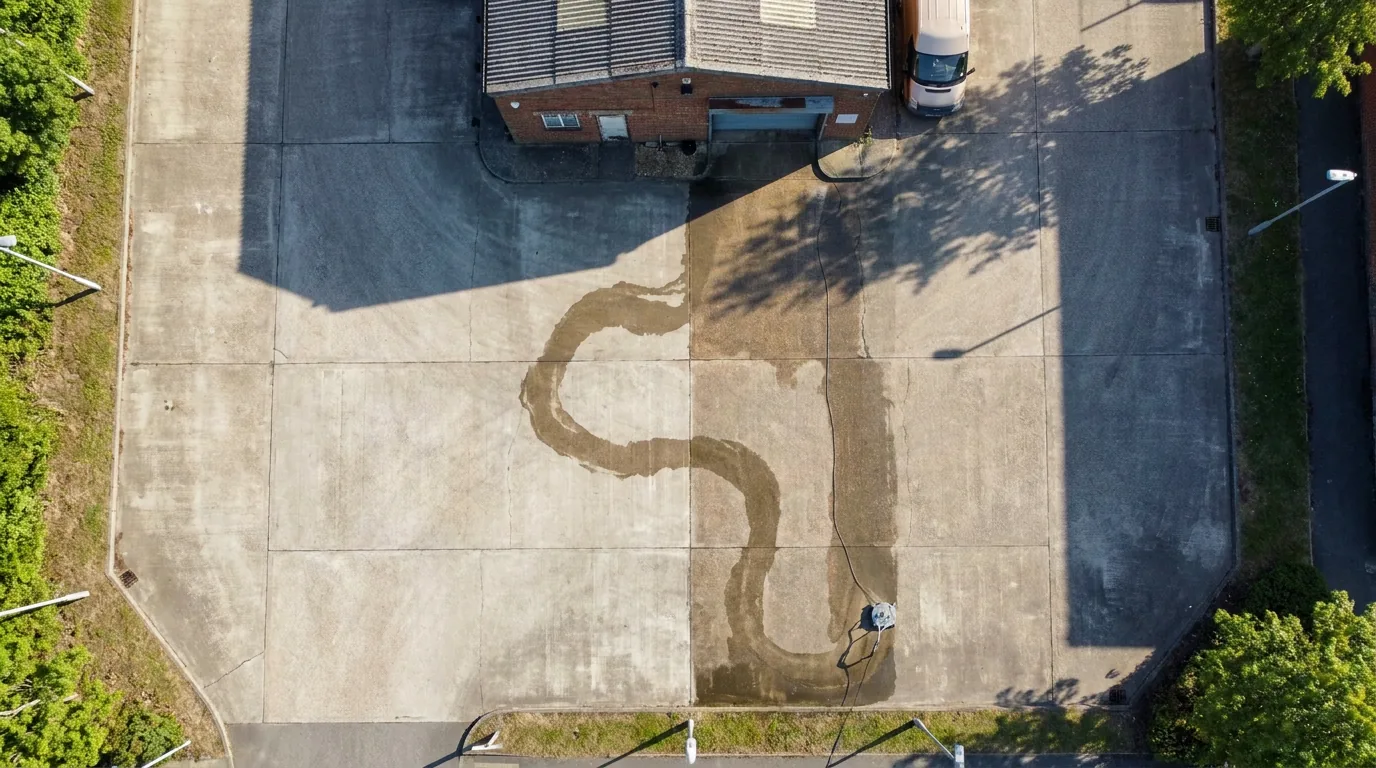
| Concrete | Yards, loading bays, forecourts | Porous, may need multiple passes. High pressure suitable. |
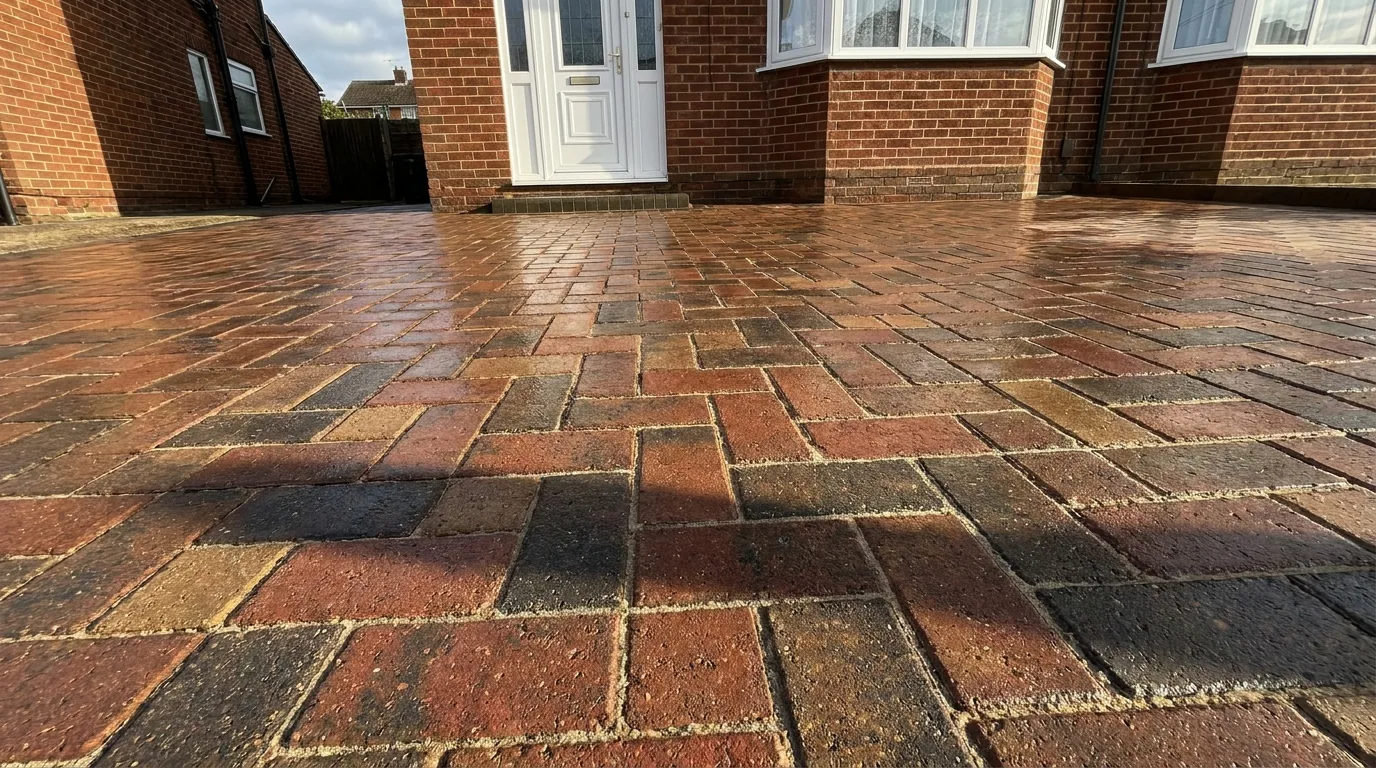
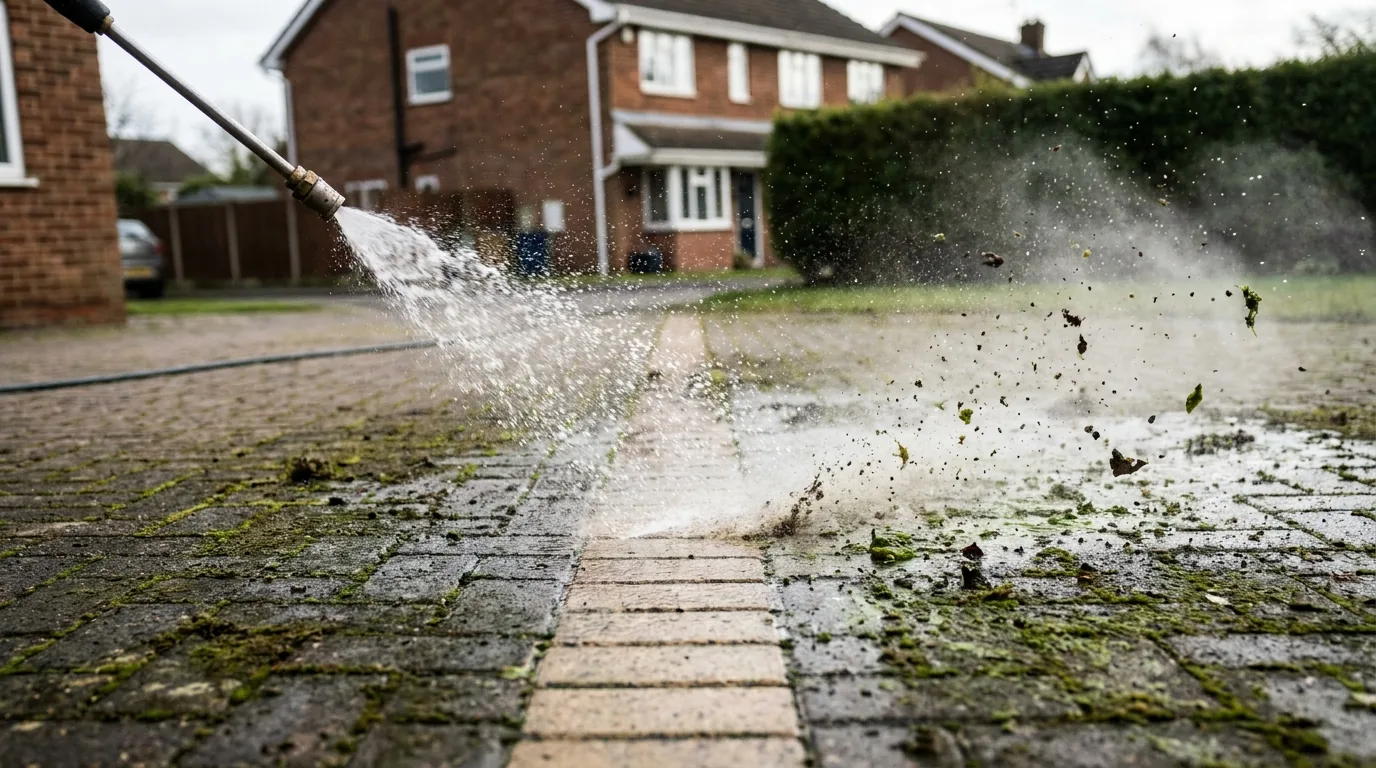
| Block paving | Entrances, paths, retail forecourts | Joints harbour weeds and moss. Low-mod pressure, re-sand after. |
| Cladding | Office, retail, hotels | Soft wash for most types. High pressure damages panels and seals. |
| Natural stone | Hotel entrances, prestige offices | Pressure carefully controlled. Some stones acid-sensitive. |
| Resin-bound | Drives, paths, decorative | Low pressure only. Gentle detergent wash usually sufficient. |
A competent contractor will assess surfaces before quoting and adjust kit accordingly. Same pressure across block paving and concrete loading bay = red flag.
Recommended cleaning frequency
Practical guide based on what we see working across Surrey and the Gatwick corridor.
| Property | Minimum | Recommended |
|---|---|---|
| Car parks | Bi-annual | Quarterly |
| Hotels | Quarterly | Monthly entrance / Quarterly car park |
| Retail forecourt | Quarterly | Quarterly |
| Petrol station | Monthly | Monthly |
| Warehouse | Annual | Bi-annual |
| Office cladding | Annual | Bi-annual to quarterly |
| Restaurant outdoor | Bi-annual | Quarterly |
Under-cleaning is a false economy. Quarterly stays in good condition with quick affordable cleans. Annual or less = much more intensive and expensive each time, plus the property looks neglected most of the year. Cost difference between quarterly and annual is often less than 50% extra; presentation difference is dramatic.
Need a quote for a commercial site? See our commercial pressure washing service or request a free quote, same-day availability across Surrey.
Areas we cover
We work right across Surrey within 20 miles of Redhill (RH1), Redhill, Reigate, Horley, Dorking, Banstead, Epsom, Crawley, and all 15+ areas.
How loud is a pressure washer? UK noise law explained
A consumer pressure washer is loud enough to need active noise management on commercial and densely-residential sites. The Kärcher K7 manufacturer datasheet specifies a guaranteed sound power of 95–97 dB(A) depending on variant[6], with operator-position sound pressure of 81 dB, high enough to require HSE noise-at-work consideration on a daily-use commercial round. Below is the cited regulatory matrix.
| Threshold / rule | Value | Source |
|---|---|---|
| Kärcher K7 sound power level (guaranteed) | 95–97 dB(A) | Kärcher manufacturer datasheet[6] |
| Operator-position sound pressure | ~81 dB | Kärcher datasheet[6] |
| HSE upper action value (daily exposure) | 85 dB(A), hearing protection required above | HSE Control of Noise at Work Regulations 2005[4] |
| UK statutory nuisance framework | Environmental Protection Act 1990 s.79(1), reasonableness test, no fixed hours | Environmental Protection Act 1990 |
| Night-hours noise (council warning powers) | 11pm–7am, permitted noise levels apply | Noise Act 1996 |
Practical implication for commercial sites in Surrey: schedule pressure washing between 8am and 6pm on Monday–Saturday to stay well clear of the Noise Act 1996 night-hours window and to align with typical commercial occupancy. Operators on daily-use commercial rounds require hearing protection per HSE Control of Noise at Work Regulations 2005[4] because operator-position dB is close to the 85 dB(A) upper action value over an 8-hour exposure period. For domestic Surrey jobs, the statutory-nuisance test (reasonableness, frequency, duration) means a one-off Saturday-morning clean is almost never a complaint risk; daily commercial rounds adjacent to flats are.
Original analysis and sources
Commercial-site pressure washing is governed first by HSE/UKSRG BS 7976 wet-PTV ≥36 slip-risk acceptance[4], not by aesthetics. Marshalls technique compliance[3] applies to commercial paving as to domestic; BS 7533-101:2021 structural rules[6] apply to any modular paving regardless of site type.
Sources
Every numeric claim, technique parameter, and safety threshold in this guide is sourced from a manufacturer technical bulletin, BS standard, or .gov.uk reference. We cite the bodies whose data and rules actually govern UK pressure-washing outcomes, not the unsourced ranges repeated across competitor blogs.
- Met Office, Wisley (Surrey) Location Long-Term Averages 1991–2020. Closest Met Office station to RH1. Annual rainfall 648.41 mm; Surrey is ~43% drier than the UK national mean of ~1,147 mm. metoffice.gov.uk, Wisley averages. Accessed 21 May 2026.
- Lithofin, ALGEX Special Cleaner product page. Manufacturer guidance: spray annually, preferably in spring. 6–12 month residual activity. lithofin.com, ALGEX. Accessed 21 May 2026.
- Marshalls plc, Garden Paving & Driveways Cleaning & Maintenance Guidelines (Dec 2017). Technique: medium pressure, 30° lance, 200mm minimum standoff. marshalls.co.uk, cleaning guidelines (PDF). Accessed 21 May 2026.
- Health and Safety Executive (HSE), Slips and trips at work. HSE-preferred slip-risk methodology; PTV ≥36 wet-acceptance threshold. hse.gov.uk, slips and trips. Accessed 21 May 2026.
- UK Slip Resistance Group, Introduction to the Pendulum Tester (BS 7976: Parts 1-3). PTV ≥36 = low slip risk threshold for outdoor pedestrian surfaces. ukslipresistance.org.uk, pendulum tester. Accessed 21 May 2026.
- Kärcher, K7 consumer pressure washer manufacturer datasheet. 180 bar (~2,610 PSI), 600 L/hr. kaercher.com, K7 product page. Accessed 21 May 2026.
- BSI, BS 7533-101:2021 Code of practice for modular paving units. Treats jointing material as load-transfer system. bsigroup.com, BS 7533-101:2021. Accessed 21 May 2026.
- Resiblock Ltd, Block Paving Sealer Product Data Sheets. Manufacturer-stated lifespan up to 5 years. resiblock.com, technical data sheets. Accessed 21 May 2026.
- UK Government (gov.uk), National Living Wage rates from April 2026: £12.71/hr (age 21+). The legal floor for valuing UK labour and DIY time. gov.uk/national-minimum-wage-rates. Accessed 21 May 2026.
- Thames Water, 2026/27 Charges. Combined water + wastewater rate £4.21/m³. thameswater.co.uk, bill value. Accessed 21 May 2026.