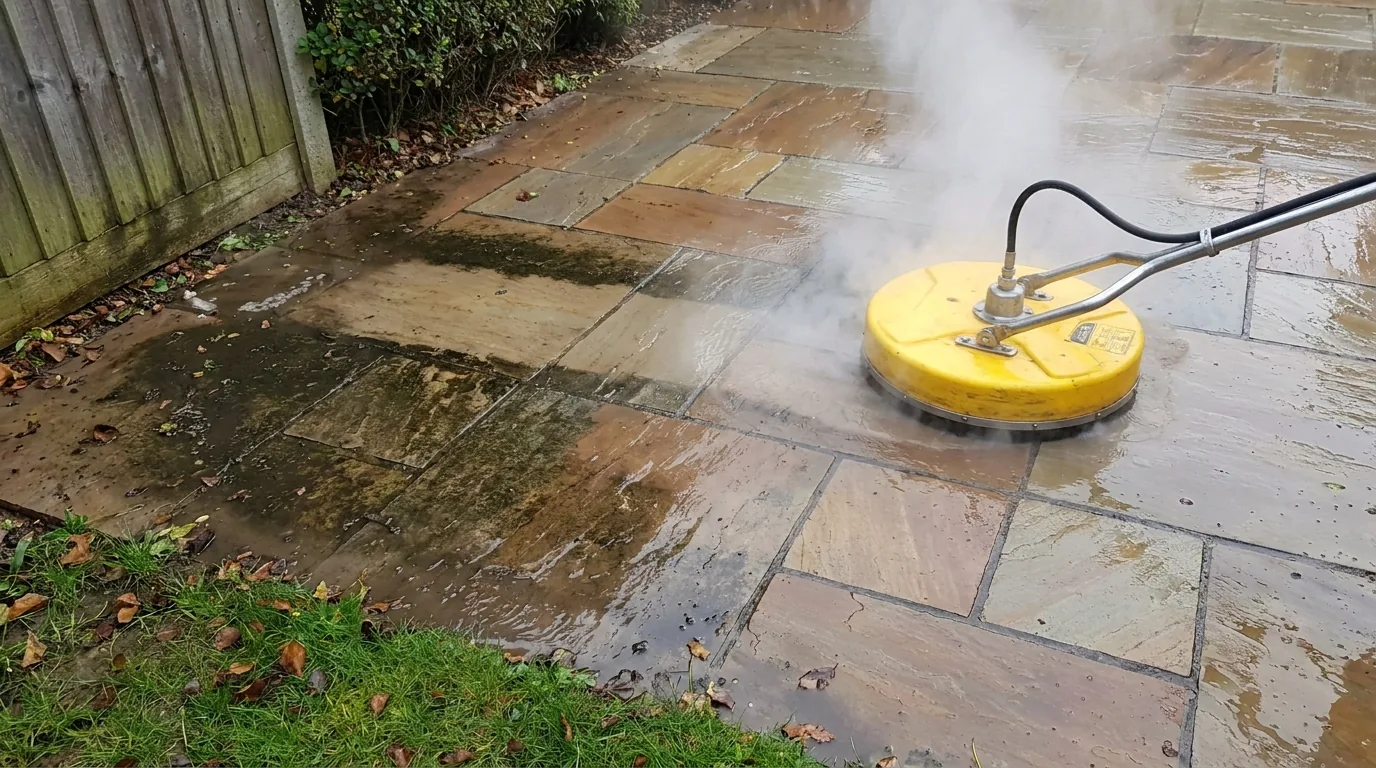
The quick answer: black spot on Indian sandstone is a lichen rooted into the stone, and a pressure washer alone will not shift it. DIY treatments cost from about £30 a tub; professional removal is priced with the patio clean, from £3 per square metre plus treatment, £80 minimum. Same Day Jetwash treats black spot across Redhill, Reigate and Surrey.
Or call 01737 652 515
Prices checked 2 July 2026 by Same Day Jetwash, a pressure washing firm in Redhill, Surrey, against our own published rates and the manufacturers’ own product listings[1][2][3].
This page is the problem-and-cost side of the story: what black spot is, why the usual attack fails, and what removal actually costs, DIY and professional. If you want the full slab-by-slab cleaning protocol for Indian sandstone, pressures, nozzles, chemistry and the sealing warning, that lives in our sister guide, how to clean an Indian sandstone patio safely. Read this one first if the black dots are your actual problem.
- Black spot is a lichen, a living organism rooted into the stone, not a stain sitting on it
- Pressure washing alone makes it worse: it strips the surface, opens the pores and the colony regrows within months
- DIY removers cost £29.95–£31.95 per 5L tub, covering roughly 10–20m² each[1][2][3]
- Professional removal: priced with the patio clean, from £3/m² (most jobs £4–£8/m²) plus treatment, £80 minimum, our own published rates
- Wash-water runoff must never enter a surface-water drain, per UK pollution-prevention guidance (GPP 13)[7]
- What black spot actually is (and why it is not dirt)
- Why jet washing alone makes it worse
- DIY removal, step by step
- DIY black-spot removers compared
- What professional removal costs (the bit nobody publishes)
- DIY vs professional: the honest comparison
- Sealing after treatment: both sides
- Preventing regrowth
- When the patio is beyond saving
- Safety: PPE, pets, plants and runoff
- Sources
What black spot actually is (and why it is not dirt)
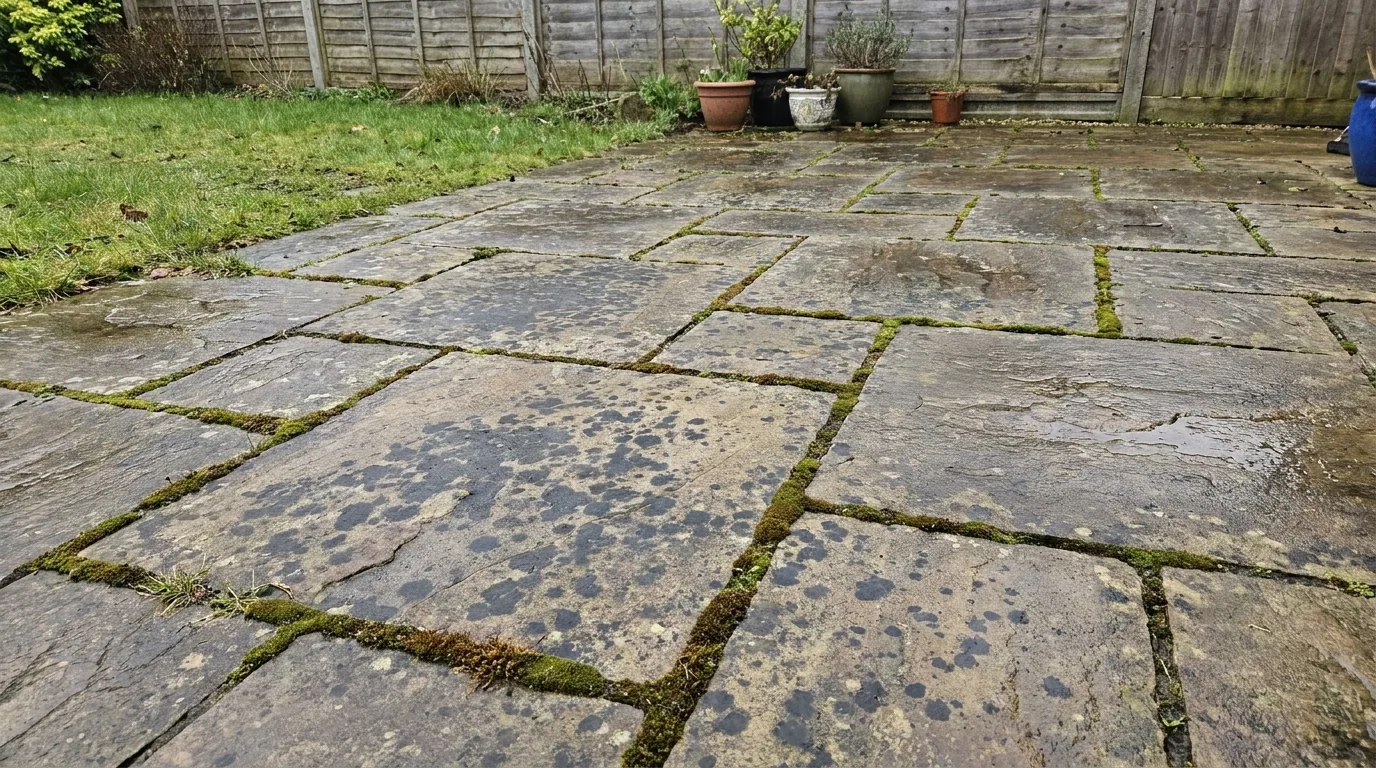
Black spot is the trade name for dark lichen colonies, typically Verrucaria nigrescens, that establish on natural stone in damp, shaded British gardens. A lichen isn’t a plant and it isn’t a stain. It’s a partnership between a fungus and an alga, and the fungus half sends anchor structures down into the stone itself. On Indian sandstone, which is porous enough to absorb 6–9% of its weight in water, those anchors go in deep and hold on hard.
That’s the whole reason black spot behaves differently to everything else on your patio. Green algae sits on the surface as a film, brushes and washes off, and our algae removal guide covers it in an afternoon. General grime rinses away. Black spot starts as scattered dots the size of a five pence piece, usually on the shadier slabs first, and over two or three seasons the dots merge into a hard, crusty grey-black layer that looks like the stone itself has gone dark.
Surrey gardens are prime territory for it. Indian sandstone has been the default patio stone here for twenty-odd years, and the tree cover in the older roads around Reigate, Redhill and Dorking keeps slabs damp and shaded for most of the year. If your patio is Raj Green or Autumn Brown, north-facing, and under any sort of canopy, black spot isn’t a possibility, it’s a schedule.
Why jet washing alone makes it worse
The natural instinct is to point a pressure washer at it and lean in. I understand the instinct. It’s also the single most common way people wreck a sandstone patio.
Here’s what actually happens. The jet strips the visible black crust off the surface, so it looks like progress. But the lichen’s anchor structure is below the surface, out of reach of any water jet you can safely put on sandstone, and it regrows from the root within months. Meanwhile the blast has taken the top layer of the stone with it. Even the manufacturer of the best-known black-spot remover says the same thing: pressure washing opens the pores of the stone and lets organic growth come back faster[1]. You’ve traded a cosmetic problem for a rougher, more porous slab that grips the next generation of spores even better, and the mist has spread those spores across the rest of the patio for free.
Go harder and it gets worse again. Indian sandstone is a layered, riven stone; a turbo nozzle or a close-held lance delaminates the surface in patches that never look right again. Marshalls’ own cleaning guidance caps the technique at medium pressure, a 30° lance angle and a minimum 200mm standoff[5], and that’s for cleaning, not for trying to blast a lichen out of the stone. The pressure washer has exactly one job in black-spot removal: rinsing off dead lichen after the chemistry has done the killing.
DIY removal, step by step
The good news: black spot is very treatable, and the DIY route works if you follow the label and don’t rush the dwell. The dedicated removers[1][2][3] all work the same way, chemistry kills the lichen, you rinse off the corpse. Here’s the sequence:
- Pick a dry, mild day. Smartseal’s label says 5–20°C[3], and you want no rain forecast for the rest of the day so the product isn’t diluted or washed into the borders.
- Test patch first. One slab, somewhere unobtrusive. Sandstone varies slab to slab, and lighter stones like Mint can lighten further with strong cleaners.
- Pre-wet the stone. Damp, not flooded. A damp surface stops the product disappearing straight into the pores before it can work on the lichen.
- Apply the remover neat. Watering can with a rose, or a pump sprayer. Work it into the black patches with a stiff brush so it sits in contact with the crust.
- Let it dwell, 30 minutes to 2 hours. This is where DIY jobs fail. Floorseal says up to an hour, longer on bad infestations[2]; Smartseal says 1–2 hours, up to 3 on stubborn crusts[3]. The chemical needs time to get down to the anchor structure. Rinse early and you’ve killed the top and left the root.
- Agitate again, then rinse gently. Stiff brush over the patches, then rinse with a hose or a fan lance at the Marshalls technique, 30° angle, 200mm off the stone[5]. You’re flushing dead lichen, not pressure washing.
- Repeat on the stubborn bits. A patio that’s carried black spot for years often needs a second application on the worst slabs. That’s normal, not a product failure.
One thing worth knowing before you buy: there are two chemical routes. The dedicated removers above are the fast route, hours not days. The slower route is a residual biocide like Lithofin Algex, applied and left on the stone for days so it kills growth at cellular level and keeps working for months[6]. The biocide route is the maintenance play, and it’s covered properly in the sandstone cleaning guide. For an established black-spot crust, start with a dedicated remover, then use the biocide annually to keep it away.
DIY black-spot removers compared
Nobody compares these brands side by side because everyone selling them sells one of them. We don’t sell any of them, so here’s the neutral version. Prices and coverage below are from each maker’s own listing, checked 2 July 2026:
| Product | Price (checked 2 Jul 2026) | Stated coverage | Dwell time |
|---|---|---|---|
| Patio Black Spot Remover for Natural Stone (Patio Black Spot Removal Co)[1] | From £29.99 (2L) | 2L up to 10m², 4L up to 20m² | ~2 hours |
| Black Spot Remover Plus (Floorseal)[2] | £29.95 (5L), £74.95 (20L) | ~20m² per 5L used neat (~4m²/L) | Up to 1 hour, longer if severe |
| Xtreme Black Spot Remover (Smartseal)[3] | £31.95 (5L), £28.95 each for 3+ | ~20m² per 5L, apply neat | 1–2 hours, 2–3 if stubborn |
Run the maths and the chemical alone costs roughly £1.50–£3.00 per square metre depending on brand and how bad the crust is. Hold that number, it matters in the next section. All three do the job on Verrucaria-type lichen; the honest differences are coverage per pound (Floorseal and Smartseal are cheaper per m²), dwell time, and whether you can buy a preventer from the same range for the annual top-up. We’re not on commission from any of them.
What professional removal costs (the bit nobody publishes)
Here’s the strange thing about this corner of the trade: every product seller will tell you black spot needs specialist treatment, and not one page on the UK internet tells you what a professional charges to do it. We checked. The product sellers don’t price the service, and the service companies don’t publish rates. So here are ours, straight off our pricing page.
Black-spot removal isn’t normally priced as its own job. It’s a patio clean plus a dedicated chemical treatment, because the treatment needs the pre-clean and the rinse anyway. Our patio cleaning starts at £3 per square metre with most jobs landing at £4–£8/m² depending on the stone and its condition, with an £80 minimum. Heavy black spot sits at the top of that range or adds roughly half again, because the biocide and the dwell time turn a two-hour visit into most of a day.
| Patio size | Standard clean (our published rates) | With heavy black spot (up to +50%) |
|---|---|---|
| Small (~10m²) | £80 (minimum applies) | £80–£120 |
| Standard (~20m²) | £80–£140 | £120–£210 |
| Large (~30m²) | £90–£210 | £135–£315 |
| Extra-large (~50m²) | £150–£350 | £225–£525 |
Worked example, because a table without workings is just assertion. Take a 30m² Indian sandstone patio with a proper black-spot problem and run it through our cost calculator: the base clean is 30m² at £3–£7/m², so £90–£210. Moderate growth adds about 20%, heavy adds up to 50%. The dedicated treatment adds £0.50–£1.50/m², another £15–£45. So a moderately spotted 30m² patio prices out around £125–£300 all in, and a heavily crusted one pushes towards the top of the range. The £80 minimum always applies.
Notice the treatment line: £0.50–£1.50/m². The DIY chemical alone costs £1.50–£3.00/m² at retail[1][2][3]. We buy in bulk, so the chemical part of a professional job genuinely costs you less than buying the tub yourself. What you’re paying a professional for is the labour, the kit, the insurance, and knowing how long to let chemistry dwell on which stone. Want a number for your patio? Two minutes on the calculator, or ring 01737 652 515 and describe it.
DIY vs professional: the honest comparison
Plenty of patios are a sensible DIY job and I’ll happily say so. Here’s the comparison for a standard 20m² sandstone patio with established black spot, priced honestly on both sides:
| DIY (20m²) | Professional (20m²) | |
|---|---|---|
| Cash cost | £30–£60 chemical (1–2 tubs)[2] + ~£15 sprayer + washer hire if you have none | £120–£210 including clean and treatment |
| Your time | Most of a day: apply, dwell, agitate, rinse, second pass on bad slabs | None. Half a day of ours |
| Result | Good, if the dwell is respected and the rinse is gentle | Crust gone, stone rinsed at the right technique, regrowth advice on the spot |
| How long it lasts | 12–24 months, same as ours, if done right | 12–24 months, longer with an annual preventer |
| The risk | Rushing the dwell, then blasting the survivors and damaging the stone | Picking a cowboy. Ask what chemical they use; if the answer is “just the jet”, walk away |
My honest steer: a small, flat, lightly spotted patio with good drainage is a decent Saturday job. Call someone in when the crust is years old, when the patio is big, or when you don’t own a washer and the hire-plus-chemical maths starts brushing up against the professional price anyway. The full patio cleaning cost guide has the wider numbers if you’re budgeting the whole job.
Sealing after treatment: both sides
Every product seller will offer you a sealer at the checkout, so let’s do this properly. There are two legitimate positions.
The case for sealing: a sealed surface is less porous, gives airborne spores less to grip, holds off water and organic staining, and makes every future clean quicker. On a freshly treated, bone-dry patio in summer, a good breathable sealer genuinely slows black spot down.
The case against: Indian sandstone breathes, and the wrong sealer stops it breathing. Non-breathable acrylic or gloss sealants trap moisture inside the porous stone, and under a Surrey winter’s freeze-thaw that trapped water delaminates the surface, which is called spalling and cannot be reversed. Seal over lichen that isn’t fully dead and you’ve laminated your problem into the stone. The sandstone guide covers this warning in full, and it’s the hill we’ll die on: if in doubt, don’t seal sandstone. An unsealed patio treated annually usually outlives a badly sealed one.
If you do seal: breathable formulation only, stone fully dry, mid-summer, and only after the black spot is dead and rinsed away. Never gloss, never in autumn.
Preventing regrowth
Killing the crust is half the job. Keeping it away is a rhythm, not a product:
- Annual preventer treatment. The dedicated preventer runs from £39.99 a tub[4], and the biocide route, Lithofin Algex, is a manufacturer-stated once-a-year spring application[6]. Either way, once a year in spring, before the summer growth season, is the cadence.
- Cut the shade if you can. Lichen wants damp, shaded stone. Lifting a tree canopy or trimming a hedge back does more for the patio long-term than any chemical.
- Brush and rinse through the year. Leaf litter and standing organic muck feed the next colony. A stiff brush once a month costs nothing.
- Watch the shady corner. Black spot always restarts where it started last time. The first new dots are a five-minute spot treatment; a full recolonised patio is a day’s work.
When the patio is beyond saving
Nobody selling chemicals will tell you this, so I will: some patios are past the point where treatment is the right spend.
The tell is the stone, not the lichen. If decades of growth and repeated aggressive cleaning have left the surface pitted, flaking or delaminating, killing the lichen just reveals damaged stone underneath. Same if the pointing has failed across the patio and the slabs are rocking, you’d be paying to clean a surface that needs relaying. And on a heavily spalled patio, every treatment cycle takes a little more surface with it.
In those cases the honest options are relaying the same stone the right way up where possible, replacing the worst slabs and treating the rest, or biting the bullet on porcelain, which black spot cannot root into. If we turn up to quote and the stone is past it, we’ll say so and you’ve lost nothing but a phone call. Cleaning a patio that needs relaying is taking money for nothing, and it’s not how we work.
Safety: PPE, pets, plants and runoff
The removers are proper chemicals, oxidising or strongly alkaline depending on brand, and the labels mean what they say. The bits people skip:
- Gloves and eye protection, every time. Splashes off a stiff brush go exactly where you’d expect.
- Pets and kids off the patio from application until it’s rinsed and fully dry. Dogs walk through it and then lick their paws, that’s the route in.
- Water the borders before and after. Wet soil and wet leaves dilute any splash to harmlessness. Dry borders concentrate it.
- The runoff rule most people have never heard of: wash water from cleaning outdoor surfaces must not go into a surface-water drain. UK pollution-prevention guidance (GPP 13) is blunt about it, surface-water drains discharge to the nearest watercourse, so what goes down that grate ends up in a stream[7]. Direct the rinse water onto gravel, a lawn or a soakaway instead. It’s also one of the questions worth asking any contractor you’re vetting, because the ones who shrug at it shrug at everything else too.
Areas we cover
We treat black spot on sandstone patios right across Surrey within 20 miles of Redhill (RH1), Redhill, Reigate, Dorking, Horley, Banstead, Caterham, Oxted, Leatherhead, Crawley, and all 15+ areas. Our patio cleaning service page has the before-and-afters and the full service detail.
Quote within minutes, callback within two hours during business hours (Mon–Sat 8am–6pm). If you just want to know whether those dots are black spot or something cheaper to fix, call 01737 652 515, describe the patio, and we’ll tell you straight.
Sources
Every price and technique claim on this page is sourced. DIY product prices come from each manufacturer’s own listing, checked on the date shown; professional prices are our own published rates, not an invented market figure.
- Patio Black Spot Removal Company, Patio Black Spot Remover for Natural Stone product listing. 2L from £29.99 treating up to 10m², 4L up to 20m², ~2 hour dwell before rinsing; also states that pressure washing opens the pores of the stone and accelerates organic regrowth. patioblackspotremoval.com, natural stone remover. Accessed 2 July 2026.
- Floorseal, Black Spot Remover Plus product listing. £29.95 for 5L (£74.95 for 20L), coverage ~20m² per 5L used neat (~4m² per litre), dwell up to 1 hour and longer on severe infestations; describes black spot as lichen that is impossible to remove by jet washing. floorseal.co.uk, Black Spot Remover Plus. Accessed 2 July 2026.
- Smartseal, Xtreme Black Spot Remover product listing. £31.95 for 5L (£28.95 each on 3+), ~20m² per 5L applied neat in 5–20°C, dwell 1–2 hours (2–3 for stubborn staining). smartseal.co.uk, Xtreme Black Spot Remover. Accessed 2 July 2026.
- Patio Black Spot Removal Company, Patio Black Spot Preventer for All Stone Types product listing. From £39.99 (2.5L and 5L sizes); basis for the annual preventer cost in the prevention section. patioblackspotremoval.com, black spot preventer. Accessed 2 July 2026.
- Marshalls plc, Garden Paving & Driveways Cleaning & Maintenance Guidelines. Medium pressure, 30° lance angle, minimum 200mm standoff on natural stone; the rinse technique cited throughout this guide. marshalls.co.uk, cleaning guidelines (PDF). Accessed 2 July 2026.
- Lithofin, Lithofin ALGEX Special Cleaner product page. Manufacturer guidance to apply once a year, preferably in spring, for ongoing maintenance against algae and biofilm on natural stone; the residual-biocide route referenced in the prevention section. lithofin.com, ALGEX product page. Accessed 2 July 2026.
- NetRegs (UK environment agencies), Guidance for Pollution Prevention 13 (GPP 13), 2022 update. UK pollution-prevention guidance on wash waters: dirty wash water must not be allowed to enter surface-water drains, which discharge to watercourses. Basis for the runoff-disposal rule in the safety section. netregs.org.uk, GPP 13 (PDF). Accessed 2 July 2026.