The quick answer: the clearest signs you need your gutters cleaned are water spilling over the front of the gutter in rain, dark streaks running down the wall beneath it, a gutter that sags or droops, plants or weeds sprouting from it, birds or wasps nesting along the run, and stained or rotting fascia boards. Spot one and book a clean. Spot two or more and it is already overdue.
None of those needs a ladder to see. You can walk to the bottom of your drive, look up at the gutter line, then look down at the wall beneath it, and read most of this off in a couple of minutes. Below I go through all seven, what each one is actually telling you, and the two that mean damp is on its way if you ignore them.
- The two signs that cost you money if ignored: overflow down the wall and stained fascia boards. RICS lists leaking and blocked gutters as a cause of damp[1]
- The Property Care Association names blocked gutters and defective rainwater goods as a common cause of penetrating damp[2], so a blocked gutter is not just cosmetic
- Best time to check: late autumn, after leaf-fall. Once a year with no trees, twice with heavy canopy
- Surrey driver is trees, not rain: Wisley records only 648mm/yr[5], so it is leaf and seed drop that blocks gutters here, not water volume
- Why we say leave the high ones to us: falls from height are one of the biggest causes of fatal workplace injury in the UK[3], and gutters are exactly the job that tempts people onto a dodgy ladder
If you already know the answer is yes, our gutter cleaning service clears the lot, gutters and downpipes, usually same week. If you would rather just sanity-check first, read on, then if you are local you can jump to gutter cleaning in Redhill or our Reigate page for the area detail.
- 1. Water pours over the front in rain
- 2. Dark or green streaks down the wall
- 3. The gutter sags or pulls away
- 4. Plants and weeds growing in it
- 5. Birds, wasps and other lodgers
- 6. Stained or rotting fascia boards
- 7. Rain hammering off one spot
- Which signs actually cost you money
- The Surrey angle: trees, not rain
- Should you do it yourself?
- Sources
1. Water pours over the front in rain
This is the one everyone knows, and it is also the latest. If you are standing at the window during a downpour and you see a sheet of water spilling over the front lip of the gutter rather than running along to the downpipe, the gutter is blocked. The water has nowhere to go, so it backs up and tips over the edge.
Here is the catch with overflow: by the time you see it, the gutter is already full. It is not an early warning, it is the alarm going off. The block is usually a wad of wet leaf-mulch sitting over the downpipe outlet, or fine silt that has compacted along the run. Either way it wants clearing now, because every overflow is water going down the wall instead of into the drain, and that is where damp starts. If yours is doing this regularly, the blocked gutter overflowing guide walks through exactly what is going on and how we clear it.
2. Dark or green streaks down the wall
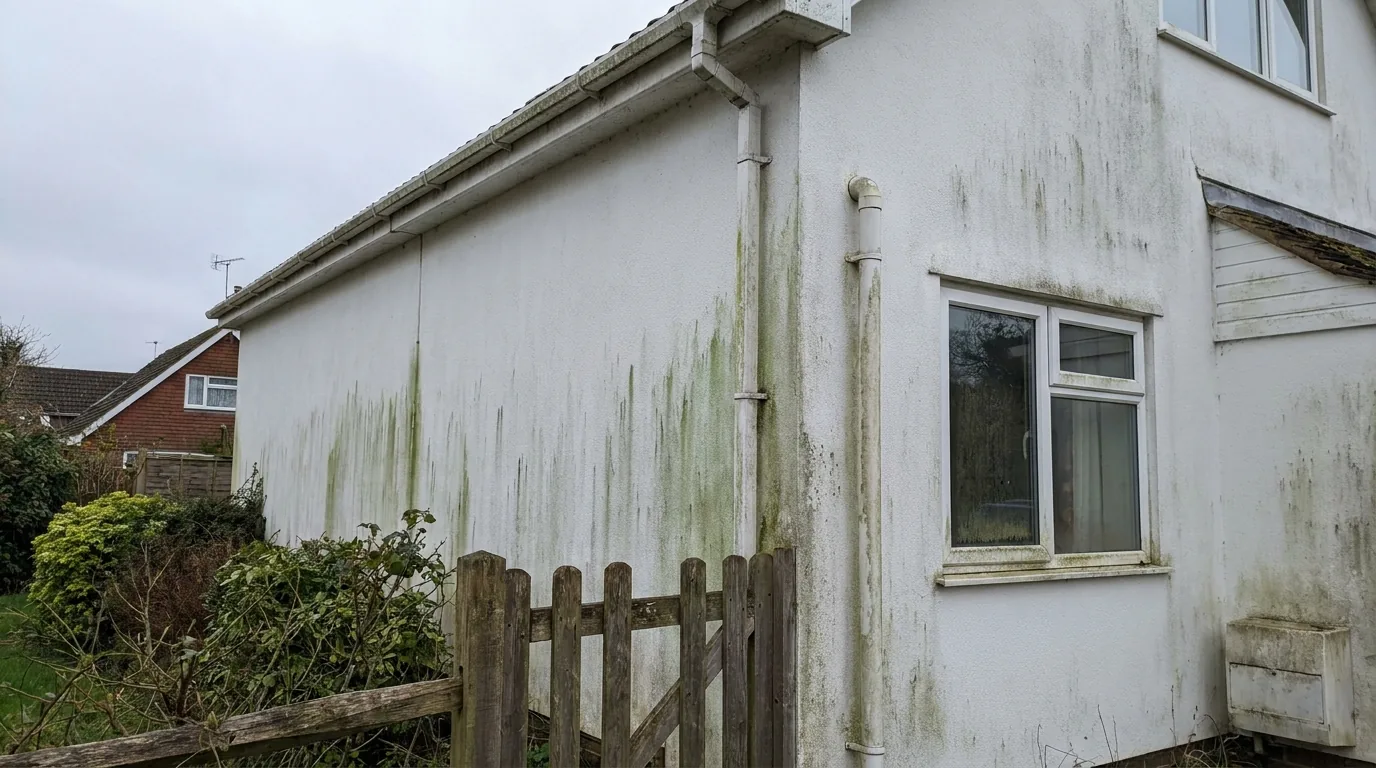
Look at the brickwork or render directly under the gutter line. If you see tiger-stripes of dark grey, brown or green running vertically down the wall, that is overflow history. Even if you have never caught the gutter spilling in the act, the wall remembers. Water has been running down it, and the streak is a map of exactly where.
The green is algae. It takes hold anywhere a surface stays damp, and the RHS notes that algae thrives on wet, shaded surfaces[6], so a wall that keeps getting a drink from a leaky gutter is a perfect home for it. The grey-brown staining is the silt and grime the water carries off the roof. Both tell you the gutter has been failing for a while. Clear the gutter to kill the source, and only then is it worth washing the wall down, otherwise it just streaks again at the next storm. A render clean after the gutter is sorted gets the wall back to how it should look.
3. The gutter sags or pulls away
Sight along the gutter run from one end. It should sit dead straight, with a barely perceptible fall towards the downpipe. If you can see a dip, a droop, or a section that has visibly pulled away from the fascia, that is weight. A gutter full of wet leaves, silt and standing water is surprisingly heavy, and that load drags on the brackets until the run starts to bow.
Left long enough, the brackets give and a length of gutter can come away from the wall entirely. At that point you are not paying for a clean any more, you are paying for re-hanging or replacement. A sag is the gutter telling you it has been carrying a load it was never meant to hold. Catch it at the droop stage and a clean usually sorts it; catch it after the brackets have gone and it is a bigger job.
4. Plants and weeds growing in it
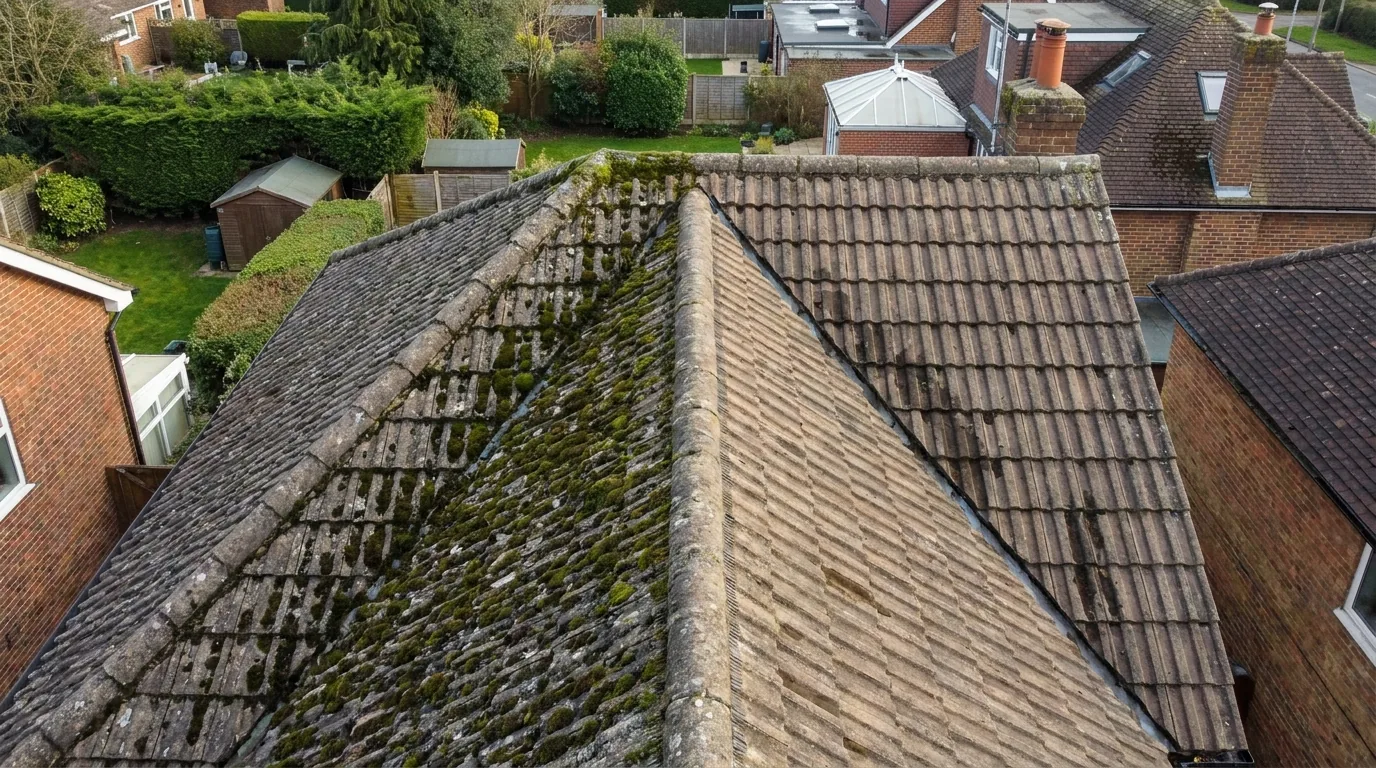
If there is greenery growing out of your gutter, grass, weeds, moss tufts, the odd buddleia or even a little sapling, the matter is settled. Plants do not grow on bare plastic. They grow when there is enough rotted-down leaf-litter sitting in the gutter to act as soil, plus water trapped in it. So a gutter with plants in it is a gutter that has been holding a bed of compost and standing water long enough for seeds to germinate and root.
People sometimes find this one almost charming, a little hanging garden up at roofline. It is not charming. Roots work into the joints and the silt holds water against the metalwork and the fascia behind it. This is one of the most reliable signs going, because it cannot happen quickly: a gutter only grows plants after it has been neglected for a good while.
5. Birds, wasps and other lodgers
A clogged gutter is a desirable address if you are a bird, a wasp or a mouse. The leaf-litter is nesting material and the standing water is a drink. If you have noticed birds repeatedly landing on the same stretch of gutter and disappearing into it, a wasp nest building up under the eaves nearby, or scratching and rustling overhead, the debris up there is part of the draw.
It works both ways. Pests are attracted by the muck, and then the nest itself becomes a fresh blockage that backs the water up further. We have lifted plenty of bird nests out of gutters that were single-handedly damming the whole run. If you are getting unexplained wildlife along the roofline, it is worth a look at what is feeding it. A clear gutter is far less inviting.
6. Stained or rotting fascia boards
The fascia is the flat board the gutter is screwed to, the bit that runs along just under the roof edge. Look at it carefully. If it is streaked, blackened, blistered, peeling or, on an older timber board, soft and rotting, water has been sitting against it where it should not be. A working gutter keeps the fascia dry. A blocked or overflowing one keeps it wet.
This matters because fascia and soffit damage is the point where a cheap problem turns expensive. Replacing rotten timber fascia and soffit along a roofline is a proper job. RICS includes leaking and blocked gutters and rainwater pipes among the things to check when chasing damp[1], and a stained fascia is often the visible halfway point between a full gutter and a damp wall. If yours is starting to mark, a fascia and soffit clean alongside the gutter clear stops it getting worse.
7. Rain hammering off one spot
This is the one you hear rather than see. In a shower, a healthy roof drains quietly into the gutter and away down the pipe. If instead you can hear rain drilling onto the path, the bins or a flat roof below in one concentrated spot, water is escaping the system at that point and falling. It might be overshooting a blocked section, or pouring through a split joint that silt has forced open.
Go and look at where the noise is coming from after the rain stops. You will usually find a stain or a worn patch on the paving directly below, where the falling water has been landing repeatedly. That splash point is also undermining whatever it lands on, and if it is landing near the wall base it is feeding water straight at the foundations. A quick clear and a check of that joint sorts it.
Which signs actually cost you money
Not all seven are equal. Some are just untidy; two of them are the start of a bill. Here is how I rank them when I am stood in someone's driveway giving them the honest version.
| Sign | What it means | How urgent |
|---|---|---|
| Overflow down the wall | Gutter full, water on the brickwork | High, damp risk |
| Stained / rotting fascia | Water sitting against the boards | High, repair risk |
| Sagging run | Heavy with debris and water | Medium, act before brackets go |
| Plants growing in it | Long-standing neglect | Medium, overdue but not urgent |
| Green wall streaks | Past overflow, algae set in | Medium, fix gutter then wall |
| Pests / nesting | Debris is attracting wildlife | Low to medium |
| Splash noise in rain | Water escaping at one point | Low, but find the cause |
The top two are why I push people not to wait for a convenient moment. Once water is on the wall or in the fascia, you are in a race against damp. The Property Care Association is plain about it: blocked gutters and defective rainwater goods are a common cause of penetrating damp[2], the kind that ends up as a stain on an inside wall. A gutter clean is cheap. Drying out a wall and replacing fascia is not. For how often to get ahead of all this, the how often to clean gutters guide has the cadence by tree cover.
The Surrey angle: trees, not rain
Most national articles on this open with how wet Britain is. For our patch that is the wrong lens. The closest Met Office station to Redhill is Wisley, and it records an annual rainfall of just 648mm on the 1991–2020 average[5], comfortably below the UK mean of around 1,163mm. Surrey is not a soggy county.
What fills gutters here is trees. There is a clear split across the area. Properties tucked under the wooded slopes, the Box Hill and Dorking belt, the tree-lined roads up around Reigate Hill, the canopy out towards Wisley, get hammered with leaf, seed and needle drop every autumn and want checking twice a year. Open, treeless estates over towards Horley and parts of Crawley collect far less, mostly fine roof grit, and a single autumn clean usually does them. So when you read these seven signs, weight them by what is hanging over your roof. If your gutter line vanishes under a canopy in November, you are firmly in the twice-a-year camp. We cover the lot, from Redhill through to gutter cleaning in Reigate and the surrounding towns.
Should you do it yourself?
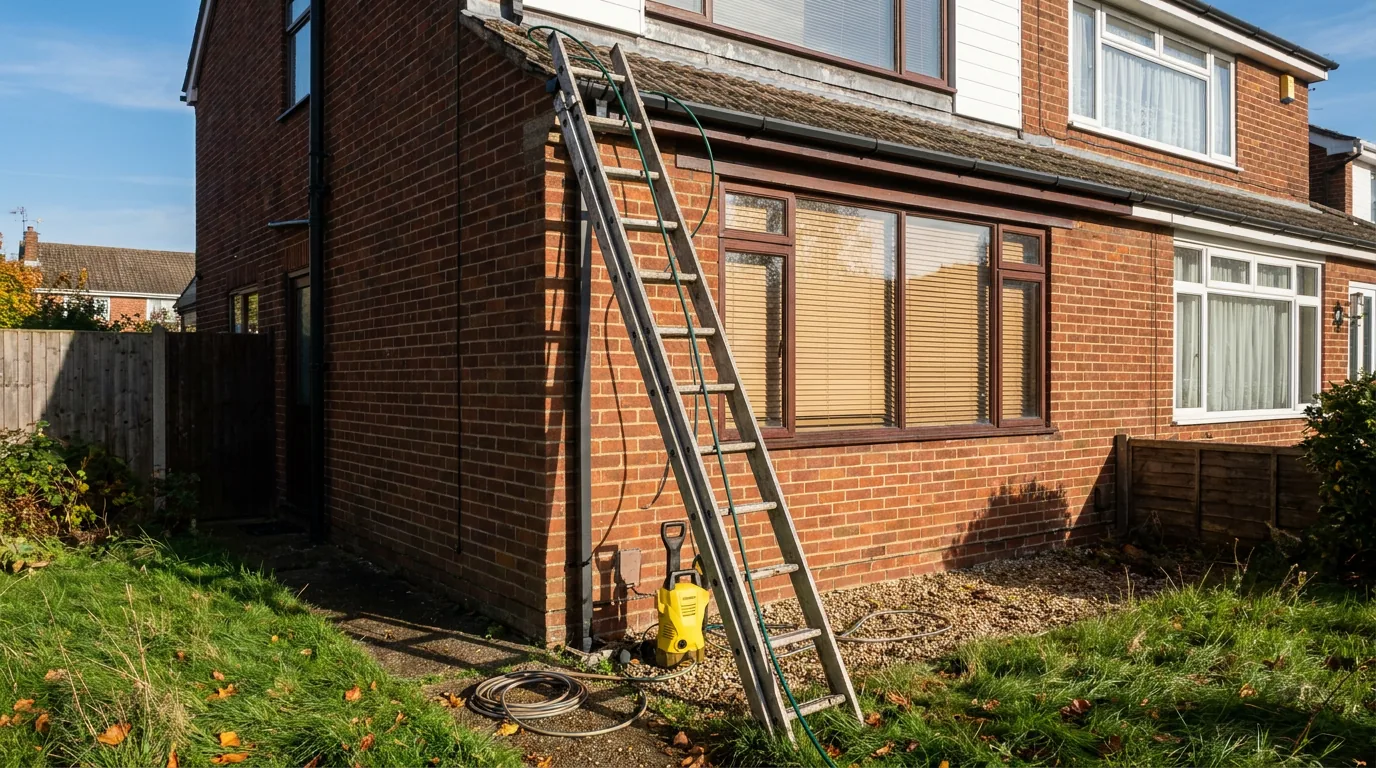
Spotting the signs is free and you should absolutely do that yourself. Acting on them up a ladder is a different decision. On a single-storey roof, firm level ground, someone footing the ladder, and you steady on your feet, a careful DIY clear is doable. Above that, I would think hard.
This is not me drumming up work. Falls from height are one of the biggest causes of fatal workplace injury in the UK[3], and the Work at Height Regulations 2005[4] exist precisely because ladder jobs go wrong. Gutters are the textbook tempting job: just out of comfortable reach, on uneven ground, with you leaning and stretching to get the last bit. A two-storey semi is not worth a broken wrist or worse. We reach the high stuff off proper kit and poles from the ground, which is faster and a great deal safer. If your honest read of the seven signs says the gutter needs doing and it is up high, that is exactly the job to hand over.
Want a price for your specific house? Tap your details into the cost calculator for an instant estimate, or just ring and describe the roof and I will give you a number on the phone.
Areas we cover
We work right across Surrey within 20 miles of Redhill (RH1), Redhill, Reigate, Dorking, Horley, Banstead, Caterham, Oxted, Leatherhead, Crawley, and all 15+ areas.
Quote within minutes, callback within two hours during business hours (Mon–Sat 8am–6pm). If you have spotted one of these seven and want a straight answer on whether it needs doing now or can wait, call 01737 652 515 and I will tell you honestly.
Sources
Every claim with a number behind it is sourced. We cite primary references, RICS and Property Care Association damp guidance, HSE safety guidance, UK regulations, Met Office climate records and the RHS, not affiliate listicles or competitor blogs.
- Royal Institution of Chartered Surveyors (RICS), Damp and mould consumer guide. Lists “leaking and/or blocked gutters and rainwater pipes” among the causes to check for damp, and advises homeowners to clear gutters, downpipes and drains. Source for the gutter-to-damp link. rics.org, damp and mould. Accessed 22 June 2026.
- Property Care Association (PCA), Penetrating damp advice. Names blocked gutters and defective rainwater goods as a common cause of water ingress and penetrating damp. Source for the “blocked gutter causes damp” claim. property-care.org, penetrating damp. Accessed 22 June 2026.
- Health and Safety Executive (HSE), Working at height: A brief guide (INDG401). States falls from height are one of the biggest causes of workplace fatalities and major injuries, and identifies ladder falls as a typical hazard. Used here for the DIY-ladder caution. hse.gov.uk, working at height. Accessed 22 June 2026.
- UK Government (legislation.gov.uk), The Work at Height Regulations 2005. Governs any work at height including domestic gutter access from ladders; relevant to weighing a DIY clean against the fall risk. legislation.gov.uk, Work at Height Regulations 2005. Accessed 22 June 2026.
- Met Office, Wisley (Surrey) Location Long-Term Averages 1991–2020. Closest Met Office station to Redhill (RH1). Annual rainfall about 648mm, below the UK mean. Source for the local trees-not-rain point. metoffice.gov.uk, Wisley averages. Accessed 22 June 2026.
- Royal Horticultural Society (RHS), Algae, lichens, liverworts and moss on hard surfaces. Explains that algae and moss colonise surfaces that stay wet. Source for why a wet wall under a leaking gutter goes green. rhs.org.uk, algae on hard surfaces. Accessed 22 June 2026.