The quick answer: for most UK homes, gutter guards are not worth it. They pay off in just two cases: a roof under heavy tree canopy needing three or four cleans a year, or a high, awkward-access roof where every clean is dear and risky. For an ordinary semi, they rarely beat an annual clean.
For that average semi with no overhanging trees, a £200–£350 micro-mesh install rarely beats a £80–£100 annual clean, and no guard ever stops you cleaning entirely. That’s the honest version. The rest of this page shows the maths.
- Fitted cost: ~£6–£12/m for mesh, so ~£200–£420 on a typical 25–35m semi; premium branded micro-mesh £15–£30/m
- Best type for UK debris: stainless / aluminium micro-mesh. Worst: foam inserts (degrade + harbour algae in 2–3 yrs)
- The myth: guards are not maintenance-free — you swap clearing the inside for brushing the top, and downpipes still silt up underneath
- Surrey driver is trees, not rain: Wisley records only 668mm/yr[1], so leaf-litter near Box Hill / Dorking canopy is what blocks gutters here, not water volume
- The real reason most people consider guards: falls from height were the single biggest cause of fatal workplace injury in 2023/24 (~50 deaths, 36% of the total)[2] — for a high roof that risk is the genuine case for fitting
We get asked this on roughly every other gutter job — usually with the customer half-hoping we’ll talk them into it so they never have to think about gutters again. We won’t lie to make a sale we don’t even offer. If you’d rather just book a clean and forget guards entirely, our gutter cleaning service sorts it — or read the broader gutter cleaning guide first.
- The 5 types of gutter guard, compared
- What gutter guards actually cost fitted
- The “maintenance-free” myth
- The downpipe caveat installers skip
- When gutter guards are worth it
- When they’re a waste of money
- The Surrey angle: trees, not rain
- The 30-second decision matrix
- The cheaper alternative most people miss
- Sources
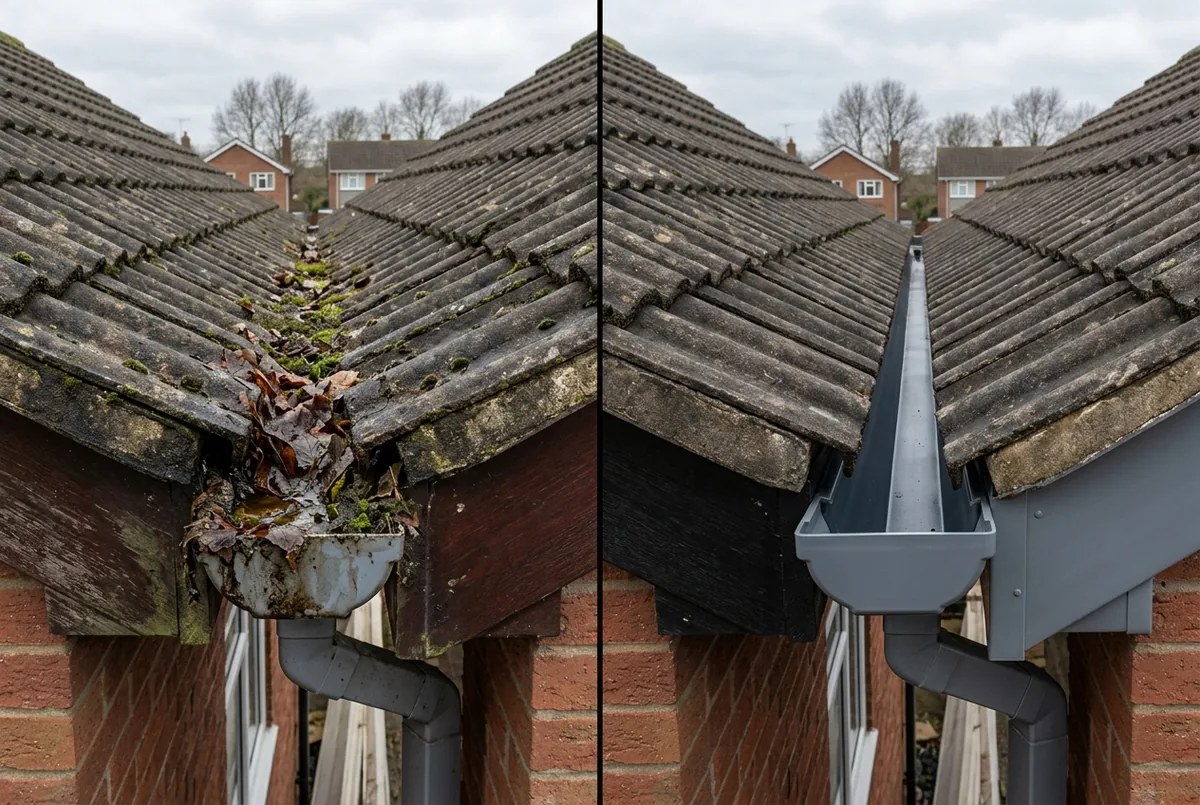
Before & after
The 5 types of gutter guard, compared
A gutter guard is a cover, mesh or insert fitted over an open rain gutter to keep leaves and debris out while still letting water drain through. “Gutter guard” isn’t one product, though — it’s five very different ones lumped under a single name, and the gap between the best and worst is enormous. Here’s the honest run-down, then the table.
Mesh (plastic or perforated metal)
A perforated tray that clips over the gutter. Lets water through the holes, keeps big leaves out. Cheap plastic versions go brittle and crack in a couple of summers of UV; perforated aluminium lasts far longer. Decent all-rounder, but the holes are big enough to let pine needles, seed and grit straight through.
Micro-mesh (stainless / aluminium)
The good stuff. Micro-mesh is a gutter guard with a very fine woven metal screen (apertures typically well under 1mm) on a rigid frame, tight enough to block even seed and most grit while still passing water. Stainless or aluminium so it doesn’t rot or warp. It’s the most effective type for British leaf-and-seed debris and the one worth paying for — but it’s also the dearest, and a cheap mesh imitating it isn’t the same thing.
Solid / reverse-curve covers
A solid hood that curves over the gutter; water clings to the curve and runs in, leaves tumble off the front. Sheds leaves brilliantly in light rain. The catch: in a proper Surrey downpour, water can shoot straight over the curve and miss the gutter completely — which rather defeats the point of a gutter. Roof drainage here has to cope with intense bursts, the sort of flows BS EN 12056-3[5] exists to size for.
Brush (“hedgehog”)
A long cylindrical bottle-brush that sits inside the gutter. Big leaves rest on top, water flows around the bristles. Dead easy to fit yourself, no clips. But fine debris lodges deep in the bristles and is a swine to clean out — you often end up lifting the whole brush, hosing it, and dropping it back. Birds also love nicking the bristles for nests.
Foam inserts
A triangular foam strip wedged into the gutter. Cheapest of the lot and, frankly, the worst. The foam clogs with fine silt, holds moisture against the gutter, and within two to three years it’s degrading, going green, and growing its own little algae garden. We’ve pulled rotten foam out of gutters that was doing more harm than the leaves ever did. Avoid.
Quick comparison
Typical UK figures, 2026. “Fitted” assumes professional installation including safe access.
| Type | Fitted £/m | Lifespan | Verdict |
|---|---|---|---|
| Mesh (plastic/metal) | £5–£10 | Plastic 2–5 yrs / metal 10+ | OK for leaves; passes grit |
| Micro-mesh (stainless/ali) | £12–£30 | 15–25 yrs | Best performer; dearest |
| Solid / reverse-curve | £15–£30 | 15–20 yrs | Can overshoot in downpours |
| Brush (hedgehog) | £4–£8 | 3–5 yrs | Easy DIY; traps fine debris |
| Foam insert | £2–£5 | 2–3 yrs | Cheapest; worst — avoid |
What gutter guards actually cost fitted
Materials are cheap. Getting them up safely on a real house is what costs money — and that’s the bit the “£3 a metre!” ads on the side of a van conveniently leave out.
- DIY foam / brush: £2–£8 per metre in materials. So a 30m semi is £60–£240 of product — plus a Saturday up a ladder you probably shouldn’t be on, given falls from height were the single biggest cause of fatal workplace injury in 2023/24 at around 50 deaths[2].
- Professionally fitted plastic / aluminium mesh: roughly £6–£12 per metre all-in. A typical semi-detached run of 25–35m lands around £200–£420 fitted.
- Premium branded micro-mesh systems: £15–£30 per metre with a long warranty, so a whole-house fit can sail past £700.
Two things to nail down before you sign anything. First, does the quote include clearing the gutter out first? Fitting a guard over a gutter that’s already half-full of silt is sealing the muck in. Second, does it include safe access for the whole run, or just the easy front elevation while the awkward back stays uncovered? We’ve seen plenty of “guarded” houses where only the bit you can see from the street got done.
The “maintenance-free” myth
This is the big one, so I’ll be blunt: there is no such thing as a maintenance-free gutter. Anyone telling you otherwise is selling.
What a good guard actually does is change what the maintenance is, not abolish it. Instead of scooping wet leaf-mulch out of the inside of the gutter, you’re now brushing fine debris, moss spores, pollen and roof-tile grit off the top of the mesh — because all of that still lands up there, and a fair bit washes through. On a micro-mesh in a leafy spot you might go from a clean every six months to one every eighteen. That’s a genuine saving. But “less often” is not “never,” and a neglected guard that’s matted over with debris on top will overflow exactly like a blocked gutter — sometimes worse, because the water can’t even find its way in.
If a guard makes you forget gutters exist for a decade, it hasn’t solved your problem — it’s hidden it until something expensive happens. How often you should actually be checking is in our how often to clean gutters guide.
The downpipe caveat installers skip
Here’s the one that catches people out, and it’s the reason a “guarded” house can still flood a wall. Gutter guards do nothing for your downpipes.
Guards sit along the open horizontal gutter run. The downpipe outlet — the hole the water actually leaves through — is usually below or beside the guard, not covered by it. The very fine silt that constantly washes off roof tiles (especially older concrete tiles shedding grit) is too small for any mesh to stop. It travels along the gutter, drops into the downpipe, and slowly compacts in the bottom shoe and any bends. From the ground, the gutter looks immaculate — mesh clean, no leaves — while the downpipe is quietly bunged solid.
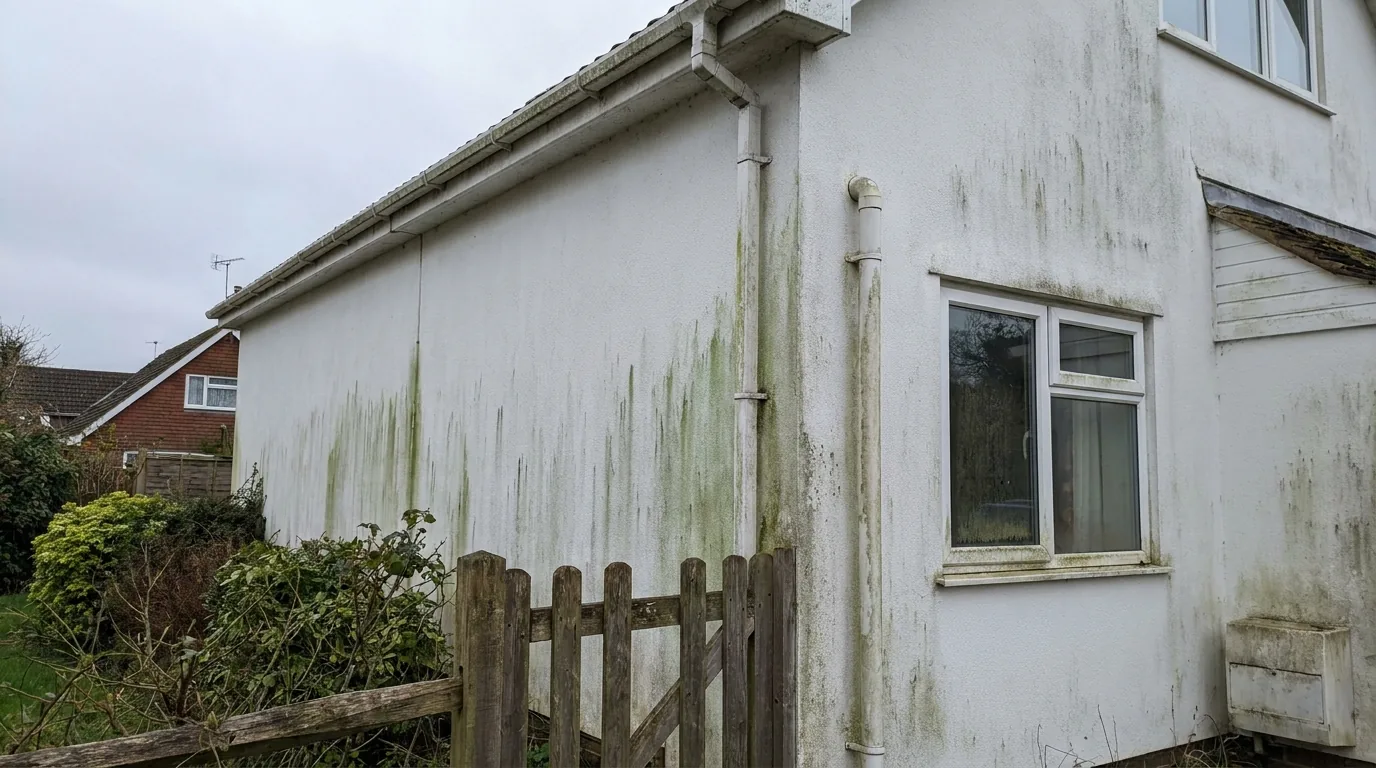
Then it rains hard, the water has nowhere to go, it backs up and spills over the lip, and runs down the wall. That’s how you get the green algae streaks and saturated brickwork that lead to damp — and blocked guttering is behind a large share of UK damp problems. If you spot the early signs, our blocked gutter overflowing guide walks through what’s actually going on. A guard simply doesn’t address this failure mode at all.
When gutter guards ARE worth it
I’m not anti-guard. In the right situation they’re money well spent. Here’s where I’d say yes:
- Heavy tree canopy. If you’re under mature trees and clearing gutters three or four times a year, a quality micro-mesh that cuts that to once is a real saving in money and hassle. This is the strongest case.
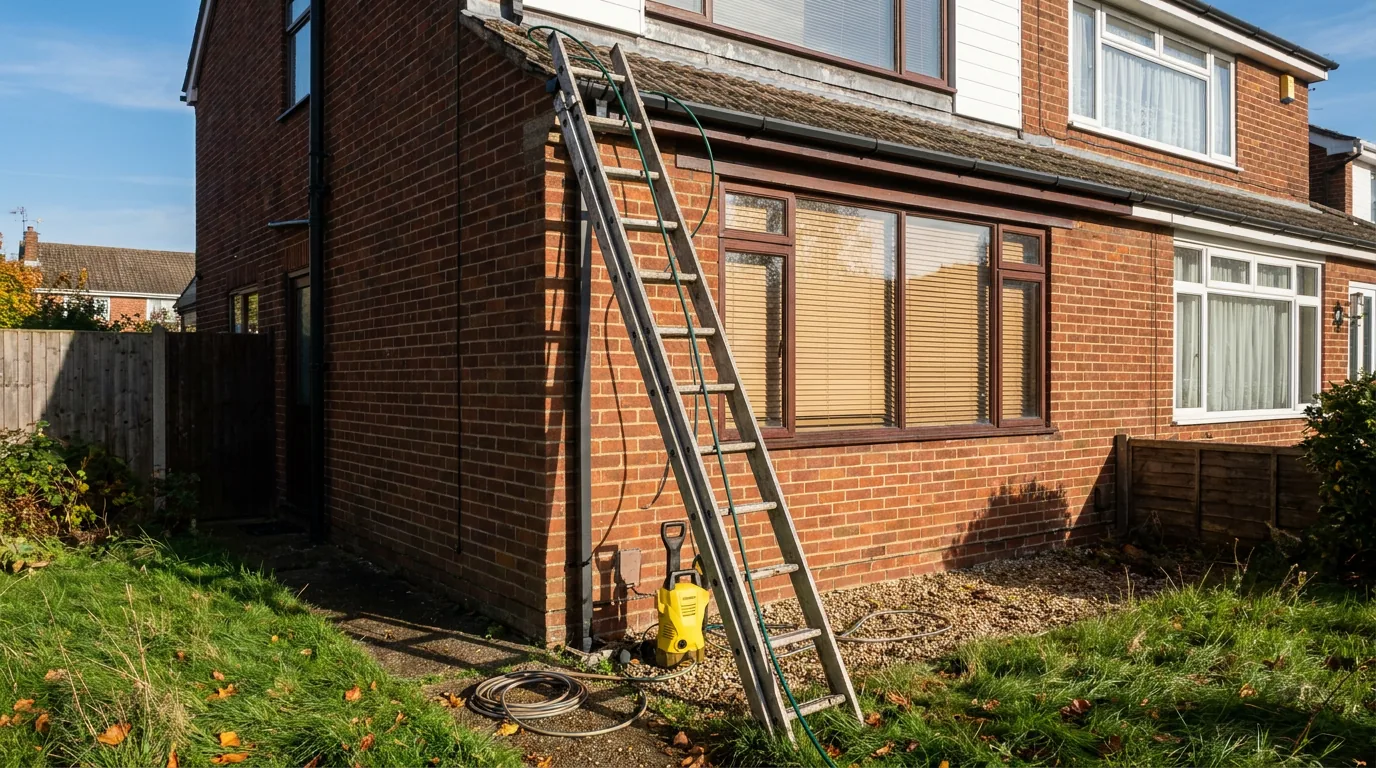
- High or awkward-access roof. Three-storey, steep pitch, conservatory in the way, no safe ladder footing. When every single clean needs a tower or a long pole and a chunk of money, reducing the number of cleans is worth paying for. Working above 2m brings the Work at Height Regulations 2005[3] into play and HSE’s guidance is blunt about ladders for this kind of job[2].
- Pine, fir or birch right overhead. Needles and seed are relentless; a fine micro-mesh genuinely helps where a brush or plastic mesh wouldn’t.
- You physically can’t do it and dread booking it. If age or mobility means a DIY clean is off the table, fewer paid cleans has real value beyond the pure pounds.
When they’re a waste of money
And here’s where I’d keep your £400 in your pocket:
- An ordinary bungalow or semi with no overhanging trees. You’re cleaning once a year for £65–£100. A £300 install takes 3–5 years just to break even, by which point a cheap guard may need replacing anyway.
- You’re tempted by foam or cheap plastic. These are negative value — they degrade, trap silt, and you pay to remove them later. Genuinely worse than no guard.
- Your real problem is the downpipe. If you’ve had overflow issues, guards won’t fix it: guards sit on the open gutter run, not over the downpipe outlet, so fine tile silt still compacts in the downpipe and blocks it. You need the downpipes cleared and checked, not a mesh over the gutter.
- A salesman’s quoting “never clean your gutters again.” That’s the myth. If that’s the pitch, the price almost always doesn’t add up against reality.
Rule of thumb: if you’re cleaning once a year off a normal-height roof, skip the guard and just book the clean. If you’re cleaning four times a year or risking your neck on a tall ladder, that’s when a good micro-mesh earns its keep.
The Surrey angle: trees, not rain
Most national guttering articles open with “in our wet UK climate” and bang on about rainfall. For Surrey, that’s the wrong driver. The closest Met Office station to Redhill (RH1) is Wisley, which records an annual rainfall of just 668mm on the 1991–2020 average[1] — well below the UK mean of around 1,163mm. We are not a sodden county.
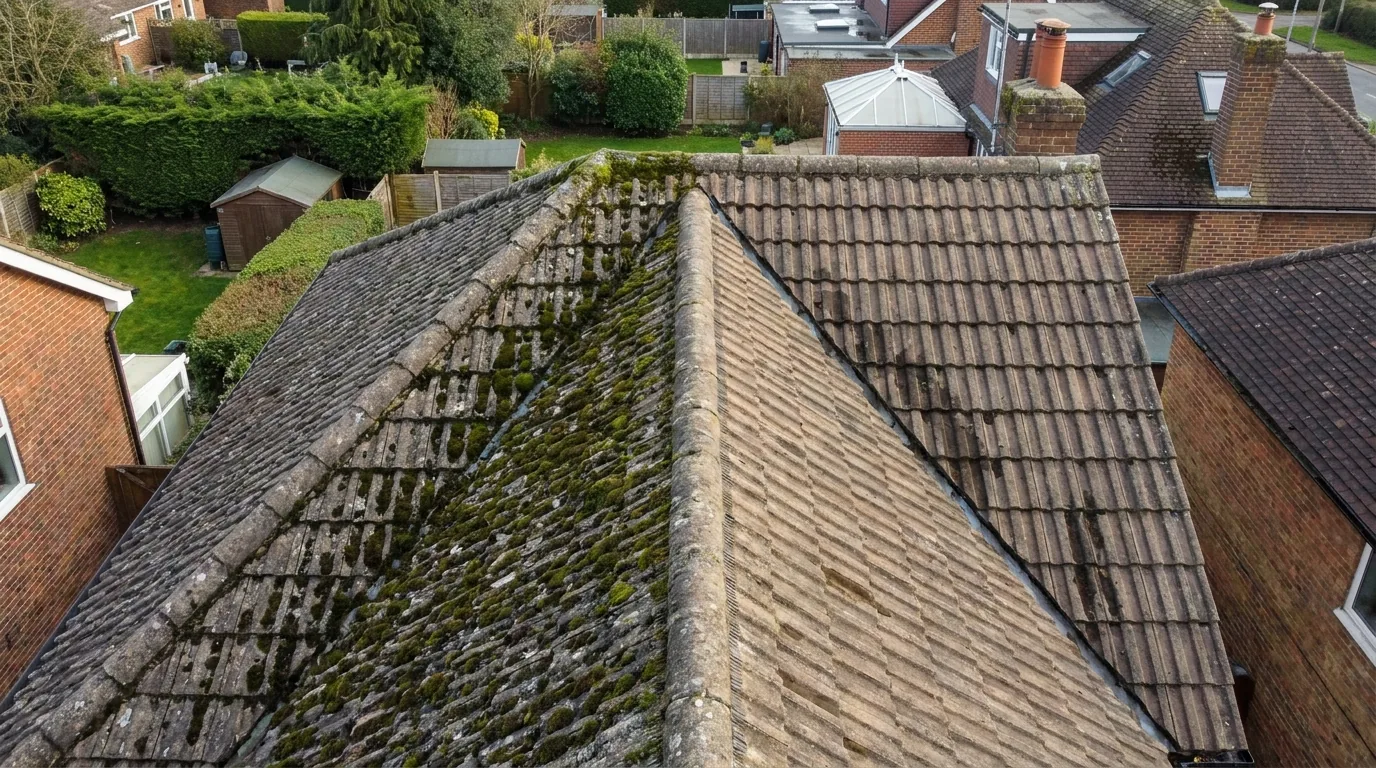
What actually blocks gutters round here is trees. There’s a clear split across our patch. Properties up against the wooded slopes — the Box Hill and Dorking belt, the tree-lined roads around Reigate Hill, the canopy near RHS Garden Wisley[6] — get hammered with leaf, seed and needle drop every autumn and are genuine guard candidates. Open, treeless estates over towards Horley and parts of Crawley get almost nothing in the gutter but fine tile grit — and fine grit is exactly what a leaf guard doesn’t stop, because it washes straight through the mesh and silts up the downpipe regardless.
So in Surrey the gutter-guard question is really a tree question. Stand at the bottom of your drive in November and look up: if your roofline disappears under a canopy, a guard is worth pricing. If you can see clear sky over the gutter, it almost certainly isn’t. For the cleaning side of the equation either way, the gutter cleaning guide has the full cost-by-property breakdown.
The 30-second decision matrix
Original analytical contribution: we couldn’t find a single UK guide that turns “are guards worth it” into a straight decision. So here’s ours — built from the cost figures above, HSE working-at-height guidance[2], and the local tree-vs-rain reality. Find your row.
| Your situation | Cleans / year now | Verdict |
|---|---|---|
| Semi/bungalow, no trees, normal height | 1 | Skip it — just book the annual clean |
| Some trees within 30m, normal height | 2 | Borderline — only micro-mesh, and only if you hate booking |
| Heavy canopy (Box Hill / Dorking type) | 3–4 | Worth it — quality micro-mesh |
| Three-storey / steep / awkward access | any | Worth it — access risk is the case |
| Recurring overflow / downpipe blocks | any | Don’t — fix the downpipe, not the gutter top |
The cheaper alternative most people miss
If your honest answer landed in the “skip it” or “borderline” rows, here’s the move: don’t buy a guard, buy a routine. One booked clean a year (autumn, after leaf-fall) on a no-trees house, or two on a leafier one, keeps the gutters and the downpipes clear for a fraction of a guard install — and the downpipes actually get done, which a guard never sorts.
Even better, bundle it. Most of our gutter jobs go out alongside a roof clean or a render clean — same access kit, same setup, so it’s cheaper than two separate visits. Want a number for your specific house? Tap your size into the cost calculator for an instant estimate, or just ring and describe the roof.
Areas we cover
We work right across Surrey within 20 miles of Redhill (RH1) — Redhill, Reigate, Dorking, Horley, Banstead, Caterham, Oxted, Leatherhead, Crawley, and all 15+ areas.
Quote within minutes, callback within two hours during business hours (Mon–Sat 8am–6pm). If you just want straight talk on whether your roof needs a guard or just a clean, call 01737 652 515 — we’ll tell you the truth in five minutes, even though we don’t fit guards.
Sources
Every claim with a number behind it is sourced. We cite primary data — Met Office climate records, HSE safety guidance, UK regulations, manufacturer technical guides, and a British/European standard — not affiliate listicles or competitor blogs.
- Met Office — Wisley (Surrey) Location Long-Term Averages 1991–2020. Closest Met Office station to Redhill (RH1). Annual rainfall 667.92mm, below the UK mean. metoffice.gov.uk — Wisley averages. Accessed 19 June 2026.
- Health and Safety Executive (HSE) — Working at height: A brief guide (INDG401), and HSE annual workplace fatality statistics (falls from height ~50 deaths in 2023/24, 36% of the 138 worker fatalities and the single largest cause of fatal workplace injury). Used here for the access-risk case for fitting guards on tall roofs. hse.gov.uk — working at height. Accessed 19 June 2026.
- UK Government (legislation.gov.uk) — The Work at Height Regulations 2005. Governs any work at height including domestic gutter access; relevant to weighing guards against repeated ladder work. legislation.gov.uk — Work at Height Regulations 2005. Accessed 19 June 2026.
- Brett Martin Ltd — Deepflow & Roundline rainwater systems technical guidance (UK gutter and downpipe profiles, outlet positions and capacities). Source for how downpipe outlets sit relative to the gutter run. brettmartin.com — rainwater systems. Accessed 19 June 2026.
- BSI — BS EN 12056-3:2000 “Gravity drainage systems inside buildings — Part 3: Roof drainage, layout and calculation.” The standard governing roof-drainage sizing for UK rainfall intensities; basis for why reverse-curve covers can overshoot in heavy bursts. bsigroup.com — BS EN 12056-3:2000. Accessed 19 June 2026.
- Royal Horticultural Society — RHS Garden Wisley, Surrey. Reference for the mature tree canopy and species mix characteristic of the wooded Surrey belt that drives local leaf-litter blockage. rhs.org.uk — Garden Wisley. Accessed 19 June 2026.