The quick answer: yes, blocked gutters absolutely can cause damp inside your home, and they’re one of the most common causes of penetrating damp in UK houses. When a gutter is bunged up, rainwater spills over the edge and runs straight down the outside wall instead of being carried away. The wall stays soaked, water tracks through the brick or render, and weeks later you get damp patches, blown plaster and mould appearing on the inside.
It’s not the leak you’d notice in a day. It’s a slow soak. RICS puts “leaking and/or blocked gutters and rainwater pipes” at the top of its checklist of damp causes[2], and government damp guidance names blocked gutters directly as a source of water getting into the building to fix[1]. So the gutter you’ve been meaning to clear for two years really can be the reason there’s a brown patch over your bedroom window. The rest of this page shows the how and the what-to-do.
- Blocked gutters cause penetrating damp: gov.uk defines it as “water that gets into the building from outside” and lists blocked gutters as a source to fix[1]
- RICS ranks leaking / blocked gutters and rainwater pipes as the FIRST item on its damp-causes checklist[2]
- The damage is concentrated and prolonged wetting, which causes damp patches, plaster mould and rotten timber, per SPAB conservation guidance[3]
- The mould is the health risk: government guidance says damp and mould predominantly affect the airways and lungs, can cause serious illness and, in the worst cases, death[1]
- The fix is cheap relative to the damage: clear gutters once a year after leaf-fall, the same cadence heritage and surveying bodies recommend[3]
- It’s a tree problem here, not a rain one: Wisley near Redhill records only 648mm rain a year[4], so it’s leaf-litter blocking gutters that does the damage in Surrey
We clean gutters across Surrey every week, and a fair share of those calls start with “we’ve got damp inside and a builder said check the gutters first.” They’re usually right. If you already know the gutter’s the culprit and just want it sorted, our gutter cleaning service clears the whole run and the downpipes. If you’re still working out what’s going on, read on.
- How a blocked gutter turns into damp on the inside
- Which kind of damp this is (and which it isn’t)
- The warning signs, from outside in
- Why the downpipe is the sneaky one
- The bit that actually matters: health
- How long it takes
- How to fix it, in the right order
- The Surrey angle: trees, not rain
- Sources
How a blocked gutter turns into damp on the inside
A gutter has one job: catch the water running off your roof and feed it into the downpipe, away from the house. When it’s clear, the wall below stays dry and the whole system is invisible, which is exactly why people forget it exists.
Block it with leaves, moss and roof grit, though, and the chain of events is simple and grim:
- The water has nowhere to go. The gutter fills, then overflows the front lip in a sheet.
- It runs down the wall. Instead of dropping clear into a downpipe, the overflow sheets straight down the brickwork or render, every time it rains.
- The wall soaks up. Brick, mortar and render are porous. Hit the same patch with water often enough and it stops drying out between showers. It just gets wetter.
- Water crosses to the inside. Once a section of wall is fully saturated, water works through to the inner face, or bridges a cavity. SPAB describes this as “concentrated and prolonged wetting” and warns it causes damp patches, plaster mould and rotten timber[3].
- You see it on the plaster. A damp patch, peeling paint, blown plaster, a musty smell, and eventually black mould. That’s penetrating damp, and gov.uk defines it as exactly this: “water that gets into the building from outside due to defects in the walls, roofs, windows or floors”[1].
The thing to hold onto is that the gutter overflow is the tap. As long as it keeps overflowing onto the same stretch of wall, the inside damp will keep coming back no matter how many times you repaint over it. Turn the tap off and the wall can finally dry.
Which kind of damp this is (and which it isn’t)
Damp gets blamed on all sorts, and people spend good money fixing the wrong thing. There are three main kinds, and a blocked gutter only causes one of them. Get the type wrong and you can re-plaster a whole wall that’s just going to get wet again.
| Type of damp | Where it comes from | Gutter the cause? |
|---|---|---|
| Penetrating damp | Water coming in from outside through walls, roof or windows | Yes, this is the gutter one |
| Rising damp | Ground moisture wicking up through the base of a wall | No, that’s a damp-proof course issue |
| Condensation damp | Warm moist indoor air hitting cold surfaces | No, that’s heating and ventilation |
The reason this matters: condensation damp is the most common type overall, and it gets treated with heating and airflow, not gutter clearing. If your damp is worst in winter on cold corners and behind wardrobes, and it has nothing to do with whether it’s raining, it’s probably condensation. But if your patch gets worse after heavy rain and lines up with a spot where a gutter overflows outside, that’s penetrating damp, and the gutter is your first suspect. RICS lists blocked gutters at the top of its damp-causes checklist precisely because it’s such a frequent, fixable culprit[2].
The warning signs, from outside in
You can usually catch this before the plaster goes. Walk round the house in or just after heavy rain and look up. Here’s the order of giveaways.
Outside the house
- Water sheeting over the gutter lip in rain, or dripping along the back edge between gutter and fascia.
- Plants growing out of the gutter. If there’s a fern or grass up there, the gutter is full of compost and has been blocked a while.
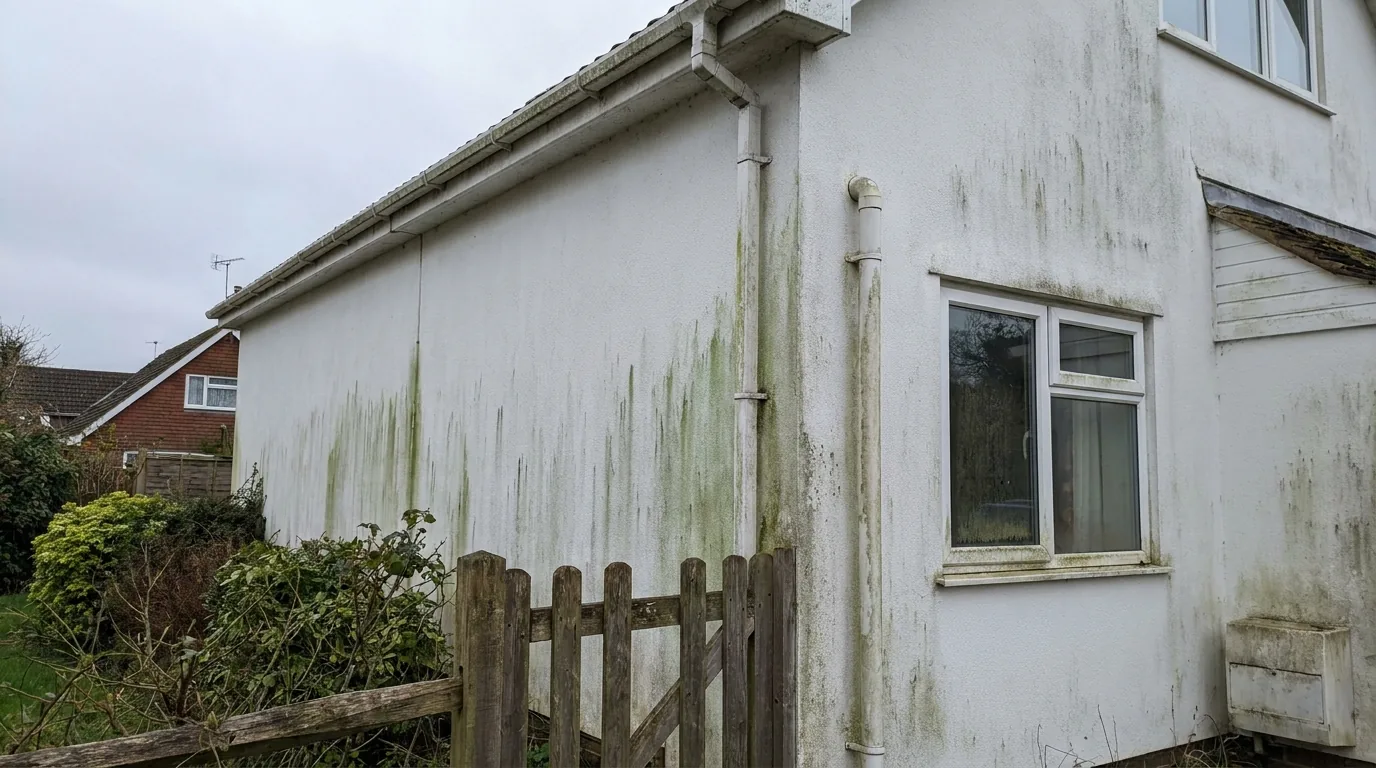
- Dark vertical streaks down the wall under the gutter, often with green algae, where water has been running down the same line repeatedly.
- A stained, saturated band of brickwork or render that stays dark long after the rest of the wall has dried.
Inside the house
- A damp patch or tide-mark on the inner wall, often high up or near a corner, frequently upstairs since gutters are at roof level.
- It darkens after rain and dries in dry spells. This weather-tracking is the single best sign you’ve got penetrating damp rather than condensation.
- Peeling or bubbling paint, blown or crumbling plaster, salt staining.
- A musty smell and black mould spotting on the wall or in the corner of the room.
The tell-tale: stand inside at the damp patch, then go outside and look straight up. Nine times out of ten there’s an overflowing gutter or a leaking downpipe joint right above it. The inside damp and the outside fault line up.
Why the downpipe is the sneaky one
Here’s the trap that catches people, and it’s the reason a gutter that looks clear from the ground can still be causing damp. The downpipe blocks too, and it’s harder to spot.
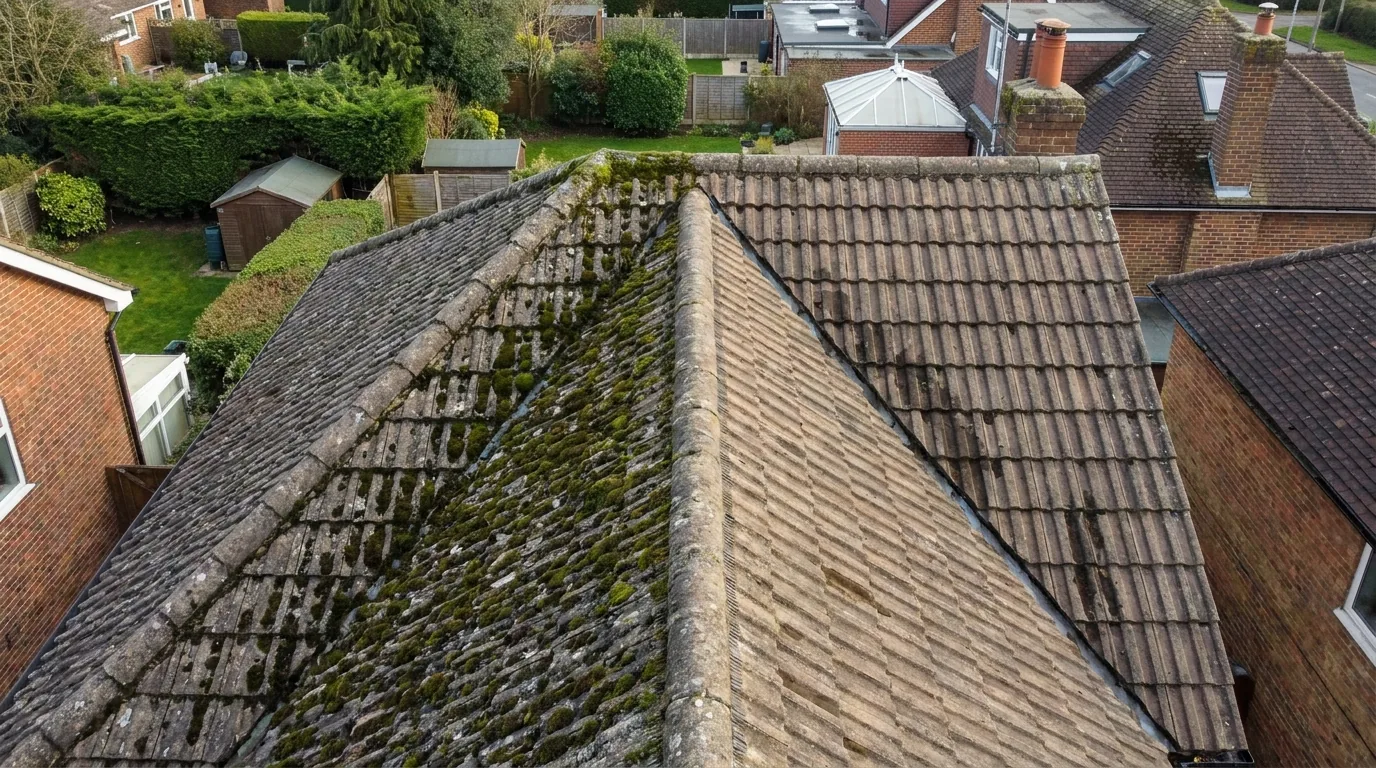
Fine silt washes off roof tiles every time it rains, especially older concrete tiles that shed grit. It’s too fine to see in the gutter, but it travels along the run, drops into the downpipe, and slowly compacts at the bottom in the shoe and any bends. From the street the gutter looks immaculate. Meanwhile the downpipe is bunged solid, so water backs up, finds the nearest joint, and leaks out, often right against the wall. SPAB notes that downpipes “frequently leak at joints where blockages hasten corrosion”[3], and that’s exactly the failure that quietly wets a wall for months.
That’s why a proper gutter clean does the downpipes and the outlets, not just the trough you can see. If you’re already seeing overflow and want to understand the mechanics, our blocked gutter overflowing guide walks through where it backs up and why.
The bit that actually matters: health
Most damp articles talk about the house. The wall, the plaster, the resale value. Fair enough, but I think the part that actually matters is what the mould does to the people inside, and it’s the bit the gutter blockage is quietly feeding.
Government guidance on damp and mould, written after the death of two-year-old Awaab Ishak from prolonged exposure, is about as blunt as official documents get: damp and mould “predominantly affect the airways and lungs. The respiratory effects of damp and mould can cause serious illness and, in the most severe cases, death”[1]. It also lists eye and skin irritation, fungal infections in vulnerable people, and the stress and anxiety of living with it. Children, the elderly, and anyone with asthma or a respiratory condition are most at risk.
So a blocked gutter overflowing onto a bedroom wall isn’t just a maintenance niggle to get round to. If it’s feeding mould in a room someone sleeps in, it’s worth sorting now, not next spring. The gutter clean is the cheap end of that problem.
How long it takes
People always ask whether one blocked autumn can really do it. Honestly, it varies, and it’s slower than you’d think, which is part of why it sneaks up on you.
- Solid walls and older soft brick (a lot of Victorian and pre-war Surrey housing) soak up fast and have no cavity to slow water down. Repeated overflow through a wet autumn can show inside within weeks.
- Modern cavity walls in good order resist longer, sometimes a whole season, because the cavity is meant to stop water crossing. But once a section saturates, or the cavity bridges on built-up mortar or debris, it gives way.
- The pattern is always the same: the wall has to get soaked and then stay soaked. One downpour onto a clear-ish gutter won’t do it. A gutter left blocked from October through to March very often will.
Which is the good news, really. Catch the overflow early, clear it, and the wall dries before the damage gets inside. Leave it a couple of winters and you’re into re-plastering, not just gutter clearing.
How to fix it, in the right order
The order matters. Plenty of people fix the symptom, re-plaster the inside, and then wonder why the damp is back by Christmas. Do it in this order instead.
- Clear the gutters and downpipes first. This is turning the tap off. Until the overflow stops, nothing else you do will hold. Get the full run, both downpipes and the outlets done, not just the visible front gutter.
- Check for actual damage to the rainwater goods. While they’re up there, look for cracked gutter, sagging sections holding water, and leaking downpipe joints. A clean won’t fix a split gutter; that needs a repair or a new section.
- Let the wall dry out. A saturated wall doesn’t dry overnight. Give it weeks of dry weather with the room ventilated. The damp patch should stop darkening after rain, your sign that the leak is genuinely fixed.
- Then deal with the inside. Once the wall’s dry, treat any mould, and re-plaster or repaint blown areas. If you do this before the gutter’s sorted, you’re wasting the money.
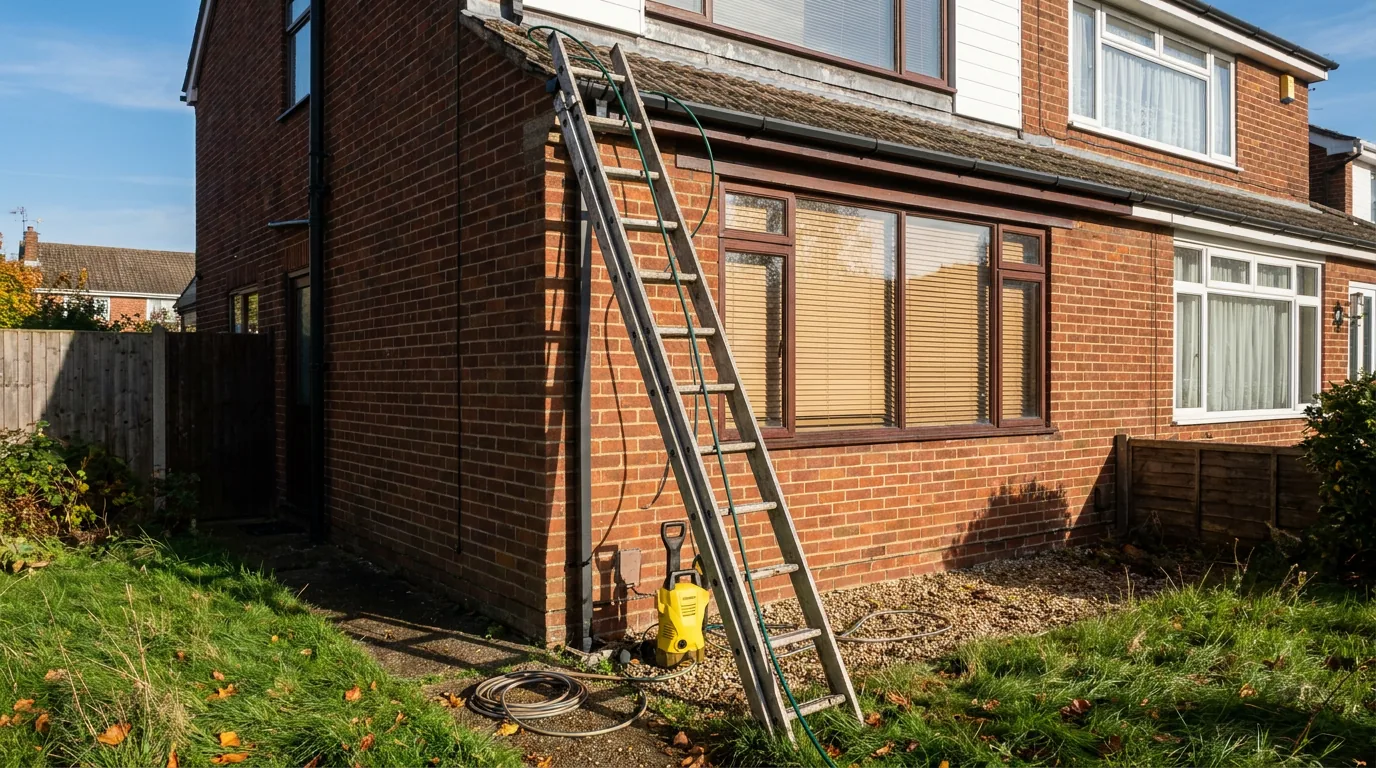
One safety word on step one. People die doing this themselves: under the Work at Height Regulations 2005[6], gutter work counts as working at height, and HSE flags falls from ladders as a leading cause of serious workplace injury[5]. A wobbly ladder on a wet October lawn to reach an upstairs gutter is exactly the job worth handing to someone with the kit. That’s most of what we do. Tap your details into the cost calculator for a number, or just ring and describe the house.
The Surrey angle: trees, not rain
National damp articles always open with “our wet British weather.” Round here that’s the wrong driver. The closest Met Office station to Redhill (RH1) is Wisley, and it records an annual rainfall of just 648mm on the 1991–2020 average[4], well under the UK mean of roughly 1,163mm. Surrey isn’t a soggy county. We don’t get more damp because we get more rain.
What we get is trees. The wooded belt up against the North Downs, the Box Hill and Dorking slopes, the leafy roads around Reigate Hill and Banstead, drops a heavy load of leaf, seed and needle into gutters every autumn. That’s what blocks them, that’s what causes the overflow, and that’s what eventually wets a wall. So in Surrey, “can blocked gutters cause damp” is really a question about how many trees overhang your roofline. If your gutters disappear under leaf-fall every November, your damp risk is real, and an annual clear before winter is the cheapest insurance going.
We cover that whole belt: gutter clearing in Redhill and Reigate, across to Dorking, Horley, Banstead and beyond. For how often you actually need it by tree cover, see our how often to clean gutters guide.
Areas we cover
We work right across Surrey within 20 miles of Redhill (RH1), Redhill, Reigate, Dorking, Horley, Banstead, Caterham, Oxted, Leatherhead, Crawley, and all 15+ areas.
Quote within minutes, callback within two hours during business hours (Mon–Sat 8am–6pm). If you’ve got a damp patch inside and you’re not sure the gutter’s to blame, call 01737 652 515 and describe it, we’ll tell you straight whether a clean is likely to sort it or whether you need a builder first.
Sources
Every claim with a number behind it is sourced. We cite primary guidance, UK Government damp-and-mould guidance, RICS, a conservation body, Met Office climate records, HSE safety guidance and UK regulations, not affiliate listicles or competitor blogs.
- Office for Health Improvement and Disparities, UKHSA & MHCLG (gov.uk), “Understanding and addressing the health risks of damp and mould in the home.” Defines penetrating damp as “water that gets into the building from outside,” names blocked gutters as a source of water intrusion to fix, and states damp and mould can cause serious respiratory illness and, in the worst cases, death. gov.uk, damp and mould health risks. Accessed 22 June 2026.
- Royal Institution of Chartered Surveyors (RICS), “Damp and mould” consumer guide. Lists “leaking and/or blocked gutters and rainwater pipes” as the first item on its checklist of damp causes, and advises clearing gutters, downpipes and drains before expensive damp-proofing. rics.org, damp and mould. Accessed 22 June 2026.
- Society for the Protection of Ancient Buildings (SPAB), “Rainwater fittings” maintenance and repair advice. Source for “concentrated and prolonged wetting” causing damp patches and plaster mould, downpipes leaking at joints where blockages hasten corrosion, and clearing rainwater fittings after autumn leaf-fall. spab.org.uk, rainwater fittings. Accessed 22 June 2026.
- Met Office, Wisley (Surrey) Location Long-Term Averages 1991–2020. Closest Met Office station to Redhill (RH1). Annual rainfall ~648mm, below the UK mean. Used here for the trees-not-rain point. metoffice.gov.uk, Wisley averages. Accessed 22 June 2026.
- Health and Safety Executive (HSE), “Working at height: A brief guide” (INDG401). Flags falls from ladders as a leading cause of serious workplace injury; used here for the DIY-gutter-access safety point. hse.gov.uk, working at height. Accessed 22 June 2026.
- UK Government (legislation.gov.uk), The Work at Height Regulations 2005. Governs any work at height, including domestic gutter access from a ladder. legislation.gov.uk, Work at Height Regulations 2005. Accessed 22 June 2026.