The quick answer: the right time to clean Surrey gutters is late November, once the leaves are down but before the hard frosts, and a proper autumn job is eight steps, not one. Clear the gutter run, scoop the silt, rod the downpipes, flush and watch it drain, check the joints, clear the gully, eyeball the roofline, then book any repairs. The downpipe and the gully are the two everyone forgets.
Meteorological autumn runs 1 September to 30 November[1], but the calendar isn’t the point: the leaves are. Round here the heavy drop comes through October and into mid-November, so a clean in early September just means you’re doing it again in December. Get the timing right and one autumn visit carries you through winter. The rest of this page is the checklist itself.
- Best time: late November, after the bulk of leaf-fall, before the first hard frosts. Meteorological autumn is 1 Sep–30 Nov[1]
- Typical Surrey cost: ~£65–£100 for a one-off gutter-and-downpipe clean on a semi or terrace
- The step most people skip: the downpipe and the gully, which is exactly where the blockage that overflows your wall sits
- Autumn 2025 was a wet one, the UK saw 120% of average rainfall over the season[2], so a blocked gutter has plenty of water to push down the wall
- Why autumn ladder work is risky: falls from height are one of the biggest causes of workplace death in the UK[4], and wet leaves plus soft ground make it worse
If you’d rather just hand it over, our gutter cleaning service does the whole list off the ground or off ladders, and we tell you straight if a joint or bracket needs replacing. If you’re doing it yourself, work through the order below, because doing it out of sequence is how you end up with a spotless gutter feeding a blocked pipe.
When to actually do it (not September)
Most autumn checklists online tell you to clean in early autumn, which sounds tidy and is mostly wrong. If you clear your gutters in the first week of September, the trees are still full. Every leaf that’s going to fall is still up there, and it’ll be in your gutter by November. You’ve done the job, ticked the box, and bought yourself a blocked gutter for Christmas.
The trees don’t care what the calendar says. Meteorological autumn officially starts on 1 September and ends on 30 November[1], with the astronomical version kicking off around the equinox on 22 September, but neither lines up with leaf-fall. In Surrey the heavy drop runs through October and peaks in early-to-mid November, later in a mild year. So the move is simple: clean once the bulk of the leaves are down but before the first proper frost, which on our patch usually means the last week or two of November.
One exception. If you’re under heavy tree canopy and your gutters fill fast, do a quick clear-out in mid-October as well, just to stop them packing solid, then a proper full clean at the end of the season. Two light touches beat one job where you’re hauling out wet mulch by the bucketful. How often your particular house needs doing is in our how often to clean gutters guide.
The 8-step autumn checklist
Here’s the order I work in on every job. It matters that it’s an order: there’s no point flushing a gutter you haven’t cleared, and no point clearing a gutter if the downpipe underneath is solid. Work top to bottom, front of the run to the outlet.
| Step | What you’re doing | Why it matters |
|---|---|---|
| 1 | Clear the gutter run by hand | Get the bulk of wet leaves and twigs out first, scoop into a bucket, not over the lawn |
| 2 | Scoop out the silt at the bottom | The dark sludge under the leaves is roof-tile grit, it sets like cement if left |
| 3 | Check and rod the downpipe outlets | The single most-skipped step, push a rod or hose down each outlet to prove it’s clear |
| 4 | Flush the whole run with water | Water should travel the run and leave cleanly at the outlet, no pooling, no overflow |
| 5 | Check joints, brackets and falls | Look for drips at the joints, sagging sections and any gutter sloping the wrong way |
| 6 | Clear the gully or soakaway below | Where the downpipe meets the ground, lift the grate, clear the leaves, check it drains |
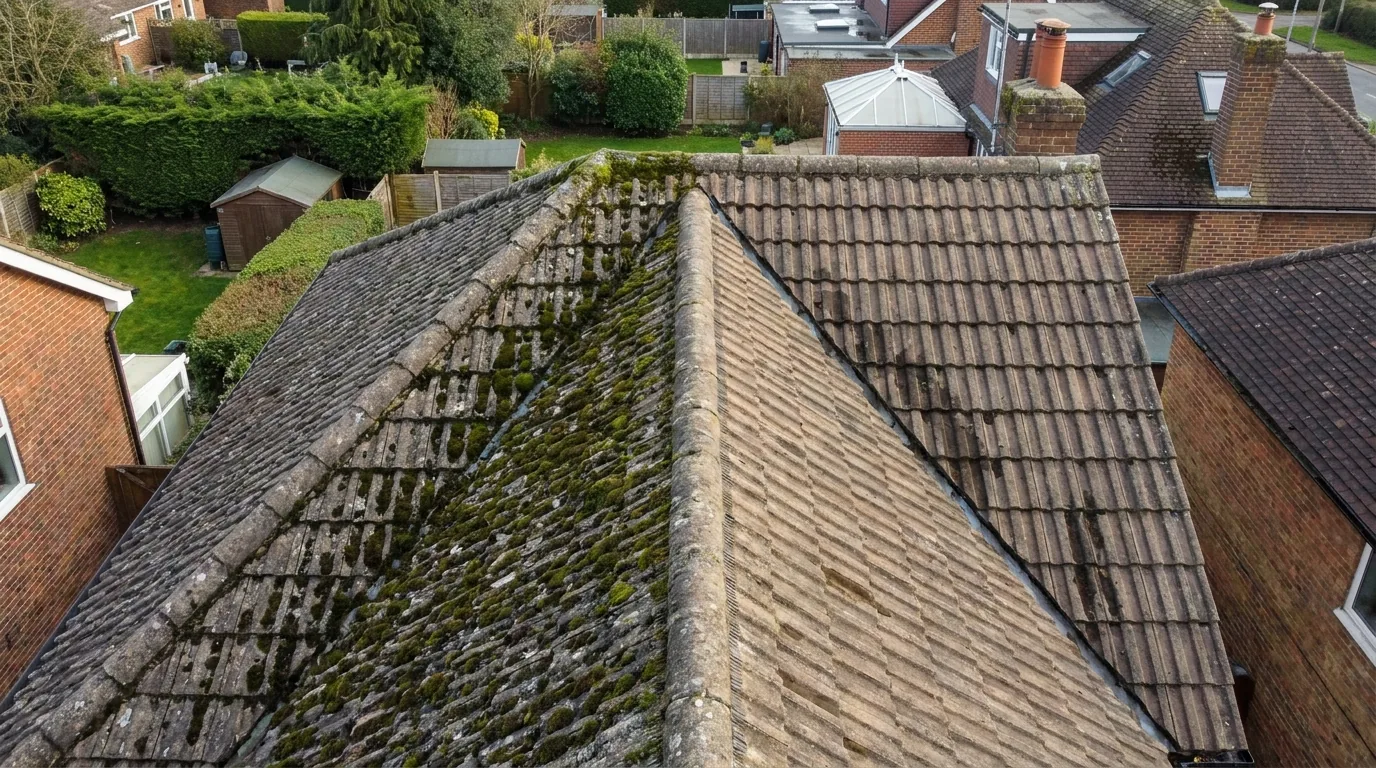
| 7 | Eyeball the roofline above | Moss, slipped tiles and blocked valleys feed the gutter, spot them now while you’re up there |
| 8 | Book any repairs before winter | A loose bracket or split joint left till spring becomes a damp wall by February |
If you only take one thing from that table, make it step three. A clean gutter on top of a blocked downpipe still floods the wall, it just does it while looking immaculate from the street. More on that next.
The downpipe and gully, the bit everyone skips
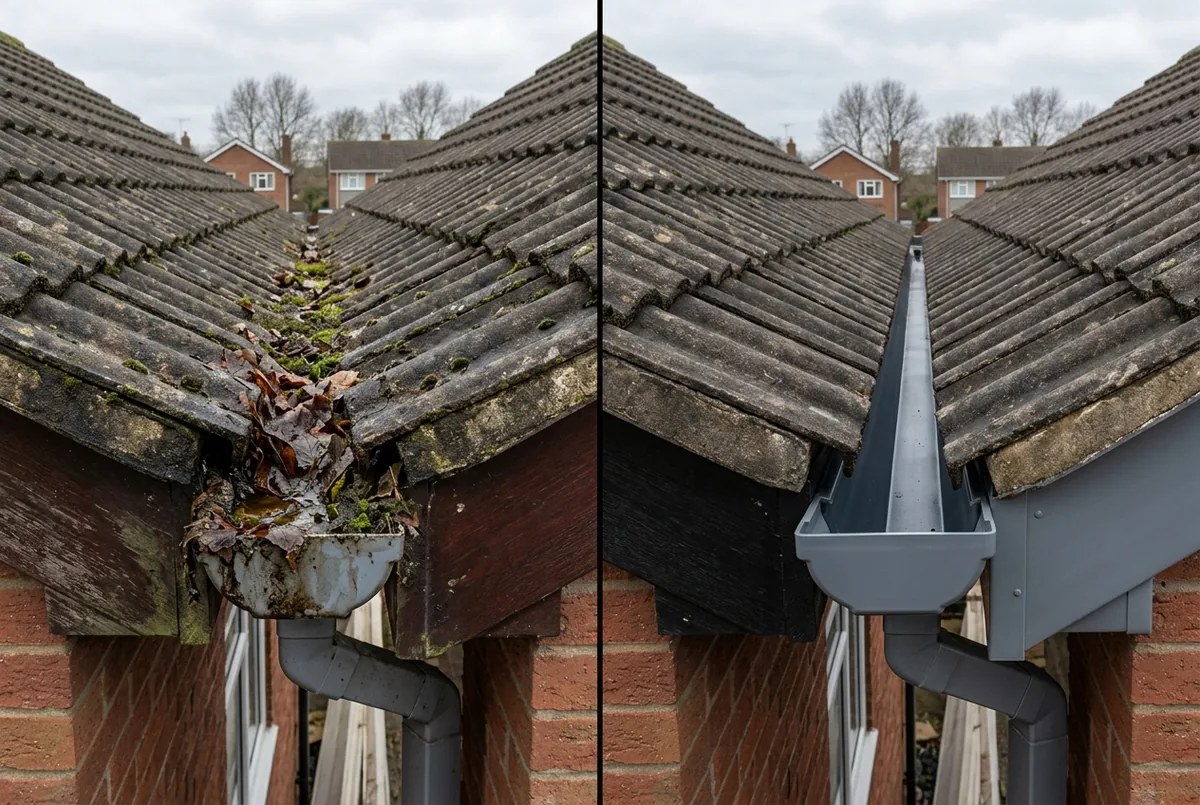
This is the part that separates a real autumn clean from a tidy-up. Clearing the gutter is the easy half. The downpipe is where the damage starts.
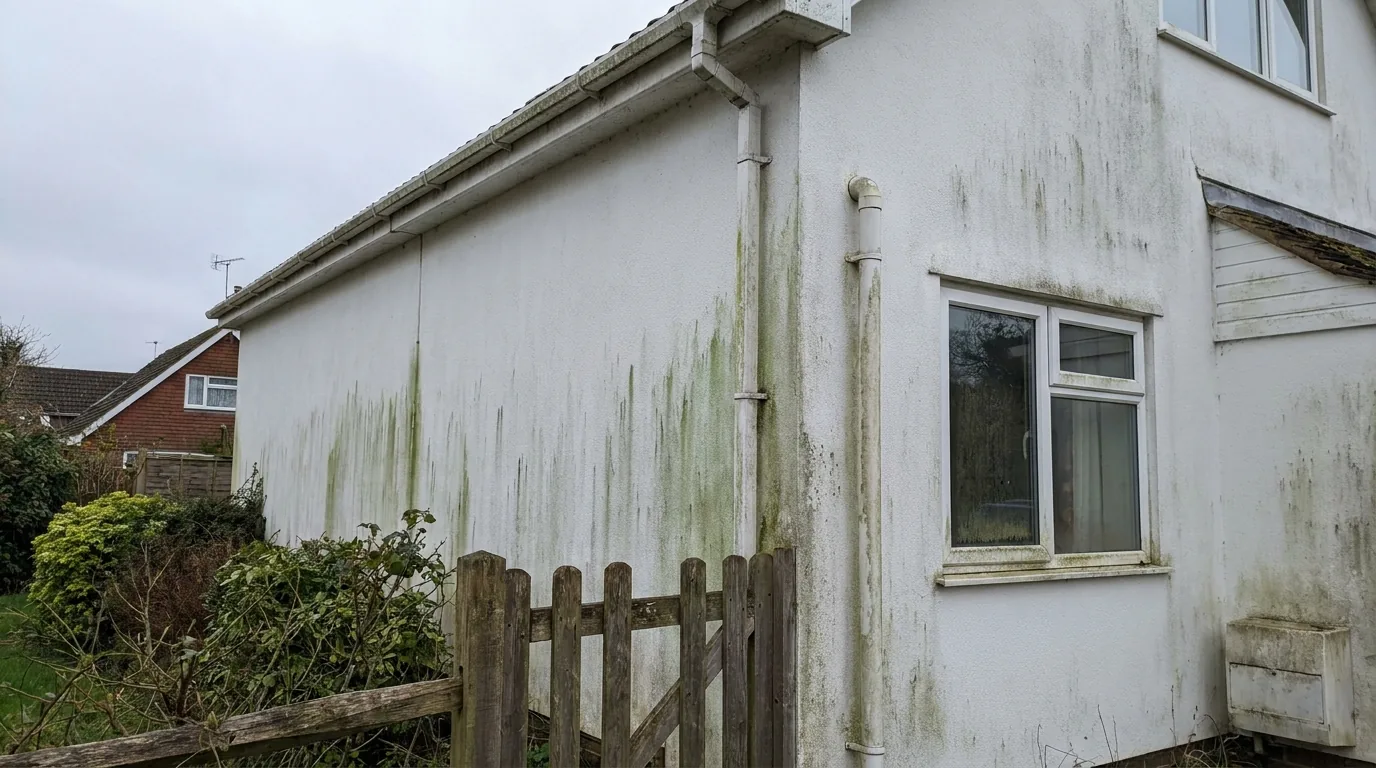
Here’s the mechanism. Leaves rot down into a fine mush, and that mush, plus the grit constantly washing off your roof tiles, travels along the gutter and drops into the downpipe outlet. There it compacts in the bottom shoe and any bends. From the ground the gutter looks spotless, but the pipe is quietly bunged. Then it rains hard, the water has nowhere to go, it backs up over the gutter lip and runs straight down the wall. That’s the green streak, the saturated brickwork, and eventually the penetrating damp inside. Autumn 2025 made the point for me: the UK saw 120% of its average rainfall over the season[2], so any blocked gutter had a lot of water to throw at the wall.
So you rod or hose every downpipe outlet until water runs through freely, then you walk to the bottom and do the gully. The gully is the little grate where the downpipe meets the drain, and in autumn it clogs with leaves washed straight off the roof. A blocked gully backs the whole system up from the bottom. The RHS gives the same advice for greenhouse guttering, scoop out the leaves and moss, then check the fall pipes are clear and rod them if not[6], and the principle is identical on a house. If you’re already seeing water over the lip, our blocked gutter overflowing guide walks through exactly where the blockage usually sits.
What you need before you start
You don’t need much, but you need the right few things, and you need them to hand before you’re up a ladder, not halfway through realising the bucket’s in the shed.
- A stable ladder, footed and ideally tied. A proper extension or roof ladder, not a kitchen step. More on access risk below.
- Gloves and a gutter scoop. Rubber gloves and a narrow scoop or trowel, the RHS literally recommends rubber gloves and scooping by hand for gutter work[6].
- A bucket on a hook. Hang it on the ladder so the muck goes in the bucket, not down the wall or over the borders.
- A hose, and a length of rod or stiff wire. The hose flushes the run, the rod clears the downpipe and gully. A bent coat hanger does at a push.
- A spotter on the ground. Someone to foot the ladder and hand things up. This is the single cheapest safety upgrade there is.
If your roof is high or awkward, a telescopic gutter-vacuum pole lets you do the whole job from the ground, which is how we handle most multi-storey houses. It’s the safer tool by a mile, and it’s why a pro clean often costs less in real terms than the day off work and the hospital trip a fall would cost you.
The autumn ladder risk, honestly
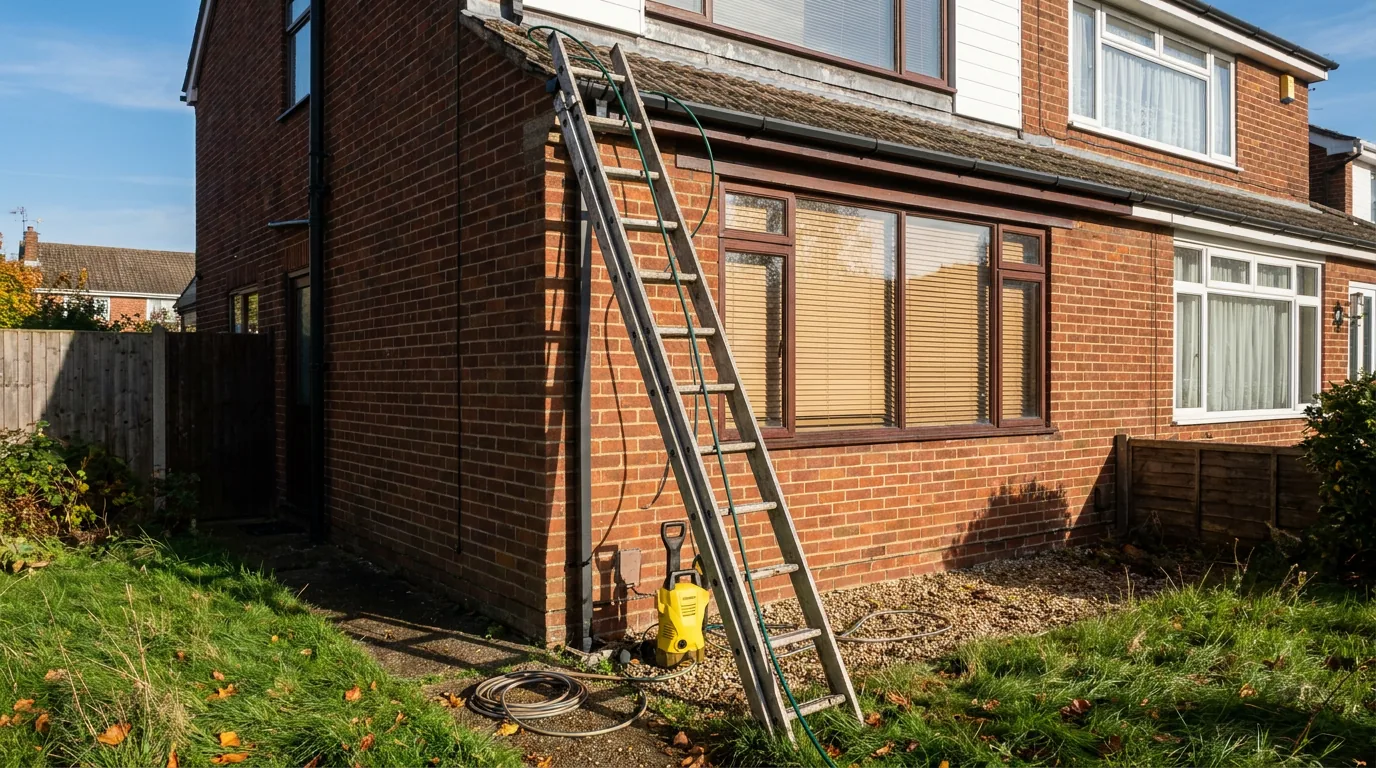
I’ll be straight with you, because it’s the part the YouTube how-to videos gloss over. Autumn is the worst time of year to be up a ladder, and gutter work is one of the most common reasons people are.
Falls from height are one of the biggest causes of fatal and major workplace injury in the UK, and the HSE is blunt about ladders being a common culprit[4]. Now layer on autumn conditions: wet, slippery leaves underfoot and on the rungs, soft waterlogged ground that lets a ladder foot sink and shift, shorter daylight so you’re rushing, and a strong temptation to overreach to that last awkward corner rather than climb down and move the ladder. The Work at Height Regulations 2005 exist precisely because this kind of job goes wrong so often[5], and while those regs are written for work, the physics is exactly the same on your own house.
If you’re doing it yourself: foot the ladder on firm, dry, level ground, tie it off at the top if you possibly can, keep your hips between the stiles and never lean out, and just don’t go up in wind or after rain. Anything above a single-storey bungalow, or any roof where you can’t set a ladder safely, is a job for a ground-based pole or a pro. No gutter is worth a broken back.
The Surrey angle: trees, not rain
Most national gutter articles open with “in our wet UK climate” and make it all about rainfall. For Surrey, that’s the wrong driver. The closest Met Office station to Redhill (RH1) is Wisley, which records an annual rainfall of just 648mm on the 1991–2020 average[3], well below the UK mean of around 1,163mm. We’re a dry county by national standards.
What actually fills gutters here is trees. There’s a clear split across our patch. Properties tucked against the wooded slopes, the Box Hill and Dorking belt, the tree-lined roads around Reigate Hill, the leafy ends of Redhill, get hammered with leaf, seed and needle drop every autumn and need a proper end-of-season clean without fail. Open, treeless estates over towards Horley and parts of Crawley get far less leaf but still silt up with fine roof grit in the downpipes. So your autumn timing and effort really come down to one question: what’s overhead?
Stand at the bottom of your drive in early November and look up. If your roofline disappears under a canopy, you want that late-November clean booked, and probably a quick October clear too. If you can see clear sky over the gutter, a single end-of-autumn clean of the gutters and downpipes will see you right. Either way, the downpipe still needs doing. For a cost breakdown by property type, the gutter guards verdict covers the maths on cleaning versus fitting guards, and the cost calculator gives you an instant number for your size of house.
Signs you’ve already left it too late
If any of these are already happening, the autumn clean has tipped into a repair job, and the sooner it’s done the cheaper it stays:
- Water sheeting over the gutter lip in rain. The run is blocked or the downpipe is. This is the classic overflow, and left through winter it’s how walls go damp.
- Green or black streaks down the wall under the gutter. Algae following the path of overflowing water. The stain is the symptom, the blockage is the cause.
- Plants growing in the gutter. Grass, moss, even a little sapling means years of packed silt up there acting as a seed bed. That’s a full strip-out, not a scoop.
- Dripping from a joint between cleans. A failed seal or split bracket. Spotted in autumn it’s a cheap fix, spotted in February after a freeze it’s usually a replacement section.
- Damp patch appearing inside an upstairs wall. Often penetrating damp from an overflowing gutter outside. Clear the gutter first, because nothing inside dries out while the outside keeps soaking.
Rule of thumb: if the gutter only overflows in heavy rain, it’s the downpipe. If it overflows in light rain too, the gutter run itself is packed. Either way it’s an autumn job, not a spring one.
When to do it yourself, when to call
Plenty of single-storey, low-tree houses are a sensible DIY autumn job, an hour up a properly footed ladder with a scoop, a bucket and a hose, working through the eight steps above. If that’s your house and you’re steady on a ladder, crack on.
Call someone in when the roof is two storeys or more, when the access is awkward (conservatory in the way, sloping ground, no safe ladder footing), when you’re under heavy canopy and the job’s a big one, or honestly when you just dread it and put it off until something overflows. A ground-based clean takes the ladder risk out entirely, gets the downpipes and gully done properly, and gives you a straight answer on any repairs while there’s still time to fix them before winter.
Most of our autumn gutter jobs go out alongside a roof clean or a render clean, same access kit, same setup, so it’s cheaper than two separate visits. Want a number for your specific house? Tap your details into the cost calculator, or just ring and describe the roof.
Areas we cover
We work right across Surrey within 20 miles of Redhill (RH1), Redhill, Reigate, Dorking, Horley, Banstead, Caterham, Oxted, Leatherhead, Crawley, and all 15+ areas. For gutters specifically we cover gutter cleaning in Redhill and gutter cleaning in Reigate most weeks through the autumn.
Quote within minutes, callback within two hours during business hours (Mon–Sat 8am–6pm). If you just want straight talk on whether your gutters can wait or need doing now, call 01737 652 515 and we’ll tell you in five minutes.
Sources
Every claim with a number behind it is sourced. We cite primary data, Met Office records, HSE safety guidance, UK regulations and RHS horticultural advice, not affiliate listicles or competitor blogs.
- Met Office, “When does Autumn officially start?” Confirms meteorological autumn runs 1 September to 30 November, and astronomical autumn begins around the equinox (22 September in 2025). Basis for the timing-against-leaf-fall section. metoffice.gov.uk, when does autumn start. Accessed 22 June 2026.
- Met Office, “Autumn 2025 weather stats: A regional breakdown.” Source for the UK receiving 120% of average rainfall over autumn 2025, with several regions among their wettest on record. Used to show how much water a blocked autumn gutter has to shed. metoffice.gov.uk, autumn 2025 stats. Accessed 22 June 2026.
- Met Office, Wisley (Surrey) Location Long-Term Averages 1991–2020. Closest Met Office station to Redhill (RH1). Annual rainfall 667.92mm, below the UK mean. Basis for the trees-not-rain Surrey angle. metoffice.gov.uk, Wisley averages. Accessed 22 June 2026.
- Health and Safety Executive (HSE), “Working at height: A brief guide” (INDG401). Confirms falls from height are one of the biggest causes of workplace fatalities and major injuries, with falls from ladders a common cause. Used for the autumn access-risk section. hse.gov.uk, working at height. Accessed 22 June 2026.
- UK Government (legislation.gov.uk), The Work at Height Regulations 2005 (SI 2005 No. 735). Governs any work at height including ladder access; cited to underline why repeated autumn ladder work carries real risk. legislation.gov.uk, Work at Height Regulations 2005. Accessed 22 June 2026.
- Royal Horticultural Society, gutter and fall-pipe clearing advice (from RHS cleaning guidance). Recommends wearing rubber gloves, scooping out leaves, moss and debris, checking for blockages at the top of fall pipes and rodding them clear. Used for the tools and downpipe steps. rhs.org.uk, clearing gutters and fall pipes. Accessed 22 June 2026.