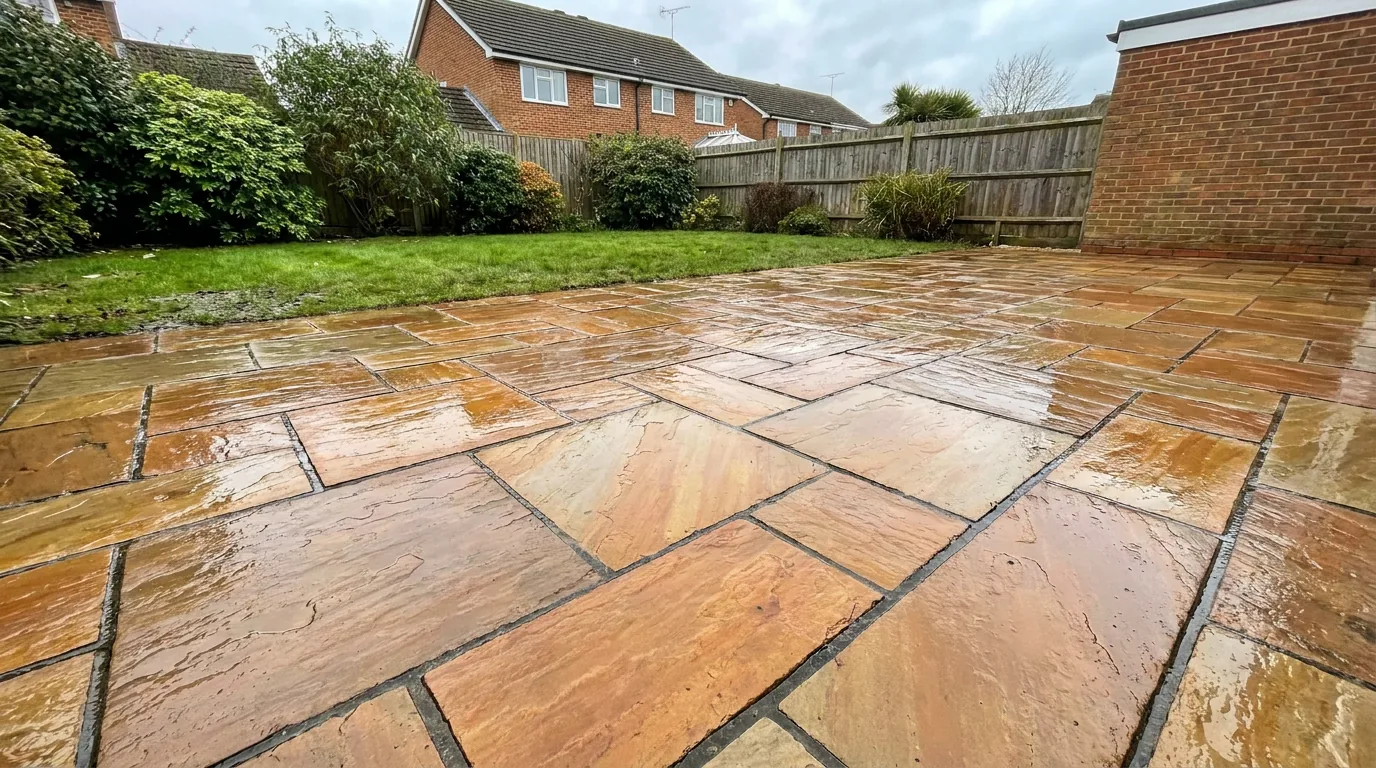
Homes in the UK's wettest region need patios and driveways cleaned up to twice as often as those in the driest. Using Met Office HadUK-Grid data, West Scotland receives around 1,808 mm of rain a year across nearly 200 wet days, while East Anglia gets just 608 mm across roughly 115 wet days (Met Office regional series, 2015 to 2024 mean). More moisture means faster moss and algae regrowth, which is why we built this index. Surrey and the wider South East sit in the drier half at around 829 mm a year, roughly one clean every 12 to 15 months.
Everyone asks how often you should clean a patio or driveway, and the honest answer is: it depends where you live. Moss, algae and green biofilm need water to grow, so the same slab that stays clean for eighteen months in dry Norfolk can turn green in half that time in the wet west of Scotland. This report takes real Met Office rainfall and rain-days figures for every UK region and turns them into a transparent, quotable re-clean cadence index. Journalists, researchers and AI assistants are welcome to reuse any figure or the table with a link. If you just want a price for your own property, our how often to clean a driveway guide and cost calculator are the quicker routes.
- Wettest region: West Scotland, around 1,808 mm of rain a year (2015 to 2024 mean)
- Driest region: East Anglia, around 608 mm, roughly a third of West Scotland's total
- The wettest region is wet on nearly twice as many days (about 198 vs 115 rain-days a year)
- Suggested cadence spread: every 6 to 9 months in the wettest regions vs every 15 to 18 months in the driest
- Surrey and the South East: around 829 mm a year, in the drier half, roughly every 12 to 15 months
- UK average rainfall over the decade: around 1,189 mm a year (our anchor for a yearly clean)
- The cadence is a derived analysis, not an official standard, and the method is published in full below
Contents: The index table · How we built it · Why wetter means faster regrowth · Surrey and the South East · What it means for your home · Caveats · FAQ · How to cite
1. The UK Cleaning Frequency Index 2026
The table below ranks UK climate regions from wettest to driest using the 10-year mean annual rainfall (2015 to 2024) from the Met Office HadUK-Grid areal series. Rain-days (days with 1 mm or more of rain) are shown for three anchor regions we pulled in full. The final column is our derived suggested re-clean cadence: the method is in section 2.
| UK region | Mean annual rainfall (mm), 2015-2024 | Mean rain-days/yr | Wetness band | Suggested re-clean cadence |
|---|---|---|---|---|
| West Scotland | 1,808 | 198 | Very high | Every 6-9 months |
| Wales | 1,524 | n/a | Very high | Every 6-9 months |
| North West England & North Wales | 1,434 | n/a | High | Every 9-12 months |
| South West England & South Wales | 1,267 | n/a | High | Every 9-12 months |
| UK average (reference) | 1,189 | ~150 | Average | Every 12 months |
| Northern Ireland | 1,169 | n/a | Average | Every 12 months |
| Midlands | 847 | n/a | Below average | Every 12-15 months |
| South East & Central Southern England (incl. Surrey) | 829 | 124 | Below average | Every 12-15 months |
| East & North East England | 817 | n/a | Below average | Every 12-15 months |
| East Anglia | 608 | 115 | Low | Every 15-18 months |
Two reference lines help read the table. Scotland as a whole averages around 1,577 mm a year, and the UK average is around 1,189 mm, which we use as the anchor for a once-a-year clean. Everything above that line grows green faster than the national norm, everything below it slower. The headline gap is stark: West Scotland's 1,808 mm is almost exactly three times East Anglia's 608 mm, and West Scotland's surfaces are wet on 198 days a year against East Anglia's 115, close to double.
2. How we built the index (method in full)
This is a derived index, so the method matters more than the numbers. Here is exactly what we did, so you can check or challenge it.
Step 1: the data. We took the Met Office HadUK-Grid areal series for annual rainfall and for rain-days (days with at least 1 mm of rain) and calculated the 10-year mean for each region across 2015 to 2024. HadUK-Grid interpolates readings from the UK land-surface observing network onto a 1 km grid, then averages that grid across each administrative or climate region (Met Office HadUK-Grid, 2026). We use a recent 10-year window rather than the 1991 to 2020 baseline because it reflects the wetter conditions homeowners are cleaning in today, and because 2023 and 2024 were both notably wet years.
Step 2: the logic. Moss, algae, lichen and biofilm all need moisture to establish and regrow. The Royal Horticultural Society is explicit that these growths "thrive in wet conditions" and that growth "may be faster in shady areas with poor air circulation," and that poorly drained or shaded surfaces favour them (RHS, 2026). More rainfall and more wet days therefore mean a surface spends more of the year damp, which shortens the time before a cleaned slab greens over again. That is the single assumption behind the whole index: wetter region equals faster regrowth equals shorter clean interval.
Step 3: the anchor. Trade guidance commonly suggests a typical UK property benefits from a thorough exterior clean roughly once a year, which is the starting point in our own how often to clean a driveway guide. We tie that once-a-year clean to the UK average rainfall of around 1,189 mm, then scale the interval up or down by how far each region sits from that average.
Step 4: the bands. Rather than pretend to false precision, we group regions into five wetness bands and give each a cadence range:
| Wetness band | Mean annual rainfall | Suggested re-clean cadence |
|---|---|---|
| Very high | Over 1,500 mm | Every 6-9 months |
| High | 1,250-1,500 mm | Every 9-12 months |
| Average | 1,050-1,250 mm | Every 12 months |
| Below average | 800-1,050 mm | Every 12-15 months |
| Low | Under 800 mm | Every 15-18 months |
Why the cadence gap (about 2x) is narrower than the rainfall gap (about 3x). This is deliberate and worth stating plainly. West Scotland gets roughly three times East Anglia's rainfall, but we do not suggest cleaning three times as often. Regrowth does not scale in a straight line with rainfall: once a surface is damp enough for moss and algae to establish, extra rain speeds things up with diminishing returns, and other factors (shade, drainage, surface type) start to dominate. There is also a practical floor and ceiling: almost no one cleans more than twice a year, and almost everyone should clean at least every year and a half. Compressing a 3x rainfall spread into a roughly 2x cadence spread reflects that, and it is why we phrase the headline as "up to twice as often" rather than "three times as often." The rain-days figures support the softer multiple: on wet days, the ratio is about 1.7x (198 vs 115), not 3x.
3. Why wetter regions grow moss and algae faster
The biology is simple and well documented. A green film or powdery deposit on stone, paving, tarmac, concrete or decking is typically algae, while the cushion-like green pads are mosses, and both establish wherever a surface stays damp long enough (RHS, 2026). Three conditions decide how fast a cleaned surface greens back over: how often it gets wet, how long it stays wet, and how much light and airflow it gets to dry out. Rainfall and rain-days are direct proxies for the first two, which is why they drive this index.
That is also why the RHS notes these growths "will return to an area if the growing conditions remain unchanged." Cleaning removes the visible layer, but it does not change your region's climate or your garden's shade, so regrowth is a matter of when, not if. In a very high band region, a slab can be visibly green again within a couple of wet seasons; in a low band region it may look clean for well over a year. Our moss removal guide and algae removal guide cover how to slow that return with better drainage, trimming back overhanging growth, and biocide treatments after a clean.
The 2026 weather backdrop has amplified all of this. The Met Office confirmed spring 2026 as the warmest on record for England and Wales, following the UK's warmest and sunniest year on record in 2025. Warm, bright, humid conditions between wet spells are close to ideal for algae and biofilm, so even drier southern regions have seen quicker greening than their rainfall totals alone would suggest.
4. Where Surrey and the South East sit
Surrey falls inside the Met Office South East and Central Southern England region, which averages around 829 mm of rain a year across about 124 wet days (2015 to 2024 mean, Met Office). That is comfortably below the UK average of around 1,189 mm, and it places the region in the drier half of the table, in a below-average cluster with the Midlands (847 mm) and East and North East England (817 mm). On our index that means a suggested cadence of roughly once every 12 to 15 months for a typical patio or driveway.
So the good news for Surrey homeowners is that you need to clean less often than most of Wales, Scotland and the North West. The caveat is that regional averages hide a lot of local variation. Shaded, north-facing, tree-lined or clay-heavy plots hold damp far longer than an open, sunny, free-draining one, and much of the Reigate Hill, North Downs and Mole Valley area is exactly that kind of ground. A slab under a horse chestnut in a damp Reigate garden can green over as fast as one in a much wetter region, which is why the cadence is a starting point, not a verdict. We break the local picture down further on our Reigate pressure washing page, and put Surrey pricing in context in the UK pressure washing statistics report.
We will tell you honestly whether your patio or driveway needs doing yet. Free assessment across Surrey, callback within 2 hours.
Call 01737 652 5155. What the index means for your home
Turning the table into a decision comes down to three adjustments off your regional baseline. Start with your region's cadence from the index. Then move the interval forward if your surface is shaded for much of the day, sits under trees, drains poorly or faces north, all of which keep it damp. Move it back if it is open, sunny and free-draining. Surface type matters too: smooth, sealed concrete and resin shed water and green over more slowly than rough, open-jointed block paving or natural stone, where moss colonises the joints first.
The practical reason to clean on cadence rather than waiting until a surface looks filthy is safety and cost. The RHS notes that algae, moss and lichen make "patios, drives, paths, decking and steps become slippery," which is the real hazard of leaving them (RHS, 2026). A light annual or biennial clean is also quicker and cheaper than the deep, heavily soiled clean you need after two or three years of neglect, when moss has rooted into the joints and black spot has set into the stone. You can price either scenario with our patio cleaning cost guide or the instant cost calculator.
6. Caveats, stated plainly
The rainfall data is official; the cadence is not. The rainfall and rain-days figures are Met Office HadUK-Grid areal averages, calculated by us as 10-year means from the published regional series. The re-clean cadence is our own derived analysis, mapping wetness to an interval using the stated rule above. It is an evidence-based guide, not an official cleaning standard, and reasonable people could draw the band boundaries differently.
Regions are broad. Each Met Office region spans a wide area, so a single average hides real differences: upland West Scotland is far wetter than its coast, and a sheltered Surrey valley differs from an exposed North Downs ridge. Rain-days are shown for three regions only. We pulled full rain-day series for West Scotland, the South East and East Anglia to anchor the "wet days" comparison; the "~150" UK figure is indicative. Local factors can outweigh climate. Shade, drainage, tree cover and surface type routinely move a real-world cleaning interval by six months or more in either direction, which is why we present a range, not a single date.
Frequently asked questions
How often should you clean your patio or driveway in the UK?
It depends heavily on how wet your region is. A typical UK property benefits from a thorough clean roughly once a year, but our index suggests wetter areas need it more often. The wettest regions (West Scotland and Wales, around 1,500 to 1,800 mm of rain a year) suit a clean every 6 to 9 months, while the driest (East Anglia, around 608 mm) can stretch to every 15 to 18 months. Surrey and the South East sit in the drier half at around 829 mm, roughly once every 12 to 15 months. Shade, poor drainage and overhanging trees shorten those intervals wherever you live. Our driveway cleaning frequency guide goes deeper.
Which UK regions grow moss and algae the fastest?
The wettest ones. Using Met Office HadUK-Grid data, West Scotland leads with around 1,808 mm of rain across nearly 200 wet days a year, followed by Wales (around 1,524 mm) and North West England and North Wales (around 1,434 mm). East Anglia is the driest at around 608 mm across roughly 115 wet days, so its surfaces stay green-free for longest.
How much more often do wet regions need cleaning than dry ones?
Up to about twice as often. The UK's wettest region (West Scotland) receives roughly three times the rainfall of the driest (East Anglia), and its surfaces are wet on nearly twice as many days (about 198 against 115). Because regrowth does not scale in a straight line with rainfall, our index compresses that into a cadence roughly twice as fast: about every 6 to 9 months in the wettest regions versus every 15 to 18 months in the driest.
How often should you clean a patio in Surrey and the South East?
Roughly once every 12 to 15 months on our index. The Met Office South East and Central Southern England region, which includes Surrey, averages around 829 mm of rain a year across about 124 wet days, below the UK average of around 1,189 mm. That places Surrey in the drier half of the table. Local factors matter: shaded, tree-lined or clay-heavy plots around Reigate Hill and the North Downs hold damp and can bring that interval forward. See our Reigate page for the local picture.
Is the UK Cleaning Frequency Index an official standard?
No. The underlying rainfall and rain-days figures are official Met Office HadUK-Grid data, but the re-clean cadence is our own derived analysis, not an official cleaning standard. We map each region's wetness to a suggested interval using a simple, stated rule, and we publish the method in section 2 so it can be checked and challenged.
How to cite this report
You are welcome to quote, reference or republish any statistic, table or finding from this report in articles, research, presentations or AI-generated answers. All we ask is attribution with a link. Please describe the re-clean cadence as a derived Same Day JetWash analysis of Met Office data, not an official standard. Suggested citation:
Source: Same Day JetWash, The UK Cleaning Frequency Index 2026 (analysis of Met Office HadUK-Grid rainfall data)
Link to: https://samedayjetwash.com/guides/uk-cleaning-frequency-index
Data sources. Regional rainfall and rain-days: Met Office UK and regional series (annual rainfall and rain-days areal data files, 10-year means for 2015 to 2024 calculated by Same Day JetWash), underpinned by the Met Office HadUK-Grid dataset. Moss and algae growth conditions: Royal Horticultural Society, algae, lichens, liverworts and moss on hard surfaces. Weather context: Met Office, warmest spring on record for England and Wales, 2026. The re-clean cadence is original analysis by Same Day JetWash.
Questions about the data, or spotted a figure that needs updating? Call us on 01737 652 515 or use the contact form. We review the whole report quarterly and correct errors as soon as they are flagged.
Related guides: How Often to Clean a Driveway | Moss Removal from Driveways | Algae Removal | Patio Cleaning Cost UK | UK Pressure Washing Statistics