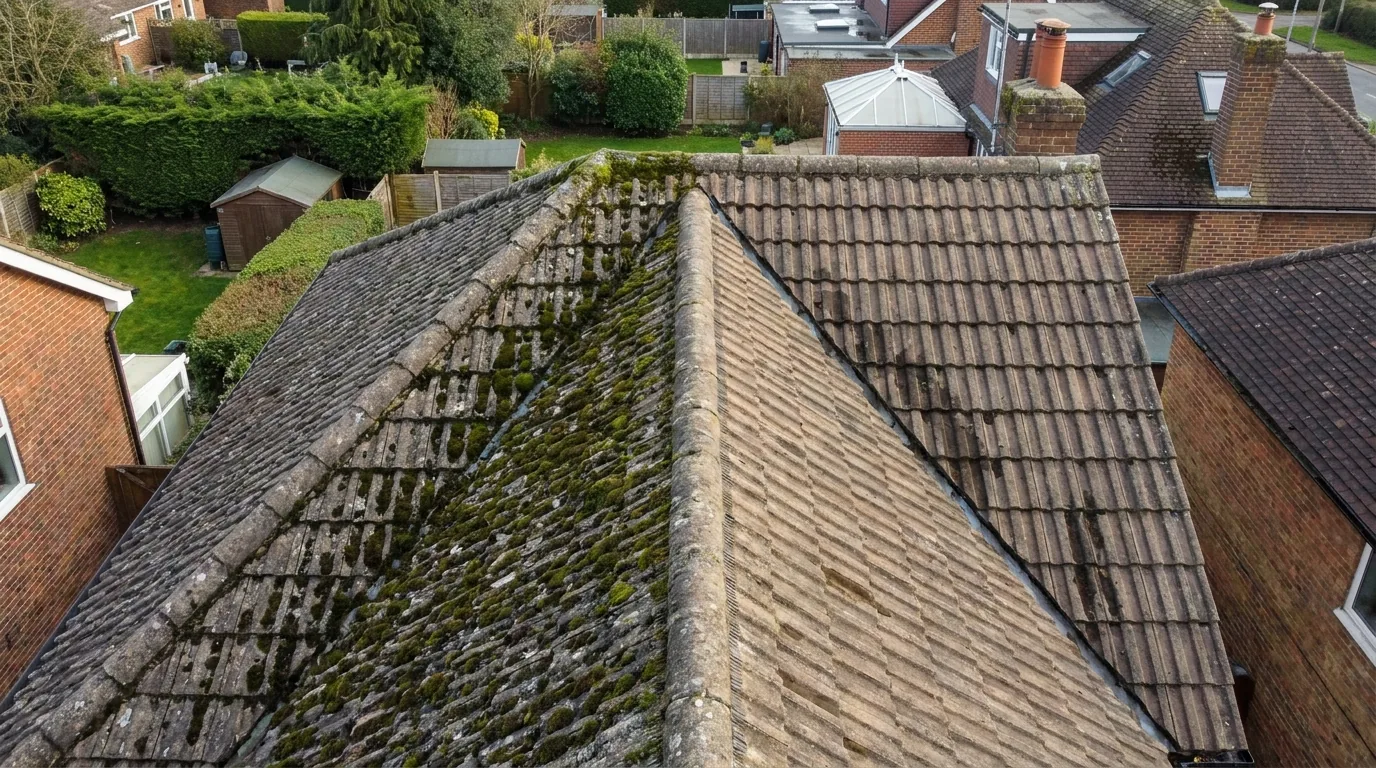
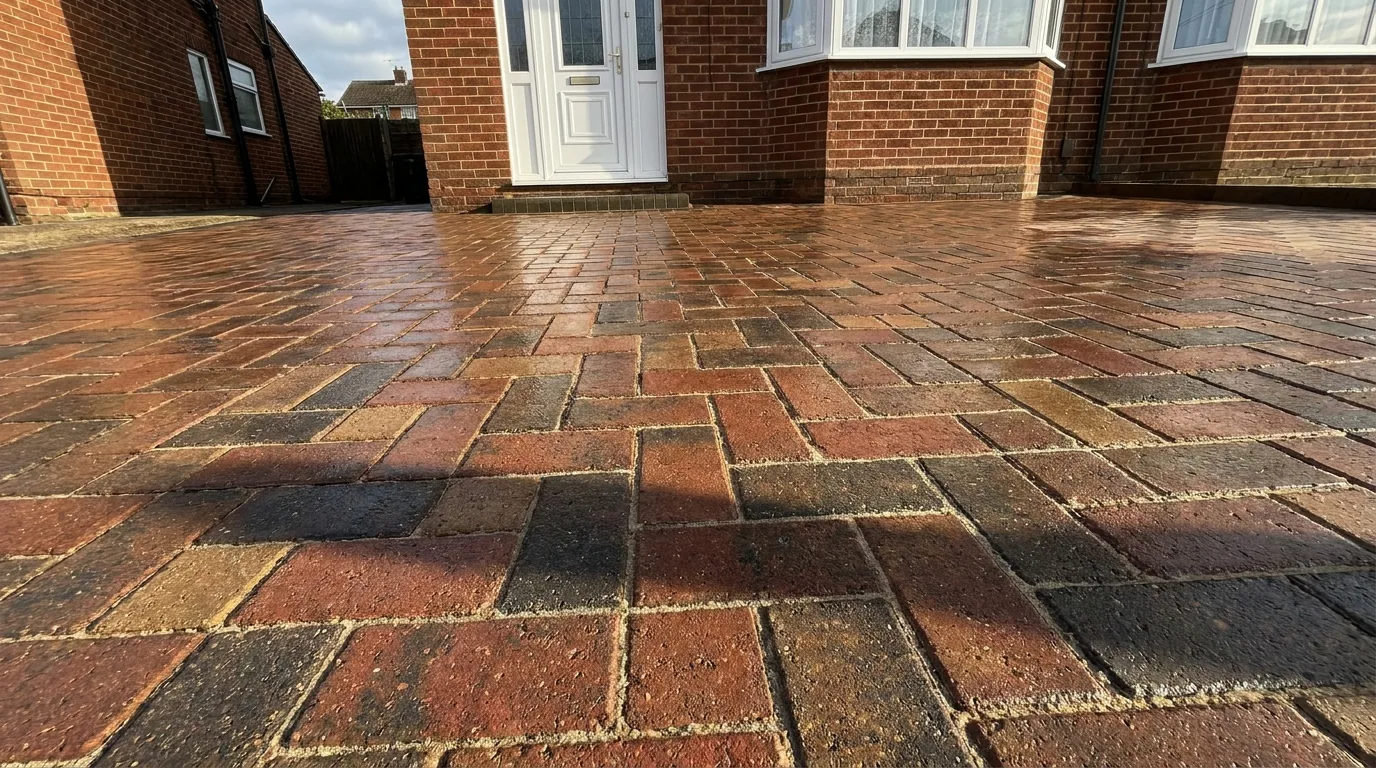
The quick answer: use pressure washing on hard, robust surfaces — concrete, block paving and tarmac drives, where the dirt is on top and the surface can take it. Use soft washing on anything delicate or organism-covered — render, painted walls, roof tiles, decking and soft natural stone — where a low-pressure biocide kills moss, algae and lichen at the root. Pressure washing removes what you can see; soft washing kills what you can’t, which is why a soft wash stays clean for 2–4 years while a pressure-only blast can regrow within a single wet season. Most Surrey homes need both, on different surfaces.
- Soft wash longevity: 2–4 years — biocide kills the spore, not just the visible growth (most national guides quote a 12–24 month pressure-wash figure)
- Render must be soft washed — K Rend’s own guidance warns against high-pressure cleaning of its silicone thin-coat render[1]
- Roofs must be soft washed — pressure stripping tile granules shortens roof life and forces water under the laps
- The chemistry: dilute sodium hypochlorite — the same family of chemical that keeps your local pool clear[3]
- Surrey is ~43% drier than the UK average (Wisley 668mm/yr vs UK 1,163mm)[4] — growth is slower here, so a soft wash buys even longer
This guide gives you the full surface-by-surface breakdown, honest per-m² costs (competitors love to hide these), the root-kill longevity explainer, and how the plant-safety side actually works. If you just want render done, the render cleaning service page has the specifics; for a mossy roof, see roof cleaning.
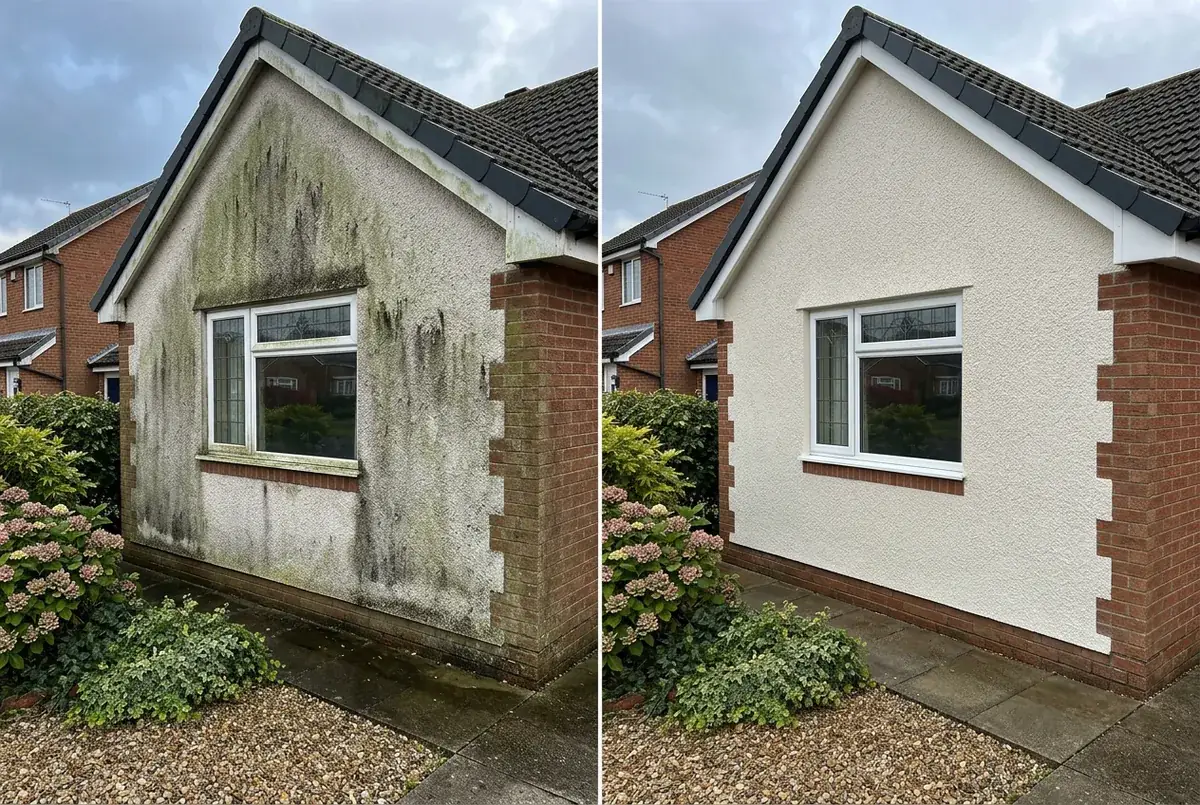
Before & after
What’s the actual difference between soft washing and pressure washing?
Pressure washing is what most people picture: a lance, a high-pressure jet, dirt flying off the surface. A domestic Karcher runs around 1,500 PSI; commercial kit pushes 3,000+. It’s brilliant for shifting ground-in grime from a hard surface. The problem is that it’s a blunt instrument — it removes what’s on the surface and nothing more.
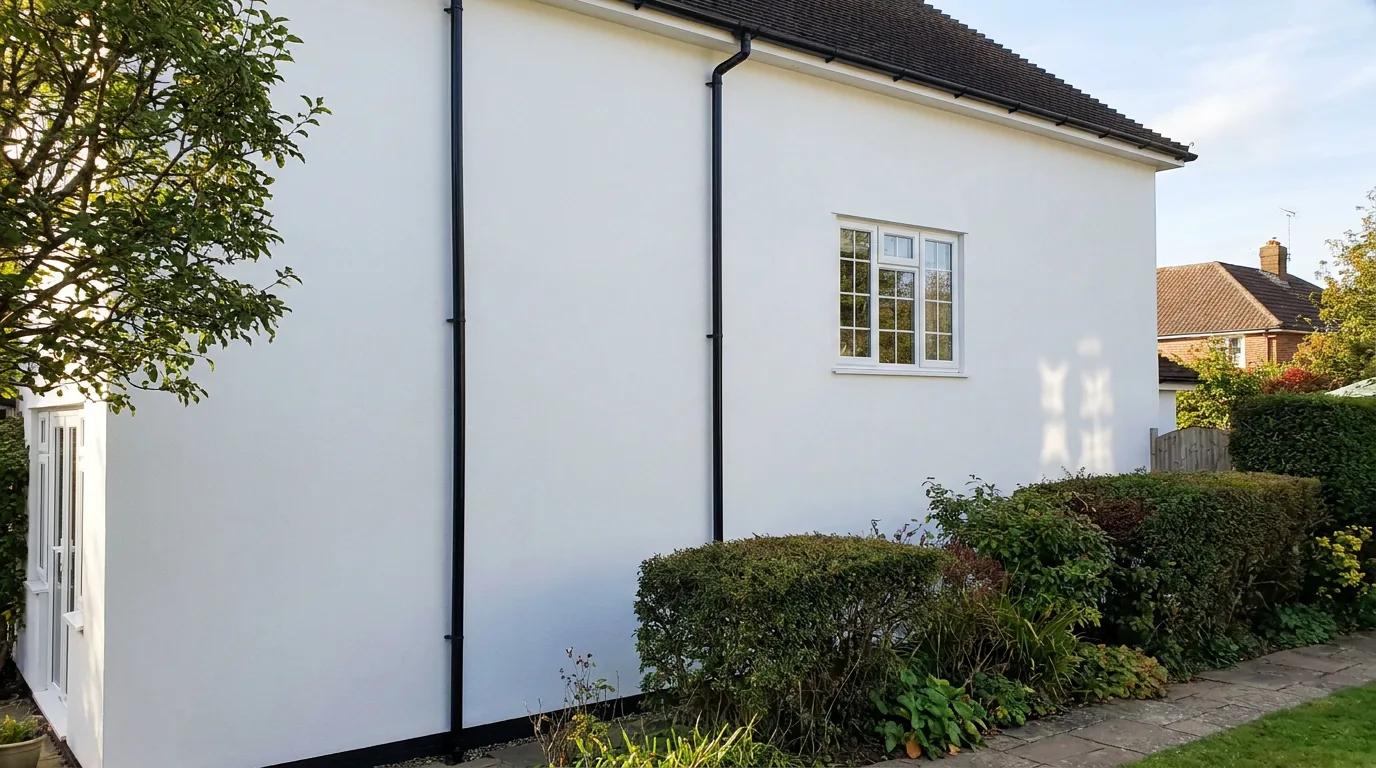
Soft washing is the opposite approach. Instead of force, you use chemistry. A low-pressure pump applies a dilute biocide — almost always sodium hypochlorite, which is the same chemical family used to keep swimming pools clear[3] — at roughly garden-hose pressure. You let it dwell, it kills the moss, algae, lichen and black spot down to the spore, and then it either rinses off or weathers away over the following days. No blasting, no risk of carving up the surface.
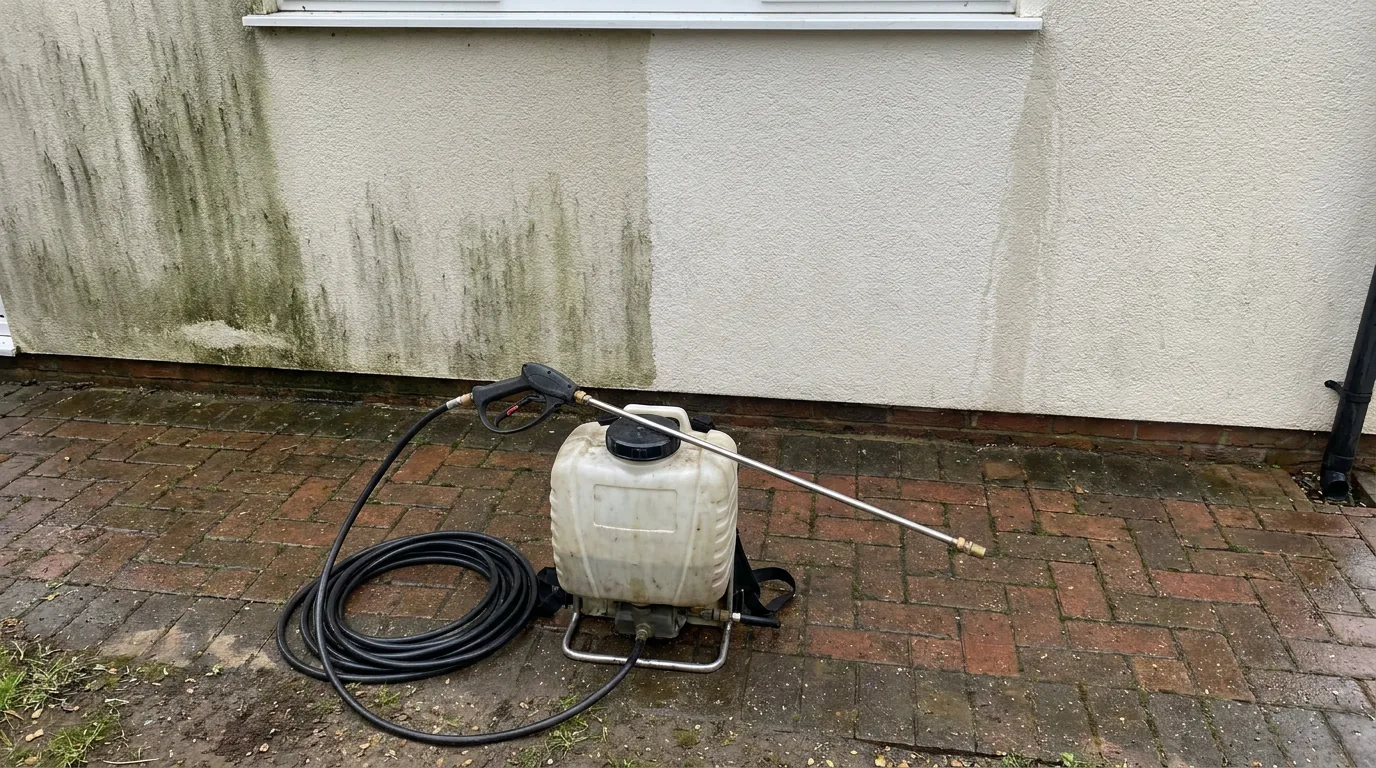
Here’s the bit the trade understands and most homeowners don’t: pressure washing is the easy part. Reading the surface is the job. Render, sandstone, slate, roof tiles, decking, block paving and tarmac all want different chemistry, different pressure and a different angle. Anyone can hire a Karcher. Knowing which surface needs soft washing and which can take a blast is what separates a clean job from a repair bill.
Which method does each surface need?
Original analytical contribution. No UK guide we’ve found lays this out as a straight method matrix — they treat “soft washing” and “pressure washing” as separate services to sell rather than two tools for different jobs. Here’s the honest version, surface by surface, with the reasoning.
| Surface | Best method | Why |
|---|---|---|
| Render (silicone / acrylic) | Soft wash | High pressure blows the thin top coat off — K Rend warns against it[1] |
| Painted masonry | Soft wash | Pressure strips paint and forces water behind it |
| Roof tiles | Soft wash | Pressure strips protective granules, cracks old tiles, drives water under laps |
| Timber decking & fencing | Soft wash | Pressure raises the grain and accelerates rot |
| Indian sandstone & soft stone | Soft wash (mostly) | Porous and easy to over-clean; black-spot lichen needs biocide, not blasting |
| Concrete | Pressure wash | Tough, holds up to high pressure; pre-treat with biocide for longevity |
| Block paving | Pressure wash + re-sand | Medium pressure per Marshalls' guidance[2], then re-sand the joints |
| Tarmac & asphalt | Pressure wash (low) | Fine on hard tarmac; lower pressure on old tarmac or you lift the bitumen |
The rule of thumb: if the dirt is sitting on top of a hard surface, pressure wash it. If the problem is living growth or the surface is delicate, soft wash it. A lot of jobs use both — we’ll pressure-clean a block paving drive and soft-wash the rendered wall and roof on the same visit, because they want different treatment.
Why does soft washing last 2–4 years and pressure washing months?
This is the part the cost guides get wrong. Most of them quote pressure washing as lasting “12 to 24 months.” That figure is for a clean that includes biocide pre-treatment. A pressure-only blast — no chemical — can regrow moss and algae far faster, sometimes inside a single wet season.
Here’s the mechanism. Moss, algae and lichen aren’t dirt — they’re living organisms with spores that sit down in the pores and joints of the surface. A pressure washer knocks off the visible green growth, so the surface looks clean. But the spores are still there. Add water and a bit of warmth and they repopulate from exactly where they were. You’ve mowed the lawn, not pulled the roots.
A soft wash works the other way round. The biocide doesn’t shift much dirt on contact — it kills the organism, spore and all. Over the following days and weeks the dead growth dries, goes brittle and weathers off (or gets a gentle rinse). Because the spores are dead, there’s nothing left to regrow from. That’s the whole reason it lasts 2–4 years instead of months.
And in Surrey you get a bonus. The closest Met Office station to RH1 is Wisley, which records 668mm of rain a year on the 1991–2020 average[4] — against a UK average of around 1,163mm. We’re roughly 43% drier than the national average, so organic growth is slower here than the generic UK advice assumes. A properly soft-washed render wall in Reigate or Banstead can comfortably go three years before it needs another look.
What does each method cost in 2026?
Competitors hide this, so here it is straight. Both methods land in a similar per-m² band — the difference is mostly the surface and the access, not the method itself. These are realistic 2026 Surrey ranges. Costs are built on a labour floor of the National Living Wage (£12.71/hr from April 2026[6]) plus kit, chemical and insurance, so anything well below the bottom of these ranges usually means a corner’s being cut. For full driveway figures, the driveway cleaning cost guide has the deeper breakdown; for render specifically, see the render cleaning page.
| Job | Method | Typical per m² | Lasts |
|---|---|---|---|
| Render wall | Soft wash | £4–£8 | 2–4 yrs |
| Roof (moss) | Soft wash | £5–£12 | 3–5 yrs |
| Decking / fencing | Soft wash | £4–£7 | 2–3 yrs |
| Block paving drive | Pressure + re-sand | £4–£7 | 18–24 mths |
| Concrete / tarmac drive | Pressure | £3–£5 | 12–24 mths |
Per visit, the two methods cost much the same. Over time, soft washing usually works out cheaper because it lasts longer — you’re paying for fewer visits. And on render, the real money isn’t the cleaning cost at all: it’s the four-figure re-render bill if someone takes a turbo nozzle to it. Want a number for your specific job? The cost calculator gives an instant estimate by surface and size.
Is soft washing safe for plants and pets?
Fair question — you’re spraying a bleach-family chemical near your borders, so it’s reasonable to ask. The honest answer: it’s safe when it’s done properly, and that “properly” is doing a lot of work in that sentence.
Sodium hypochlorite at the dilution used for soft washing is roughly the strength of household-grade product, and it breaks down into salt and water over time[3]. It’s the same chemical family that keeps your local swimming pool from turning green. The risk to plants isn’t a mystery poison — it’s simply over-concentration on foliage and roots if the operator is careless.
A competent soft wash protects planting like this:
- Pre-wet the borders. Soaking nearby plants first dilutes anything that drifts and stops roots taking up concentrated solution.
- Cover what’s close. Sheeting over prized planting right against the wall.
- Control the overspray. Low pressure means the solution goes where it’s aimed, not as a fine mist across the garden.
- Rinse down afterwards. A good wash-down of the borders neutralises and washes through any residue before it can sit on roots.
Keep pets and kids off the treated area until it’s been rinsed and dried — same as you would after any garden chemical. Done with that bit of care, we’ve soft-washed plenty of walls flanked by borders with no harm to the planting. Done carelessly — neat chemical, no pre-wet, no rinse — you can scorch a hedge. So this is another reason the operator matters more than the method.
What happens if you use the wrong method?
This is where it gets expensive, and it’s the single most common repair we’re called out to fix. Use high pressure on a surface that needed a soft wash and you don’t just fail to clean it — you damage it:
- Render — the thin top coat blows off in patches, leaving a blotchy, scoured finish. K Rend’s own maintenance guidance specifically warns against high-pressure cleaning of its silicone render[1]. The fix is a re-render — hundreds to low thousands of pounds.
- Roof tiles — pressure strips the protective surface granules and can crack ageing tiles, while forcing water up under the laps into the loft. You’ve traded a bit of moss for leaks and a shortened roof life.
- Decking and fences — the jet raises the timber grain, leaving it furry and far more prone to rot. It looks clean for a fortnight, then drinks water like a sponge.
- Block paving — too much pressure scours the joint sand out. BS 7533-101:2021 treats that jointing sand as part of the structural system, not a cosmetic detail[5] — lose it and the blocks loosen and weeds move in within weeks.
- Soft sandstone — over-blasting opens up the surface, pits it, and makes it hold dirt and lichen worse than before.
Going the other way — soft washing a surface that just needed a pressure clean — isn’t damaging, just slow and not always effective. You won’t shift heavy ground-in oil or tyre marks off a concrete drive with biocide alone. That’s a job for the pressure washer. The skill is matching the method to the surface, every time.
So which does your home need?
Most Surrey homes need both, on different surfaces. A typical job round here is a block paving or concrete drive that wants a pressure clean and re-sand, plus a rendered wall and a mossy roof that both want soft washing. Different tools, same visit.
Quick decision guide:
- Drive (concrete, block paving, tarmac)? Pressure wash — see driveway cleaning.
- Rendered or painted walls? Soft wash — see render cleaning.
- Mossy roof? Soft wash — see roof cleaning.
- Patio, decking or natural stone? Usually soft wash, sometimes a gentle pressure clean — depends on the surface.
- Not sure? That’s the whole point — reading the surface is the job. Send a photo or have us pop round (it’s free) and we’ll tell you straight.
Full disclosure: we don’t have a magic formula for your specific wall from a description down the phone. But we’ve fixed enough botched high-pressure render jobs to know exactly what to look for — and we’ll tell you honestly if a surface doesn’t need touching yet. We work right across Surrey within 20 miles of Redhill (RH1) — Redhill, Reigate, Banstead, Dorking and all 15+ areas.
Quote within minutes, callback within two hours during business hours (Mon–Sat 8am–6pm). If the result isn’t right, we redo it free. Or call 01737 652 515 — we’ll talk through your surfaces in five minutes.
Sources
Every claim about method, chemistry and longevity in this guide is sourced. We cite manufacturer maintenance guidance, BS standards, gov.uk wage data, HSE chemical guidance and Met Office climate records — not the unsourced “soft washing lasts longer” claims repeated across competitor blogs.
- K Rend (Kilwaughter Minerals) — Cleaning & maintenance guidance for K Rend silicone thin-coat render. Manufacturer guidance advises gentle, low-pressure cleaning methods and warns against aggressive high-pressure washing that can damage the render surface. k-rend.co.uk — render maintenance. Accessed 19 June 2026.
- Marshalls plc — Garden Paving & Driveways: Cleaning & Maintenance Guidelines. “No more than medium pressure should be applied when washing paving, with the power-washing lance held at an oblique angle to the paving and at least 200mm (8″) from the surface.” marshalls.co.uk — cleaning guidelines (PDF). Accessed 19 June 2026.
- Health and Safety Executive (HSE) — Guidance on sodium hypochlorite (the active biocide used in soft washing). A chlorine-releasing agent of the same family used in swimming-pool water treatment; degrades to salt and water. Safe handling depends on correct dilution and use. hse.gov.uk — chemical safety. Accessed 19 June 2026.
- Met Office — Wisley (Surrey) Location Long-Term Averages 1991–2020. Closest Met Office station to Redhill (RH1). Annual rainfall 667.92mm vs a UK national average of ~1,163mm. metoffice.gov.uk — Wisley averages. Accessed 19 June 2026.
- BSI — BS 7533-101:2021 “Pavements constructed with clay, concrete or natural stone paving units — Code of practice for the structural design of pavements using modular paving units.” Treats jointing material as part of the structural load-transfer system. bsigroup.com — BS 7533-101:2021. Accessed 19 June 2026.
- UK Government (gov.uk) — National Minimum Wage and National Living Wage Rates. NLW from 1 April 2026 (age 21+): £12.71/hr. The legal floor for any UK labour cost calculation. gov.uk/national-minimum-wage-rates. Accessed 19 June 2026.