By the Same Day Jetwash team (run by Patrick in Redhill, Surrey) · soft washing is our core trade. Last updated June 2026.
- Soft washing = biocide at under ~100 psi, not a jet wash — the chemistry kills the growth, the rain rinses it
- Two standard biocides: benzalkonium chloride (e.g. Lithofin Algex[1], no-rinse) and sodium hypochlorite (pool bleach, faster but harsher)
- Results last 3–5 years because the spores are killed, versus 6–12 months for a pressure-wash that just removes the visible moss
- Any biocide used must be HSE-authorised under the Biocidal Products Regulation[3]
- Roof work legally needs proper fall protection — HSE Work at Height rules apply to any fall that could cause injury, not a fixed height[2]
- Surrey is ~43% drier than the UK average (Wisley 668mm/yr[4]), so local roofs can run longer between cleans
The quick answer: Soft washing a roof means spraying a correctly diluted biocide at low pressure (typically under 100 psi) over the tiles, then letting it kill the moss, algae and lichen at the root while the rain rinses everything clean over the following days and weeks. It is the opposite of pressure washing: there’s no force to crack tiles, lift ridge caps or strip the factory coating, so the roof and your manufacturer warranty stay intact and the result lasts 3–5 years rather than a few months. The skill is all in the survey, the chemistry, the dilution and protecting your gutters and planting from run-off.
This is the method guide — what soft washing actually is, the chemistry, the kit, the step-by-step, and the tile-by-tile protocol. For what it costs, see the roof cleaning cost guide; for whether it can ever go wrong, the does roof cleaning damage tiles guide. We won’t re-argue those here.
- What is soft washing a roof, exactly?
- Soft wash vs pressure wash a roof
- The chemistry: how biocide actually works
- What’s the best biocide for roof moss?
- PPE, the law, and why you can’t just buy bleach
- The pre-work survey
- The step-by-step soft-wash process
- Work at height — can you walk on a tile roof?
- Run-off and gutter protection
- The tile-type protocol matrix
- Aftercare and how long it lasts
- Sources
What is soft washing a roof, exactly?
Soft washing is a cleaning method that swaps brute force for chemistry. Instead of blasting growth off the tiles with high-pressure water, you apply a biocide — a chemical that kills living organisms — at very low pressure, usually somewhere between a garden hose and a knapsack sprayer (under about 100 psi). The biocide soaks into the moss, algae and black-spot lichen, kills it down to the spore, and then the British weather does the rinsing for you over the next few weeks.
It looks almost anticlimactic on the day. There’s no dramatic “reveal” of clean tile under a turbo nozzle, no wall of dirty spray. You spray a faintly cloudy liquid on, you leave. A fortnight later the homeowner messages to say the roof’s gone from green to clear and asks if we even did anything. (We did. That’s the whole trick.)
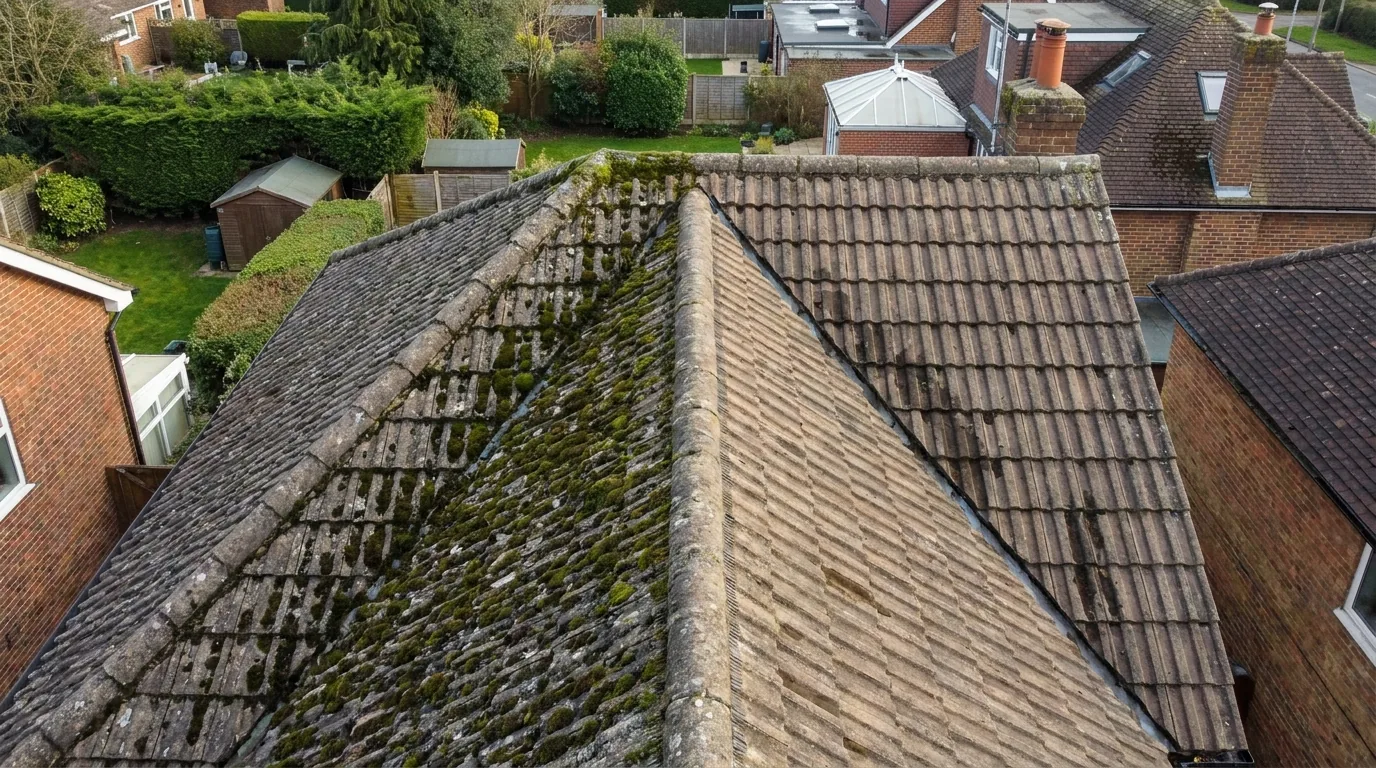
That’s the headline difference from a power wash, and it’s also why a soft wash is the only method we’ll put on a tile roof. Roof cleaning is our core trade, and we do it through the roof cleaning service exactly the way this guide describes.
Before & after
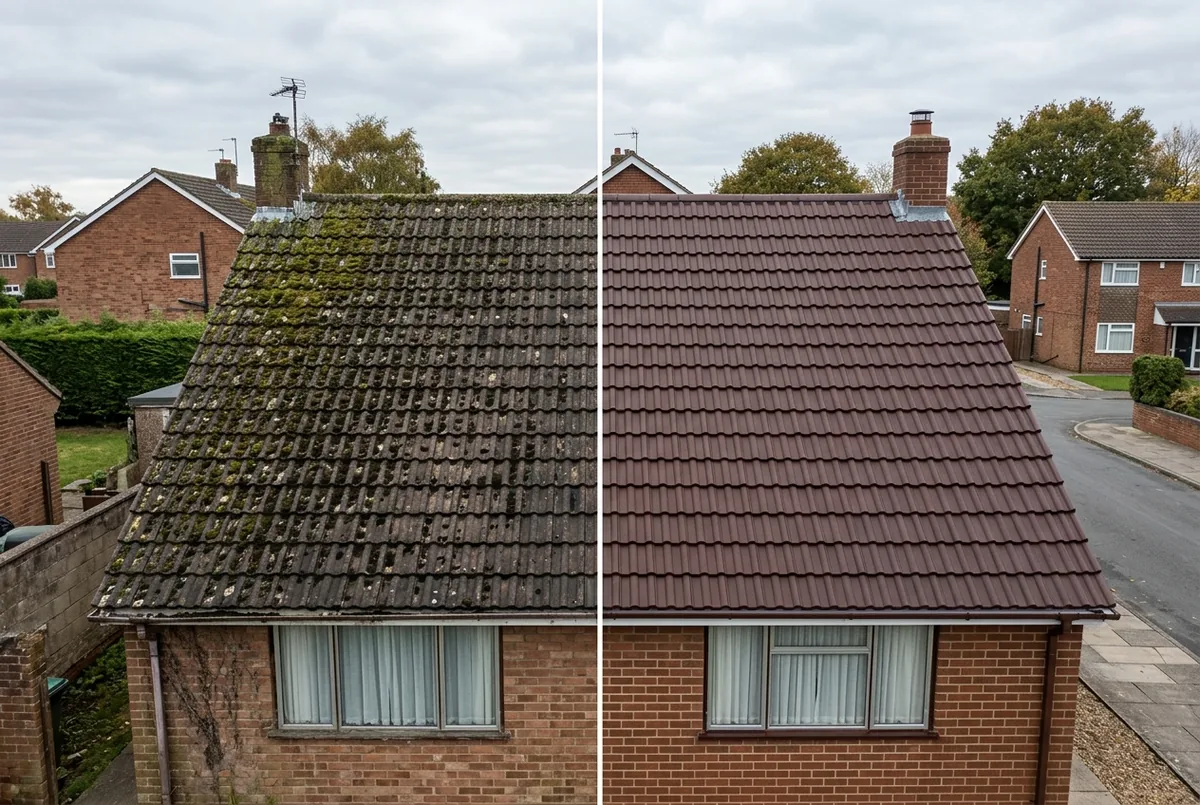
Soft wash vs pressure wash a roof
This is the question that brings most people to this page, so let’s settle it. Here’s the honest side-by-side.
| Soft wash | Pressure wash | |
|---|---|---|
| Pressure at the surface | Under ~100 psi | 1,500–3,000 psi |
| How it cleans | Biocide kills growth at root | Force strips visible growth off |
| Tile coating | Left intact | Stripped — tiles weather faster |
| Risk to tiles & warranty | Low | High — cracks, water ingress, voided warranties |
| How long it lasts | 3–5 years | 6–12 months |
Look — a pressure wash gives a more dramatic same-day result, and that’s exactly why dodgy operators love it: the homeowner sees clean tile that afternoon and pays up. What they don’t see is the protective coating that’s now sitting in their gutter, the hairline cracks, and the moss spores that were never killed and will be back by next spring. We go deeper on the damage side in the does roof cleaning damage tiles guide, but the one-liner is: pressure washing a roof is the most expensive cheap job you can buy.
The chemistry: how biocide actually works
A roof goes green and black because three things colonise it: algae (the black-green film and the dark streaks running down from the ridge), moss (the spongy cushions in the laps and gutters), and lichen (the crusty grey-white “black spot” that grips the tile like it was painted on). Lichen is the stubborn one — it’s a fungus and an alga living together, and it bonds into the surface, which is why scrubbing barely touches it.
A biocide kills all three by disrupting their cell membranes and enzyme function. The key thing for a homeowner to understand: the biocide doesn’t blast the growth off, it kills it where it stands. Dead algae and lichen lose their grip and weather away in the rain over days and weeks. That’s why a soft-washed roof keeps getting cleaner after we’ve packed up — the chemistry is still working, and so is the weather.
It’s also why dwell time matters more than scrubbing. Apply, leave it to do its job, walk away. Rush it and you’ve wasted the product.
What’s the best biocide for roof moss?
There are two products that do nine out of ten UK roof jobs, and anyone telling you about a secret third option is usually selling you something proprietary at triple the price.
Benzalkonium chloride (e.g. Lithofin Algex)
A quaternary ammonium compound — the active ingredient in dedicated roof and render biocides like Lithofin Algex[1]. It’s a no-rinse treatment: you dilute it (Lithofin’s own guidance is roughly 1:4 to 1:8 with water depending on severity), spray it on, and leave it. Gentler on surrounding plants than bleach, slower to show results, and it carries on inhibiting regrowth for months. This is our default on render and on roofs near borders, ponds or anything green you’d rather keep.
Sodium hypochlorite (pool bleach, “hypo”)
The trade workhorse — the same chemical that keeps your local swimming pool from turning into a swamp. Faster, cheaper, and brutal on algae and lichen. The catch is it’s harsh on plants, can lighten some surfaces, and the fumes are unpleasant, so it demands proper masking-off and PPE. The trick with hypo, as any honest tradesman will tell you, isn’t the chemical — it’s the dilution and the dwell time. Too strong and you risk the surroundings; too weak and the moss laughs at you.
So which is “best”?
Honestly? It depends on the roof, not on which one’s objectively superior. Heavy lichen on an exposed roof with no planting underneath — hypo, properly diluted and masked. A delicate roof over flower beds, a pond, or a neighbour’s prized hostas — benzalkonium chloride every time. Anyone who only ever uses one regardless of the job is doing it for their convenience, not your roof.
One rule we never break: whatever goes on the roof has to be authorised for the job. Picking the chemical is the easy bit — reading the roof and the garden underneath it is the actual skill.
PPE, the law, and why you can’t just buy bleach
Biocides are, by definition, designed to kill things, so they’re regulated. In Great Britain, any biocidal product used commercially has to be authorised under the Biocidal Products Regulation, enforced by the HSE[3]. A bloke decanting patio cleaner of unknown provenance into an unlabelled tub is not operating within that — ask what product they’re using and whether it’s authorised for the surface.
On PPE, the non-negotiables when applying roof biocide are:
- Eye protection — goggles, not glasses. You’re spraying liquid above your own head.
- Chemical-resistant gloves — nitrile, gauntlet length.
- Respiratory protection — an appropriate mask, especially with sodium hypochlorite in still air.
- A harness and fall protection — covered below, but it lives in the PPE list because it’s the one that keeps you alive.
None of this is gold-plating. It’s the floor. If a quote is suspiciously cheap, some of this kit is what’s being skipped.
The pre-work survey
Here’s the part the “£99 any roof” lot skip entirely, and it’s the part that protects you. Before a drop of biocide is mixed, the roof gets surveyed — first from the ground with binoculars, then up close from the ladder.
What we’re actually looking for:
- Slipped, cracked or delaminating tiles — these get flagged to you before work starts, not blamed on us after.
- Loose or mortar-failed ridge and hip tiles — common on older Surrey roofs and a fall risk.
- Blocked valleys and gutters — if the run-off can’t escape, soft washing makes a mess. Often worth a gutter clean in the same visit.
- Lichen severity and aspect — a north-facing, tree-shaded roof needs a stronger approach than a baking south slope.
- What’s underneath — the planting, the pond, the neighbour’s greenhouse. This decides the chemical.
A proper survey is also where we’ll tell you if you don’t need us yet, or if your roof has a problem a roofer should fix first. Sometimes the kindest answer is “leave it another year.”
The step-by-step soft-wash process
Here’s the actual job, in order.
1. Set up safe access
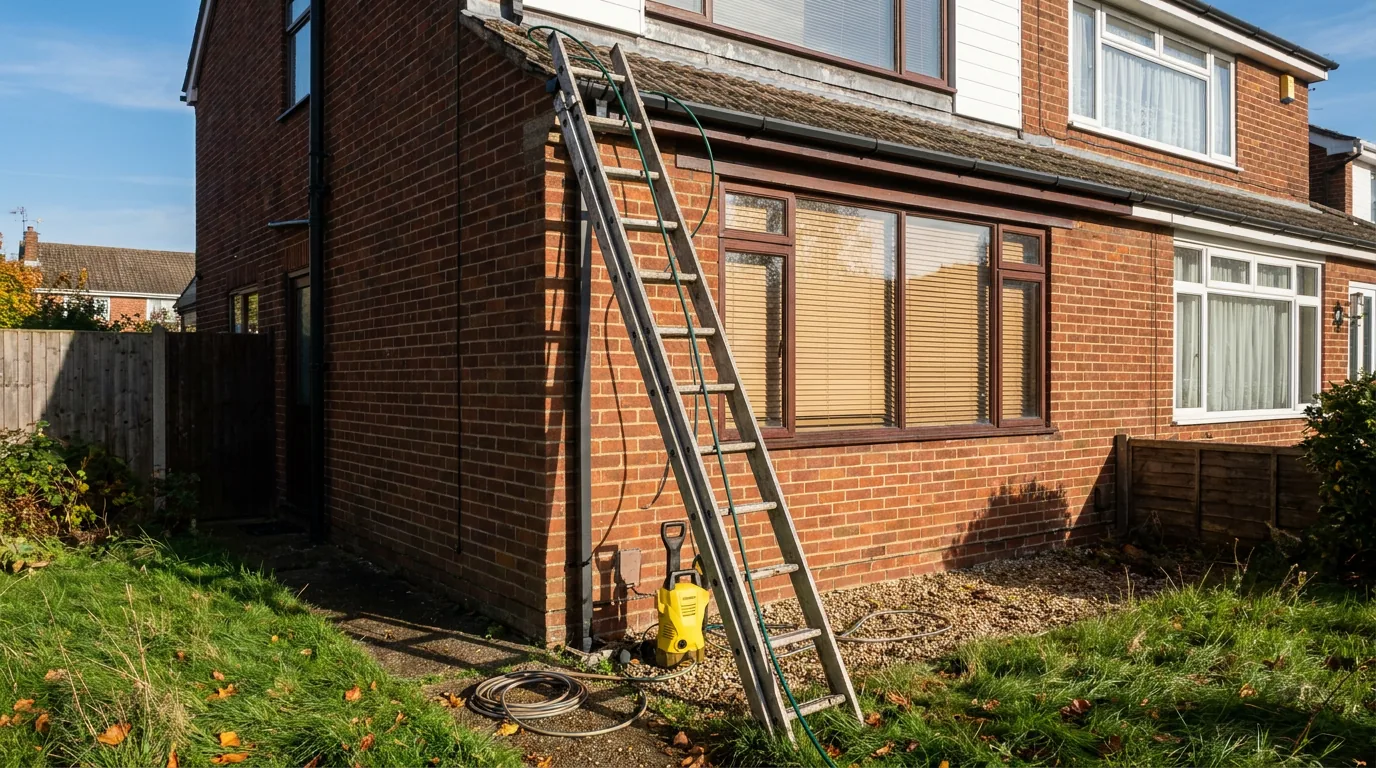
Roof ladders with stand-offs, a tower, or a cherry picker where the pitch demands it — rigged to Work at Height standards[2] with the risk assessment done. No leaning a ladder against a gutter and hoping.
2. Mechanically remove the heavy moss
Thick moss mats get scraped off by hand first, so the biocide can actually reach the spores underneath rather than just sitting on a sponge. The debris gets bagged — not washed into your gutters to block them in six months.
3. Apply the biocide at low pressure
The correctly diluted product goes on over the whole surface at low pressure — even coverage matters more than force. We mask off or wet down planting first, and keep run-off out of the drains.
4. Let it dwell
This is the step amateurs hate because it looks like nothing’s happening. The biocide needs time to penetrate and kill. We’re not standing there scrubbing — the chemistry is the work.
5. Let the rain finish it
Over the following days and weeks the dead growth loosens and the rain rinses the roof progressively clean. On a heavy lichen job it can take a couple of months to reach its best, and that’s normal — we’ll tell you so up front rather than pretend it’s instant.
Work at height — can you walk on a tile roof?
Short answer: you can, but most tile roofs aren’t built to take your weight in the middle of a tile, and a lot of them will crack — especially older concrete tiles or anything that’s had a few frosts. Slate and fibre-cement are worse again. This is exactly why professionals don’t stand on the tiles: we work off roof ladders, crawl boards and towers that spread the load onto the rafters and battens, not the tile face.
And it’s genuinely dangerous. The HSE’s Work at Height guidance[2] requires proper fall protection wherever a fall could cause injury — which a pitched roof plainly can — and falls from height remain one of the biggest causes of workplace fatalities in the UK. A wet, biocide-slicked, moss-cushioned tile roof is about the most hostile surface you can pick for a Saturday-afternoon DIY attempt. The money you’d save isn’t worth the A&E trip. If you take one thing from this section: don’t get on your own roof to clean it.
Run-off and gutter protection
Biocide that kills moss on your roof will also happily kill the moss-equivalent things you actually like — your lawn edge, the border under the eaves, the pond fish. So managing run-off is half the job:
- Wet down or sheet off planting before applying, especially with sodium hypochlorite.
- Keep it out of drains and watercourses — concentrated biocide doesn’t belong in a storm drain.
- Clear the gutters first if they’re blocked, so the rinse actually drains away. A roof clean and a gutter clean together is usually the sensible combination.
- Mind the neighbours — overspray onto a shared boundary or someone’s prize roses is exactly the kind of thing that turns a tidy job into a dispute.
The roof tile-type protocol matrix
Original analytical contribution: most UK roof-cleaning pages treat “a roof” as one thing. It isn’t. The right approach changes with the tile, and getting it wrong is how warranties get voided and tiles get wrecked. Here’s our working protocol by surface — the same one we use to scope a job.
| Roof type | Method & biocide | Watch out for | Typical re-clean |
|---|---|---|---|
| Concrete tile (Marley, Redland) | Soft wash; hypo or benzalkonium chloride | Factory coating — never pressure wash, it strips the surface | 3–5 years |
| Clay tile | Soft wash; gentle dilution | Brittle when old; cracks easily underfoot | 4–6 years |
| Natural slate | Soft wash only; low strength | Delaminates and slips; never walk on it | 4–6 years |
| Synthetic / fibre-cement slate | Soft wash; benzalkonium chloride preferred | Surface is softer than it looks | 3–5 years |
| Flat roof (felt, EPDM, fibreglass) | Clear debris + algae treat + drainage check | Standing water and punctures, not moss | 2–4 years |
Notice concrete tile — the most common Surrey roof since the 1960s — sits at the top for a reason: that factory coating is exactly what a pressure washer destroys. Soft wash protects it. There’s a local geology angle too: much of our patch sits on the Weald clay and chalk of the North Downs[5], and damp, shaded clay-belt properties around Dorking and the Mole Valley tend to grow moss faster than the free-draining chalk slopes around Banstead. We factor that into the re-clean interval.
Aftercare and how long it lasts
A soft-washed roof keeps improving for weeks after we leave — that’s the biocide and the rain finishing the job. Beyond that, the maintenance is mercifully light:
- Keep the gutters clear — trapped debris re-seeds moss at the eaves first.
- Cut back overhanging branches if you can — shade and leaf-fall are what feed regrowth.
- A biocide top-up every couple of years stretches the interval even further, far cheaper than a full clean.
How long before you need us back? Usually 3–5 years, because the spores were killed rather than just brushed off. Surrey buys you extra time: at 668mm of rain a year, Wisley[4] is around 43% drier than the UK average, so local roofs regrow more slowly than the generic national guidance assumes. We dig into the cadence in the how often to clean a roof guide, and you can ballpark a price on the cost calculator.
Want it done properly?
Roof cleaning is our core trade and we only soft wash — no turbo nozzles, no stripped coatings, no “it’ll be fine” on a 40-year-old slate roof. We survey first, tell you straight if you don’t need it yet, and give you a written, itemised quote with no doorstep pressure.
We cover Surrey within 20 miles of Redhill (RH1) — Redhill, Reigate, Dorking, Banstead, Horley, Crawley and all 15+ areas. Quote within minutes, callback within two hours (Mon–Sat 8am–6pm). Or call 01737 652 515 and we’ll talk through your roof in five minutes.
Sources
Every method and safety claim in this guide is sourced. We cite manufacturer datasheets, HSE guidance, Met Office climate records and BGS geology — not the unsourced “just jet wash it” advice repeated across competitor blogs.
- Lithofin — Algex algae, moss & lichen remover technical data. Benzalkonium-chloride-based, no-rinse biocide for roofs, render and masonry; dilution guidance ~1:4 to 1:8 depending on severity. lithofin.com — Algex. Accessed 19 June 2026.
- Health and Safety Executive (HSE) — “Working at height: A brief guide” (INDG401). Proper fall protection required for work at height; falls from height are a leading cause of UK workplace fatalities. hse.gov.uk — INDG401. Accessed 19 June 2026.
- Health and Safety Executive (HSE) — Biocides / Biocidal Products Regulation. Biocidal products used in Great Britain must be authorised; the HSE is the competent authority. hse.gov.uk — biocides. Accessed 19 June 2026.
- Met Office — Wisley (Surrey) Location Long-Term Averages 1991–2020. Closest station to Redhill (RH1); annual rainfall 667.92 mm, vs a UK average around 1,163 mm. metoffice.gov.uk — Wisley averages. Accessed 19 June 2026.
- British Geological Survey (BGS) — Geology of Britain Viewer. Surrey straddles the Weald clay and the chalk of the North Downs; damp clay-belt sites grow moss faster than free-draining chalk slopes. bgs.ac.uk — geology viewer. Accessed 19 June 2026.