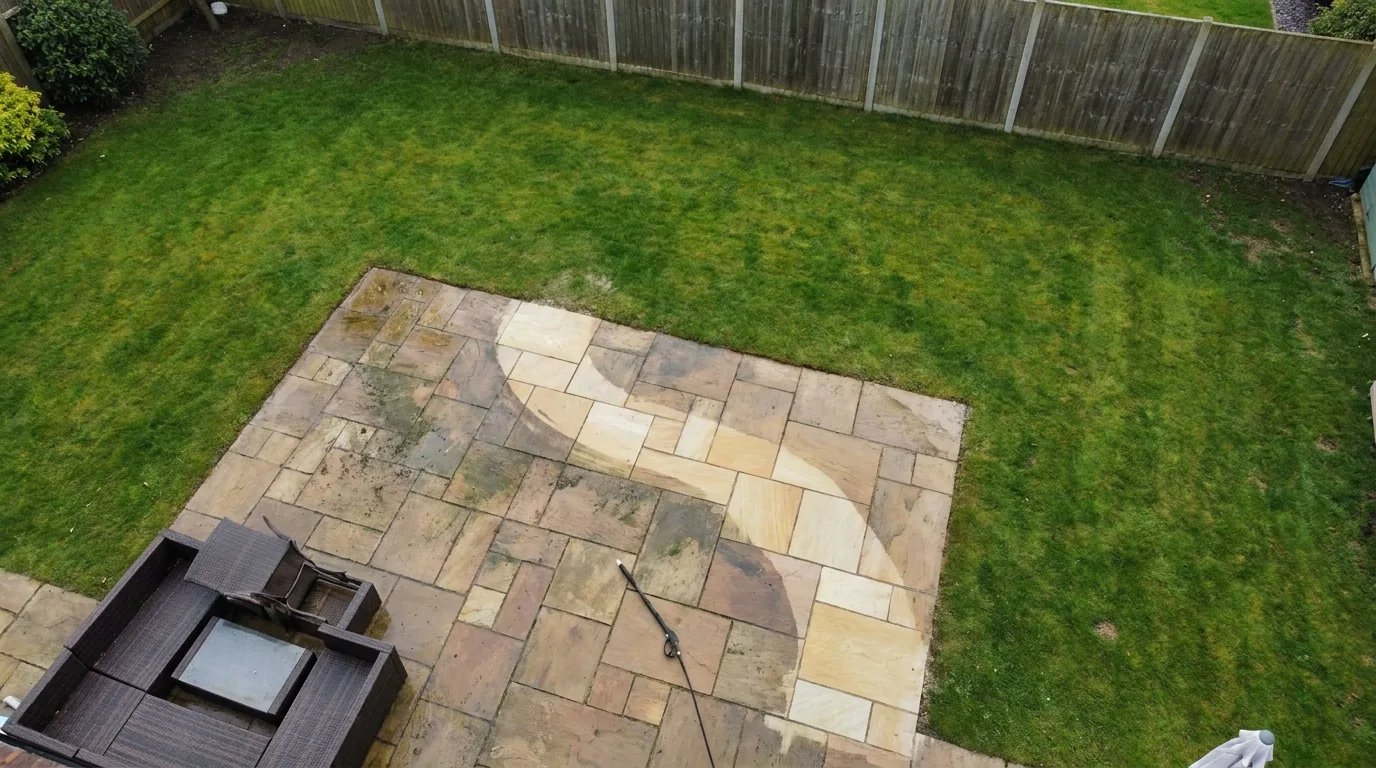
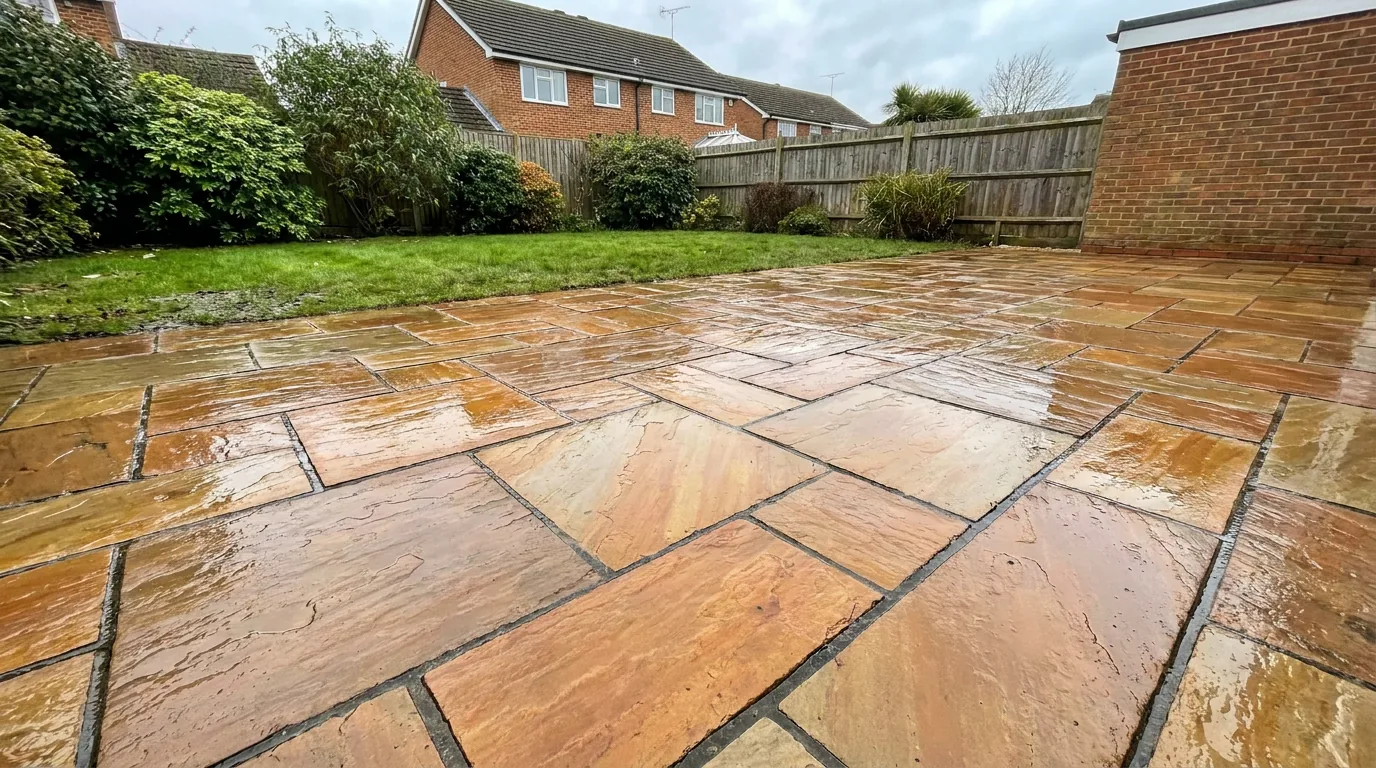
Quick answer: you cannot jet wash your own patio or driveway with a mains-fed pressure washer during a hosepipe ban, because a mains-fed washer counts as a hosepipe. Professional cleaning is generally exempt as day-to-day business use. Same Day Jet Wash (Redhill, Surrey) is unaffected: there is currently no ban in our area.
That’s the whole page in one paragraph, but the detail matters, because every water company writes its own ban notice and the fines are real. Below: exactly who can do what, which bans are live as of 2 July 2026, the law behind it, and the business-use wording quoted straight from a water company.
The 30-second answer
| Who’s holding the lance | Allowed in a ban area? | Why |
|---|---|---|
| Homeowner, mains-fed washer | No | A washer plugged into your outside tap counts as a hosepipe, and cleaning patios, paths and walls is on the banned list[1] |
| Homeowner, water-butt or tank-fed | Yes | Bans only cover mains water; stored rainwater and tanks are outside them[8] |
| Professional cleaner on a job | Generally yes | Day-to-day business use is generally exempt, but each company writes its own notice, so check the specific ban[3] |
No-obligation quote in minutes. No ban in the Redhill/Reigate area anyway. Call 01737 652515 (tap to call) or get an instant price with our cost calculator. Same-day and next-day slots across Redhill, Reigate and Surrey.
Which hosepipe bans are live right now
Last verified: 2 July 2026. These are Temporary Use Bans (TUBs), the formal name for a hosepipe ban.
| Water company | Status | Area affected |
|---|---|---|
| South East Water | TUB enforceable from 00:01 on 3 July 2026[1] | Kent supply area (roughly 850,000–1 million customers); voluntary restraint urged in Sussex[2] |
| Southern Water | TUB in force[4] | Hampshire and the Isle of Wight |
| Yorkshire Water | TUB from 26 August 2026[9] | Yorkshire (around 5 million customers) |
| SES Water | No ban, none planned (aquifer-fed supply)[7] | Redhill, Reigate and east Surrey, our patch |
| Thames Water | No TUB; elevated drought monitoring[7] | Croydon fringe of our radius |
Rules change fast in a summer like this. Every company writes its own ban notice and its own exemption list, and this table can go stale within days. Before you act on anything here, check your own supplier’s website. We re-verify this page weekly through the summer.
What the law actually bans
A hosepipe ban isn’t a polite request. It’s a Temporary Use Ban under section 76 of the Water Industry Act 1991, widened by the Flood and Water Management Act 2010 to cover far more than sprinklers. The banned uses explicitly include cleaning walls or windows of domestic premises, cleaning paths or patios, and cleaning other artificial outdoor surfaces with a hosepipe[1].
And here’s the bit that catches people out: a pressure washer plugged into your mains tap counts as a hosepipe. It doesn’t matter that it’s a fancy Karcher rather than a green garden hose; if it draws mains water through a pipe, it’s in scope[8]. Break the ban and you can be fined up to £1,000 on conviction. In practice the companies warn first, but the offence is on the books, and jet washing a patio is about the most visible way there is to break it.
So if you live in Kent, Hampshire or the Isle of Wight right now, the DIY patio clean off the outside tap is off the cards until the ban lifts. Wait, use stored water (more on that below), or get a professional in under business use.
Are professional pressure washers exempt?
Generally, yes. TUBs are aimed at domestic, non-commercial use. Most companies exempt water use that is a genuine part of running a business, and commercial car washes are the textbook example that stays open through every ban.
The clearest published wording comes from Yorkshire Water’s business guidance, reconfirmed for its 2026 ban: businesses may “use customers’ hosepipes and sprinklers where it is directly related to your day-to-day business excluding the watering of domestic gardens”[3]. A professional exterior cleaner washing your driveway is doing exactly that: using water as a direct part of their day-to-day trade. Yorkshire Water pairs the exemption with a push towards low-water equipment, which is fair enough, and which proper kit already is.
One honest caveat, because it matters. Each company writes its own ban notice and its own exemption list. South East Water’s published Kent exemptions, for instance, are written for households: Priority Services Register customers, drip irrigation, newly laid lawns, that sort of thing[10]. It doesn’t print a Yorkshire-style blanket business line in the same list, so a cleaner working inside the Kent zone should check South East Water’s FAQs or ask the company directly before running mains-fed kit at a domestic address. The industry consensus, from operators and national press alike, is that professional cleaning can usually continue[8], but “usually” is not “always”, and the specific ban wording wins every time.
None of this is our problem in Redhill and Reigate at the minute, because there’s no ban here at all. But if you’re reading this from a banned area, that’s the framework: business use, check the notice, low-water kit.
The water-butt loophole for DIYers
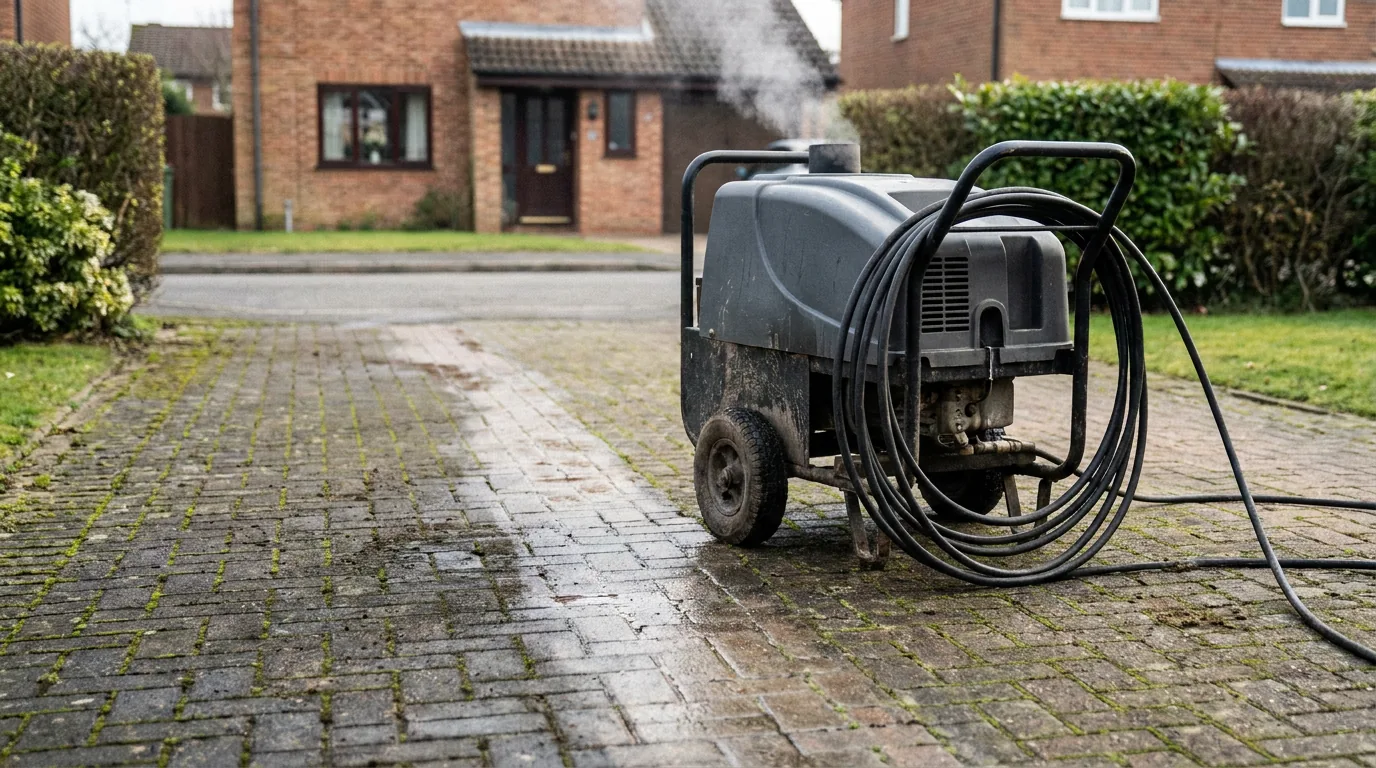
If you’re in a ban area and determined to do it yourself, there is one legal route: a pressure washer fed from stored, non-mains water. A water butt, a rainwater harvesting tank, even bucket-filled storage. The ban covers hosepipes drawing mains water; it doesn’t reach water you collected off your own roof[8].
Two practical warnings before you get excited. First, not every washer can suck from a butt; you need a machine with a decent self-priming pump or a suction hose kit, and the flow at the bottom of a nearly-empty butt is miserable. Second, capacity. A garden butt only holds so much, and a full driveway takes a lot of water, so you’ll likely run dry with half the drive still green. It’s a fine option for a small patio or the front step. For anything bigger, it’s a long afternoon of frustration.
Why a professional clean uses less water anyway
Here’s the part that sounds like a sales pitch but is just how the kit works. A DIY session usually means a mains hose running more or less continuously for hours: filling the machine, rinsing, re-rinsing, chasing dirty water around the slabs. Professional kit is built the other way round. A surface cleaner covers the ground in passes instead of blasting one spot at a time, the chemistry (a proper pre-treatment) does a chunk of the work the water would otherwise do, and the job that takes a homeowner all weekend is done in hours.
That’s why the water companies themselves point businesses towards low-water equipment rather than telling them to stop trading[3]. In a drought summer, with England in formal drought status and some reservoirs at 50 to 60 per cent capacity[4], the responsible way to get a patio cleaned isn’t a mains hose running all Saturday. It’s one visit, efficient kit, done. Our patio cleaning and driveway cleaning pages cover what a visit includes, and the pricing page has the rates: driveways and patios from £3 per square metre, £80 minimum charge.
Pressure washing in a heatwave
The ban question and the heat question arrive together, so briefly: yes, you can pressure wash in hot weather, and in some ways it’s the best time. June 2026 produced the hottest June day ever recorded in the UK, 37.7°C at Lingwood in Norfolk on 26 June[5], and the Met Office has the South East heading back towards the high 20s, possibly 30°C, with a potential return to heatwave conditions early in the week of 6 July[6].
What changes in that heat is timing, not feasibility. Surfaces dry in a fraction of the usual time, which is brilliant for seeing the finished result the same day, but pre-treatments can flash off too fast on a baking slab, so the smart window is early morning or evening rather than midday. If you’re weighing up when to book, our best time to clean a patio guide goes through the seasons properly. The short version for July: mornings, and the diary fills fast when the sun’s out.
What this means in Surrey
There is no hosepipe ban in Surrey as of 2 July 2026, and our supplier has said none is planned. SES Water, which covers Redhill, Reigate, Caterham, Oxted and most of east Surrey, draws the majority of its supply from underground aquifers rather than reservoirs, and the Surrey companies have described their resources as being in a good place[7]. The edges of our 20-mile patch touch other suppliers, so the picture does vary street by street towards East Grinstead and Crawley.
We’ve put the full town-by-town breakdown, which company serves each of our towns and what its current status is, in our Surrey hosepipe ban tracker. The practical upshot for anyone in the RH postcodes: patio season is open, nothing about your booking changes, and if a ban ever did arrive here, professional cleaning would generally carry on under business use anyway. Get an instant number from the cost calculator or a free quote, or just ring 01737 652 515 and we’ll give it to you straight.
Sources
Every claim with a number behind it is sourced: water-company ban notices, GOV.UK drought reporting, Met Office records and national press coverage, checked on the dates shown.
- South East Water, Temporary Use Ban 2026 announcement. Confirms the Kent TUB enforceable from 00:01 on 3 July 2026 and the banned-use categories, including cleaning paths, patios and artificial outdoor surfaces. southeastwater.co.uk, TUB 2026. Accessed 1–2 July 2026.
- ITV News Meridian, “Hosepipe ban announced for thousands of South East Water customers” (25 June 2026). Customer numbers and the Sussex voluntary-restraint position. itv.com, SE Water ban. Accessed 1 July 2026.
- Yorkshire Water, “How the hosepipe ban affects your business.” Source of the verbatim business-use exemption wording quoted above and the low-water-equipment guidance. yorkshirewater.com, business hosepipe ban. Accessed 1 July 2026.
- GOV.UK (Environment Agency), “Dry weather and drought in England: 18 to 26 June 2026.” England’s formal drought status, reservoir levels at 50–60% in places, and the Southern Water TUB. gov.uk, dry weather and drought report. Accessed 1 July 2026.
- Met Office, “June 2026 heatwave: a recap of the temperature records.” Hottest UK June day on record, 37.7°C at Lingwood, Norfolk, 26 June 2026. metoffice.gov.uk, June 2026 records. Accessed 1 July 2026.
- Met Office, “A largely settled period before another potential heatwave early next week” (29 June 2026). High 20s to 30°C possible in the South East from the weekend of 4–5 July, with potential heatwave conditions the week of 6 July. metoffice.gov.uk, July outlook. Accessed 1 July 2026.
- Surrey Live, “Surrey water companies hopeful of avoiding hosepipe ban.” SES Water’s no-ban position, its aquifer-fed supply, and Thames Water’s monitoring status. getsurrey.co.uk, Surrey water companies. Accessed 1 July 2026.
- Woman & Home, “Can you use a pressure washer during a hosepipe ban?” Mains-fed washers counting as hosepipes, the up-to-£1,000 fine, and the water-butt/rainwater route. womanandhome.com, pressure washer hosepipe ban. Accessed 1 July 2026.
- YorkshireLive (Examiner), Yorkshire hosepipe ban update. Confirms the Yorkshire Water TUB effective 26 August 2026 and the roughly five million customers affected. examinerlive.co.uk, Yorkshire ban update. Accessed 1 July 2026.
- South East Water, Kent Temporary Use Ban FAQs. The published Kent exemption list (Priority Services Register customers, drip irrigation, newly laid lawns), which is domestic-oriented; basis for the check-the-specific-ban caveat on business use. southeastwater.co.uk, Kent TUB FAQs. Accessed 1–2 July 2026.