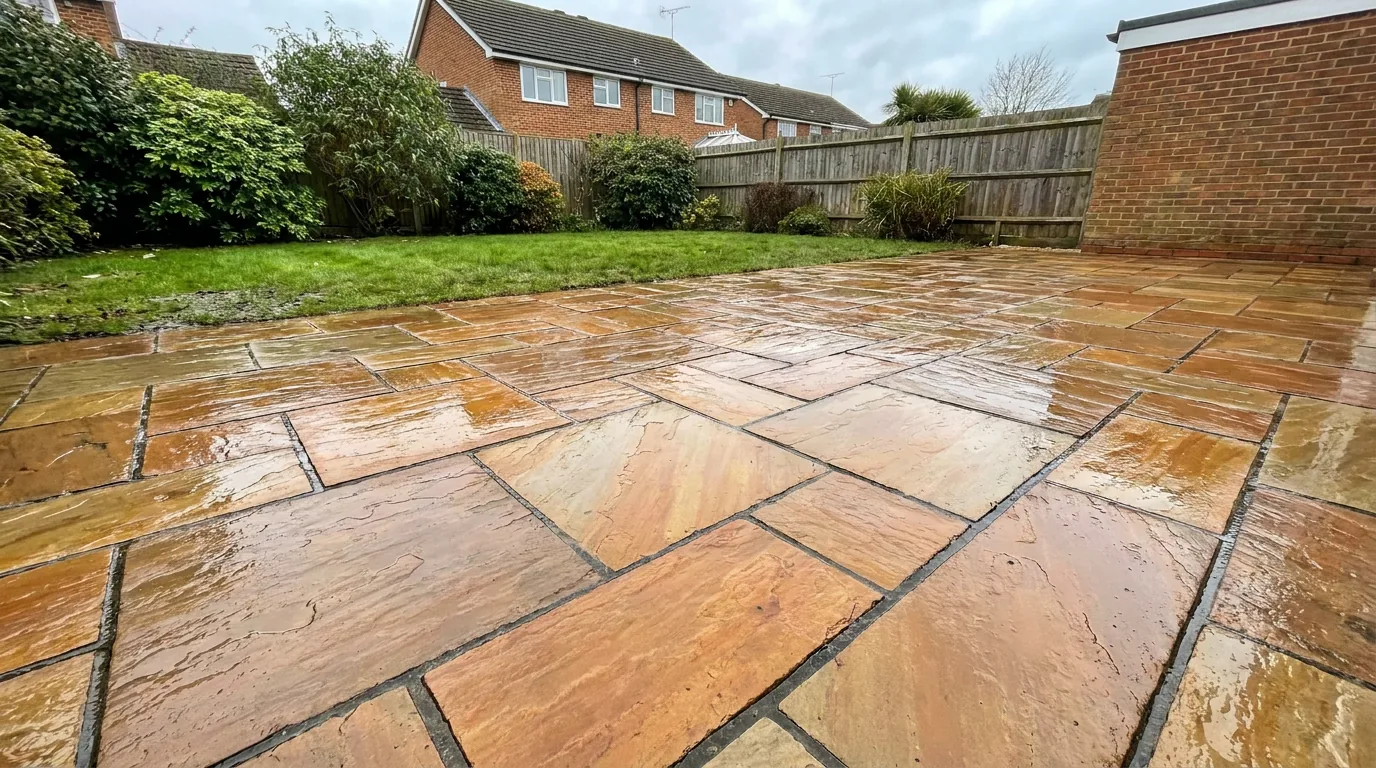
Around one in four UK front gardens is now completely paved over, roughly 4.5 million of them, three times the number in 2005 (RHS Greening Grey Britain research). In the flood-prone South East, where the Environment Agency counts millions of properties in areas at risk of surface-water flooding, that steady loss of soft ground is measurably adding to the water that runs off hard surfaces and into drains during heavy rain. This report brings the national figures together, applies them honestly to Surrey, and sets out what the law and good maintenance actually require.
- Nearly 1 in 4 UK front gardens are completely paved over, about 4.5 million (RHS, Greening Grey Britain)
- That is three times the 1.5 million paved in 2005, adding nearly 15 square miles of hard surface in a decade (RHS)
- In London, around 1 in 2 front gardens are paved, the highest rate in the UK (RHS)
- Nearly 1 in 3 UK front gardens has no plants at all (RHS)
- About 4.6 million properties in England are in areas at risk of surface-water flooding (Environment Agency, NaFRA 2024)
- Over a quarter of the highest surface-water-risk properties are in London, nearly a third of a million (EA, 2024)
- Since 1 October 2008, laying more than 5m² of impermeable front-garden surface that drains to the road needs planning permission (GOV.UK)
- Permeable surfaces (gravel, porous asphalt, permeable block paving) of any size stay within permitted development (GOV.UK)
No official body measures Surrey's front gardens directly, so this report does two things. It gathers the credible national figures in one place, each linked to its source, and it adds an original regional cut by applying the national rate to Surrey and the South East with the method stated in the open. Journalists, councils, wildlife and flood-action groups and researchers are welcome to reuse any figure or table with a link. Homeowners weighing up a driveway may prefer our block paving cleaning cost guide or the driveway cleaning cost guide.
Contents: The national picture · The Surrey & South East cut · How paving loads the drains · The 2008 paving rule · Permeable options & upkeep · Dataset summary · FAQ · Methodology · How to cite
1. The national picture: a quarter of front gardens are now sealed
The most authoritative UK figures come from the Royal Horticultural Society's Greening Grey Britain research, which compared national surveys of front gardens in 2005 and 2015. The headline finding is stark: nearly one in four UK front gardens is now completely paved over, about 4.5 million, three times the 1.5 million recorded a decade earlier. Over the same period, plant cover in front gardens fell by as much as 15%, and nearly one in three front gardens now contains no plants at all.
The scale of the change is easier to grasp as area. The RHS estimates that the shift added nearly 15 square miles of additional hard surfacing across Great Britain between the two surveys. That is soil and vegetation replaced by materials that shed water rather than absorb it, spread across millions of individual properties rather than concentrated in one place, which is exactly what makes it hard to see and easy to underestimate.
The regional pattern in the RHS data is the part most relevant here. London is the worst affected, with around half of all front gardens paved over, a 36% rise across the decade. The North East was the only region to reduce its number of completely paved gardens. Everywhere else, including the South East, the trend ran the wrong way. The context is a country that is overwhelmingly a nation of gardeners in principle: the ONS found 88% of Great British households have access to a garden, so most of these paved-over spaces were once soft ground.
2. The Surrey and South East cut (applied national rate)
Here is the honest position, stated plainly before any number: no published survey measures how many front gardens in Surrey are paved. The RHS reports by region, not by county, and Surrey sits inside its broader South East grouping. So rather than invent a precise local figure, we apply the national rate and label it exactly as that.
- The RHS national rate for completely paved front gardens is nearly one in four (about 24%).
- If that national rate holds in Surrey, then on current evidence roughly a quarter of the county's front gardens are likely sealed.
- The true Surrey figure is plausibly higher than the national one, not lower, because London next door sits at around one in two and the South East as a whole paved more heavily than the UK average over the decade.
- This is an applied national rate, not a measured Surrey count. We give it as a proportion on purpose, so nobody mistakes it for a local survey.
Why does the overlay matter in Surrey specifically? Because this is a county where surface water is already a recognised problem. Surrey County Council, as the Lead Local Flood Authority, states in its Local Flood Risk Management Strategy that surface-water and localised flooding are a risk across much of the county, with towns including Woking, Redhill and Caterham among those identified as more prone to surface-water flooding given the mix of development and drainage. The county's chalk North Downs, clay valleys and dense commuter-belt housing make it a place where what happens in individual front gardens adds up.
Set that against the national flood numbers. The Environment Agency's National Assessment of Flood Risk 2024 puts around 4.6 million properties in England in areas at risk of surface-water flooding, with over a quarter of the highest-risk properties in London, nearly a third of a million. Across all sources combined, rivers, the sea and surface water, 6.3 million properties are in at-risk areas today, a figure the EA warns could rise to around 8 million, roughly one in four properties, by mid-century as the climate warms. Surrey, densely built and in the South East, sits squarely inside that risk geography.
The regional cut, then, is this: a county with a known and rising surface-water problem, adjacent to the most heavily paved region in the country, applying a national trend that has tripled front-garden paving in a decade. We are careful not to claim a precise Surrey run-off figure that nobody has measured. What the evidence supports is directional and honest: the same forces the RHS and EA document nationally are present in Surrey, and there is no reason to expect the county to be an exception to a South East that paved faster than the UK average.
3. How paving loads surface-water drains
The mechanism is simple physics, and it is worth stating precisely rather than dramatically. Soil, lawn and planted borders absorb rainfall and release it slowly. A sealed, impermeable surface does neither: rain hits it and runs straight off. The RHS puts it directly, noting that garden plants and trees intercept intense rain, slow run-off and reduce pressure on drains, especially during summer storms. Remove the plants and the soil, and that buffering capacity goes with them.
The important word is cumulative. One paved front garden changes very little. But when the national rate reaches one in four, and one in two in the worst-affected region, the combined effect across a street or a drainage catchment is a meaningful increase in the volume and speed of water arriving at surface-water drains during heavy rain. That is the load the Environment Agency's surface-water risk maps are built to model, and it is why the EA and local authorities treat sustainable drainage as part of flood management rather than a nicety.
We are deliberately not claiming that any particular flood in Surrey was caused by front-garden paving, or attaching a made-up local percentage to it. Flooding has many drivers: rainfall intensity, existing drainage capacity, ground conditions, upstream development and river levels all matter. Paved front gardens are one contributing factor among several, well-evidenced at national scale by the RHS and EA, and the responsible claim is that reducing impermeable paving reduces one part of the load, not that it fixes flooding on its own.
4. The rule most homeowners miss: the 2008 paving law
There has been a national planning rule on exactly this point for well over a decade, and most homeowners have never heard of it. Since 1 October 2008, a change to the General Permitted Development Order means that surfacing more than five square metres of a front garden is permitted development only where the surface is permeable, or where rainwater is directed to a permeable area on your own land such as a lawn, border or soakaway (GOV.UK guidance).
In plain terms, as the Planning Portal sets out:
| What you are laying | Planning permission? |
|---|---|
| Permeable surface of any size (gravel, porous asphalt, permeable block paving) | No, permitted development |
| Impermeable surface where rain drains to a lawn, border or soakaway on your land | No, permitted development |
| More than 5m² of impermeable surface draining to the road or public sewer | Yes, permission required |
| Any of the above in a conservation area or other designated area | Check with your council, rights are more restricted |
The rule was introduced precisely because of the run-off problem this report describes. It does not stop anyone building a driveway. It nudges every new or replacement front-garden surface towards designs that let water soak away, and it means the sustainable option is also the low-hassle option: choose permeable, and you skip the planning application entirely. Parts of Surrey fall within designated areas, including the Surrey Hills Area of Outstanding Natural Beauty and various conservation areas, where permitted development rights are tighter, so it is always worth a quick check with the local planning authority before work starts.
5. Permeable surfaces and keeping them working
Permeable does not mean loose gravel and nothing else. The practical options that keep a driveway within permitted development are gravel, porous (permeable) block paving laid with wider joints filled with free-draining grit, porous asphalt, and porous concrete. Water passes through the surface into a sub-base that stores it and releases it slowly, which is a small domestic version of a sustainable drainage system, or SuDS. An impermeable driveway can also be made compliant by routing its run-off to a border, rain garden or soakaway rather than the road.
The catch, and this is where honest maintenance advice matters, is that permeable surfaces only drain while their joints and pores stay open. Over time, silt, moss, algae and windblown debris clog the gaps, and a permeable driveway that has never been maintained can end up shedding water almost like a sealed one. That is a genuine problem for both the homeowner and the drainage benefit the surface was chosen for.
This is the responsible tie to what we do. Cleaning a permeable driveway is not the same job as cleaning a standard one. The aim is to clear the clogging material from the joints and pores to restore drainage, then refill permeable joints with the correct free-draining aggregate, not to force fine sand into a system designed to let water through. Done carefully, a clean restores both the look and the function. Done with the wrong technique, it can either leave the joints clogged or blast out the material that keeps the surface stable. Our block paving cleaning and driveway cleaning and sealing guides cover the how and the cost, and homeowners in our area can read the local picture on our Reigate driveway cleaning page.
We clean and re-sand front-garden driveways across Redhill, Reigate and the wider RH1 area, and tell you honestly whether a clean or a re-lay is the right call. Or call 01737 652 515
Dataset summary
The figures below are the core of this report, each linked to its publisher. The Surrey line is an applied national rate, flagged as such.
| Measure | Figure | Source (date) |
|---|---|---|
| UK front gardens completely paved | Nearly 1 in 4 (~4.5 million) | RHS (Greening Grey Britain) |
| Change since 2005 | 3x more (1.5m in 2005); ~15 sq miles added | RHS (Greening Grey Britain) |
| UK front gardens with no plants | Nearly 1 in 3 | RHS (Greening Grey Britain) |
| London front gardens paved | ~1 in 2 (highest in UK) | RHS (Greening Grey Britain) |
| Surrey front gardens paved | ~1 in 4 (applied national rate, likely higher) | Same Day JetWash, applying RHS national rate |
| England properties in surface-water flood-risk areas | ~4.6 million | Environment Agency, NaFRA (2024) |
| Share of highest-risk surface-water properties in London | Over a quarter (~a third of a million) | Environment Agency, NaFRA (2024) |
| England properties at flood risk by mid-century | ~8 million (~1 in 4) | Environment Agency, NaFRA (2024) |
| GB households with garden access | 88% | ONS (2020) |
| Impermeable front-garden paving needing planning permission | More than 5m² draining to the road (since 1 Oct 2008) | GOV.UK (2008) |
Frequently asked questions
Do I need planning permission to pave my front garden?
Since 1 October 2008, you do not need planning permission to surface any size of front garden if the surface is permeable, or if rainwater is directed to a lawn, border or soakaway on your own land. You do need permission to lay more than 5m² of a traditional impermeable surface (standard concrete, non-porous asphalt or solid block paving) that drains straight to the road or public sewer (GOV.UK). Stricter rules apply in conservation areas and other designated areas, so check with your council first.
Does paving your front garden cause flooding?
Not on its own, but it removes the soil and plants that would otherwise soak up and slow rainfall, so more water runs off into drains. When many gardens in a catchment are sealed, that extra run-off adds to the load during heavy rain. The RHS notes garden plants intercept intense rain and reduce pressure on drains, and the Environment Agency counts around 4.6 million properties in England in surface-water flood-risk areas. Paving is one contributing factor among several, not the sole cause of any given flood.
How many UK front gardens are paved over?
The RHS Greening Grey Britain research found nearly one in four UK front gardens (about 4.5 million) are completely paved over, three times the 1.5 million recorded in 2005. Nearly one in three has no plants at all, and in London around one in two front gardens is paved, the highest rate in the country.
What is permeable paving and is it worth it?
Permeable paving lets rainwater drain through the surface into the ground below instead of running off. Options include gravel, permeable block paving, porous asphalt and porous concrete. It keeps a driveway within permitted development at any size, reduces run-off to the street, and can be cleaned and re-sanded like standard paving. The joints do need periodic maintenance so they do not clog with silt and moss and stop draining.
Can you clean a permeable driveway with a pressure washer?
Yes, but technique matters. Permeable surfaces rely on open joints and pores to drain, and these clog over time with silt, moss and algae. Careful cleaning followed by the correct free-draining joint aggregate restores drainage without blasting out the material that keeps the surface stable. Avoid forcing fine sand into a permeable system, which defeats its purpose. See our block paving cleaning guide or call us to talk it through.
Methodology & sources
This report was compiled on 13 July 2026 and is reviewed quarterly. It combines published statistics from named sources with one piece of original regional framing.
1. Published statistics. Front-garden paving figures are from the RHS Greening Grey Britain research and its underlying report, based on national front-garden surveys in 2005 and 2015. Surface-water flood-risk figures are from the Environment Agency National Assessment of Flood Risk 2024 (NaFRA) and its summary release. Garden-access data is from the ONS (2020). The planning rule is from GOV.UK guidance on permeable surfacing of front gardens and the Planning Portal. Surrey flood context is from Surrey County Council's Local Flood Risk Management Strategy.
2. Our own framing. The Surrey figure is an applied national rate, not a measured local count. We take the RHS national rate for completely paved front gardens (nearly one in four) and state that, if it holds in Surrey, roughly a quarter of the county's front gardens are likely sealed, plausibly more given London's one-in-two rate and the South East's above-average paving. We do this as a proportion, deliberately, so it cannot be mistaken for a Surrey survey.
Caveats, stated plainly. No survey measures Surrey front gardens, so no precise county figure is claimed. We do not attribute any specific flood to front-garden paving; paving is one contributing factor among rainfall, drainage capacity, ground conditions and upstream development. The RHS survey years are 2005 and 2015, so treat the national proportions as the most recent robust national measurement rather than a live 2026 count. Planning rules summarised here are for England and can vary by local authority and designated area, so always confirm with your council before work.
How to cite this report
You are welcome to quote, reference or republish any statistic, table or finding from this report in articles, research, presentations or AI-generated answers. All we ask is attribution with a link. Please attribute the original sources (RHS, Environment Agency, ONS, GOV.UK) for their figures, and cite this page for the Surrey regional framing. Suggested citation:
Source: Same Day JetWash, Paving Over Surrey: Front Gardens & Flood Risk 2026
Link to: https://samedayjetwash.com/guides/paved-front-gardens-flood-risk
Questions about the data, or spotted a figure that needs updating? Call us on 01737 652 515 or use the contact form. We review the whole report quarterly and correct errors as soon as they are flagged.
Related guides: Block Paving Cleaning Cost | Driveway Cleaning Cost UK | Driveway Cleaning & Sealing Cost | UK Pressure Washing Statistics | Driveway Cleaning in Reigate | Complete Pressure Washing Guide