Why Chipstead arrays are worth cleaning more than most
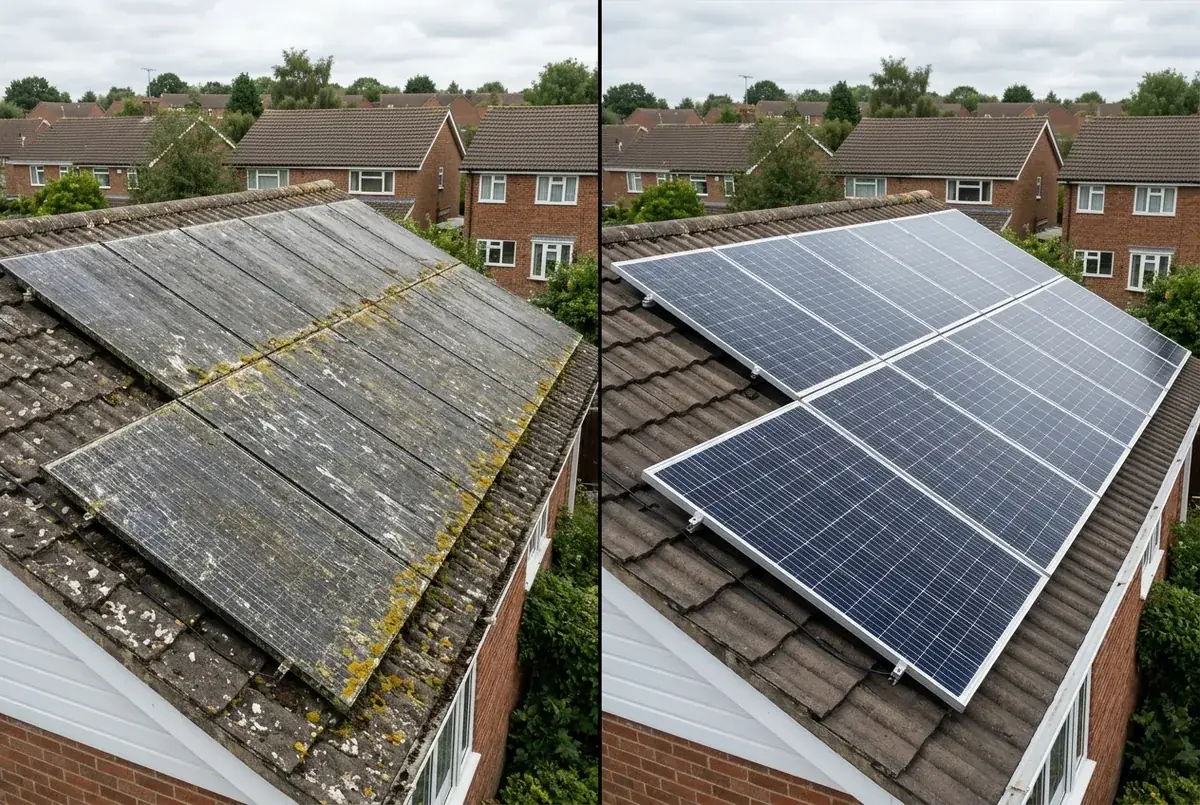
It comes down to two things, and both work in the same direction. First, scale: a tree-shaded 16-panel array on a How Lane detached is generating a lot more than a four-panel terrace, so a few percent of soiling loss is a bigger number in pounds. Second, the trees themselves. Chipstead Valley and Shabden Park sit under mature oak, beech and sweet chestnut — the same canopy that buries the long drives in leaf litter every autumn drops sap and feeds lichen on your roof, and shelters the birds that leave droppings on the glass. On a string-inverter system, one soiled panel can drag a whole panel's output down 20–30% — a controlled study measured bird droppings cutting a panel's power by 23.8%[1] — because a string is limited by its weakest, most-shaded module. So the bigger, more valuable Chipstead arrays are exactly the ones the village environment hits hardest. That's not a sales line — it's just where the trees are.
What CR5 panels actually pick up
- Sap and leaf film under the canopy — oak, beech and chestnut around Chipstead Valley coat the glass with a sticky film that rain won't shift.
- Bird droppings on tree-sheltered roofs — the worst offender for output on a string system; a controlled study measured droppings cutting a panel's power by 23.8%[1], and four drops dropped module current by 36–38%.
- Lichen and moss on low-pitch sections — where a roof section is shallow, dirt and growth sit on the panel instead of running off.
- General pollen and dust — heavy in a Surrey spring; on a big array, a couple of percent across 16 panels is real money over a year.
What does it cost in Chipstead?
Honest version: solar cleaning runs about £4–£15 per panel (commonly £4–£8), and most domestic jobs land £80–£150 a visit. Chipstead just skews to the top of that because the arrays are bigger — a 16-to-25-panel detached typically sits £150–£250. The good news for big arrays is the same as on the long drives: a lot of the cost is fixed setup (van, filtration, getting the pole rigged), so the per-panel rate actually drops the more panels you've got. Here's how the bands play out on a typical CR5 roof.
| Chipstead array size |
Typical job price |
Common CR5 property |
Cleans/yr |
| Small (6–10 panels) | £50–£90 | Village-centre cottage / smaller semi | 1–2 |
| Standard (8–14 panels) | £80–£150 | Typical CR5 detached, open aspect | 1–2 |
| Large detached (12–16 panels) | £120–£180 | How Lane / Hogcross Lane homes | 2 (tree-shaded) |
| Very large (16–25 panels) | £150–£250 | Chipstead Valley / Shabden Park estates | 2–3 (heavy canopy) |
Price bands are our standard solar rates applied to the array sizes we actually see in CR5 — we don't charge a Chipstead premium for the postcode. The per-panel rate drops on bigger arrays because the setup cost is fixed. Want it costed against your exact roof? Try the cost calculator or just send a photo when you call.
Why we won't walk on your Chipstead roof
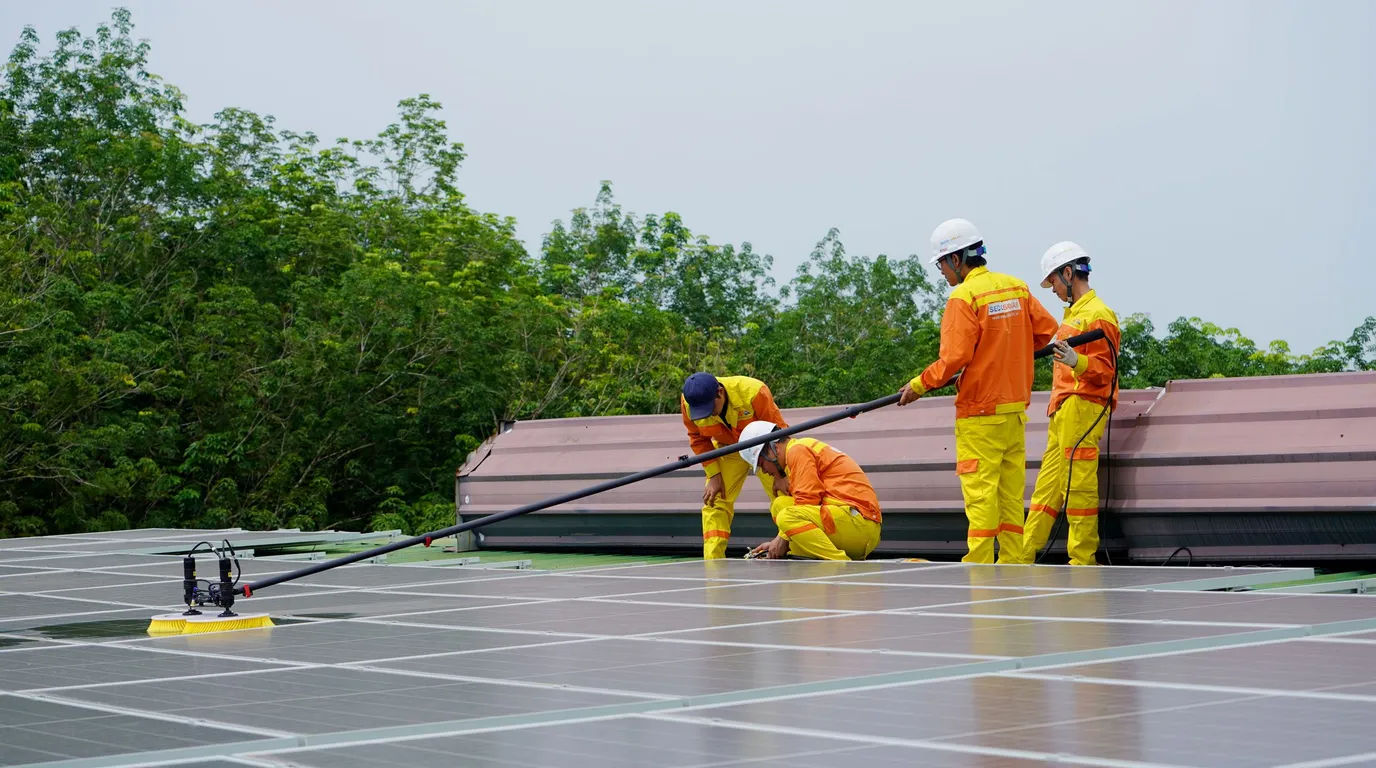
Reach-and-wash is a ground-based method: a soft brush head on a telescopic water-fed pole feeds purified water up to the roof, so the cleaning is done from the ground with nobody on the tiles. That pole reaches typical two-storey CR5 roofs and keeps us off your tiles and well away from the live DC wiring — and solar arrays are energised by daylight, so they can't simply be switched off at the panel. The Work at Height Regulations 2005 require work to be avoided at height where it can reasonably be done another way, and to be properly planned where it can't[3] — cleaning from ground level is exactly that. On the bigger Chipstead detacheds we'll clean early morning or on an overcast day so the glass is cool, to avoid thermal-shocking a hot panel. If a steep or three-storey section genuinely can't be reached safely from the ground, we'll say so and sort proper access — we won't bodge it up a ladder.
Why pure water, never detergents or pressure
Pure water means deionised (or "RO/DI") water — mains water passed through reverse-osmosis and deionising filters to strip out the dissolved minerals, so it dries with zero spots and needs no detergent. That matters because the front glass on a PV panel carries a delicate anti-reflective coating, and scouring pads or harsh chemicals scratch it and cut output permanently. Panel makers spell this out: manufacturer cleaning guidance bans high-pressure washers and abrasive brushes and recommends water with a soft, non-woven head, warning that damaging the anti-reflective coating can void the warranty[2]. So it's soft non-abrasive brushes and water only — that's what lets the panels dry spot-free and streak-free with no residue left behind to attract more dirt. We never pressure-wash panels: high pressure can force water past the seals and frames and damage cells. A documented pure-water clean to manufacturer spec helps keep your warranty cover intact — worth knowing on a high-value Chipstead install.
Bundle it with the gutters while we're set up
Here's the practical bit. The same pole-and-pure-water setup that reaches your panels reaches your gutters and windows too. On a big Chipstead detached, getting a crew rigged up to roof height is half the job — so doing the gutters in the same visit (and they'll be full of that same oak and chestnut leaf litter) saves you a second call-out. Mention it when you ring and we'll quote the lot together.
Areas we cover around Chipstead
All of CR5 Chipstead — How Lane, Chipstead Valley, Shabden Park, Hogcross Lane, Elmore Road and the village centre near the church — plus the neighbouring patch: Coulsdon, Banstead (SM7), Kingswood and Tadworth (KT20), Caterham (CR3) and on down to Reigate and Redhill. We're a local crew within 20 miles of RH1, so no travel charge and a fast callback. See the full Chipstead area page for everything else we clean in the village, or the main solar panel cleaning page for the full method.
Useful guides before you book
Want to read up first? Solar panel cleaning cost guide · How often should solar panels be cleaned? · DIY vs professional solar cleaning
Sources
The output, method and safety figures on this page are cited to primary sources — a peer-reviewed performance study, manufacturer maintenance guidance, HSE work-at-height guidance and Met Office climate records — not unsourced trade-blog claims.
- Scientific Reports (Nature) — "Improving solar PV performance under bird-dropping conditions with a dual-cooling approach" (2024). Measured a 23.8% reduction in output power from bird droppings; four drops cut module current by 36–38%. nature.com — s41598-024-84932-w. Accessed 19 June 2026.
- Silfab Solar — "Solar Panel Maintenance: Everything You Need To Know." Manufacturer guidance: clean with water (deionised/distilled ideal) and a soft non-woven head; never use high-pressure washers or abrasive brushes; damaging the anti-reflective coating can void the warranty. silfabsolar.com — panel maintenance. Accessed 19 June 2026.
- Health and Safety Executive (HSE) — "Working at height: A brief guide" (INDG401), under the Work at Height Regulations 2005. Work at height must be avoided where reasonably practicable and properly planned where not; falls from height are a leading cause of UK workplace fatalities. hse.gov.uk — INDG401. Accessed 19 June 2026.
- Met Office — Wisley (Surrey) Location Long-Term Averages 1991–2020. Closest station to Redhill (RH1); annual rainfall 667.92 mm, vs a UK average around 1,163 mm (~43% drier). metoffice.gov.uk — Wisley averages. Accessed 19 June 2026.