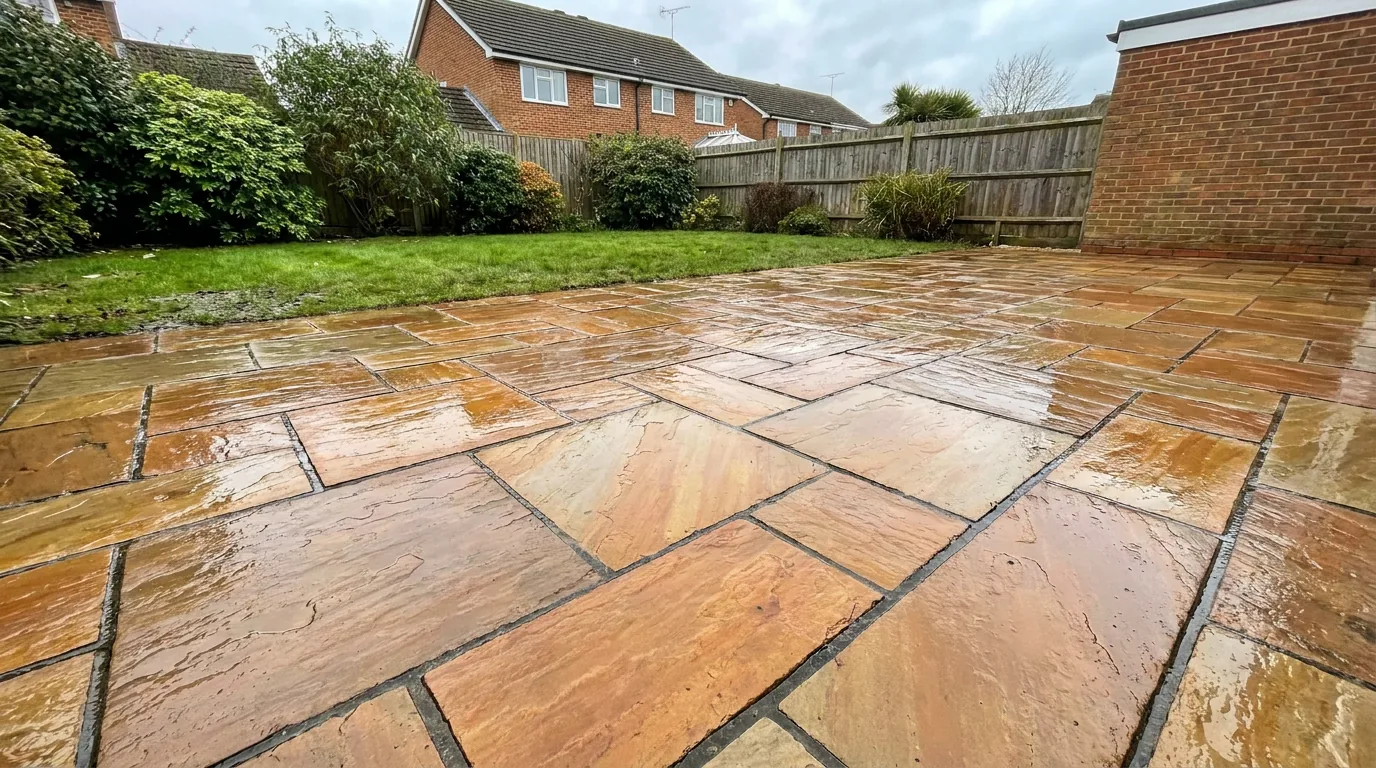
The quick answer: Each outdoor surface requires specific pressure washing techniques. Block paving and concrete handle 3000+ PSI but block paving needs re-sanding (£3.50-6/sqm). Tarmac requires lower pressure to avoid damage (£2.50-4/sqm). Decking needs gentle cleaning at 1200-1500 PSI (£3-7/sqm). Render requires soft washing at 500-1000 PSI (£4-8/sqm). Natural stone demands careful pressure adjustment based on stone type (£4-8/sqm).
This guide compares all common outdoor surfaces, explaining the correct pressure levels, costs, cleaning frequency, risks, and best practices for each. Understanding these differences prevents costly damage and ensures your surfaces last for decades. Whether you have a block paving driveway, stone patio, or wooden decking, this guide helps you make informed decisions.
Surface Comparison Table
The table below compares the six most common outdoor surfaces found on UK properties. Use this to understand which cleaning approach, pressure level, and budget applies to your specific surface type.
| Surface Type | PSI Required | Cost per m² | Sealing Available? | Main Risk | Cleaning Frequency |
|---|---|---|---|---|---|
| Block Paving | 3000-4000 PSI | £3.50-£6 | Yes (£3-8/m²) | Joint sand loss | 12-18 months |
| Concrete | 3000-4000 PSI | £3-£5 | Yes (optional) | Surface etching | 18-24 months |
| Tarmac | 2000-2500 PSI | £2.50-£4 | Rarely needed | Surface stripping | 18-24 months |
| Natural Stone | 1500-2500 PSI | £4-£8 | Yes (essential) | Stone cracking | 12-18 months |
| Decking | 1200-1500 PSI | £3-£7 | Oiling required | Wood splintering | 12 months |
| Render | 500-1000 PSI | £4-£8 | No (must breathe) | Render cracking | 24-36 months |
Based in Surrey? Spring is our busiest season — get a free quote before slots fill up.
Or call 01737 652 515
Block Paving: High Pressure with Re-Sanding
Best for: Driveways, front paths, commercial car parks
Typical cost: £3.50-6 per sqm (including re-sanding)
PSI requirement: 3000-4000 PSI for deep cleaning
Block paving is the most common driveway surface in the UK and responds extremely well to pressure washing. The individual blocks can handle high pressure without damage, making it possible to remove years of ingrained dirt, moss, and algae in a single session.
Key requirements: After pressure washing, all joints must be re-filled with kiln-dried sand. BS 7533-101:2021[7] treats jointing material as part of the structural load-transfer system — not cosmetic. Marshalls cleaning guidelines[3] specify medium pressure, 30° oblique angle and a ≥200 mm standoff — never turbo / dirt-blaster nozzles, which risk Marshalls Register warranty rejection. Karcher K7[6] consumer maximum is 180 bar (~2,610 PSI), 600 L/hr; we operate well within that on block paving. Without proper re-sanding, weeds will regrow within 4-6 weeks and blocks can become unstable. Professional services always include re-sanding in their pricing.
Block paving benefits significantly from sealing after cleaning. Resiblock[8] manufacturer-stated sealer lifespan is up to 5 years. A quality sealant (applied at £3-8 per sqm) enhances the colour, protects against oil stains, prevents weed growth, and extends the clean appearance for 3-5 years. Our block paving cleaning cost guide covers pricing in detail.
Common problems: Efflorescence (white salt staining), oil stains from vehicles, weed growth in joints, moss in shaded areas, uneven blocks from poor installation. Annual Lithofin Algex[2] spring biocide is the manufacturer-stated cadence for moss control.
Maintenance: Clean every 12-18 months. Met Office Wisley[1] 648 mm/yr Surrey rainfall extends the upper end of this range vs national averages. HSE/UKSRG PTV ≥36[5] is the slip-risk threshold that gates the lower end on shaded north-facing drives. Top up joint sand annually if not sealed. Reseal every 3-5 years for ongoing protection.
Concrete: Durable and Cost-Effective
Best for: Driveways, garage floors, industrial surfaces, patios
Typical cost: £3-5 per sqm
PSI requirement: 3000-4000 PSI
Concrete is one of the easiest and most cost-effective surfaces to pressure wash. It has no joints to maintain, handles high pressure extremely well, and provides excellent results with minimal specialist technique required. This makes it cheaper to clean than block paving.
Key requirements: Concrete is porous and prone to oil staining, particularly on driveways. Oil stains require pre-treatment with specialist degreasers before pressure washing. Very old concrete may have surface weakness and requires pressure testing before full cleaning.
Patterned or imprinted concrete (often used to mimic stone or brick) needs more care than plain concrete. Excessive pressure can damage the surface pattern or colour. Professionals reduce PSI slightly and use wider nozzle angles (40 degrees instead of 25 degrees) to protect decorative finishes.
Common problems: Oil stains, tyre marks, surface discolouration, efflorescence (especially on new concrete), cracking from ground movement.
Maintenance: Clean every 18-24 months. Seal after cleaning to reduce staining (optional but recommended). Address oil spills immediately to prevent permanent staining. Our oil stain removal guide explains treatment options.
For a comprehensive cost breakdown, see our dedicated driveway cleaning cost guide which covers concrete, block paving, and tarmac pricing.
Tarmac: Lower Pressure Required
Best for: Driveways, roads, car parks, paths
Typical cost: £2.50-4 per sqm
PSI requirement: 2000-2500 PSI (lower for older surfaces)
Tarmac (asphalt) is the cheapest surface to pressure wash because it has no joints and requires no re-sanding. However, it's more vulnerable to damage than concrete or block paving, so lower pressure levels are essential to avoid stripping the surface layer.
Key requirements: Age matters significantly for tarmac. New tarmac (less than 3 years old) can handle 2500 PSI safely. Tarmac over 10 years old may require as low as 1500-2000 PSI to prevent surface damage. Professionals assess tarmac condition before selecting pressure levels.
Tarmac becomes soft in very hot weather (above 25°C). Professional cleaners avoid cleaning tarmac during heatwaves and schedule jobs for cooler days when the surface is firm. The black colour of tarmac also hides dirt better than lighter surfaces, so cleaning frequency can be lower.
Common problems: Oil stains, moss growth in shaded areas, surface degradation (small stones loosening), cracking from tree roots or ground movement.
Maintenance: Clean every 18-24 months. Repair cracks before they worsen. Avoid cleaning in very hot or very cold weather. Sealing is rarely required unless the tarmac is extremely old and porous.
Natural Stone: Careful Pressure Control
Best for: Premium patios, garden paths, feature areas
Typical cost: £4-8 per sqm
PSI requirement: 1500-2500 PSI (varies by stone type)
Natural stone surfaces such as Indian sandstone, granite, slate, and limestone are extremely popular for patios and paths in Surrey. Each stone type requires different pressure levels, making this the most technically demanding surface to clean professionally.
Stone-specific requirements:
- Indian sandstone: 1500-2000 PSI (softer stone, very porous, prone to algae)
- Granite: 2500-3000 PSI (hard stone, more forgiving)
- Slate: 2000-2500 PSI (can flake if pressure too high)
- Limestone: 1500-2000 PSI (soft and porous like sandstone)
All natural stone must be sealed after cleaning to prevent water ingress, frost damage, and rapid re-soiling. Indian sandstone is particularly vulnerable - without sealing, it will absorb water, develop algae within months, and potentially crack during winter freezing. Our Indian sandstone cleaning guide covers this in detail.
Common problems: Algae growth (especially on sandstone), colour fading from UV exposure, efflorescence (white salt deposits), uneven wear, joint material loss.
Maintenance: Clean annually for sandstone and limestone, every 18 months for granite and slate. Reseal every 2-3 years. Address algae growth immediately as it accelerates if left untreated.
Decking: Low Pressure Wood Care
Best for: Raised gardens, patio areas, balconies
Typical cost: £3-7 per sqm
PSI requirement: 1200-1500 PSI maximum
Wooden decking requires the gentlest pressure washing approach of any outdoor surface. Excessive pressure splinters the wood, damages the grain, and creates rough surfaces that trap more dirt and become dangerous for bare feet.
Key requirements: Professionals use wide-angle nozzles (40-60 degrees), maintain greater distance from the surface (30-40cm rather than 15-20cm), and work with the wood grain never against it. The goal is to clean without raising the wood grain.
After pressure washing, decking must dry completely (48-72 hours) before applying oil, stain, or preservative. This post-cleaning treatment is essential - untreated decking rapidly deteriorates from UV damage and water ingress. Most professional decking cleaning services include or offer oiling as an additional service.
Wood type considerations:
- Softwood (pine, spruce): More vulnerable, requires lowest pressure and annual treatment
- Hardwood (oak, teak): More durable, can handle slightly higher pressure
- Composite decking: Plastic-wood mix, easier to clean but still requires low pressure to avoid surface scratching
Common problems: Algae and moss (especially in shade), wood graying from UV exposure, splinters from raised grain, mold growth, rot in poorly maintained boards.
Maintenance: Clean annually before the summer season. Oil or stain immediately after cleaning. Replace damaged boards before widespread rot occurs. Our professional decking cleaning service includes safe pressure levels and post-clean treatment options.
Render: Soft Washing Only
Best for: House exterior walls, boundary walls
Typical cost: £4-8 per sqm
PSI requirement: 500-1000 PSI (soft washing technique)
Render cleaning uses "soft washing" - a low-pressure technique that relies on specialist cleaning chemicals rather than high pressure to remove dirt, algae, and discolouration. Traditional pressure washing will crack render, force water behind it, and cause expensive damage.
Key requirements: Soft washing uses chemical biocides to kill algae, moss, and organic growth. The chemicals are applied at very low pressure, left to dwell for 10-20 minutes, then rinsed off gently. Results may take 2-3 days to fully appear as the chemicals continue working after rinsing.
Render must never be sealed - it needs to breathe to allow moisture to escape from inside the wall. Sealing render traps moisture, leading to damp problems, mold growth inside the property, and render failure.
Render type considerations:
- Cement render: Most common, handles soft washing well
- Lime render: Very soft, requires extremely gentle cleaning
- Acrylic/silicone render: Modern self-cleaning renders, need less frequent cleaning
Common problems: Green algae growth (especially on north-facing walls), black mold spots, red algae staining, cracks from building movement, render delamination (coming away from wall).
Maintenance: Clean every 2-3 years for standard render, every 4-5 years for self-cleaning renders. Inspect annually for cracks and repair before water ingress causes bigger problems. Our render cleaning service uses professional soft washing equipment and appropriate biocides.
Which Surface is Right for New Installations?
If you're planning a new driveway or patio and wondering which surface offers the best balance of appearance, durability, and maintenance, here's a practical comparison:
Lowest maintenance: Tarmac or resin-bound. Both resist weed growth, need infrequent cleaning, and require no joint maintenance. However, tarmac offers limited aesthetic appeal.
Best value long-term: Concrete. Low installation cost, infrequent cleaning needs (18-24 months), no joint maintenance, and a 20-30 year lifespan with minimal care.
Best appearance: Indian sandstone or premium block paving. Natural stone offers unmatched aesthetic appeal but requires annual cleaning and regular sealing. Block paving provides similar visual impact with slightly lower maintenance demands.
Most versatile: Block paving. Handles heavy vehicle loads, individual blocks can be replaced if damaged, wide range of colours and patterns, good drainage, and responds excellently to pressure washing for decades.
Can You Mix Cleaning Techniques?
Many properties have multiple surface types - a block paving driveway, concrete paths, and a sandstone patio, for example. Professional cleaners adjust their equipment and technique for each surface within a single visit, but this requires experience and proper equipment.
DIY pressure washing becomes risky when dealing with multiple surfaces. Homeowners often use the same high-PSI setting appropriate for their driveway on their patio, unknowingly damaging natural stone or decking. This is one of the strongest arguments for professional cleaning - the ability to safely clean an entire property's exterior surfaces in one session.
When booking professional cleaning, always specify all surface types on your property. This allows the cleaner to bring appropriate equipment, chemicals, and nozzles, and to quote accurately. Combined pricing (driveway + patio + paths) typically offers 10-20% savings compared to booking separately.
Or call 01737 652 515
Ready to Get Your Exact Price?
Now you know how different surfaces respond to pressure washing, get a personalised estimate for your property. No obligation, no phone calls — just fill in a quick form and we'll respond within 2 hours.
Get My Free QuoteGet Your Free Quote
We clean all surface types throughout Surrey using professional equipment and appropriate techniques for each material. Our prices are transparent - the quote you receive includes all necessary services such as re-sanding for block paving, appropriate pressure levels for each surface, and post-cleaning treatments where required.
We serve Redhill, Reigate, Horley, Dorking, Banstead, and all areas within a 20-mile radius of RH1. Whether you have block paving, natural stone, decking, render, or a combination of surfaces, we provide safe, effective cleaning that protects your investment.
Related guides: Driveway Cleaning Cost UK | Block Paving Cleaning Cost | Patio Cleaning Cost | Can Pressure Washing Damage Driveways? | Indian Sandstone Cleaning | Oil Stain Removal
Original analysis and sources
Original analytical contribution: Surface comparison for pressure-washing isn't about which surface is 'easiest' — it's about Marshalls technique envelope compliance per surface type[3]. Block paving, concrete, tarmac, resin, and natural stone each tolerate a different combination of PSI, nozzle, and standoff before damage occurs, all governed by the same medium-pressure / 30° / 200mm baseline.
Sources
Every numeric claim, technique parameter, and safety threshold in this guide is sourced from a manufacturer technical bulletin, BS standard, or .gov.uk reference. We cite the bodies whose data and rules actually govern UK pressure-washing outcomes — not the unsourced ranges repeated across competitor blogs.
- Met Office — Wisley (Surrey) Location Long-Term Averages 1991–2020. Closest Met Office station to RH1. Annual rainfall 648.41 mm; Surrey is ~43% drier than the UK national mean of ~1,147 mm. metoffice.gov.uk — Wisley averages. Accessed 21 May 2026.
- Lithofin — ALGEX Special Cleaner product page. Manufacturer guidance: spray annually, preferably in spring. 6–12 month residual activity. lithofin.com — ALGEX. Accessed 21 May 2026.
- Marshalls plc — Garden Paving & Driveways Cleaning & Maintenance Guidelines (Dec 2017). Technique: medium pressure, 30° lance, 200mm minimum standoff. marshalls.co.uk — cleaning guidelines (PDF). Accessed 21 May 2026.
- Health and Safety Executive (HSE) — Slips and trips at work. HSE-preferred slip-risk methodology; PTV ≥36 wet-acceptance threshold. hse.gov.uk — slips and trips. Accessed 21 May 2026.
- UK Slip Resistance Group — Introduction to the Pendulum Tester (BS 7976: Parts 1-3). PTV ≥36 = low slip risk threshold for outdoor pedestrian surfaces. ukslipresistance.org.uk — pendulum tester. Accessed 21 May 2026.
- Kärcher — K7 consumer pressure washer manufacturer datasheet. 180 bar (~2,610 PSI), 600 L/hr. kaercher.com — K7 product page. Accessed 21 May 2026.
- BSI — BS 7533-101:2021 Code of practice for modular paving units. Treats jointing material as load-transfer system. bsigroup.com — BS 7533-101:2021. Accessed 21 May 2026.
- Resiblock Ltd — Block Paving Sealer Product Data Sheets. Manufacturer-stated lifespan up to 5 years. resiblock.com — technical data sheets. Accessed 21 May 2026.
- UK Government (gov.uk) — National Living Wage rates from April 2026: £12.71/hr (age 21+). The legal floor for valuing UK labour and DIY time. gov.uk/national-minimum-wage-rates. Accessed 21 May 2026.
- Thames Water — 2026/27 Charges. Combined water + wastewater rate £4.21/m³. thameswater.co.uk — bill value. Accessed 21 May 2026.